
SLIDE 1
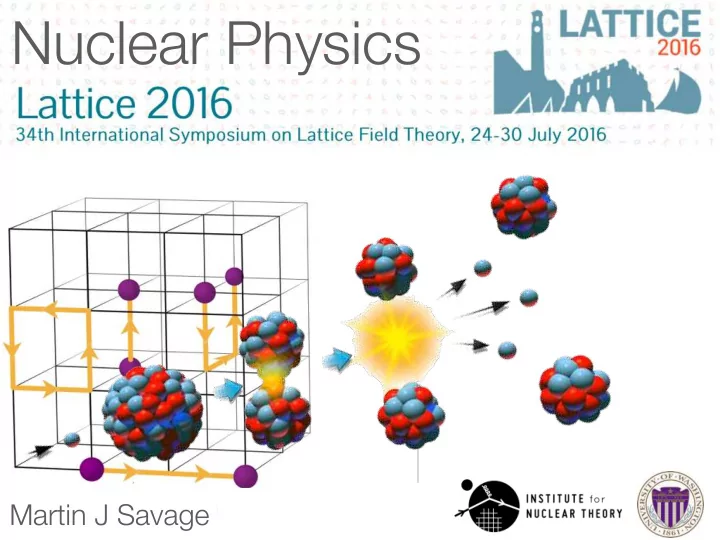
Nuclear Physics
Martin J Savage
Nuclear Physics Martin J Savage Nuclear Forces, Equation of State - - PowerPoint PPT Presentation
Nuclear Physics Martin J Savage Nuclear Forces, Equation of State and Astrophysical Environments Gandolfi, Gezerlis and Carlson, Annual Reviews of Nuclear and Particle Science (2015) Hebeler, Lattimer, Pethick and Schwenk, Ap.J. 2013 nnn Rare
Martin J Savage
Nuclear Forces, Equation of State and Astrophysical Environments
Hebeler, Lattimer, Pethick and Schwenk, Ap.J. 2013 Gandolfi, Gezerlis and Carlson, Annual Reviews of Nuclear and Particle Science (2015)
nnn
nnn nnnn Theory Experiment
(US$ 730M)
Observation LIGO - Imprints Gravity Waves
Rare Isotope Facilities
Canada, Germany, Japan, Korea, US, …
Nuclear Matrix Elements > >
𝑤, e, μ, X - JLab, 𝑤-experiments, DUNE, DM, edm, …
(Amy Nicholson, plenary later this week)
Gluons and an EIC
Future experimental QCD Program will be an Electron-Ion Collider ~ 2025
(H. Mäntysaari and B. Schenke)
Gluon density in the nucleus at four different times. Phiala Shanahan, First Lattice QCD Study of Gluonic Transversity, later this week
Low-Energy Nuclear Physics
6
Many-Body Methods e.g. SM, GFMC, NCSM, SRG, DFT,…
Methods and Difficulties Many-Body Spectra
p + p + n + n d + p + n nn + p + p nn + pp d + d
3He + n4He H0 +L
50
DE HMeVL
L=12 fm , »p»=0 L=48 , »p»=0 L=32 , »p»=0 L=24 , »p»=0e.g., what was found and expected at Mπ ~ 800 MeV
Methods and Difficulties Signal-to-Noise
Lepage asymptotic MN - 3/2 Mπ
Nucleon Effective Mass
Noise-to-Signal Mass Scale
The Golden Window for Nuclei
dictated by source and sink structure
T=128
Energy scale of the signal-to-noise ratio
9
Methods and Difficulties Signal-to-Noise
A=1 A=2 Golden Window
Methods and Difficulties Contractions
Detmold and Orginos (2011) Yamazaki et al (2011) Doi and Endres (2012)
Naively: Proton : N cont = 2 235U : N cont = 101494
Symmetries provide significant reduction Automation, Recursion, … delay the problem but it remains Large number of contractions
A=28 Detmold and Orginos (2012)
Methods and Difficulties Correlators
energy eigenvalue e.g., A1+ irrep
Extended to Coupled-Channels systems:
e.g., Raul Briceno and Zohreh Davoudi, Phys.Rev. D88 (2013) no.9, 094507
Methods and Difficulties Correlators
HAL QCD method(s): HAL QCD
NN tensor, mπ ~ 145 MeV, prelim.
qqq qqq
r wall UE(r,r’) : Expected to correctly reproduce S-matrix at energy eigenvalues
image by Leinweber
UE(r,r’) : assume -> V(r-r’) + …
Methods and Difficulties Correlators
Luscher’s method(s): PACS, NPLQCD, Mainz,
k∗2 [l.u.]
27 irrep
k∗ cot δ(27) [l.u.]
Two-parameter ERE: 68% C.I. Two-parameter ERE: 90% C.I. Three-parameter ERE: 90% C.I. Three-parameter ERE: 68% C.I. 323 × 48 : 68% C.I. 243 × 48 : 68% C.I.
483 × 64 : 68% C.I.
d = (0, 0, 0) d = (0, 0, 1) d = (0, 0, 2)
p −k∗2
Zohreh Davoudi
Applicable out to inelastic threshold, then can be extended by including
Effective Range Expansion valid below t-channel cut, k < mπ /2
Statistics of Correlation Functions
14
Log Normal in plateau region evolves into symmetric but non-Gaussian at late times
Noise, sign problems, and statistics, Michael G. Endres, David B. Kaplan, Jong-Wan Lee, Amy N. Nicholson, Phys.Rev.Lett. 107 (2011) 201601
Distribution of Canonical Determinants in QCD, Andrei Alexandru, C. Gattringer, H. -P. Schadler, K. Splittorff, J.J.M. Verbaarschot, Phys.Rev. D91 (2015) no.7, 074501
NN and Nuclei PACS
Multi-nucleon focus : nn, d,3He, 4He
mπ ~ 145 MeV
Talk by Takeshi Yamazaki
NN and Nuclei PACS
mπ ~ 300 MeV
Multi-nucleon focus : nn, d,3He, 4He
Takeshi Yamazaki, Ken-ichi Ishikawa, Yoshinobu Kuramashi, Akira Ukawa, Phys.Rev. D92 (2015) no.1, 014501
nf=0 nf=3 nf=2+1 nf=2+1 nf=2+1
mπ ~ physical in process
BB Interactions HAL QCD
Slides prepared by T. Doi - thank you
Towards Lattice QCD Baryon Forces at the Physical Point: First Results
Takumi Doi et al. (HAL QCD). arXiv:1512.04199 [hep-lat]
BB Interactions HAL QCD
NN tensor
Do not use plateaus in EMPs to extract UE(r,r’)
BB Interactions Mainz
H-dibaryon is focus 4 pion masses
Parikshit Junnarkar, Anthony Francis, Jeremy Green, Chuan Miao, Thomas Rae, Hartmut Wittig, PoS CD15 (2015) 079, PoS LATTICE2015 (2016) 082
NN Higher Partial Waves
20 (NPLQCD 800 MeV isotropic clover ensembles)
Amy Nicholson et al (CalLatt) - PoS LATTICE2015 (2016) 083
d nn
3He 4He
nS
L 3 H L 3 He S 3He L 4 He H-dib
nX
LL 4 He 1+ 0+
1 2
+0+ 1+
1 2
+3 2
+1 2
+3 2
+0+ 0+ 0+ 1+ 0+ 0+
s=0 s=-1 s=-2
2-Body 3-Body 4-Body
DE HMeVL
Nuclei from QCD
Beane et al (NPLQCD), Phys.Rev. D87 (2013) 3, 034506, Phys.Rev. C88 (2013) 2, 024003
mπ ~ 800 MeV
Deuteron appears to be unnatural but not finely-tuned ?? Generic feature of YM with nf=3
NN Interactions NPLQCD
mπ ~ 450 MeV
mπ ~ 800 MeV
(Zohreh Davoudi)
NN Interactions NPLQCD
radius of interaction in 3S1
100 200 300 400 500
pLAB (MeV)
10 20 30 40 50 60
δ (degrees)
NSC97f Juelich '04 EFT
100 200 300 400 500
pLAB (MeV)
10 20 30
δ (degrees)
NSC97f Juelich '04 EFT
nΣ- 1S0 nΣ- 3S1
Hyperon-Nucleon Interactions and the Composition of Dense Nuclear Matter from Quantum Chromodynamics, Beane et al (NPLQCD), Phys.Rev.Lett. 109 (2012) 172001
Is there a Plateau Crisis ?
Recently, HAL QCD has suggested that practitioners of Luscher’s method have been seduced by false plateaus !
Possible for non-isolated states - will become an increasing problem toward the physical point Signal-to-noise problem presents challenge for establishing ground states HAL QCD and PACS have performed tests with Wall-sources and localized sources.
e.g., Mirage in Temporal Correlation functions for Baryon-Baryon Interactions in Lattice QCD, Takumi Iritani et al.. arXiv:1607.06371
Slide prepared by Iritiani of HAL QCD - thank you. [Aoki, Doi]
All states need to be in their ground states before any calculations of ground state properties of multi-baryon systems are meaningful - including taking ratios of C(t). This applies to all methods.
Slides from Yamazaki on their careful comparisons - thank you. Needs much higher statistics in this study
Is there a Plateau Crisis ?
Observations:
consistent
Slide prepared by Yamasaki of PACS-CS - thank you.
PACS : Yamazaki et al (2016)
Is there a Plateau Crisis ?
mπ ~ 800 MeV
Light Nuclei and Hypernuclei from Quantum Chromodynamics in the Limit of SU(3) Flavor Symmetry
NPLQCD Collaboration, Phys.Rev. D87 (2013) no.3, 034506
Is there a Plateau Crisis ?
Thoughts:
Light Nuclei : Quark Mass Effects
200 400 600 800 5 10 15 20 25 30
mπ (MeV) Bd (MeV)
NPLQCD, isotropic Yamazaki et al. NPLQCD, anisotropic
Note:
Decomposition of Nuclear Masses and Bindings
29
100 200 300 400 500 600 700 800 20 40 60
mπ (MeV)
3He : B (MeV)
Yamazaki et al NPLQCD
Nucleon Mass
Dictates a Class Dark Matter Interactions
The Periodic Table as a function
30
Enhances the scope of the Lattice Calculations
Effective Field Theory for Lattice Nuclei , N. Barnea et al, Nov 20, 2013. 5 pp. , Phys. Rev. Lett. 114 (2015) 5, 052501
MECs
First Inelastic Nuclear Reaction : physical point:
Ab Initio Calculation of the np → dγ Radiative Capture Process, NPLQCD, Phys. Rev. Lett. 115 (2015) 13, 132001
[ 306 mb single nucleons alone ]
σLQCD = 334.9(5.3) mb σexpt = 334.2(0.5) mb
Magnetic Moments Neutron Spin States
400 MeV
|eB| ~ 0.7 GeV2 ~ 1020 Gauss
NPLQCD, Phys.Rev.Lett. 113 (2014) no.25, 252001 and Phys.Rev. D92 (2015) no.11, 114502
Threshold for break-
p-n Σ+-Σ- Ξ0-Ξ-
1 2 3 4 5 6
Octet Baryon
μ (nBM)
Experiment mπ=450 MeV , β=6.1 mπ=800 MeV , β=6.1 mπ=800 MeV , β=6.3
Dark Nuclei
BSM Nuclei as Dark Matter ? Use QCD technology for SU(2) color - bound states.
William Detmold, Matthew McCullough, and Andrew Pochinsky, Phys. Rev. D 90, 115013 (2014), Phys. Rev. D 90, 114506 (2014).
In Process
A=2 : NN, NΛ, NΣ, ΛΛ… ΞΞ, ΩΩ
S-matrix : Bound states and s-wave and higher scattering, Luscher’s method for S-matrix, HAL QCD’s methods, Effective Hamiltonians Magnetic and Axial moments and polarizabilities, Four-quark operators, reactions
A=3, 4 : 3He, nnn, NNΛ, …, ΞΞΞ,
S-matrix : Bound states, HAL QCD’s methods, matching to NNEFT and phenomenological nuclear methods
Magnetic and Axial moments and polarizabilities,
A>4 : p-shell nuclei
Bound states and continuum states, matching to NNEFT and phenomenological nuclear methods
Anticipated Progress
35
Closing Remarks
directly from Quantum Chromodynamics
experimental programs in NP and HEP
Thanks to Organizers !!
FIN