Nuclear Magnetic Resonance (NMR) Atoms observed in proteins - 1 H , - - PDF document

nuclear magnetic resonance nmr
SMART_READER_LITE
LIVE PREVIEW

Nuclear Magnetic Resonance (NMR) Atoms observed in proteins - 1 H , - - PDF document

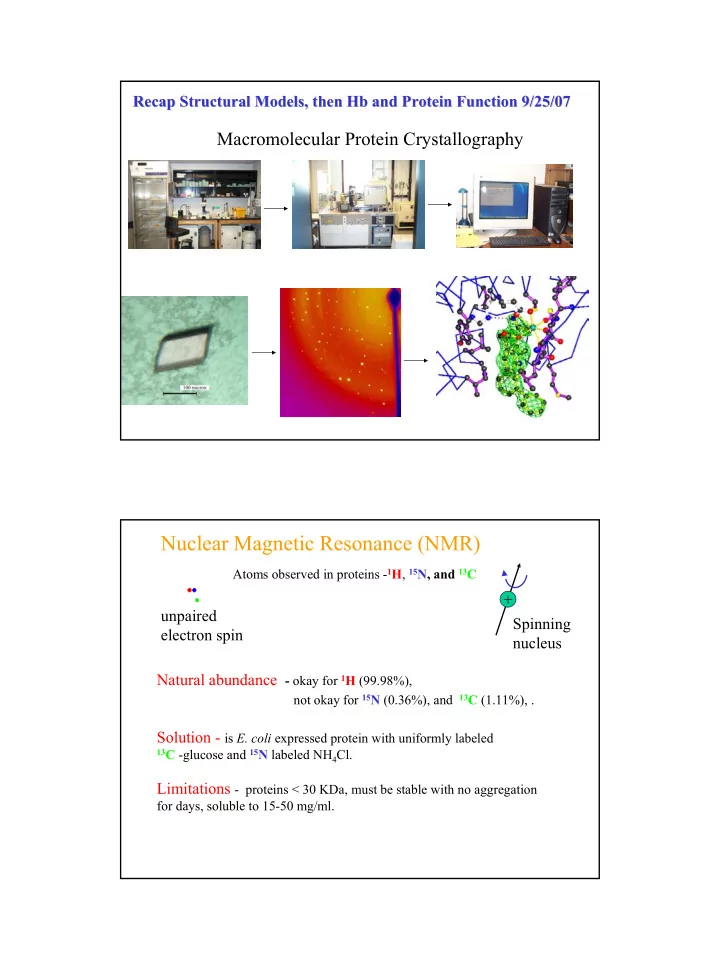
Recap Structural Models, then Hb Recap Structural Models, then Hb and Protein Function 9/25/07 and Protein Function 9/25/07 Macromolecular Protein Crystallography Nuclear Magnetic Resonance (NMR) Atoms observed in proteins - 1 H , 15 N, and 13


slide-1
SLIDE 1

1

Macromolecular Protein Crystallography

Recap Structural Models, then Recap Structural Models, then Hb Hb and Protein Function 9/25/07 and Protein Function 9/25/07

Nuclear Magnetic Resonance (NMR)

unpaired electron spin + Spinning nucleus Natural abundance - okay for 1H (99.98%),

not okay for 15N (0.36%), and 13C (1.11%), .

Solution - is E. coli expressed protein with uniformly labeled

13C -glucose and 15N labeled NH4Cl.

Limitations - proteins < 30 KDa, must be stable with no aggregation

for days, soluble to 15-50 mg/ml. Atoms observed in proteins -1H, 15N, and 13C

slide-2
SLIDE 2

2

X X-

  • ray Crystal Structures of

ray Crystal Structures of calmodulin calmodulin

NMR Structures

  • f closed form calmodulin
slide-3
SLIDE 3

3

Bundle of 30 NMR models

  • f calmodulin

Cases of Bundle Spread

  • Missing restraints
  • dynamics

NMR vs. Crystallography – advantage/disadvantages 1) Experimental difficulties need for homogeneity in common need good crystals for crystallography need 13C and 15N label for NMR size limits of technique 2) Reported structures look different – i.e. bundle Crystal vs. solution structure 3) Complementary information high resolution vs. dynamics positional amplitude, time domains certainty

slide-4
SLIDE 4

4

Hemoglobin – Hb α2β2 heterotetramer α 141 a.a. β 144 a.a. α vs. β 42% identical 62% similar Myoglobin – Mb 153 a.a. 17 kDa monomer Mb and Hb bind O2 Go to chime demo to show oxygen binding pocket

http://www.udel.edu/chem/bahnson/Chem641/chime/Index.htm

http://www.whfreeman.com/lehninger/

N N N N CO2

  • O2C

Fe2+

porphyrin heme group

slide-5
SLIDE 5

5

T-state in blue R-state in red O2 binding shifts Helix F by only 0.4 Å to right T-state to R-state Transition in Hb Go to chime demo to see movement:

http://www.udel.edu/chem/bahnson/Chem641/chime/Hb.htm

http://www.whfreeman.com/lehninger/ T-state has stronger inter-subunit salt bridges Go to chime demo to see movement: http://www.whfreeman.com/lehninger/

slide-6
SLIDE 6

6

T4 R4 Symmetry Model of Cooperativity T-state: low affinity R-state: high affinity Saturation Curves for Hb and Mb and Hill Plot 2,3-BPG is an negative allosteric effector

  • O2C

OPO3

2-

OPO3

2-

2-3-bisphosphoglycerate Go to chime demo to see BPG binding in T-state

http://www.udel.edu/chem/bahnson/Chem641/chime/Hb+BPG.htm

http://www.whfreeman.com/lehninger/