SLIDE 2 130208 Bibliotheca Alexandrina Compiled by Claudia Nessim and Ghada Sami
uclear Energy, also called Atomic Energy, is energy that is released in significant amounts in processes that affect atomic nuclei, the dense cores of
- atoms. It is distinct from the energy of other atomic phenomena such as
- rdinary chemical reactions, which involve only the orbital electrons of atoms.
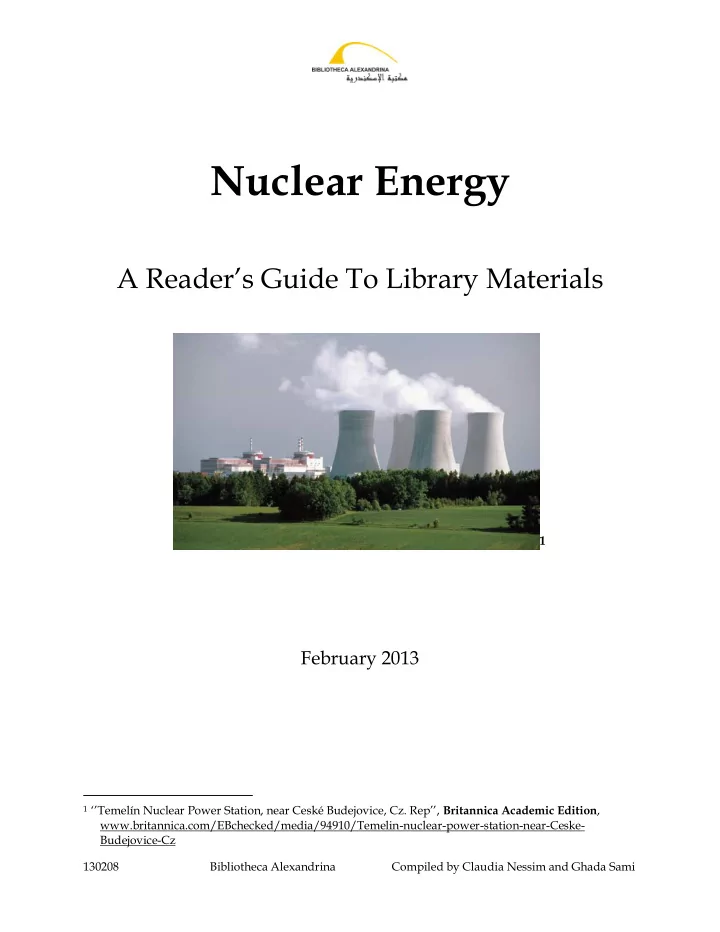
One method of releasing nuclear energy is by controlled nuclear fission in devices called reactors, which now operate in many parts of the world. Another method for obtaining nuclear energy, controlled nuclear fusion, had not been perfected by the late 1980s. Nuclear energy has been released explosively by both nuclear fusion and nuclear fission.2
How to Find Books on the Shelf
To locate books on Nuclear Energy, you may use the following call numbers: 333.7924 (B2) Nuclear Industry 539.7 (B1) Nuclear Reactions/Reactors 621.48 Nuclear Engineering 628.535 Radioactive Pollution For further assistance, you may ask a reference librarian in the Main Library or email us at: infobib@bibalex.org
Reference Works
Krivit, Steven B., Jay H. Lehr, and Thomas B. Kingery, eds. Nuclear Energy Encyclopedia: Science, Technology, and Applications. Wiley Series on Energy. Hoboken, NJ: Wiley, 2011. BA Call Number: Ref 621.04203 N9641 2011 (B4 –- References) Glossary of Nuclear Power Plant Ageing. Paris: Nuclear Energy Agency; Organisation for Economic Co-Operation and Development (OECD), 1999. e-book. OECD iLibrary (database). OECD. www.oecd-ilibrary.org/nuclear-energy/glossary-of-nuclear-power-plant- ageing_9789264073289-en-fr
2 “Nuclear Energy”, Encyclopædia Britannica Online, academic ed.
www.britannica.com/EBchecked/topic/421564/nuclear-energy
N