
SLIDE 1
1
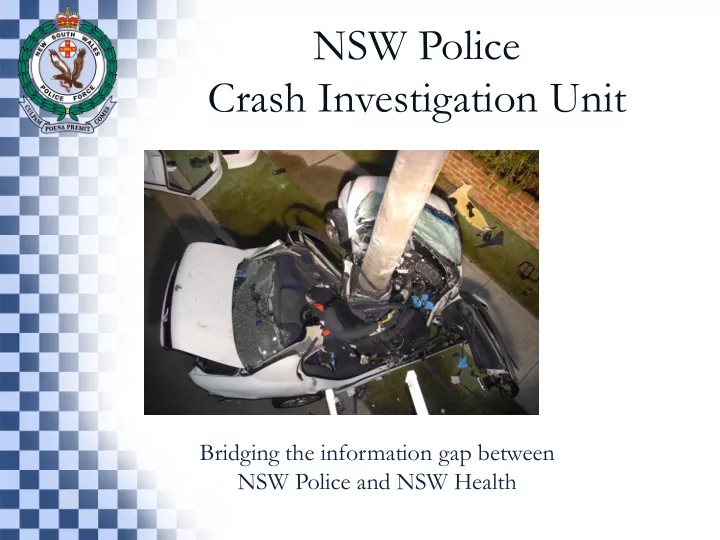
NSW Police Crash Investigation Unit
Bridging the information gap between NSW Police and NSW Health
Updated June 2014
NSW Police Crash Investigation Unit Bridging the information gap - - PowerPoint PPT Presentation
NSW Police Crash Investigation Unit Bridging the information gap between NSW Police and NSW Health Updated June 2014 1 Who is the Crash Investigation Unit? The Crash Investigation Unit (CIU), a specialist unit forming part of the NSW Police
1
Updated June 2014
2
determined or there are conflicting statements
‘On Duty Service member’ is involved
trains etc)
3
Orders, Good Behaviour Bonds, Fines, Licence Disqualifications
4
5
General Duties Police: General duties police attend the scene, assist the injured, ensure initial traffic management issues are attended and finally, assess the scene and circumstances of the collision. If it is believed by general duties police that Crash Investigation criteria are met, the CIU is contacted to attend. CIU: When contacted, the CIU referral officer will ask general duties police a number of questions about the collision. Those questions will relate to the circumstances surrounding the collision and the collision results. Until all
made.
6
7
the initial assessing hospital member? Police are aware that the patient at this stage may not have been fully examined by a Doctor
internal, extremities? Police are aware at this stage the assessment made may only be an initial one. At no time will the information given be seen as a diagnosis, simply as it is, an indication of the injury type and level of seriousness. Should the patient’s condition change, investigating police will make the necessary adjustments to the investigation.
8
9
10
11
Serious injury is generally related to being ‘grievous bodily harm’ (GBH). A new definition of grievous bodily harm was inserted into the Crimes Act in May 2005. The new definition now includes (a) the destruction (other than in the course of a medical procedure) of the foetus of a pregnant woman, whether or not the woman suffers any harm, and (b) any permanent or serious disfiguring of the person.
It was held in the case of R v Ashman (1858) 1 FF 88, that ‘it is not necessary that the harm is either permanent or dangerous’. In DPP v Smith (1961) AC 290, it was held that the words should be given their ordinary and natural meaning where ‘grievous means no more and no less than really serious’.
12
13
During the course of a serious injury or fatal crash investigation, police will require confirmation regarding two significant issues: Extent and nature of injuries: Police require confirmation of the extent and seriousness of those injuries as soon as possible. This enables an informed decision by the police investigating the collision regarding the most appropriate course
Blood sample numbers: For inclusion in subsequent police reports and for follow up enquiries.
14
Blood Sample required from an injured driver: Where practicable, the blood sample should be taken from the injured patient within 2hrs of the collision time to ensure any positive results are automatically admissible at court (but may be taken up to 12 hrs after collision). Where the driver presents at hospital with an injury the sample MUST be taken using kit with serial no 7####. There are NO circumstances when police will be required to use both kits for the same
hospital patient.
Once a sample is obtained and properly sealed it is to be deposited in the police blood box at the hospital.
15
Blood/Urine Sample from a driver under arrest. Where the driver is under arrest for the purpose of a sample under mandatory requirements following fatal accidents, the sample MUST be taken within 4 hours of collision. A drug testing kit besides containing additional equipment for obtaining a urine sample will be readily identified by the letter 'D' before the certificate number.
Once a sample is obtained and properly sealed it is to be deposited in the police blood box at the hospital.
16
17
18
When investigating a collision, to help determine the cause and series of events, police not only rely upon witness statements, but also physical evidence. Relevant to hospital staff, are collisions involving pedestrians, specifically in circumstances of ‘fail to stop’. To assist in locating involved vehicles and positively identifying their involvement, physical evidence such as paint transfer or glass fragments may be contained within a pedestrians clothing, or vice versa, the clothing contained within the damage of a vehicle. Understanding of course, that a hospitals main concern is the patients care, police ask that consideration be given to the collection and preservation of a pedestrians clothes and shoes on their behalf.
19
20
21