Nothing in biology makes sense except in light of evolution - - PowerPoint PPT Presentation

nothing in biology makes sense except in light of
SMART_READER_LITE
LIVE PREVIEW

Nothing in biology makes sense except in light of evolution - - PowerPoint PPT Presentation

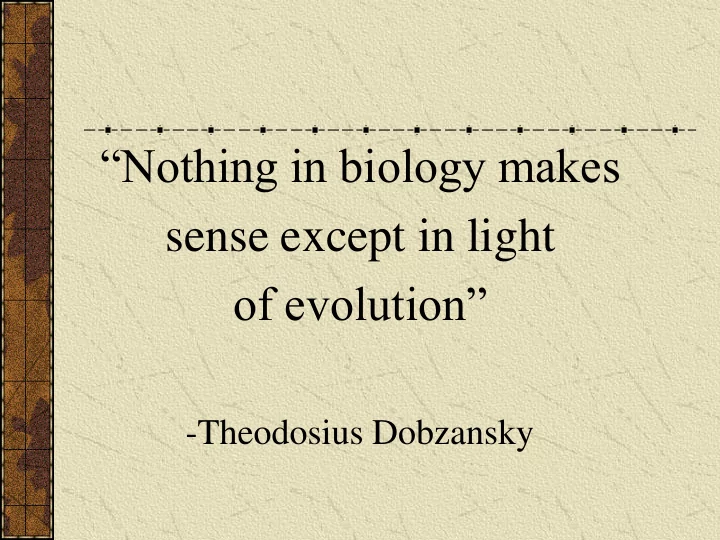
Nothing in biology makes sense except in light of evolution -Theodosius Dobzansky Nothing in biology makes sense except in light of evolution Viewed evolution as "a change in the frequency of an allele within a gene pool


slide-1
SLIDE 1

“Nothing in biology makes sense except in light

  • f evolution”
  • Theodosius Dobzansky
slide-2
SLIDE 2

“Nothing in biology makes sense except in light of evolution” Viewed evolution as "a change in the frequency of an allele within a gene pool“ His Idea: that it is through mutations in genes that natural selection takes place.

Theodosius Dobzansky

slide-3
SLIDE 3

The History of Evolutionary Thought

slide-4
SLIDE 4

Aristotle (384-322 B.C.)

Ladder of Life

 2 types of animals – those w/ blood & those w/o

Animals classified by their way of life Plants by structure Observation of various marine life anatomy was remarkably accurate Distinguished whales from dolphins

slide-5
SLIDE 5
  • Linnaeus was classifying organisms

based on what they looked like.

  • This made it difficult to classify
  • rganisms that seemed to share

characteristics with both kingdoms that Linnaeus proposed, Plants and Animals.

  • For example, fungi including mold

and mushrooms do not move (or do they?) so they seem to be plants but, unlike plants…..?????

slide-6
SLIDE 6

Lion Cat Dog Man Catbird Phylum Chordata Chordata Chordata Chordata Chordata Class Mammalia Mammalia Mammalia Mammalia Aves Order Carnivora Carnivora Carnivora Primata Passeriformes Family Felicidae Felicidae Canidae Hominidae Minidae Genus Felis Felis Canus Homo Dymetella Species leo domesticus carolinensis sapiens familiaris

slide-7
SLIDE 7
slide-8
SLIDE 8

Classifying organisms often starts at the cellular level

slide-9
SLIDE 9

Cladistics (phylogeny)

A system of classification based on the study of evolutionary relationships history of groups of organisms.

slide-10
SLIDE 10
slide-11
SLIDE 11

Primate Evolution

slide-12
SLIDE 12
slide-13
SLIDE 13

An Example of Cladogram Construction for Vertebrates

Trait

Outgroup (lobed- finned fish)

Frog Turtle

Kangaroo

Mouse Human

Dorsal Nerve Cord

Yes Yes Yes Yes Yes Yes Legs NO Yes Yes Yes Yes Yes

Nature of Egg

Requires water Requires water

Hard shell prevents drying

Develops inside the mother Develops inside the mother Develops inside the mother

Nature of development

In egg In egg In egg

Marsupial

Placental Placental Hair No No No Yes Yes reduced Presence

  • f pouch

No No No Yes No No Bipedal posture No No No Yes No Yes

slide-14
SLIDE 14

Georges-Louis Buffon (1707-1788)

Buffon questions a 2,000

  • yr. dogma 100 yrs. before

Darwin Openly suggests the earth is older than 6,000 years Supported a concept similar to Lyell’s uniformitarianism Multiple Centers of Creation

slide-15
SLIDE 15

Jean-Baptiste Lamarck (1744-1829)

His name is associated merely w/ a discredited theory of heredity – he died in obscurity & poverty Darwin & Lyell give him great credit Law of use/disuse Law of acquired characteristics

slide-16
SLIDE 16

LAMARCK’S THEORY

slide-17
SLIDE 17

ACCORDING TO DARWIN…

slide-18
SLIDE 18

Thomas Malthus (1766-1834)

1798 wrote “Essay on the Principle of Population” Humans have the tendency to outgrow their food supply Forces that work against this, war, famine, and disease Darwin read essay and thought this reasoning applied more strongly to animals and plants

slide-19
SLIDE 19

Sir Charles Lyell (1797-1875)

British geologist Wrote Principles of Geology Showed that the earth was very old and changed its form slowly (i.e. erosion) Dated the age of rocks by using fossils embedded in stone as time indicators

slide-20
SLIDE 20

How Lyell’s work helped Darwin

Darwin witnessed volcanic eruptions Darwin witnessed an earthquake that raised a rocky shoreline 3m above its original position Noted fossils of marine life many feet above sea level

slide-21
SLIDE 21

This understanding of geology influenced Darwin in 2 ways:

First, Darwin asked himself: If the Earth could change over time, might life change as well? Second, he realized that it would have taken many, many years for life to change in the way he

  • suggested. This would have been possible only if

the Earth were extremely old

slide-22
SLIDE 22

James Hutton (1726-1797)

Layers of rock are moved by forces beneath the earth’s surface Proposed the earth had to be much older than a few thousand years

slide-23
SLIDE 23

Hutton’s Theory of Geological Change

Some rocks twist and bend Others are buried and

  • thers are pushed up from

the sea floor Resulting rocks are shaped by natural forces These processes operate extremely slowly over the course of millions of years

slide-24
SLIDE 24

Alfred Wallace (1823-1913)

Studied the way geography limited or facilitated the extension of species range How ecology influenced the shaping of adaptations In 1858, shared with Darwin on the Theory of Evolution by means of Natural Selection

slide-25
SLIDE 25

Charles Darwin (1809-1882)

Voyaged around the world 1831-1836 Wrote On the Origin

  • f Species which

reveals his ideas on Evolution by means of Natural Selection

slide-26
SLIDE 26

Natural Selection Summarized:

Darwin’s theory suggests that in a species: There is a tendency towards overproduction Variation exists Variations are inherited Individuals survive in their environments with varying degrees of success Best adapted, survive and pass favorable variation on to next generation In time, great differences arise, until a new species evolved from an old species

slide-27
SLIDE 27

Biological Fitness

slide-28
SLIDE 28

What is biological fitness???

slide-29
SLIDE 29

Survival of the Fittest….

Fitness - the genetic contribution of an individual to succeeding generations relative to the contributions of

  • ther individuals in

the population

slide-30
SLIDE 30
slide-31
SLIDE 31
slide-32
SLIDE 32

Coevolution: Mutual evolutionary influence between two species

  • Typically evolution of two species totally dependent on each other.
  • Exert selective pressure on the other, so they evolve together.
  • Extreme example of mutualism.
slide-33
SLIDE 33

Homologous Structures

Structures that have different mature forms in different

  • rganisms but develop from the

same embryonic tissues.

slide-34
SLIDE 34
slide-35
SLIDE 35

. A kind of evolution wherein organisms evolve structures that have similar structures or functions in spite of their evolutionary ancestors being very dissimilar or unrelated. These structures are referred to as analogous.

slide-36
SLIDE 36
slide-37
SLIDE 37
slide-38
SLIDE 38
slide-39
SLIDE 39
slide-40
SLIDE 40
slide-41
SLIDE 41
slide-42
SLIDE 42