Charles Darwin 1809 - 1882 Charles Most influential contributor - - PDF document

charles darwin
SMART_READER_LITE
LIVE PREVIEW

Charles Darwin 1809 - 1882 Charles Most influential contributor - - PDF document

Charles Darwin 1809 - 1882 Charles Most influential contributor to thoughts about Darwin evolution The Origin of Species 1859 Presented evidence for changes in species through Natural Selection 1 2 Contrast of Views


slide-1
SLIDE 1

1

Charles Darwin

1

Charles Darwin

 1809 - 1882  Most influential contributor

to thoughts about evolution

 The Origin of Species

 1859

 Presented evidence for

changes in species through Natural Selection

2

Contrast of Views

3

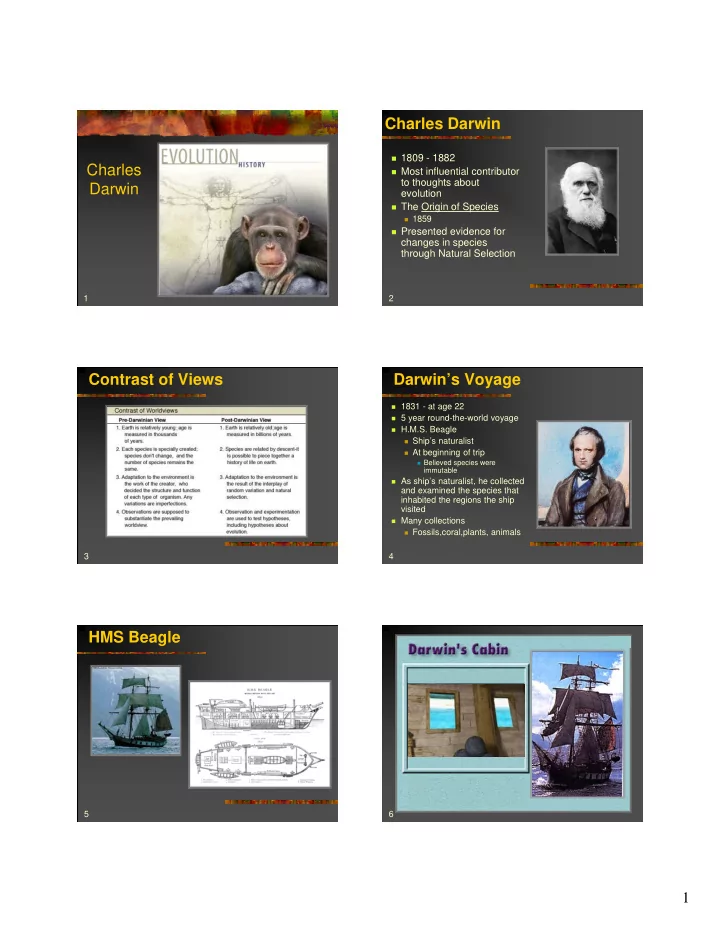
Darwin’s Voyage

 1831 - at age 22  5 year round-the-world voyage  H.M.S. Beagle  Ship’s naturalist  At beginning of trip

 Believed species were

immutable

 As ship’s naturalist, he collected

and examined the species that inhabited the regions the ship visited

 Many collections  Fossils,coral,plants, animals

4

HMS Beagle

5 6

slide-2
SLIDE 2

2

7

Galapagos Islands

 Volcanic islands - 3.5 mya  Isolated, west of Ecuador  All inhabitants are descended

from species that arrived on islands from elsewhere

EQUATOR Galapagos Islands

8

Darwin’s Finches

 13 species of finches  Share many morphological

features

 Differ in several ways

 Beak size  Beak shape  Food eaten

 Evolved from a single

species

 He attempted to correlate

variations in their traits with environmental challenges 9

Galapagos Tortoises

Long neck Flared shell Short neck Domed shell

DRY ISLANDS WET ISLANDS 10

Galapagos Iguanas

Land Iguana

Terrestrial vegetation

Marine Iguana

Algae eater

11

Theory of Natural Selection

Charles Darwin Alfred Russel Wallace 12

slide-3
SLIDE 3

3

Darwin’s Theory

 A population can change over time when

individuals differ in one or more heritable traits that are responsible for differences in the ability to survive and reproduce.

13

Alfred Russel Wallace

 1823-1913  Naturalist who arrived at the same

conclusions Darwin did

 Wrote to Darwin describing

his views

 Prompted Darwin to finally

present his ideas in a formal paper

 Both presented papers

 Linnean Society of London  July 1, 1858

14

“On the Origin of Species”

 Basic draft finished in 1842  Kept in drawer for 16 years  Other research

 Coral reefs  Barnacles

 Joint presentation of ideas at Linnean

Society

 Final draft published - 1859

 Immediate sensation

15

Darwin & Wallace Proposed Two Theories

 1. The living organisms we see today are all related

by descent (common ancestry)

 2. The means by which evolution occurs is a

process of 'natural selection.'

 organisms differ from one another

 i.e., there is variation

 these differences are heritable,

 i.e. passed from generation to generation many

 more organisms are born than survive and reproduce

(mortality)

 therefore, any variation that makes one offspring more

successful than another will have a greater chance of being passed to the next generation

 ("survival of the fittest")

16

DARWIN’S OBSERVATIONS and DEDUCTIONS

17

DARWIN’S OBSERVATIONS and DEDUCTIONS

18
slide-4
SLIDE 4

4

DARWIN’S OBSERVATIONS and DEDUCTIONS

19

DARWIN’S OBSERVATIONS and DEDUCTIONS

20

DARWIN’S OBSERVATIONS and DEDUCTIONS

21

DARWIN’S OBSERVATIONS and DEDUCTIONS

22

DARWIN’S OBSERVATIONS and DEDUCTIONS DARWIN’S OBSERVATIONS and DEDUCTIONS

23

DARWIN’S MAIN IDEAS

24

slide-5
SLIDE 5

5

REVIEW OF DARWIN’S POINTS 1-2

 Individuals of a species vary in form,

function, and behavior

 Much of the variation is heritable  Can be transmitted from parents to offspring

 Some forms of heritable traits are adaptive

to the prevailing environmental conditions

 They improve an individuals chance of

surviving and reproducing

25

REVIEW OF DARWIN’S POINTS 3-4

 Natural selection is the outcome of

differences in the survival and reproduction of individuals that show variation in one or more traits

 Natural selection leads to a better fit with

prevailing environmental conditions.

 Adaptive forms of traits tend to become more

common and other forms less so

 The population changes its characteristics

 IT EVOLVES

26

NATURAL SELECTION

 “Those individuals that

possess superior physical, behavioral, or

  • ther attributes are more

likely to survive than those that are not so well endowed”

 Selection

 Artificial  Natural

 Survival of the fittest

27

Natural Selection

 A difference in the survival and reproductive

success of different phenotypes

 Acts directly on phenotypes and indirectly on

genotypes

 Change over Time

 Over time, the alleles that produce the most

successful phenotypes will increase in the population

 Less successful alleles will become less common  Change leads to increased fitness

 Increased adaptation to environment

28

Natural Selection-Put Another way

 Individuals vary in some heritable traits  Some forms of heritable traits are more adaptive

 A trait that gives the individual an advantage in

survival or reproduction, under a given set of circumstances

 Natural selection is differences in survival and

reproduction among individuals that vary in their traits

 Adaptive forms of traits become more common

than other forms

29

THE EVOLUTIONARY VIEW

Life’s diversity is the sum total

  • f variations in traits that have

accumulated in different lines

  • f descent generation after

generation, as by natural selection or other processes

  • f change

30