SLIDE 1 Notes on the Urbanization of Our Planet
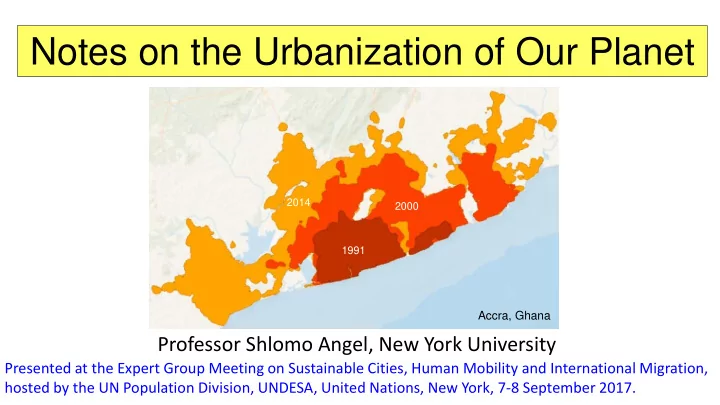
Accra, Ghana
1991 2000 2014
Professor Shlomo Angel, New York University
Presented at the Expert Group Meeting on Sustainable Cities, Human Mobility and International Migration, hosted by the UN Population Division, UNDESA, United Nations, New York, 7-8 September 2017.
SLIDE 2
The Urbanization Project
SLIDE 3
The Year 2100
SLIDE 4
Declining urban growth rates
SLIDE 5
Urban population will stabilize by 2100
SLIDE 6
On the doubling of the urban population since 1959
SLIDE 7
On tripling the present areas of cities by 2100
SLIDE 8
Explaining urban extents
SLIDE 9
SLIDE 10
Urban densities are in decline
SLIDE 11
One-third of the urban extents of cities remains open space
SLIDE 12
SLIDE 13
Urban extents tripled in area during the 1990-2015 period
SLIDE 14
SLIDE 15
The share of the population living in cities
SLIDE 16
The share of the urban population in less developed countries
SLIDE 17
Urban population growth, 2015-2050
SLIDE 18
The 18-to-1 ratio
SLIDE 19
Two regions will absorb 60% of urban population growth to 2050
SLIDE 20
SLIDE 21
Explaining the share of the population living in cities
SLIDE 22
GDP per capita and the level of urbanization
SLIDE 23
SLIDE 24
Urbanization and economic development
SLIDE 25
SLIDE 26
Urbanization and public health
SLIDE 27
SLIDE 28
What is a city?
SLIDE 29
SLIDE 30
The universe of cities
SLIDE 31
SLIDE 32
All city-size ranges contain similar total populations
SLIDE 33
SLIDE 34
Cities of different population sizes are growing at the same rate
SLIDE 35
SLIDE 36
There are discrepancies between country definitions of ‘urban’
SLIDE 37
SLIDE 38
Explaining differences in what constitutes ‘urban’
SLIDE 39
Shifting the focus from ‘people’ to ‘land for people’
SLIDE 40
The Urbanization Project is both inevitable and desirable
SLIDE 41
The risks that the Urbanization Project entails are asymmetrical
SLIDE 42
Preparations for urbanization are falling behind
SLIDE 43
SLIDE 44
Urbanization without fear
SLIDE 45
Thank you!