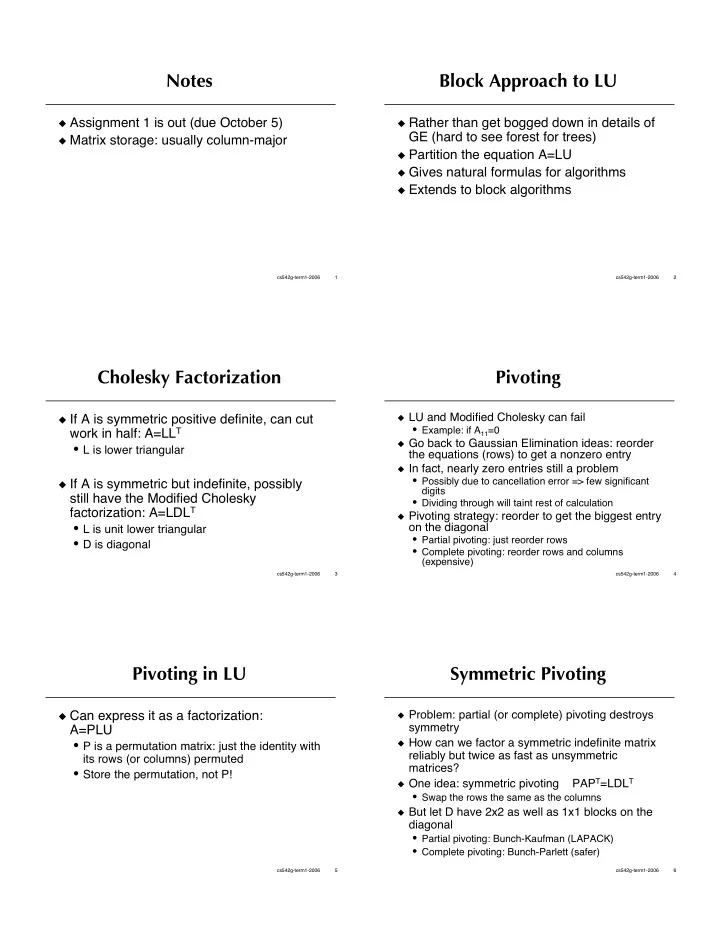
Notes Block Approach to LU Assignment 1 is out (due October 5) - - PDF document

notes block approach to lu
SMART_READER_LITE
LIVE PREVIEW

Notes Block Approach to LU Assignment 1 is out (due October 5) - - PDF document

Notes Block Approach to LU Assignment 1 is out (due October 5) Rather than get bogged down in details of GE (hard to see forest for trees) Matrix storage: usually column-major Partition the equation A=LU Gives natural formulas


slide-1
SLIDE 1

1 cs542g-term1-2006

Notes

Assignment 1 is out (due October 5) Matrix storage: usually column-major

2 cs542g-term1-2006

Block Approach to LU

Rather than get bogged down in details of

GE (hard to see forest for trees)

Partition the equation A=LU Gives natural formulas for algorithms Extends to block algorithms

3 cs542g-term1-2006

Cholesky Factorization

If A is symmetric positive definite, can cut

work in half: A=LLT

  • L is lower triangular

If A is symmetric but indefinite, possibly

still have the Modified Cholesky factorization: A=LDLT

  • L is unit lower triangular
  • D is diagonal

4 cs542g-term1-2006

Pivoting

LU and Modified Cholesky can fail

  • Example: if A11=0

Go back to Gaussian Elimination ideas: reorder

the equations (rows) to get a nonzero entry

In fact, nearly zero entries still a problem

  • Possibly due to cancellation error => few significant

digits

  • Dividing through will taint rest of calculation

Pivoting strategy: reorder to get the biggest entry

  • n the diagonal
  • Partial pivoting: just reorder rows
  • Complete pivoting: reorder rows and columns

(expensive)

5 cs542g-term1-2006

Pivoting in LU

Can express it as a factorization:

A=PLU

  • P is a permutation matrix: just the identity with

its rows (or columns) permuted

  • Store the permutation, not P!

6 cs542g-term1-2006

Symmetric Pivoting

Problem: partial (or complete) pivoting destroys

symmetry

How can we factor a symmetric indefinite matrix

reliably but twice as fast as unsymmetric matrices?

One idea: symmetric pivoting PAPT=LDLT

  • Swap the rows the same as the columns

But let D have 2x2 as well as 1x1 blocks on the

diagonal

  • Partial pivoting: Bunch-Kaufman (LAPACK)
  • Complete pivoting: Bunch-Parlett (safer)
slide-2
SLIDE 2

7 cs542g-term1-2006

Reconsidering RBF

RBF interpolation has advantages:

  • Mesh-free
  • Optimal in some sense
  • Exponential convergence (each point extra

data point improves fit everywhere)

  • Defined everywhere

But some disadvantages:

  • Its a global calculation

(even with compactly supported functions)

  • Big dense matrix to form and solve

(though later well revisit that…

8 cs542g-term1-2006

Gibbs

Globally smooth

calculation also makes for

  • vershoot/

undershoot (Gibbs phenomena) around discontinuities

Cant easily control

effect

9 cs542g-term1-2006

Noise

If data contains noise (errors), RBF strictly

interpolates them

If the errors arent spatially correlated, lots

  • f discontinuities: RBF interpolant

becomes wiggly

10 cs542g-term1-2006

Linear Least Squares

Idea: instead of interpolating data + noise,

approximate

Pick our approximation from a space of

functions we expect (e.g. not wiggly -- maybe low degree polynomials) to filter

  • ut the noise

Standard way of defining it: f (x) = ii(x)

i=1 k

  • = argmin
  • f j f (x j)

( )

2 j=1 n

  • 11

cs542g-term1-2006

Rewriting

Write it in matrix-vector form:

fi j j(xi)

j=1 k

  • 2

= b Ax 2

2 i=1 n

  • b = f1

f2

  • fn

( )

T

x = 1

  • k

( )

T

Aij = i(x j) (a rectangular n k matrix)

12 cs542g-term1-2006

Normal Equations

First attempt at finding minimum:

set the gradient equal to zero (called “the normal equations”)

  • x b Ax 2

2 = 0

  • x (b Ax)T (b Ax)

( ) = 0

  • x bTb 2xT ATb + xT AT Ax

( ) = 0

2ATb + 2AT Ax = 0 AT Ax = ATb

slide-3
SLIDE 3

13 cs542g-term1-2006

Good Normal Equations

ATA is a square kk matrix

(k probably much smaller than n)

Symmetric positive (semi-)definite

14 cs542g-term1-2006

Bad Normal Equations

What if k=n?

At least for 2-norm condition number, k(ATA)=k(A)2

  • Accuracy could be a problem…

In general, can we avoid squaring the

errors?