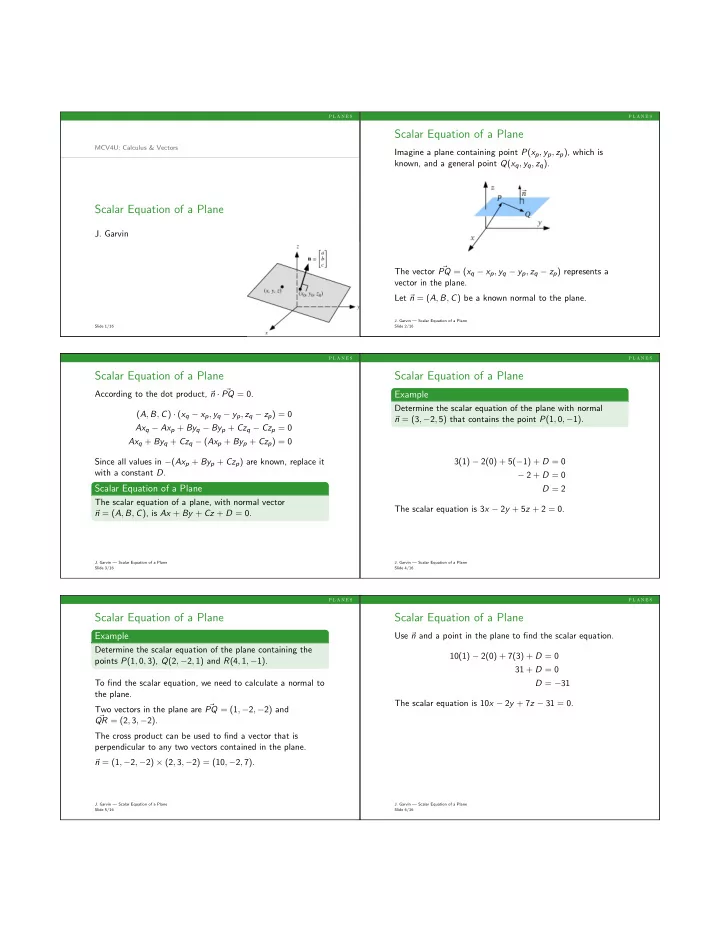
Scalar Equation of a Plane MCV4U: Calculus & Vectors Imagine a - - PDF document

scalar equation of a plane
SMART_READER_LITE
LIVE PREVIEW

Scalar Equation of a Plane MCV4U: Calculus & Vectors Imagine a - - PDF document

p l a n e s p l a n e s Scalar Equation of a Plane MCV4U: Calculus & Vectors Imagine a plane containing point P ( x p , y p , z p ), which is known, and a general point Q ( x q , y q , z q ). Scalar Equation of a Plane J. Garvin The vector


slide-1
SLIDE 1

p l a n e s

MCV4U: Calculus & Vectors

Scalar Equation of a Plane

  • J. Garvin

Slide 1/16

p l a n e s

Scalar Equation of a Plane

Imagine a plane containing point P(xp, yp, zp), which is known, and a general point Q(xq, yq, zq). The vector PQ = (xq − xp, yq − yp, zq − zp) represents a vector in the plane. Let n = (A, B, C) be a known normal to the plane.

  • J. Garvin — Scalar Equation of a Plane

Slide 2/16

p l a n e s

Scalar Equation of a Plane

According to the dot product, n · PQ = 0. (A, B, C) · (xq − xp, yq − yp, zq − zp) = 0 Axq − Axp + Byq − Byp + Czq − Czp = 0 Axq + Byq + Czq − (Axp + Byp + Czp) = 0 Since all values in −(Axp + Byp + Czp) are known, replace it with a constant D.

Scalar Equation of a Plane

The scalar equation of a plane, with normal vector

  • n = (A, B, C), is Ax + By + Cz + D = 0.
  • J. Garvin — Scalar Equation of a Plane

Slide 3/16

p l a n e s

Scalar Equation of a Plane

Example

Determine the scalar equation of the plane with normal

  • n = (3, −2, 5) that contains the point P(1, 0, −1).

3(1) − 2(0) + 5(−1) + D = 0 − 2 + D = 0 D = 2 The scalar equation is 3x − 2y + 5z + 2 = 0.

  • J. Garvin — Scalar Equation of a Plane

Slide 4/16

p l a n e s

Scalar Equation of a Plane

Example

Determine the scalar equation of the plane containing the points P(1, 0, 3), Q(2, −2, 1) and R(4, 1, −1). To find the scalar equation, we need to calculate a normal to the plane. Two vectors in the plane are PQ = (1, −2, −2) and

  • QR = (2, 3, −2).

The cross product can be used to find a vector that is perpendicular to any two vectors contained in the plane.

  • n = (1, −2, −2) × (2, 3, −2) = (10, −2, 7).
  • J. Garvin — Scalar Equation of a Plane

Slide 5/16

p l a n e s

Scalar Equation of a Plane

Use n and a point in the plane to find the scalar equation. 10(1) − 2(0) + 7(3) + D = 0 31 + D = 0 D = −31 The scalar equation is 10x − 2y + 7z − 31 = 0.

  • J. Garvin — Scalar Equation of a Plane

Slide 6/16

slide-2
SLIDE 2

p l a n e s

Scalar Equation of a Plane

Example

Determine the scalar equation of the plane with vector equation r = (3, 1, −2) + s(1, 0, 2) + t(−2, 1, 0). Two direction vectors are given in the vector equation, so find the cross product of them to determine the normal to the plane.

  • n = (1, 0, 2) × (−2, 1, 0) = (−2, −4, 1).

Use the normal and a point on the line to determine the scalar equation. − 2(3) − 4(1) + 1(−2) + D = 0 D = 12 The scalar equation is 2x + 4y − 1z − 12 = 0.

  • J. Garvin — Scalar Equation of a Plane

Slide 7/16

p l a n e s

Scalar Equation of a Plane

Example

Determine the vector and parametric equations of the plane with scalar equation 3x + 2y − z − 5 = 0. A simple method is to find three points on the plane, and use these points to create the two required direction vectors. Begin by rewriting the equation of the plane as z = 3x + 2y − 5. x y z = 3x + 2y − 5 Point z = 3(0) + 2(0) − 5 = −5 P(0, 0, −5) 1 z = 3(0) + 2(1) − 5 = −3 Q(0, 1, −3) 1 z = 3(1) + 2(0) − 5 = −2 R(1, 0, −2)

  • J. Garvin — Scalar Equation of a Plane

Slide 8/16

p l a n e s

Scalar Equation of a Plane

Two direction vectors for the line are PQ = (0, 1, 2) and

  • QR = (1, −1, 1).

A possible vector equation for the line is

  • r = (1, 0, −2) + s(0, 1, 2) + t(1, −1, 1).

The corresponding parametric equations are x = 1 + t, y = s − t and z = −2 + 2s + t.

  • J. Garvin — Scalar Equation of a Plane

Slide 9/16

p l a n e s

Scalar Equation of a Plane

If two planes are parallel (or coincident), their normals will also be parallel. This implies that n1 = k n2 for some real value k. If two planes are perpendicular, their normals will also be perpendicular. This implies that n1 · n2 = 0.

  • J. Garvin — Scalar Equation of a Plane

Slide 10/16

p l a n e s

Scalar Equation of a Plane

Example

Determine if the planes π1 : x − 3y + 5z + 4 = 0 and π2 : 4x − 12y + 20z + 18 = 0 are coincident, parallel, perpendicular or neither. From the given equations, n1 = (1, −3, 5) and

  • n2 = (4, −12, 20). Since

n2 = 4 n1, the planes are either coincident or parallel. Since the equation for π2 is not a scalar multiple of the equation for π1 (the constant is off), the planes are not coincident. Therefore, planes π1 and π2 are parallel.

  • J. Garvin — Scalar Equation of a Plane

Slide 11/16

p l a n e s

Scalar Equation of a Plane

Example

Determine if the planes π1 : x − 3y + 5z + 4 = 0 and π2 : x + 2y + z + 3 = 0 are coincident, parallel, perpendicular

  • r neither.

From the given equations, n1 = (1, −3, 5) and n2 = (1, 2, 1). Using the dot product, (1, −3, 5) · (1, 2, 1) = 0. Therefore, planes π1 and π2 are perpendicular.

  • J. Garvin — Scalar Equation of a Plane

Slide 12/16

slide-3
SLIDE 3

p l a n e s

Scalar Equation of a Plane

Two non-parallel planes must intersect (more on this later). The angle formed between the two planes will be the same as the angle formed between their normals. We can use the dot product to calculate the measure of this angle.

Angle Between Two Intersecting Planes

The angle, θ, between two intersecting planes π1 and π2 is given by cos θ = n1 · n2 | n1|| n2|.

  • J. Garvin — Scalar Equation of a Plane

Slide 13/16

p l a n e s

Scalar Equation of a Plane

Example

Determine the angle formed between the intersecting planes π1 : x − y − 2z + 3 = 0 and π2 : 2x + y − z + 2 = 0. From the given equations, n1 = (1, −1, −2) and

  • n2 = (2, 1, −1).

Calculate the magnitudes of n1 and n2. | n1| =

  • 12 + (−1)2 + (−2)2

= √ 6 | n2| =

  • 22 + 12 + (−1)2

= √ 6

  • J. Garvin — Scalar Equation of a Plane

Slide 14/16

p l a n e s

Scalar Equation of a Plane

Use the dot product to calculate the angle between the normals and, thus, between the planes. cos θ = (1, −1, −2) · (2, 1, −1) √ 6 √ 6 = 2 − 1 + 2 6 = 1 2 Therefore, the angle between the planes is 60◦ (or 120◦).

  • J. Garvin — Scalar Equation of a Plane

Slide 15/16

p l a n e s

Questions?

  • J. Garvin — Scalar Equation of a Plane

Slide 16/16