NON-STATIONARITY OF WATER REGIME IN SLOVENIA Mojca raj and - - PowerPoint PPT Presentation

non stationarity of water regime in slovenia
SMART_READER_LITE
LIVE PREVIEW

NON-STATIONARITY OF WATER REGIME IN SLOVENIA Mojca raj and - - PowerPoint PPT Presentation

NON-STATIONARITY OF WATER REGIME IN SLOVENIA Mojca raj and collegues elezniki (Slovenia), 2007 Introduction Climate variability is both an important environmental subject and a significant political issue. The global mean


slide-1
SLIDE 1

NON-STATIONARITY OF WATER REGIME IN SLOVENIA

Mojca Šraj and collegues

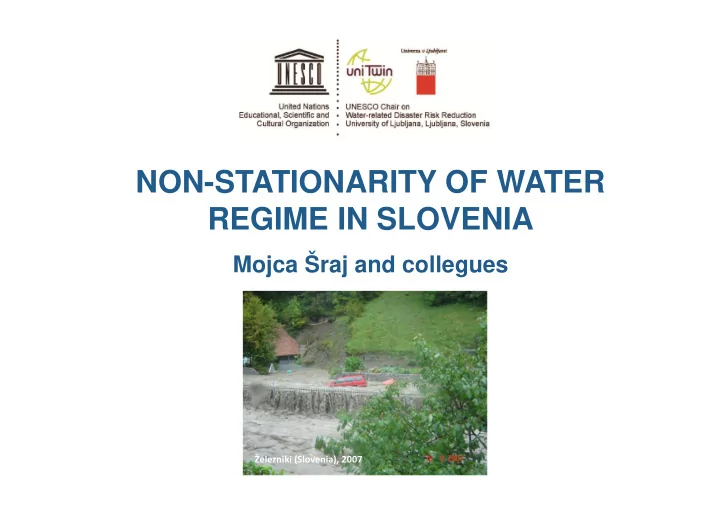
Železniki (Slovenia), 2007
slide-2
SLIDE 2

Introduction

  • Climate variability is both an important environmental subject and a

significant political issue.

  • The global mean surface air temperature have increased

significantly in the past decades (Jones et al., 1999; Pachauri et al., 2014). However, the magnitudes differ amoung regions.

  • Similarly, researchers found significant changes in precipitation that

differ amoung regions.

  • However, increasing or decreasing temperature or precipitation

trends are not necessarily associated with the corresponding trends

  • f high flows.
  • Consequently, no uniform pattern has been found for (flood)

discharge series around the globe (e.g.Robson et al. 1998; Douglas et al. 2000; Zhang et al. 2001; Kundzewicz et al. 2005; Bezak et al., 2014)

2

slide-3
SLIDE 3

Precipitation trends in Slovenia

3

JESEN ZIMA POMLAD POLETJE

Increasing trend Decreasing trend No significant trend

AUTUMN WINTER SPRING SUMMER

Kobold et al., 2012

slide-4
SLIDE 4

Extreme flood events in Slovenia

  • As a consequance extreme events in Slovenia have

been more frequent over the last decades (Kobold et al., 2012).

4 1923 1928 1933 1938 1943 1948 1953 1958 1963 1968 1973 1978 1983 1988 1993 1998 2003 2008

Floods with the the return period of at least 50 years in at least 3 watersheds

Kobold et al., 2012

slide-5
SLIDE 5

Example of deviations in discharges

5

  • dstopanje srednjih letnih pretokov in letnih visokovodnih konic
  • 80
  • 60
  • 40
  • 20

20 40 60 80

1895 1900 1905 1910 1915 1920 1925 1930 1935 1940 1945 1950 1955 1960 1965 1970 1975 1980 1985 1990 1995 2000 2005 2010

Odstopanje pretoka (%)

srednji letni pretok (Qs) visokovodne konice (Qvk) 10-letno drseče popvprečje (Qs) 10-letno drseče popvprečje (Qvk)

Alpine pluvial-nival water regime

Discharge deviation [%] Mean annual Qs Flood peaks Qvk 10-years moving average Qs 10-years moving average Qvk

Kobold in Dolinar, 2014

  • As an example of discharge changes Litija station on the

Sava river is presented.

Litija - Sava

slide-6
SLIDE 6

Trends in high discharges in Slovenia

6

Menih., 2014

  • These are the facts that influence also on the accuracy
  • f the estimated design discharges.
slide-7
SLIDE 7

Flood frequency analyses

  • We also investigated the influence of climate change on

design discharges.

  • FFA were performed for different 30-years periods using

the AM discharge data sets and POT samples.

  • Different distributions were used and parameters were

estimated using the method of moments and the method

  • f L-moments.

7

slide-8
SLIDE 8

Flood frequency analyses

8

Example of the Litija station

Bezak et al., 2016

slide-9
SLIDE 9

Differences in design discharges between two periods

9

54 stations

22 21 11

Menih., 2014

slide-10
SLIDE 10

New approaches

  • These were the results of traditional FFA based on the

assumption of stationarity; which may be questioned.

  • According to the presented results, it is obvious that new

approches are needed considering climate change impact.

  • One of them is to implement time trend into the parameters of

the probability distribution functions.

  • The problem with time varying distribution parameters is that it

is difficult to justify why they would continue to change in the future exactly in the same way they did in the past.

  • As an alternative, models have been developed that correlate

the distribution parameters to other variables such as land use or climatological variables (e.g. ENSO)

10

slide-11
SLIDE 11

11

Šraj et al., 2016

slide-12
SLIDE 12

Conclusions

  • The influence of climate change on the design discharge

should be considered, but how?

  • Predicting the design flood for the life span of the structure

in the future using time dependant non-stationary models needs to be considered with care, since it is possible that changes in the future will not be exactly the same as those in the past.

  • The advantage of the non-stationary model with annual

precipitation as a covariate is that it avoids direct temporal

  • extrapolation. To use this model for design purposes,

reliable scenarios of future precipitation are needed.

  • We can conclude that improvements of FFA techniques

regarding non-stationarity are still the goal for hydrologists in the near future.

12

slide-13
SLIDE 13

Thank you for your attention!

13

slide-14
SLIDE 14

Our recent publications about the topic

  • ŠRAJ, Mojca, VIGLIONE, Alberto, PARAJKA, Juraj, BLÖSCHL, Günter. The influence of

non-stationarity in extreme hydrological events on flood frequency estimation. Journal of Hydrology and Hydromechanics, 2016, 64(4), 426-437, doi: 10.1515/johh-2016-0032

  • BEZAK, Nejc, BRILLY, Mitja, ŠRAJ, Mojca. Flood frequency analysis, statistical trends and

seasonality analyses of discharge data : a case study of the Litija station on the Sava river. Journal of flood risk management, 2016, 154-168, doi: 10.1111/jfr3.12118.

  • ŠRAJ, Mojca, MENIH, Matevž, BEZAK, Nejc. Climate variability impact assessment on the

flood risk in Slovenia. Physical geography, 2016, 37(1), 73-87, doi: 10.1080/02723646.2016.1155389.

  • ŠRAJ, Mojca, BEZAK, Nejc, BRILLY, Mitja. Bivariate flood frequency analysis using the

copula function: a case study of the Litija station on the Sava River. Hydrological

  • processes. In press, 2014, doi: 10.1002/hyp.10145
  • BEZAK, Nejc, HORVAT, Alja, ŠRAJ, Mojca. Analysis of flood events in Slovenian streams.

Journal of Hydrology and Hydromechanics, 2015, 63(2), 134-144, doi: 10.1515/johh-2015- 0014.

  • BRILLY, Mitja, KAVČIČ Katarina, ŠRAJ, Mojca, RUSJAN Simon, VIDMAR, Andrej. Climate

change impact on flood hazard. Evolving Water Resources Systems: Understanding, Predicting and Managing Water–Society Interactions. Proceedings of ICWRS2014, Bologna, Italy, June 2014 (IAHS Publ. 36X, 2014).

  • BEZAK, Nejc, BRILLY, Mitja, ŠRAJ, Mojca. Comparison between the peaks over threshold

method and the annual maximum method for flood frequency analyses. Hydrological sciences journal, 59/5, 2014, 959-977, doi: 10.1080/02626667.2013.831174.

14