No manual for the future: Helping private woodland owners adapt to - - PowerPoint PPT Presentation

no manual for the future helping private woodland owners
SMART_READER_LITE
LIVE PREVIEW

No manual for the future: Helping private woodland owners adapt to - - PowerPoint PPT Presentation

No manual for the future: Helping private woodland owners adapt to climate change Anna Lawrence and Mariella Marzano Woodland ownership in the UK England N. Scotland Wales Total Ireland Public 214 61 481 114 870 (000 ha)


slide-1
SLIDE 1

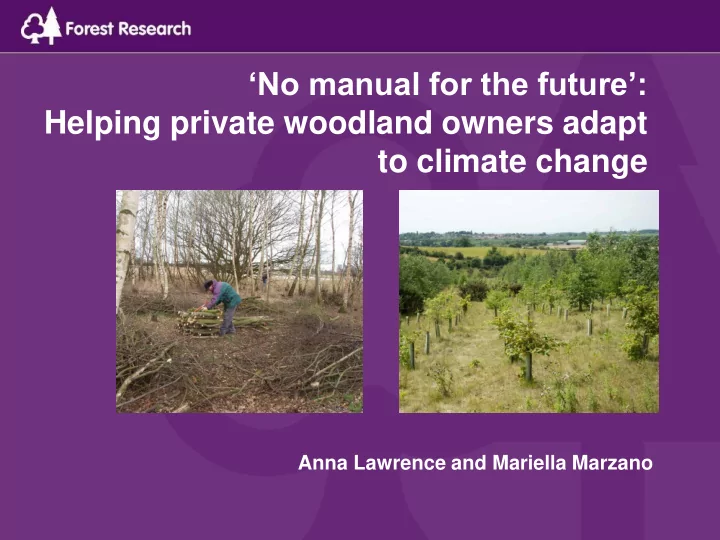
‘No manual for the future’: Helping private woodland owners adapt to climate change

Anna Lawrence and Mariella Marzano

slide-2
SLIDE 2

14/06/2012

2

Woodland ownership in the UK

England N. Ireland Scotland Wales Total Public (000 ha) 214 61 481 114 870 Private (000 ha) 1083 27 909 190 2209 % private 84% 31% 65% 63% 72%

slide-3
SLIDE 3

14/06/2012

3

The UK and Wales

slide-4
SLIDE 4

14/06/2012

4

Evidence review: owners’ attitudes

  • 34 studies met the criteria
  • Wildlife and conservation high

priority

  • Culture of ownership / control

/ responsibility

  • Economics not explicitly a

priority but related to low confidence in markets not lack of interest

  • Widespread perception of

complexity and bureaucracy

  • Communication is at least as

important as financial incentives

  • But very little evidence from

Wales (Lawrence et al 2010)

slide-5
SLIDE 5

14/06/2012

5

Adaptive Forest Management

Review of international literature Specific challenges in the UK:

  • Relatively high population

density, intense and multiple demands on land use

  • Fragmented habitats
  • Fragmented ownership (and

high private ownership)

  • Declining silviculture content in

higher education Potential opportunities in the UK:

  • Strong tradition of partnership
  • Strong culture of knowledge

networks (Lawrence & Gillett 2011)

slide-6
SLIDE 6

14/06/2012

6

MOTIVE

  • Values and attitudes towards climate

change influence responsiveness to adaptive forest management

  • How forest owners, managers and

industry (public and private sector) experience and respond to uncertainty and risk in the context of climate change

  • Interviews with private sector
  • wners, managers and agents (advisors)

in Wales

  • Questions around perceptions of climate

change, current management, experimentation, information sources

slide-7
SLIDE 7

14/06/2012

7

Focus on Wales: Policy drivers

UK policy drivers

  • Climate change and delivery of

ecosystem services

  • Woodland creation and

management prominent Woodland for Wales (the Welsh forest strategy) Aim: ‘Woodlands are better adapted to ensure a range of benefits’ This means: Clearfelling avoided where alternative management systems would make a better contribution to ecosystem services

slide-8
SLIDE 8

14/06/2012

8

Categories of owners

  • Large woodland owner e.g. Estates
  • Farmers
  • Weekend woodland owners
  • ‘Investment’ or commercial owners
  • Large NGOs
  • Local authorities
  • Public bodies (other than Forestry

Commission)

  • Community woodland groups
slide-9
SLIDE 9

14/06/2012

9

Findings: local authority and small scale owners

  • Not convinced of need to adapt
  • Those who want to adapt believe it is best to rely on native

species

“Some of the species they [owners] say they’re choosing is because of climate change, but I’m not massively convinced. I think it’s replanting the native woodland and ‘I like these trees” (Public Body - grants) “Nobody has proved to me that local biodiversity does not have sufficient adaptation…to withstand the changes that are coming” (Community Woodlands)

slide-10
SLIDE 10

14/06/2012

10

Findings: estate owners / managers

  • In general tend to be older and more sceptical of

climate change

  • Some are key advocates of continuous cover

forestry

  • More likely to manage for overall resilience not

climate change

“It seems beneficial to actually use what’s there within the woodland rather than go to the costs of clearfelling a site” (Estate Manager) “I think there’s probably quite a lot of scepticism on behalf of landowners that there’s going to be a problem, which I think is probably general public scepticism anyway” (Management Advisor)

slide-11
SLIDE 11

14/06/2012

11

Findings: commercial plantations

  • Not widely concerned or interested
  • Some willing to be innovative

“Most commercial investments in forestry tend to have a 10 to 20 year investment period…that’s probably difficult to tie in with climate change which is over a longer time period” (Management Advisor) “…what I’ve been proposing in some of these woodlands is start to underplant [with other species] where we can … the reaction I get back, ‘oh there’s no market for Silver Fir in this country…well maybe there will have to be a market in a few years time” (Management Advisor)

slide-12
SLIDE 12

14/06/2012

12

Uncertainty is recognised but:

  • Easier to discuss climate change in the context of pests and

diseases – concerns about species suitability

  • Uncertain commercial potential of future species choice and

markets

Beliefs about climate change and risk

“I’m not sure that the connection’s been made between climate change and growing trees”. (Management Advisor) “Sitka spruce can grow anywhere” (Forest manager) “[They say] well what would you recommend?’ And it’s hard to say, I mean the usual recommendation is just plant a good variety because there’s no way we can say” (Public body - grants)

slide-13
SLIDE 13

14/06/2012

13

Knowledge Exchange

“If you’ve got too much information, sometimes you don’t do anything about it because it frightens you” (Public Body – non FC)

Photo: Ted Wilson

“The best feedback we get and the most excited people get is if they have a chance to talk…and the chance to see somebody else’s woodland and to hear somebody else being passionate and explaining what they’ve done” (Community Woodlands) “We don’t know…even with good advice with people who have thought about these things, the unknowns like disease…mean that advice very quickly can be discarded” (Public body – non FC)

slide-14
SLIDE 14

14/06/2012

14

Conclusions

  • Preliminary research
  • Understand the stakeholders
  • Very different types, with different values and motivations
  • Some of their behaviours are probably helpful vis a vis

climate change

  • Species choice
  • Silvicultural systems
  • Work with their priorities
  • Policy drivers and owner / manager motivations are not

necessarily related to climate change although the

  • utcomes may be
  • Invest in communication:
  • information / demonstration / networking and field based

knowledge exchange is part of the answer