No conflicts of interest related to this Exploring Brain - - PowerPoint PPT Presentation

no conflicts of interest related to this exploring brain
SMART_READER_LITE
LIVE PREVIEW

No conflicts of interest related to this Exploring Brain - - PowerPoint PPT Presentation

No conflicts of interest related to this Exploring Brain Connectivity in Autism presentation and Sensory Processing Disorders Funding Dr. Muhkerjee: General Electric Board Member & Research Support (mild UCSF Developmental


slide-1
SLIDE 1

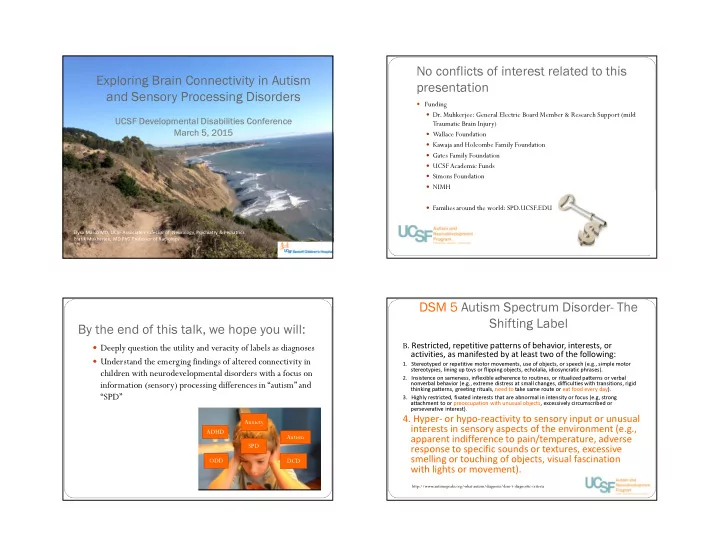
Exploring Brain Connectivity in Autism and Sensory Processing Disorders

UCSF Developmental Disabilities Conference March 5, 2015

Elysa Marco MD, UCSF Associate Professor of Neurology, Psychiatry & Pediatrics Pratik Mukherjee, MD PhD Professor of Radiology

No conflicts of interest related to this presentation

Funding

  • Dr. Muhkerjee: General Electric Board Member & Research Support (mild

Traumatic Brain Injury)

Wallace Foundation Kawaja and Holcombe Family Foundation Gates Family Foundation UCSF Academic Funds Simons Foundation NIMH Families around the world: SPD.UCSF.EDU

By the end of this talk, we hope you will:

Deeply question the utility and veracity of labels as diagnoses Understand the emerging findings of altered connectivity in

children with neurodevelopmental disorders with a focus on information (sensory) processing differences in “autism” and “SPD”

SPD ADHD Autism ODD DCD Anxiety

DSM 5 Autism Spectrum Disorder- The Shifting Label

  • B. Restricted, repetitive patterns of behavior, interests, or

activities, as manifested by at least two of the following:

  • 1. Stereotyped or repetitive motor movements, use of objects, or speech (e.g., simple motor

stereotypies, lining up toys or flipping objects, echolalia, idiosyncratic phrases).

  • 2. Insistence on sameness, inflexible adherence to routines, or ritualized patterns or verbal

nonverbal behavior (e.g., extreme distress at small changes, difficulties with transitions, rigid thinking patterns, greeting rituals, need to take same route or eat food every day).

  • 3. Highly restricted, fixated interests that are abnormal in intensity or focus (e.g, strong

attachment to or preoccupation with unusual objects, excessively circumscribed or perseverative interest).

  • 4. Hyper- or hypo-reactivity to sensory input or unusual

interests in sensory aspects of the environment (e.g., apparent indifference to pain/temperature, adverse response to specific sounds or textures, excessive smelling or touching of objects, visual fascination with lights or movement).

http://www.autismspeaks.org/what-autism/diagnosis/dsm-5-diagnostic-criteria

slide-2
SLIDE 2

Disorder ≠ Etiology

Strive for an Etiology!!

Genetics Injury Environment

Genetics: Just one example 16p11.2 CNV

Autism multiplex family with 16p11.2p12.2 microduplicationsyndrome in monozygotic twins and distal 16p11.2 deletion in their brotherAnne-ClaudeTabet, MarionPilorge, RichardDelorme, FrédériqueAmsellem, Jean- MarcPinard, MarionLeboyer, AlainVerloes, BrigitteBenzackenand CatalinaBetancurBACKTO ARTICLE

Genetics and Sensory Processing

(and/or Autism and/or ADHD and/or Language disorder and/or schizophrenia and/or bipolar)

Copy Number Variations: 16p11.2

Unique Website: www.rarechromo.org The Cognitive and Behavioral Phenotype of the 16p11.2 Deletion in a Clinically Ascertained Population. Hanson, E et. al Biol Psychiatry 2014

Why the and/or’s?

slide-3
SLIDE 3

Genetics and Sensory Processing (and/or Autism)

Triplet Repeat Disorders: Fragile X

Genetics and Sensory Processing (and/or Autism)

Single Point Mutations: ARGHEF9

How can genetics guide treatment and Prognosis?

Fragile X

mGLUR5 = STX209 (Arbaclofen)? GABA Specialized Clinics with screening of family members Investigate for associated conditions

Arghef9

GABA, GABA, GABA

16p11.2

Focus on articulation and praxis Focus on specific aspects of cognitive control Meds? Seizures?

Brain Injury/Structural malformation and Sensory Processing (and/or Autism)

Fetal Alcohol Syndrome (other exposures) Prematurity Stroke Infection Agenesis of the Corpus Callosum Migraine?

slide-4
SLIDE 4

Brain Injury: Prematurity

Posterior Brain Regions: Multisensory & Interhemispheric

http://bestpractice.bmj.com/best- practice/monograph/674/resources/image/bp/2.h tml

What did we find?

Wickremasinghe, Rogers, Johnson & Marco; PAS 2012; Former Preterm Infants Exhibit Abnormal Sensory Behavior

Brain Malformations: Agenesis of the Corpus Callosum

Partial Thin Absent Images courtesy of Dr. Elliott Sherr

Brain Structure/genetics: AgCC Low Registration

57% 43%

AgCC

Score of 1-4 Score of 5

Demopoulos, Arroyo, Dunn, Sherr, Marco (Neurolosychology, in revision) Individuals with agenesis of the corpus callosum show sensory processing differences as measured by the Sensory Profile.

slide-5
SLIDE 5

How can understanding brain injury/structural differences guide treatment:

AgCC:

Focus on registration- increasing intensity and salience of

sensory input

Focus on auditory processing Slow it down Consider excitation as well as inhibition-keep one hand busy

when working on the other.

Prematurity

Increase the stimulus intensity Focus on Auditory-Visual Integration!

Environment (Experience over Time)

Sensory Deprivation v. Engagement/Experience Trauma/Conflict v. Comfort Screen Time: passive v. active, addictive v. stimulating Skill practice and Success

Charting our course:

2014 Updates on sensory processing and neuroimaging

assessment But first, What does a child neurologist and pediatric neuroradiologist mean by sensory processing:

Cognitive Control Perception Unimodal Perception Encoding Multimodal Integration Interpretation Planning Motor Planning Output Motor Output

slide-6
SLIDE 6

How are the sensory domains organized and Connected? How do we look into our kids’ brains?

Structural

CT MRI DTI

Functional

MEG fMRI

Biological Basis For SPD using DTI

TBSS Data Driven Approach SPD boys 8-12y compared to

Controls With a focus on sensory processing: we recruited, evaluated, and scanned kids with SPD…

Right handed boys

SPD n=16 Controls n=25

Age Matched

8 to 11 years old

FSIQ matched

SPD mean 113 (100-131) Control mean 115 (97-130)

slide-7
SLIDE 7

Then, we looked for lesions…

Group SPD (n=16) Controls (n=25) Corpus Callosum Decreased White matter Grey Matter Injury Posterior Fossa Cyst

Next, we looked for volume…

Free Surfer p Total Cortex .87 Intracranial .63 TotalWhite .49 Left White .58 Right White .42 Left Cortex .94 Right Cortex .81

So finally, we looked at white matter integrity using diffusion tensor imaging (DTI)

+ =

Fractional Anisotropy & Radial Diffusivity

Based on water movement under the influence of a gradient: FA= Degree of directionality RD= rate of movement perpendicular to the WM tract.

Diffusion Tensor Imaging on Teenagers, Born at Term With Moderate Hypoxic-ischemic Encephalopathy ZoltanNagy, KatarinaLindström, HelenaWesterberg, StefanSkare, JesperAndersson, BoubouHallberg, AndersLilja, OlofFlodmark, HugoLagercrantz, TorkelKlingbergand ElisabethFernell

slide-8
SLIDE 8

The differences were striking!

Poster Body

  • f the

Corpus Callosum Bilateral posterior thalamic radiations http://brain.oxfordjournals.org/content/128/11/2562/F7.large.jpg

Q: how does decreased FA relate to auditory behavior? A: better connection = more typical behavior

Sensory Profile- Auditory

Q: how does decreased FA relate to multisensory behavior? A: better white matter = more typical behavior

Sensory Profile- Multisensory

Q: And what about attention?… A: Better attention = better left frontal white matter

Sensory Profile- Attention

slide-9
SLIDE 9

What is found in autism?

J Psychiatry Neurosci. 2011 January; 36; Pervasive microstructure abnormalities in autism: A DTI study

So we added a group of boys with autism…and Shin (like Charlie Sheen) Chang!

Right handed boys

SPD n=16 ASD n=15 Controls n=23

Age Matched

Between 8 to 12 years old

PIQ matched

SPD mean 116 ASD mean 102 Control mean113

WMIQ:

SPD: 104 ASD: 100 Control: 108

2nd Published Report

HARDI Probabilistic Streamline

Tractography Hypothesis Tract Based Approach

SPD boys 8-12y compared to Controls ASD boys 8-12y compared to Controls

How do they compare?

Both ASD and SPD groups show decreased FA in basic

sensory perception and integration tracts (SPD > ASD)

FF

slide-10
SLIDE 10

How are they different?

The ASD group is more affected in the face processing and

auditory tracts

& does this relate to the real world?

Tract strength is correlated with auditory processing

performance (SPD>ASD)

& does this relate to the real world?

Tract strength is correlated with working memory

performance (SPD>ASD)

r = 0.49, p < 0.001

slide-11
SLIDE 11

& does this relate to the real world?

Tract strength is correlated with social skills (driven by the

ASD group)

r = -0.39, p = 0.004

Take home message:

Children with SPD and ASD show decreased connectivity in

basic (posterior) sensory tracts

Children with ASD are more affected in facial recognition

and language tracts

These changes in connectivity correlate with working

memory and social behavior across diagnosis

From structure to Function: How do neurons talk to each other? How can you measure electrical activity?

slide-12
SLIDE 12

Functional imaging with magnetoencephalography

Milli-second & milli-meter

cortical activity resolution (w/MRI co-registration)

Non-invasive Well tolerated Resting Paradigms and

Activity based Paradigms

Autism Group Control Group

Slow Deviant Fast Slow Deviant Fast Amplitude (fT)

Minimal group differences by clinical autism diagnosis

LH RH

Bringing the bedside to the scanner…

Two groupings: Clinical Autism Diagnosis and Tactile Sensitivity

Autism Controls Tactile Sensitive Tactile Typical

slide-13
SLIDE 13

Slow Deviant Fast Slow Deviant Fast

Autism Group Control Group

Slow Deviant Fast Slow Deviant Fast

Tactile Sensitive Tactile Typical

Amplitude (fT) Amplitude (fT) Left Hemisphere Right Hemisphere

What we have learned:

  • Phenotype must guide our Neurotype analysis; not the

label

  • We see EARLY differences at the level of primary cortex

So how do we move from the scanner back to the bedside?

  • 1. Use scanning tools to IDENTIFY & MEASURE neural

deficits in individuals & CREATE personalized sensory based intervention approach

  • 2. Provide objective measures of intervention EFFICACY

Interventions: Our goal (like yours!) is to build both areas of strength and areas of challenge (Visuomotor and Attention)

slide-14
SLIDE 14

Develop tablet based tools for assessment and training (paired with neuroimaging)!

Adam Gazzaley

Director of “The NIC”

Eric Johnston Lucas Arts

Many Hands :

Bay Area SPD

providers

The kids and their

parents! SPD MEG/DTI Team Srikantan Nagarajan Pratik Mukherjee Elliott Sherr Leighton Hinkley Carly Demopoulos Annie Aitken Shivani Desai Ashley Antovich Julia Harris Susannah Hill Richard Hill Angelina Jocson Kasra Khatibi Anne Bernard Monica Arroyo Heidi Kirsch Anne Findlay Suzanne Homna Julia Owens Shin Chang EVO Team Adam Gazzaley Joaquin Anguera Shivani Desai Ashley Antovich Cammie Rolle Johno Gibbons

MAC Bruce Miller Joel Kramer John Neuhaus Sensory Processing Foundation Lucy Miller Sarah Schoen Autism Neurodevelopment Program Bryna Siegel Robert Hendren Lauren Weiss