Next Generation Earth System Prediction: Strategies for Subseasonal - - PowerPoint PPT Presentation

next generation earth system prediction strategies for
SMART_READER_LITE
LIVE PREVIEW

Next Generation Earth System Prediction: Strategies for Subseasonal - - PowerPoint PPT Presentation

Next Generation Earth System Prediction: Strategies for Subseasonal to Seasonal Forecasts Presented by insert cover image Duane Waliser JPL/Caltech/NASA On Behalf of the S2S Study Committee Weather, Water, and Climate Forecasts are Vital


slide-1
SLIDE 1

Next Generation Earth System Prediction: Strategies for Subseasonal to Seasonal Forecasts

insert cover image

Presented by

Duane Waliser

JPL/Caltech/NASA
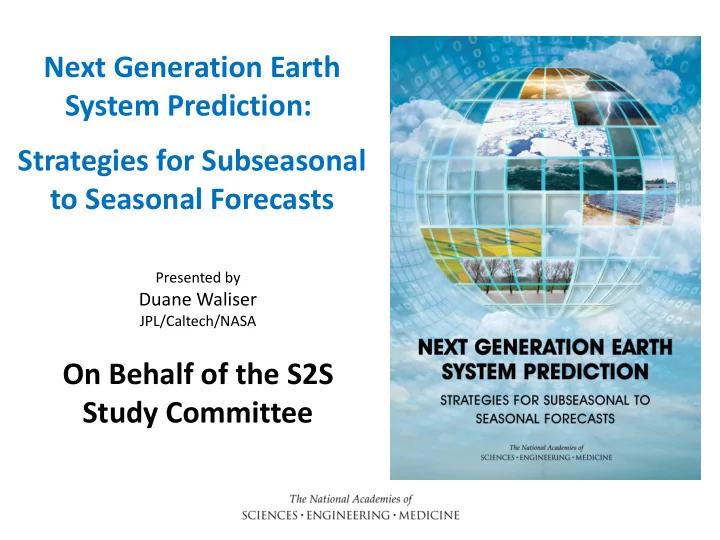
On Behalf of the S2S Study Committee

slide-2
SLIDE 2

Weather, Water, and Climate Forecasts are Vital to Decision Making

Businesses Governments Individuals

slide-3
SLIDE 3

Forecast Timescales

  • Weather

0-14 Days

  • Subseasonal

2-12 Weeks

  • Seasonal

3-12 Months

  • Interannual

1 year - Decade

  • Climate

Decades - Centuries

Subseasonal to Seasonal (S2S) 2 weeks -12 months

slide-4
SLIDE 4

What if Longer-Range Forecasts Were More Skillful and Widely Used?

  • Many decisions must be

made in the space between weather forecasts and climate projections

  • Improving S2S forecasts

would benefit many sectors of society

  • Will improve planning and

preparation to help save lives, protect property, increase economic vitality

slide-5
SLIDE 5

Current State of S2S Forecasting

S2S forecasts are increasingly used in agriculture, energy, and water resource management—but more engagement with users in other sectors will increase use

Precipitation Outlook for April–June 2016 Issued March 15, 2016

slide-6
SLIDE 6

Current State of S2S Forecasting

Scientific knowledge gap, gaps in observations and modeling, and limited computational capacity currently limit accuracy of S2S forecasts

Range of present- day MJO forecast skill Estimates of predictability (i.e. upper-limit)

  • f MJO

prediction skill Indication of significant room for forecast skill improvement

Figure 4.2 Neena et al., J. Climate, 2014

Prediction Skill and Predictibility (# of Days)

slide-7
SLIDE 7

Why This Study?

  • Sponsored by Office of Naval Research, Heising-

Simons Foundation, NASA, and NAS Arthur L. Day Fund Task:

  • To describe a strategy to increase the nation's

capacity for S2S forecasting

  • To develop a 10 year scientific research agenda to

accelerate progress

slide-8
SLIDE 8

Committee Roster

  • Raymond J. Ban (Chair), Ban and

Associates, LLC

  • Cecilia Bitz, University of

Washington

  • Andy Brown, UK Met Office
  • Eric Chassignet, Florida State

University

  • John A. Dutton, Prescient Weather,

Ltd.

  • Robert Hallberg, NOAA Geophysical

Fluid Dynamics Laboratory

  • Anke Kamrath, National Center for

Atmospheric Research

  • Daryl Kleist, University of Maryland,

College Park

  • Pierre F.J. Lermusiaux,

Massachusetts Institute of Technology

  • Hai Lin, Environment Canada
  • Laura Myers, University of Alabama
  • Julie Pullen, Stevens Institute of

Technology

  • Scott Sandgathe, University of

Washington

  • Mark Shafer, The University of

Oklahoma

  • Duane Waliser, Jet Propulsion

Laboratory

  • Chidong Zhang, University of Miami

Committee held five in-person meetings, spoke with dozens of researchers and users Report reviewed by 12 outside experts

slide-9
SLIDE 9

The Committee’s Vision

S2S forecasts will be as widely used a decade from now as weather forecasts are today

  • Fulfilling this vision will

take sustained effort and investment

slide-10
SLIDE 10

Fulfilling the Vision: Research Strategies

  • 1. Engage Users
  • 2. Increase S2S

Forecast Skill

  • 3. Improve

Prediction of Disruptive Events

  • 4. Include More

Earth System Components

slide-11
SLIDE 11

Example: Recommendation A

  • More detailed actions listed under each recommendation
  • Tables (S.1 and 8.1) give further guidance
slide-12
SLIDE 12
  • Vision and research

agenda are bold

  • S2S forecasts will be

as widely used a decade from now as weather forecasts are today

  • Fulfilling this vision

will take sustained effort and investment

Bringing It All Together

slide-13
SLIDE 13

The Sub-seasonal to Seasonal (S2S) Prediction Project

13

“Bridging the gap between weather and climate” Co-chairs: Frédéric Vitart (ECMWF) Andrew Robertson (IRI)

slide-14
SLIDE 14

Mission Statement

  • “To improve forecast skill and understanding on the

sub-seasonal to seasonal timescale with special emphasis on high-impact weather events”

  • “To promote the initiative’s uptake by operational

centres and exploitation by the applications community”

  • “To capitalize on the expertise of the weather and

climate research communities to address issues of importance to the Global Framework for Climate Services”

One of 3 Post-THORPEX Projects: S2S, HiW, PPP

slide-15
SLIDE 15

Subseasonal Forecast Database

WCRP-WWRP S2S Project International Program for S2S Research

S2S Database S2sprediction.net

slide-16
SLIDE 16
  • Daily real-time forecasts + re-forecasts
  • 3 weeks behind real-time
  • Common grid (1.5x1.5 degree)
  • Variables archived: about 80 variables

including ocean variables, stratospheric levels and soil moisture and temperature

slide-17
SLIDE 17

S2S Project Website

WCRP-WWRP S2S Project

slide-18
SLIDE 18

Program Status

  • Initial 5 year period ends fall of 2018
  • Recently conducted a user survey of how to

expand/improve products, objectives, etc.

  • Proposal for 2nd 5 year period being developed

now.

  • Note