NEW RETAIL rethinking the physical shop DT17 - 2rd Sem - Oral - - PowerPoint PPT Presentation

new retail rethinking the physical shop
SMART_READER_LITE
LIVE PREVIEW

NEW RETAIL rethinking the physical shop DT17 - 2rd Sem - Oral - - PowerPoint PPT Presentation

Theme 2: NEW RETAIL rethinking the physical shop DT17 - 2rd Sem - Oral Synopsis exam - Marketing & Communication Design What will challenge the physical stores in the future? ? Introduction to my model brand Vision: make sophisticated


slide-1
SLIDE 1

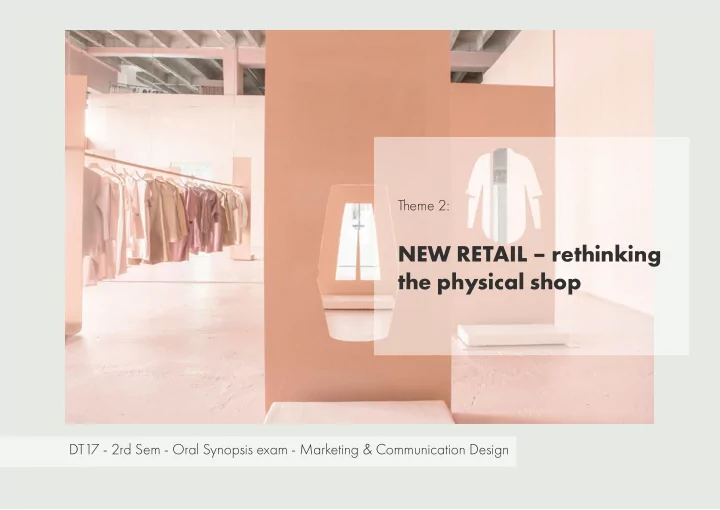
DT17 - 2rd Sem - Oral Synopsis exam - Marketing & Communication Design Theme 2:

NEW RETAIL – rethinking the physical shop

slide-2
SLIDE 2

What will challenge the physical stores in the future?

?

slide-3
SLIDE 3

Introduction to my model brand

Founded in 2002 by Troels H. Povlsen, Mette & Rolf Hay Mission: create modern furni- ture, focusing on materials, sus- tainability and quality industrial manufacturing Vision: make sophisticated design accessible to the largest possible audience Competitors Normann Copenhagen, Muo- to, Broste and Ferm living Target group People between 20-70 who are interested in design Value: development through sharing skills, simple solutions and learning by doing

slide-4
SLIDE 4

Why does HAY have to rethink its physical stores?

  • Clothing and shoe stores are affected - however, it will be observable in furniture stores as well1
  • Leading brands as Amazon, Nike and Co. redesign their physical stores - trickle down effect2
  • Significant growth in the interior design business followed by the macro trend technology3
  • Competitive advantage
  • HAY has the financial capacity to invest in their future4

Working future-oriented is today more important than ever for HAY

Sources:

  • 1. https://www.housefull.com/blog/why-buying-furniture-online-is-becoming-popular
  • 2. https://qz.com/956745/retail-experiments-from-farfetch-nike-and-amazon-offer-visions-of-the-store-of-the-future/
  • 3. Augment. How Augmented Reality & Innovation are Shaping the Future of Interior Design. Augment News (2016)
  • 4. https://finans.dk/erhverv/ECE9958452/stifter-blev-genindsat-som-direktoer-efter-drama-nu-tjener-hay-mere-end-nogensinde/. (Accessed:
slide-5
SLIDE 5

My problem statement

But how can HAY transform today‘s shopping experience such that consumers are enticed to still visit their physical retail stores in the future? How may HAY shift their focus towards not only selling their products but also providing a real-life experience in a future setting?

slide-6
SLIDE 6

Theories and Methods

Initiatives for HAY‘s retail future research methods theories qualitative research quantitative research primary research secondary research

video-recorded in-depth inter- views of my personas in-store observation expert interview

  • nline survey

KEA facilities

articles statistics trend forecasts books SWOT/TOWS IVAN model PESTEL model Zeitgeist Business Model Canvas Value Proposition Canvas 4 Realms of an Experience Customer engagement Marketing plan

slide-7
SLIDE 7

My initiatives for HAY‘s retail future

slide-8
SLIDE 8

1st initiative: Pop-up shop

  • an addition to HAY‘s existing stores
  • more about the real-life experience
  • goal: to raise brand awareness and
  • ffer the customer an insight into HAY‘s

universe

  • combines education, inspiration and

entertainment

slide-9
SLIDE 9

1st initiative: Pop-up shop

  • it will be based on the 'un-store' con-

cept

  • customer has the possibility to scroll

through the product range on ipads and send the information to their phones

  • the advantage of the un-store is to col-

lect data of consumers behavior

slide-10
SLIDE 10

1st initiative: Pop-up shop

The second level has two functions:

  • artist exhibition that covers the whole

room in one print (inspired by Louisiana)

  • virtual reality device which offers to

experience HAY‘s showrooms – aims to give the customer inspiration for their

  • wn home
slide-11
SLIDE 11

1st initiative: Pop-up shop

  • There will be an exhibition which will

be a mixture of the digital and analo- gue world of HAY

  • Ideas for the exhibition: the journey of

the furniture, prototype, information ab-

  • ut product range, etc.
  • Focus on education and entertain-

ment and presenting the customer HAY‘s way of thinking and its univer- se

slide-12
SLIDE 12

HAY

  • 1. ETAGE

OPSTALT FACADE A GRUNDPLAN SNIT FACADE A FACADE A

5,25 2,50 25 2,50 6,00 2,50 6,00 1,00 1,00 2,75

M:. 1/50

HAY

slide-13
SLIDE 13

2nd initiative: Branded VR device

  • VR device that enables the customer to

see the showroom in a virtual reality at home

  • additionally, the device will have a

print of HAY’s employed artist to make it visually appealing

  • they will be for free for the first 1000

visitors at the launch event, afterwards they will be sold for 30 DKK per device

slide-14
SLIDE 14

2nd initiative: Branded VR device

slide-15
SLIDE 15

3rd initiative: Marketing material

  • there will be new marketing mate-

rial annually when the content of the exhibition on the second floor chan- ges

  • minimalistic style matching HAY‘s

brand image

  • will be available for sale in the pop-

up shop

slide-16
SLIDE 16

4th initiative: HAY goes mobile

HAY goes mobile

Initiative for HAY‘s retail future

slide-17
SLIDE 17

4th initiative: HAY goes mobile

slide-18
SLIDE 18

4th initiative: HAY goes mobile

slide-19
SLIDE 19

4th initiative: HAY goes mobile

slide-20
SLIDE 20

Customer jobs Functional: Easier way of styling home - through AR app Social: #HAYxMYHOME connects the consumer, they gain status Products & Services

  • App: Online shop, the

virtual realiy showrooms, the augmented reality function, the education section, the social media channel and the news about HAY‘s universe

  • Pop-up store: Exhibition,

Virtual Reality room, pos- sibility to shop online in the sotre

  • Branded VR device

Gains

  • Saving money/time
  • Instant and easy access to information
  • Knowledge about quality design

Pains

  • Lack of expert knowledge about

furniture

  • Lack of imagination
  • Driving to a mall or the city center is

time consuming Gain Creators

  • Seeing furniture in your own home through the AR function

strengthen the consumers purchasing decision and less furniture will be returned to the store - saves consumer time and money

  • Easy overview of product range & information through the

app

  • Educating people on quality desing through the app

Pain Relievers

  • Expert knowledge is provided through the educational

section and news page of HAY‘s app

  • AR functionality helps the consumer to visualise the appea-

rance and dimensions of the furniture

  • Placing the pop-up shop close to public spaces

Extract of Value Proposition Canvas

store design

slide-21
SLIDE 21

Consumer Mindset Map

Technologically savvy Technologically challenged Interior design professional Interior design hobbyiest

Design enthusiasts at the age range bet- ween 20-55.

Steven Pilger, 25 Bioninformatics student Jens Holm, 47 Sales agent for MP Denmark Victoria Großardt, 30 Architecture student Malene Hasse, 53 Interior designer & teacher at KEA

Early adopter Curious Aesthetic Function orientated Future orientated Passionate Traditional Modern Creative Digital Brand conscious Open minded Artistic Sustainable Analogue Critical Imaginative Experienced in de- sign business Late Mainstream Inquisitive

slide-22
SLIDE 22

Why does it make sense for HAY to incorporate my proposals?

  • additive value for their company
  • strengthen their competitive strategy
  • not one of HAY‘s competitors has incorporated technology or real

customer experience in their pop-up shops before

  • trends shift from America to Europe
  • could attract a new target group
slide-23
SLIDE 23

Pros and Cons

  • DK is an easy country to adapt my

proposals - digital pioneer and de- sign history

  • HAY would be the first to heighten

the standards in terms of in-store expe- rience

  • incorporating the newest technology

could offer HAY new collaboration partners and might attract a new tar- get group

  • VR devices‘s retail price might be too

low

  • might be a risk to not sell items at

the store except for the posters and VR devices

  • annually exhibitions could be too

long to constantly attract visitors