New results on asymptotics of holonomic sequences Cyril Banderier - - PowerPoint PPT Presentation

new results on asymptotics of holonomic sequences
SMART_READER_LITE
LIVE PREVIEW

New results on asymptotics of holonomic sequences Cyril Banderier - - PowerPoint PPT Presentation

New results on asymptotics of holonomic sequences Cyril Banderier CNRS, LIPN, Paris XIII (Villetaneuse, France) http ://lipn.fr/ banderier based on work in progress with... Felix Chern & Hsien-Kuei Hwang, Taipei ALEA2009, Mar. 17,


slide-1
SLIDE 1

New results on asymptotics of holonomic sequences

Cyril Banderier CNRS, LIPN, Paris XIII (Villetaneuse, France)

http ://lipn.fr/∼banderier

based on work in progress with... Felix Chern & Hsien-Kuei Hwang, Taipei ALEA’2009, Mar. 17, 2009

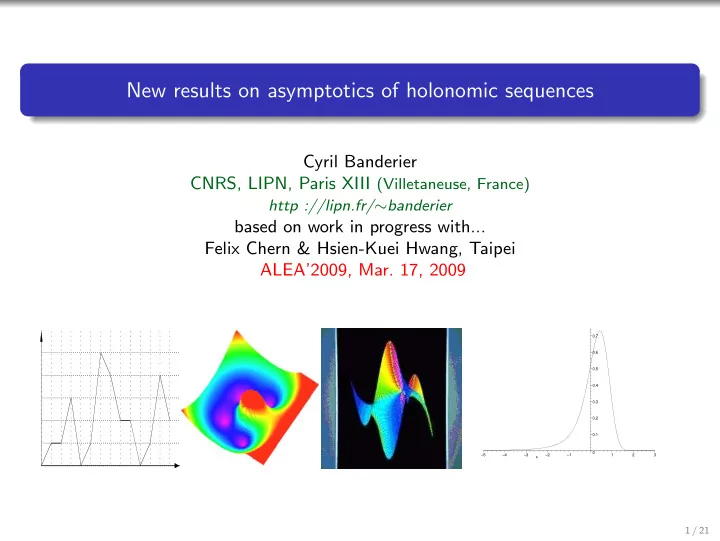
0.1 0.2 0.3 0.4 0.5 0.6 0.7 –5 –4 –3 –2 –1 1 2 3 x

1 / 21

slide-2
SLIDE 2

What is the link between ... ?

fast formulae for computing π,

1 π . . .

irrationality of ζ(3) Young tableaux of bounded height (generalized) hypergeometric functions Latin squares the triple product identity of Jacobi k-regular graphs cost of searching in quadtrees, m-ary search trees alternating sign matrices consecutive records in permutations non 3-crossing partitions (lot of ) random walks in the (quarter) plane automatic integration ”Calabi-Yau” parametrizations enumeration and asymptotics in statistical mechanics (polyominoes, etc) identities involving symmetric functions ...

2 / 21

slide-3
SLIDE 3

What is the link between ... ?

fast formulae for computing π,

1 π . . .

irrationality of ζ(3) [Ap´ ery, 1978] Young tableaux of bounded height (generalized) hypergeometric functions Latin squares the triple product identity of Jacobi k-regular graphs cost of searching in quadtrees, m-ary search trees [Hwang, Fuchs, Chern, 2006] alternating sign matrices. consecutive records in permutations non 3-crossing partitions (lot of ) random walks in the (quarter) plane automatic integration ”Calabi-Yau” parametrizations [Zudilin, Almkvist & al., 2008] enumeration and asymptotics in statistical mechanics (polyominoes, etc) [Guttmann & al., Di Francesco & al.] identities involving symmetric functions ALL OF THEM ARE HOLONOMIC OBJECTS !

3 / 21

slide-4
SLIDE 4

Holonomic = P-recursive sequences = D-finite functions

Sequence (an)n∈N is P-recursive := it satisfies a linear recurrence with polynomial coefficients in n. (2 + n)an+1 − (2 + 4n)an = 0 A(z) is D-finite (differentialy finite) := its derivatives span a vector space of finite dimension. ⇐ ⇒ A(z) satisfies an ODE (= ordinary differential equation) with coefficients polynomials in z. 1 + (2z − 1)A(z) + (4z2 − z)A′(z) = 0, A(z) =

  • n≥0

anzn These 2 notions are equivalent. > 25% of the sequences in the Sloane EIS are P-recursive. > 60% of the special functions in the Abramowitz-Stegun book are D-finite. The importance of D-finite functions was established in the 80’s by Stanley/Gessel/Lipshitz/Zeilberger (which also uses the word ”holonomic”).

4 / 21

slide-5
SLIDE 5

D-finiteness and holonomy

Holonomy is related to the growth rate of the coefficients of the Hilbert function, [Bernstein 1971] : A(z) =

n∈N anzn is holonomic iff an := dimC{xiδj zA(z), i + j = n} = O(nd).

(kind of minimal “noetherianity”... good, algorithms will terminate ! [Chyzak, 1998]) NB : Holonomy theory is in fact quite general (shift for sequences, differentiation, integration, mahlerian substitutions, for one or several variables), using Ore algebra and Groebner bases allows automatic proof of a lot of identities related to integrals or sums (as in the book “A = B”).

5 / 21

slide-6
SLIDE 6

D-finite functions have a lot of closure properties...

Rational or hypergeometric functions are trivially D-finite (recurrence for the coefficients !). Proposition [Comtet, 70’s] : Algebraic functions are D-finite. Proof : Differentiating P(z, F(z)) = 0 and using Bezout identity between P and P′ implies that F ′ belongs to C(z) ⊕ C(z)F ⊕ · · · ⊕ C(z)F d−1, then proceed by recurrence. Proposition [folklore/Gessel/Stanley/Lipshitz/Zeilberger..., 80’s] Closure by addition, product (and therefore nested sums m

j=1

n

k=1 fn,i . . .),

Hadamard product (anbn), diagonal (fn,n,n,n,n), (cf generalisation of Delannoy numbers) algebraic substitution, Laplace/Borel (inverse) transform (n!an, an/n!), shuffle (cf P´

  • lya drunkard),

manipulation of symmetric functions. ⇒ A very good class for computer algebra !

6 / 21

slide-7
SLIDE 7

Holonomy ⇒ automatic proof of combinatorial identities

  • Ex. 1 : irrationality of ζ(3) =

n≥1 1 n3 [Ap´

ery, 1978], Schmidt-Strehl identity :

n

  • k=0
  • n

k 2 n + k k 2 =

n

  • k=0
  • n

k

  • n + k

k

  • k
  • j=0
  • k

j 3

  • Ex. 2 : Mehler’s identity for Hermite polynomials :

as

  • n≥0

Hn(x)zn n! = exp(z(2x −z)) then

  • n≥0

Hn(x)Hn(y)zn n! = exp( 4z(xy−z(x2+y2))

1−4z2

) √ 1 − 4z2 Advertising for useful programs proving/guessing combinatorial identities : Combstruct and Gfun/Mgfun/Rate packages in Maple/Mathematica [Flajolet/Salvy/Zimmermann/Chyzak/Krattenthaler].

7 / 21

slide-8
SLIDE 8

Computational complexity of the coefficients

Rational functions : O(d3 ln(n)) [using binary exponentiation on the associated matrix] Algebraic functions : O(dn) [because they’re D-finite !] Special functions from physics : O(n) time for computing n coefficients of their Taylor expansions give the key for a fast plot of their graph !

8 / 21

slide-9
SLIDE 9

Why do a computer scientist care for asymptotics of an ?

It is crucial for average case analysis of algorithms ! This is the message of Knuth in The art of computer programming : algorithms = data structures = combinatorial structures recursivity = recurrence cost = asymptotics ⇒ good programs = good mathematical analysis of the hidden combinatorial structures. Not only you can then decide which algorithm will almost always be the faster (on my laptop, I prefer an = .5n ln n than an = 30n ln n) but you can then tune some algorithms in an optimal way ! Recent applications : uniform random generation of combinarial objects ! before until size 1000, now, thanks to analytic combinatorics : until size 106, Boltzmann method [Flajolet & al.]

9 / 21

slide-10
SLIDE 10

The unreasonable efficiency of complex analysis

Hecke : “Es ist eine Tatsache, daβ die genauere Kenntnis des Verhaltens einer analytischen Funktion in der N¨ ahe ihrer singul¨ aren Stellen eine Quelle von arithmetischen S¨ atzen ist.” Hadamard : “The shortest path between two assertions in the real world goes through the complex world.” Moral : insight on the singularities (landscape) of A(z) = insight on the coefficients an’s

10 / 21

slide-11
SLIDE 11

Asymptotics are related to the singularities

A singularity can be : a pole 1/z, a branching point ln(z), √z, essential singularity exp(1/z), a natural boundary point Πk≥1 1 1 − zk , ... R dominant singularity (=radius of convergence) of F(z) = fnzn = ⇒ Fn grows like 1/Rn. Power of complex analysis gives much more ! Singularity analysis [Flajolet-Odlyzko] If F(z) ∼ A(z), then with A(z) algebraic : (1 − z)α =

k≥1

α

k

  • (−z)k (kind of continuous version of Newton

binomial formula) fn ∼ C/Γ(−α)R−nn−1−α Alg-log functions : (1 − z)α lnβ

1 1−z :

fn ∼ n−α−1 ln(n)β Dominant singularities : one has to add the contribution of each of them. F(z) = 1/(1 − z2) = ⇒ fn = 1n + (−1)n

11 / 21

slide-12
SLIDE 12

Frobenius method

Classifications of singularities for differential equations Fuchs 1866, Fabry 1885. Poincar´ e expansions of P-recursive sequences Birkhoff and his student Trjitzinsky 1932 Trjitzinsky-Birkhoff method ”ressurected” by Wimp & Zeilberger 1985 fn ∼ n!r exp(nq)nα ln nh with r, q ∈ Q, α ∈ C, h ∈ N non rigourous matched asymptotics : plug and identify... Frobenius method Frobenius 1873, Wasow : If F is D-finite, then F(z) ∼ linear combination of exp(zr)zα ln(z)iA(zs) with r ∈ Q, i ∈ N, α, s ∈ C, A ∈ Q[[z]]. The GF approach has some advantages : fn = n

√ 17 is not holonomic but is the

asymptotic of some holonomic sequence (Quadtrees). ln(n), pn, π(n) are not holonomic [via GF]. [Flajolet/Gerhold/Salvy, 2005]. Bernoulli

  • numbers. Bell numbers exp(exp(x) − 1). Cayley tree function C(z) = z exp(C(z)).

irreducible polynomials on a finite field (=Lyndon words). (“en passant” : not context free).

12 / 21

slide-13
SLIDE 13

regular and irregular singularities of DE

regular singularity (=Fuchsian) : degree of the indicial equation equals the order of the ODE irregular singularity : degree of the indicial equation smaller than the order of the ODE ∂10

z + · · · + z10F(z) : regular

∂10

z + · · · + z11F(z) : irregular

roots differ by integer : ”resonance” implies ln(z) Famous open problem : Frobenius method gives a linear combination, but with which coefficients, i.e. it is unknown if we can get the value of K in an ∼ KAnnα ! ! ! One solution : numerical approximation ! Another solution : Banderier-Chern-Hwang

13 / 21

slide-14
SLIDE 14

Sequence accelaration schemes

A first trick (if no ”resonance”) gives the follow pattern for most of D-finite sequences : cn :=

f 2

n

nαf2n = K + K1/n + K2/n2 + . . . .

Aitken ∆2 method doubles the precision ! : bn := cn −

(cn+1−cn)2 cn+1−2cn+cn−1 = K + K1 2n + . . .

iterated Aitken : lg(n) iterations leads to O(1/n2). This often allows to go from 3-4 correct digits to ∼ 8 digits. For some specific sequences, it is possible to get more : Richardson (clever linear combinations), generalized Richardson, (when applied to integrals = Romberg, ...links with Simpson). This often allows to get ∼ 20 digits. It is possible to get more ? yes : the Acinonyx Jubatus algorithm.

14 / 21

slide-15
SLIDE 15

The cheetah algorithm

acinonyx jubatus, aka cheetah. Theorem (Cheetah accelaration formula) K =

n

  • i=1

(−1)d−i id i!(d − i)!a(i) + O(1/nn) This accelaration scheme needs to be adapted if ”resonance”. This acceleration scheme is impressive when other singularities are ”far away” (O(1/nn) vs. O(1/ρ′n)). This shemes is also working if K1, K2, . . . are large ! bn = K + K1/n + K2/n2 + . . . works fine for iterative floating point evaluation (Lambert function for getting right precision)

15 / 21

slide-16
SLIDE 16

An explicit formula for the constant

Theorem K is a period (in the sense of Kontsevich & Zagier). (integral representation). K has a sum representation : K = H(1) where H(z) is a D-finite function (over Q(α)). K = 1 P′

0(α)

  • j≥0

Bjr ∗(α + j) where Bj =

d

  • k=1

Pk(α + k) P0(α + k) Bj−k B0 = 1 key ideas : non homogeneous differential equations, change of variables + suitable type, ”inverting” the equation by integration, fn ∼ Knα−1/Γ(α) ⇔ f ∗(w) ∼ K/(w−α) ⇔ P0(w)f ∗(w) =

d

  • j=0

Pl(w+l)f ∗(w+l)+g ∗(w) Mellin integral : r ∗(s) = 1

0 (1 − x)s−1r(x)dx

Using A=B techniques often allows to evaluate this sum ! Since 1930, it was an open problem (thought to be undecidable) to get the constant K, and we can now prove formulae like K = 2/π, K = Γ(1/3), . . . for infinitely many cases ! And we have fast numerical schemes for the remaining cases !

16 / 21

slide-17
SLIDE 17

Walks on the honeycomb lattice

Theorem (Banderier 2008) hexagonal lattice : nice links with Calabi-Yau & number theory. xy-Manhattan lattice : on Z2 : EllipticK on N2 ; excursions = C 2

n = ”bishop moves on

N2” see also [Mishna & Bousquet-M´ elou 2008]. x-Manhattan lattice : on Z2 : Heun general function eN(4n) =

n

  • k=1

n

  • i=k
  • n − 1

i − 1

  • n

i − 1

  • i − 1

k − 1

  • i

k − 1

  • /(ik)

triangular lattice : eZ(2n) =

n

  • k=0
  • 2k

k

  • n

k 2 eN(2n) =

n

  • k=0
  • 2k

k

  • n

k

  • n + 1

k

  • /(k + 1)2

17 / 21

slide-18
SLIDE 18

Calabi-Yau equations and number theory

Calabi (1954) conjecture existence of a given Einstein-K¨ ahler metric on compact complex manifolds proven by Yau in 1978. Key step for superstring theory/mirror symmetries (perhaps confirmed by the LHC in the CERN). Huge activities for understanding those equations (kind of generalisation of elliptic curves).... [image]. Intriguing links with number theory : an= number of solutions in Z/nZ. An associated L-function leads to function whose inverse has some nice properties (rationality/D-finiteness...). In number theory, those functions first appeared in the work of Beukers (kind of generalisation of the work of Ap´ ery for irrationality of ζ(k)). Zagier, Zudilin and Almkvist (2008) give a large list of ”Calabi-Yau” equations ( ≈ D-finite equations).

18 / 21

slide-19
SLIDE 19

Few digits of Flajolet’s constant...

asymptotics for walks on hexagonal lattice... K=a constant which is not in the Plouffe invertor, and for which the Maple ”identify(x,all=true)” command finds nothing (LLL/Bailey and Ferguson’s PSLQ (Partial Sum of Least Squares) algorithm). K=1.32955319062990875968415374751767439529213577661488351801455178605811839 0198623412260695169439409364110631740615844724789164424098387720984338669 7498880650413104980702895723471826251071043678119741704206383060189858651 05503354396586243644607903280088302664637101353666792743998428953080760 48527974749038819240619236694384863843287228218307203144500972326041594 4117911307016350904025227449807186157980691036817380097177653579150873521 06234174484960448338736546728448100954759692974580712081666126294304734 995251002368260783121775874701969443747500756424053619829482170181906130 737803156649965810879278147434747755184684561983891466779222102946516831 13837028258503747445332236423034195944922226533542619501409547423552914 358927308618120122473794813410866463528056842814044415899130055907591021 14444637423575650869592828910304574627906218425736722151181354508324530 67627348469454491894639109969781433413545533190824588051168904855456143

  • 6958382232810160002907366818623076194013104839856789344252172963870. . .(and

10000 more digits !)

19 / 21

slide-20
SLIDE 20

Last moment results

[Zeilberger & al., EJC, 13 March 2009] (thx to Christian Krattenthaler !) : k-non-crossing tangled diagrams. k = 2 : 49/50

  • 35/π7nn−3/2, k = 3 : 16807

648 π21n/n5

[Nicolas Curien] : random fragmentation (triangulation) of polygons : D-finite ! distance between 2 nodes = Knα (with α =

√ 17−3 2

: link with Quad-trees ? ? ? ! ! !). (K : the branch is a mix of several singularity expansions of same modulus).

20 / 21

slide-21
SLIDE 21

Conclusion

I hope I convinced you that : D-finite functions are nice objects D-finite functions are ubiquitous in combinatorics it is now possible to access to the full asymptotics of their coefficients in many (new) cases ! (not only the hypergeometric cases !) Automatization : new Maple package in progress, (possible to mix it with the Van der Hoeven/Salvy/Mezzaroba package in development ), NB : there are bugs with the Zeilberger package.

21 / 21