NEW PASTURES Community Group day at Halcombe Rugby Clubrooms, August - - PDF document

new pastures
SMART_READER_LITE
LIVE PREVIEW

NEW PASTURES Community Group day at Halcombe Rugby Clubrooms, August - - PDF document

Summary of presentation given by Dr Tom Fraser to Manawatu Breeding and Finishing Monitor Farm NEW PASTURES Community Group day at Halcombe Rugby Clubrooms, August 3 rd 2011 Prepared by Ginny Dodunski, Totally Vets Ltd, Feilding. TOM FRASER


slide-1
SLIDE 1

NEW PASTURES

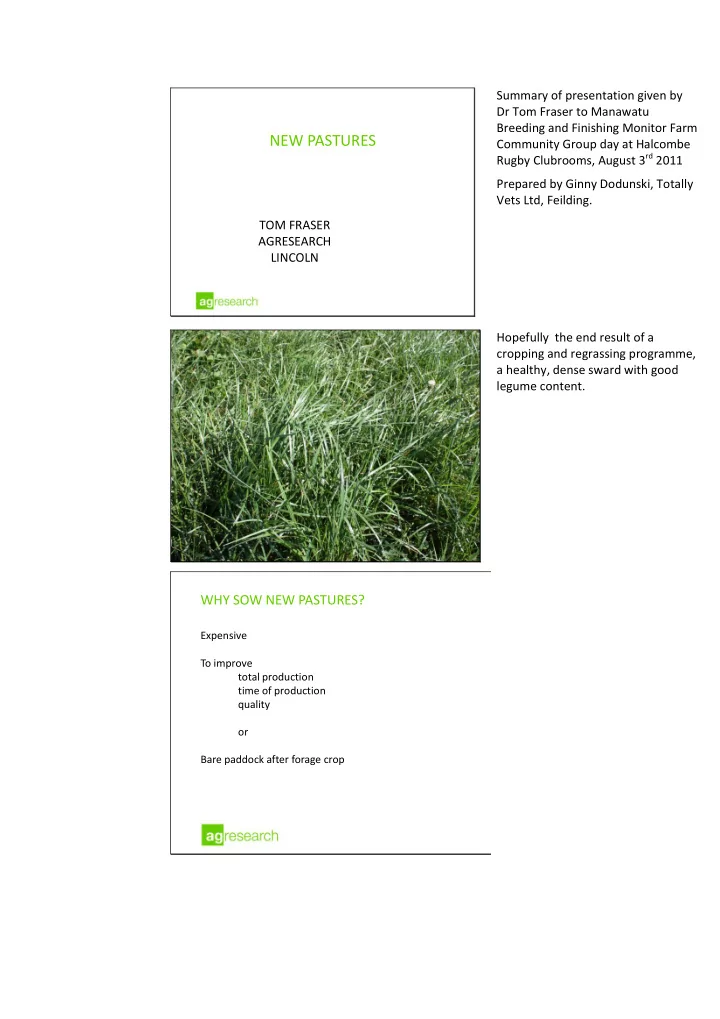
TOM FRASER AGRESEARCH LINCOLN Summary of presentation given by Dr Tom Fraser to Manawatu Breeding and Finishing Monitor Farm Community Group day at Halcombe Rugby Clubrooms, August 3rd 2011 Prepared by Ginny Dodunski, Totally Vets Ltd, Feilding. Hopefully the end result of a cropping and regrassing programme, a healthy, dense sward with good legume content.

WHY SOW NEW PASTURES?

Expensive To improve total production time of production quality

  • r

Bare paddock after forage crop

slide-2
SLIDE 2

TERMINOLOGY

Pasture renewal - any method of establishing new pasture Full cultivation – spray existing pasture, ploughing, discing, roller-tilling etc before sowing Spray & drill - kill existing pasture using herbicide then direct drill grass seed Undersowing – direct drill grass seed into existing pasture Oversowing – spreading seed on soil surface MAKING THE BEST OUT OF NEW PASTURES Must get good establishment poor establishment is the main reason for poor performance When established treat differently to old pastures cost $1200/ha plus don’t overgraze don’t graze during stress periods requires high fertiliser inputs Expect greater production

Work out costs for your own

  • peration: Wishnowsky’s = $770/Ha

BASICS FOR ESTABLISHMENT Planning should start a year before sowing new pasture contractor Why does pasture need renewing? soil fertility drainage weeds and pests poor animal performance Identify the reason and fix the problems

Book contractor early, monitor their work (get the seedbed you need not what they want to do under time constraint!)

slide-3
SLIDE 3

BASICS FOR ESTABLISHMENT

Seedbed preparation fine firm moist weed free Similar requirements for spray drill conditions

The reverse applies: If you don’t have all of these you won’t get good establishment.

SOWING DEPTH

Effect of sowing depth on ryegrass emergence

20 40 60 80 100 5 10 15 20 25 30 35 Time from sowing (Days) Percentage of sown seeds Broadcast 5mm 10mm 20mm 50mm

There is minimal difference in emergence at 2 weeks between broadcast and 20mm sowing depths, but 50mm is too deep.

SOWING DEPTH

Effect of sowing depth on white clover emergence 20 40 60 80 100 5 10 15 20 25 30 35 Time from sowing (Days) Percentage of sown seeds Broadcast 5mm 10mm 20mm 50mm

Clover seed is best sown at 5 – 10mm, and at 50mm none will germinate.

slide-4
SLIDE 4

CHOICE OF SPECIES/CULTIVARS

What is the objective for the pasture? persistence quality production Ryegrass may not be best option White clover may not be best option

CHOICE OF RYEGRASS SEED

  • Select endophyte
  • Flowering date
  • Diploid or Tetraploid?
  • Then cultivar
  • Certified seed

ASW

BB MB RootA Slug GG Por

Nil AR1 WT AR37

AR1 persistence: Partly resistant to black beetle which occurs north of Taupo Overgrazing of AR1: Easy to let happen as stock prefer it Do no sow in marginal areas where persistence is problem for all ryegrasses AR37 let us understand root aphid (observed bigger roots) Root aphid chronic pest especially in late autumn early winter--- waxy white in root zone mistaken for fungus

slide-5
SLIDE 5

NOVEL ENDOPHYTE MANAGEMENT

  • More palatable than wild endophyte
  • Animals preferentially graze Novel and Nil

Potential reseeding of wild

  • Lacks toxins in plant base to deter grazing animals
  • Novel endophyte requires:
  • Higher residuals
  • Protection from grazing when stressed

Don’t feed hay on nil or low endophyte paddocks unless it’s from same source

SOWING RATE FOR RYEGRASS

Industry guidelines 15-30 kg/ha some research suggests 6-12 kg/ha 18 kg/ha = 9 million ryegrass seeds/ha = 810 plants/m2 Stable ryegrass pasture: 250-350 plants/m2 Ryegrass sowing rates are too high for good legume establishment Tetraploids need a heavier rate than diploids

SEED CERTIFICATIOCERN

Quality seed represents the basic building block In a sowing mix of 20kg/ha ryegrass and 3 kg/ha white clover… 1% weed seed = 230 000 weed seeds/ha or 23/m2 P & G certificate supplies information on the purity and germination of the seed line

1% doesn’t sound much, BUT when calculated it equals 23 weeds per metre Squared!!!!! AND it is guaranteed (Murphy’s law) that the majority of these weeds WILL germinate and establish!

slide-6
SLIDE 6

SEED CERTIFICATION CERTIFICATE

IT’S ALSO FREE! Ask seed agent for a copy, they can get one very easily either electronically or faxed very quickly. Don’t buy seed without one – important to be fully informed when making expensive decisions such as these. The P and G cert has a heap of info on it. It includes traceability right down to the actual paddock in the case of a certified line. This particular line is a first generation certified line of seed. Very good purity. Inert matter are things like dirt, chaff, straw etc. 0.2% other seed: Fathen and Wireweed Also get a certificate for endophyte type and level which is very important.

MANAGEMENT – YEAR 1

Graze first when plants survive “pluck test” Graze regularly to encourage shoot growth - 10 cm to 3 cm residual Use nitrogen (20-25 kg/ha) to increase plant size before summer Silage etc in first spring reduces growth and persistence Avoid overgrazing Please fertilise it is meant to grow more

Take home line: Nitrogen is not just for dairy farmers! Sheep and beef farmers ARE allowed to use Nitrogen!

slide-7
SLIDE 7

WEED CONTROL Use herbicides to control weeds Apply herbicides when weeds are small Less competition, favours grass and clover seedling growth