NEW MEXICO DEPARTMENT OF CULTURAL AFFAIRS Presentatjon to the - - PDF document

new mexico department of cultural affairs
SMART_READER_LITE
LIVE PREVIEW

NEW MEXICO DEPARTMENT OF CULTURAL AFFAIRS Presentatjon to the - - PDF document

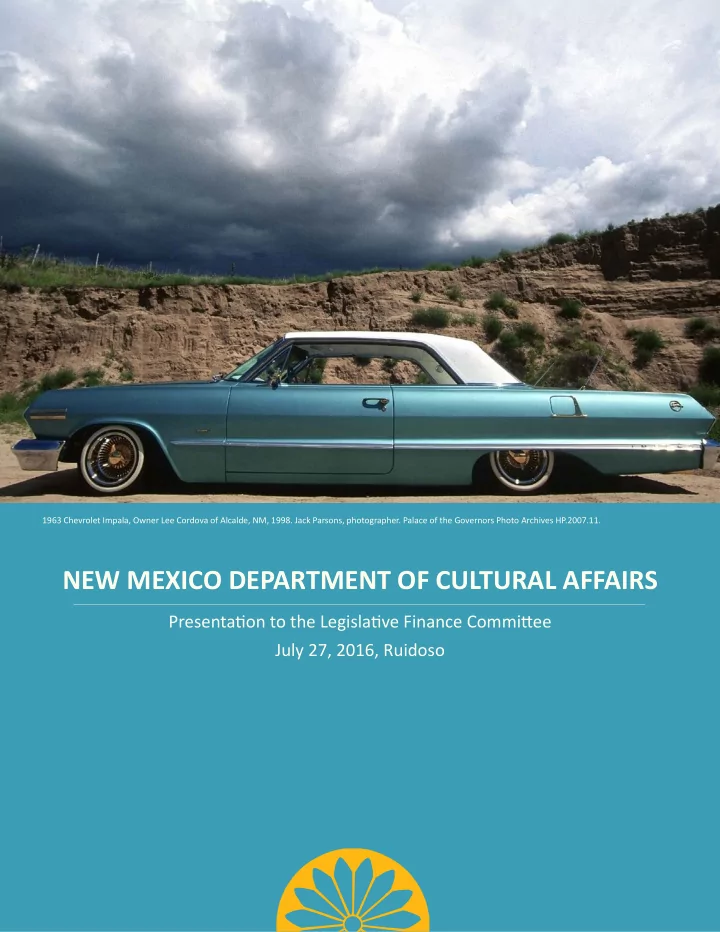
1963 Chevrolet Impala, Owner Lee Cordova of Alcalde, NM, 1998. Jack Parsons, photographer. Palace of the Governors Photo Archives HP.2007.11. NEW MEXICO DEPARTMENT OF CULTURAL AFFAIRS Presentatjon to the Legislatjve Finance Commituee July 27,


slide-1
SLIDE 1

NEW MEXICO DEPARTMENT OF CULTURAL AFFAIRS

1963 Chevrolet Impala, Owner Lee Cordova of Alcalde, NM, 1998. Jack Parsons, photographer. Palace of the Governors Photo Archives HP.2007.11.

Presentatjon to the Legislatjve Finance Commituee July 27, 2016, Ruidoso

slide-2
SLIDE 2

2

The interior courtyard of Santa Fe’s Palace of the Governors, the oldest public building in the country.

The Department of Cultural Afgairs is New Mexico’s cultural steward—charged with preserving and showcasing the state’s cultural riches.

With its eight museums, eight historic sites, arts, historic preservatjon, archaeology and library programs, New Mexico’s Department of Cultural Afgairs is among the most ambitjous and respected state cultural agencies in the natjon. Together, the facilitjes, programs and services

  • f the department see over 1.2 million visitors annually and help support a $5.6 billion cultural

industry in New Mexico. The Department is divided into fjve programs and consists of 15 divisions. DCA owns and cares for 190 buildings comprising 1.3 million square feet on 16 campuses totaling over 1,000 acres. Its facilitjes are located throughout the state with programs and services reaching every county in New Mexico. The Department’s annual budget is approximately $39.5 million, of which $29.4 million is General Fund.

FOUNDED IN 1909 AS THE MUSEUM OF NEW MEXICO, DCA’S ORIGINS PREDATE THE STATE OF NEW MEXICO ITSELF.

slide-3
SLIDE 3

3

MUSEUMS AND HISTORIC SITES PROGRAM In communitjes across New Mexico, the state’s eight museums and eight Historic Sites interpret, celebrate, and present the history, culture, and art of our state.

Museums

  • New Mexico Museum of Space History,

Alamogordo

  • New Mexico Museum of Natural History &

Science, Albuquerque

  • Natjonal Hispanic Cultural Center, Albuquerque
  • New Mexico Farm and Ranch Heritage

Museum, Las Cruces

  • New Mexico History Museum, Santa Fe
  • New Mexico Museum of Art, Santa Fe
  • Museum of Indian Arts & Culture, Santa Fe
  • Museum of Internatjonal Folk Art, Santa Fe

Historic Sites

  • Coronado Historic Site, Bernalillo
  • Fort Stanton Historic Site, Capitan
  • Bosque Redondo Memorial at Fort Sumner

Historic Site, Fort Sumner

  • Jemez Historic Site, Jemez Springs
  • Lincoln Historic Site, Lincoln
  • Taylor-Reynolds-Barela Historic Site, Mesilla
  • Fort Selden Historic Site, Radium Springs
  • El Camino Real Historic Trail Site, South of

Socorro

PRESERVATION PROGRAM

  • Historic Preservatjon Division

The Historic Preservatjon Division directs efgorts and administers programs to ensure New Mexico’s unique architectural heritage is preserved.

  • Archaeology Division

The Offjce of Archaeological Studies conducts archaeological research projects throughout New Mexico in advance of new constructjon on public lands.

LIBRARY SERVICES PROGRAM

  • New Mexico State Library

The New Mexico State Library serves all public and tribal libraries throughout the state by puttjng on workshops, distributjng equipment, and providing training and technical assistance.

ARTS SERVICES PROGRAM

  • New Mexico Arts

Provides fjnancial support and technical assistance for arts services and programs to non-profjt

  • rganizatjons statewide.

PROGRAM SUPPORT PROGRAM

  • Administratjve Services Division

Provides administratjve support in budgetjng, fjnance, and human resources to all divisions of the department.

  • Offjce of the Cabinet Secretary

Oversees and provides leadership to the department.

slide-4
SLIDE 4

4

IN ALBUQUERQUE The New Mexico Museum of Natural History & Science preserves and interprets the natural and scientjfjc

heritage of our state through extraordinary collectjons, research, exhibits, and programs designed to ignite a passion for lifelong learning.

The Natjonal Hispanic Cultural Center ofgers a

variety of programs and actjvitjes throughout the year in various artjstjc disciplines. Currently the Center conducts programs in the visual arts, performing arts, history & literary arts, media arts, and educatjon.

IN ALAMOGORDO The New Mexico Museum of Space History

explores the role that New Mexico has played in the development of the U.S. Space Program through collectjng, preserving, and interpretjng signifjcant artjfacts relevant to the history of space.

IN LAS CRUCES The New Mexico Farm and Ranch Heritage Museum brings to life the 3,000-year history of farming

and ranching in New Mexico with living history programs, exhibitjons, demonstratjons and 47 acres packed with real stories about real people.

Inset photos by Siggi Churchill @siggichurchill, Corey Taratuta @onthewhiteline

MUSEUMS

ON JULY 1ST, THE NEW MEXICO MUSEUM OF SPACE HISTORY OPENED THE NEW HORIZONS DOMED THEATRE AND PLANETARIUM, WHICH FEATURES THE WORLD’S FIRST 4K LASER PLANETARIUM SYSTEM. UTILIZING FUNDING FROM THE STATE OF NEW MEXICO, CITY OF ALAMOGORDO, INTERNATIONAL SPACE HALL OF FAME FOUNDATION, AND PRIVATE DONATIONS, THE $550,000 PROJECTION SYSTEM WAS INSTALLED DURING THE MONTH OF JUNE.
slide-5
SLIDE 5

5

MUSEUMS

IN SANTA FE The New Mexico Museum of Art is a leading art

museum of the Southwest. Built in 1917, the structure itself is a work of art, considered a masterpiece of Pueblo Revival architecture and the best representatjon of the synthesis of Natjve American and Spanish Colonial design styles.

The New Mexico History Museum/Palace of the Governors tells the story of the state through

programs and exhibitjons. The Palace of the Governors is the natjon’s oldest contjnuously occupied public building and the state’s oldest museum. The museum campus includes the Fray Angélico Chávez History Library and Photo Archives, the Palace Print Shop & Bindery, and the Natjve American Artjsans Program.

The Museum of Indian Arts and Culture

chronicles the art and history of the state’s Natjve peoples. The museum’s collectjons include 80,000 archaeological, ethnographic, and fjne arts objects, and more than 10 million artjfacts from almost 12,000 carefully excavated archaeological sites across New Mexico.

The Museum of Internatjonal Folk Art opened to

the public in 1953 and has gained natjonal and internatjonal recognitjon as home to the world’s largest collectjon of folk

  • art. The extraordinary collectjon of some 150,000 artjfacts

from more than 150 natjons. Changing exhibitjons feature ingallery art-making actjvitjes for all ages to enjoy together, as well as the Tree of Life Children’s Play Area, with toys, books, and a neighboring library of folk art books for parents and care givers.

Photo by Šarūnas Burdulis @sarunas_b

THE MUSEUM OF ART WILL CELEBRATE THE 100TH ANNIVERSARY OF ITS OPENING IN 2017.

slide-6
SLIDE 6

6

HISTORIC SITES

Fort Selden Historic Site preserves the remains of Fort Selden,

which was built in the Mesilla Valley in 1865 to protect setulers and travelers from escalatjng hostjlitjes as setulers encroached on Apache homelands.

Lincoln Historic Site preserves 1880s-era New Mexico, ofgering

visitors a true taste of the Old West, when the Lincoln County War and a host of characters, including Billy the Kid, launched this town into the history books.

Jemez Historic Site combines the San José de los Jémez Mission,

built in 1621, with exhibitjons and interpretatjon that present the history and culture of the Jemez Pueblo People in their own words.

Taylor-Barela-Reynolds-Mesilla Historic Site, one

  • f several historic buildings facing the famous plaza in Mesilla,

preserves the history of 19th century New Mexico.

EIGHT HISTORIC SITES LOCATED IN COMMUNITIES ACROSS THE STATE CHRONICLE THE UNIQUE HISTORY OF NEW MEXICO.

slide-7
SLIDE 7

7

The Bosque Redondo Memorial at Fort Sumner Historic Site transports

visitors into the heart of history and tragedy. With exhibitjons and public programs, it commemorates the “Long Walk” of the Navajo and Apache people.

El Camino Real Historic Trail Site presents the history of exchange between Mexico,

Europe, and America, interpretjng the long and arduous journey over the “Royal Road,” which shaped the history of New Mexico and the Southwest over 300 years.

Coronado Historic Site is named afuer the Spanish explorer Francisco Vásquez de

Coronado, who, with his soldiers, camped near the Tiwa village of Kuaua in 1540.

Fort Stanton, established in 1855, may be one of the most intact 19th-century military

forts in the country.

slide-8
SLIDE 8

8

STEWARDSHIP

DCA has both a statutory and fjduciary responsibility to protect New Mexico’s investment in its cultural assets, which are conservatjvely valued at just under one billion dollars.

Our collectjons contain one-of-a-kind objects – artjfacts, documents, photographs, and works of art – that together form a cohesive record of the people of the state, their interests, aspiratjons, and expression. DCA facilitjes include some of the most recognized and iconic places in the state.

slide-9
SLIDE 9

9

DCA’s responsibilitjes extend beyond places, objects, and landscapes, and reach into the heart of what makes our state unique – our people.

Educatjon programs coordinated by each of our museums and historic sites complement and enhance the efgorts of formal educatjonal instjtutjons, providing students with tangible, hands-

  • n experiences and bringing history to life.

DCA serves over 1 million children through programming each year.

EDUCATION

slide-10
SLIDE 10

10

COMMUNITY SUPPORT

The Department of Cultural Afgairs leverages state investment to increase its impact by working with a variety of public and private

  • rganizatjons, instjtutjons, and consortja.

Over the past year, more than 1,300 volunteers across New Mexico contributed more than 115,000 hours of their tjme on Department of Cultural Afgairs’ programs and projects, an estjmated value of $2.3 million. DCA’s volunteer contributjon is equivalent to 56 full tjme employees. In FY 15, DCA’s foundatjon partners contributed $4.5 million in support of special exhibitjons and educatjonal programs.

Photo by Denise Womack-Avila @santafesweets

slide-11
SLIDE 11

11

ECONOMIC IMPACT

A statewide study commissioned by DCA and conducted by UNM’s Bureau of Business and Economic Research (BBER) was released, which found that the cultural industry in New Mexico has a $5.6 billion impact to the state’s economy.

The study found that cultural tourists spend 36% more than average tourists and travel longer, with a higher percentage using hotels, motels or B&Bs, contributjng more to lodgers tax than other tourists.

ONE QUARTER OF TOURISM IN NEW MEXICO IS A RESULT OF CULTURAL AND HERITAGE ACTIVITIES.

The 2016 Internatjonal Folk Art Market drew approximately 20,000 visitors during a single weekend, and directly collected and contributed more than $200,000 to the state of New Mexico in gross receipts taxes. Estjmated tax revenues from visitors spending and lodging total over $1 million, and overall economic impact to the State of New Mexico was over $10 million.

Photo by Denise Womack-Avila @santafesweets

slide-12
SLIDE 12

12

CAPITAL OUTLAY

DCA manages over 190 buildings comprising 1.3 million square feet, located on 16 campuses and totaling over 1,000 acres. Over 100 DCA facilitjes are historic structures, with statutorily required specialized preservatjon needs.

DCA’s operatjng budget has minimal funding for on-going and preventatjve maintenance or lifecycle repairs. Because most DCA facilitjes are open to the public seven days a week, they are subject to signifjcant wear and tear. Unforeseen facility closures have a negatjve impact on public access and DCA’s operatjng budget, which relies on revenue earned from admissions and facility rentals. DCA capital outlay expenditures were $4.3 million in FY 16. Fort Stanton was transferred to DCA in 2007 with no operatjng budget. It encompasses 240 acres, surrounded by 1,300 acres of undeveloped BLM land, with 88 buildings on the site. Most are registered historic buildings, some datjng back to 1855.

RISK MANAGEMENT HAS VALUED DCA’S FACILITIES AND CONTENTS AT JUST UNDER 1 BILLION DOLLARS.

slide-13
SLIDE 13

13

FY 18 CAPITAL REQUEST

DCA’s preliminary FY 18 request prioritjzes capital outlay needs across the department in 5 areas.

Capital prioritjes address public health and safety, security of collectjons, and preservatjon of facilitjes. This includes specialized temperature and humidity controls, robust security systems, fjre suppression systems, and ADA compliance. Additjonal prioritjes include structural and site stabilizatjon, as well as exhibit and facility upgrades. For FY 18, DCA is requestjng:

  • 1. Life, Health & Safety

$ 2.4M

  • 2. Collectjons Risk Abatement

$ 4.7M

  • 3. Lifecycle Repairs and Upgrades

$ 7.7M

  • 4. Exhibits and Facilitjes Renovatjon

$ 2.4M

  • 5. Equipment

$ 1.0M TOTAL REQUEST $ 18.2M

slide-14
SLIDE 14

14

STAFFING ISSUES

The department currently has 97.5 vacant positjons (a 19% vacancy rate) and key vacancies in the museums and historic sites program must be fjlled.

DIVISION VACANT POSITIONS VACANCY RATE Museums 45 302.8 15% Historic Sites 15 37 41% Library 12.5 48 26% Historic Preservatjon/Arch 12 57 21.1% Arts 2 14.5 13.8% Program Support 11 52 21.2% 97.5 512.2 19.0%

slide-15
SLIDE 15

15

BUDGET

DCA’s FY 17 total general fund operatjng budget of $29.4 million is $5.8 million, or 19.7% lower than FY 09—the year the New Mexico History Museum opened. Due to a lack of General Fund, non-recurring fund balance has been used since FY 11 to subsidize

  • peratjons and will be depleted in FY 17.

Solvency will be diffjcult to achieve in FY 17 due to a reductjon of general fund support for DCA of $1.2 million and reductjon in budgeted fund balance of $892 thousand.

28,000 28,500 29,000 29,500 30,000 30,500 31,000 31,500 32,000 32,500 FY15 FY16 FY17 Final

General Fund and Fund Balance Budgeted (000's)

Fund Balance General Fund

slide-16
SLIDE 16

16

FY 17 OPERATING BUDGET

  • Total DCA operatjng budget of $39.5 million is $2.9 million lower than FY 16, or 7 percent.
  • In FY 17, the department projects a personnel costs and benefjt defjcit of up to $2.1 million.
  • $619.0 fund balance projected at the start of FY 17. Of this amount:

Š $250.0 is budgeted for personnel cost and benefjts Š $196.1 is restricted for the union pay setulement Š $173.0 projected remaining fund balance

slide-17
SLIDE 17

17

COST SAVING MEASURES

NEAR-TERM ACTIONS taken to address shortgalls Increasing Revenues

  • DCA has increased admission rates and reduced the number of free Sundays. It is

antjcipated that revenue will increase by $442 thousand in FY 17 due to these changes. Cost Reductjons

  • A limited reductjon-in-force was approved by the State Personnel Board on July 21,
  • 2016. A reductjon of 11 positjons is part of a department reorganizatjon to streamline
  • peratjons and help the department by saving $627.0
  • DCA has frozen approximately $756.0 in the contracts and other costs category to be

available to address the projected personnel costs and benefjts shortgall.

  • This fall, operatjng hours and days of operatjon will be reduced at some museums and

historic sites.

  • Additjonal reductjons will be diffjcult, because DCA has a high percentage of facility

fjxed costs such as utjlitjes, telecommunicatjons, insurance, security, and credit card processing fees. LONG-TERM STRATEGIES if state general fund remains fmat and or is reduced, the department will be at a point of failure:

  • DCA will be forced to close and reduce the operatjons of facilitjes.
  • Additjonal stafg reductjons will be necessary.
  • Dramatjc reductjons in educatjon, programming and outreach to the public and schools

will be necessary.

slide-18
SLIDE 18

18

DCA LEADERSHIP

DCA LEADERSHIP

MUSEUMS AND HISTORIC SITES PROGRAM

  • Museum of Indian Arts & Culture

Della Warrior, Director

  • Museum of Internatjonal Folk Art

Charlene Cerney, Actjng Director

  • Natjonal Hispanic Cultural Center

Rebecca Avitja, Director

  • New Mexico Farm and Ranch Heritage Museum

Mark Santjago, Director

  • New Mexico History Museum

Andrew Wulf, Director

  • New Mexico Museum of Art

Mary Kershaw, Director

  • New Mexico Museum of Natural History & Science

Margie Marino, Director

  • New Mexico Museum of Space History

Chris Orwoll, Director

  • New Mexico Historic Sites
  • Dr. Jefg Pappas, Actjng Director
  • Los Luceros Historic Property

Rudy Acosta, Manager

  • Museum Resources Division

Will Ticknor, Director PRESERVATION PROGRAM

  • Historic Preservatjon Division
  • Dr. Jefg Pappas, Director
  • Offjce of Archaeological Studies
  • Dr. Eric Blinman, Director

LIBRARY SERVICES PROGRAM

  • New Mexico State Library

Kathleen Peifger, New Mexico State Librarian ARTS SERVICES PROGRAM

  • New Mexico Arts

Loie Fecteau, Director PROGRAM SUPPORT

  • Administratjve Services Division

Greg Geisler, Director, CFO

  • Informatjon Technology

Satya Neel, CIO

  • Offjce of the Cabinet Secretary

Veronica Gonzales, Cabinet Secretary Michael Delello, Deputy Cabinet Secretary