New Dynamic Interaction Game based Learning Tool for Chinese - - PowerPoint PPT Presentation

new dynamic interaction game based learning tool for
SMART_READER_LITE
LIVE PREVIEW

New Dynamic Interaction Game based Learning Tool for Chinese - - PowerPoint PPT Presentation

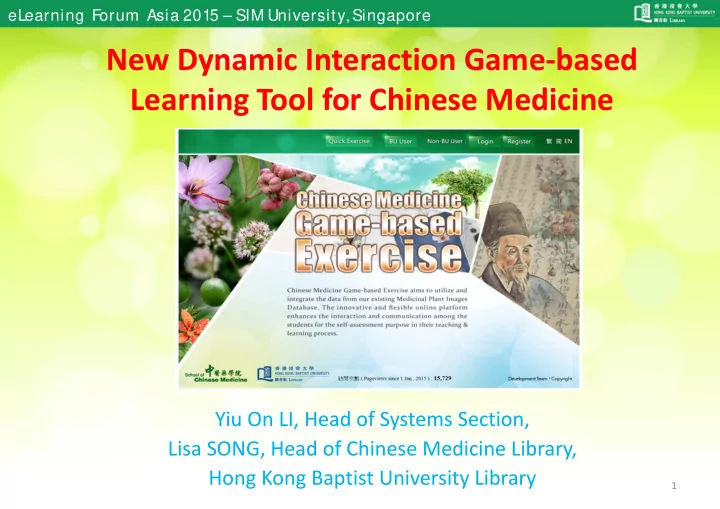
eLearning Forum Asia 2015 SIM University, Singapore New Dynamic Interaction Game based Learning Tool for Chinese Medicine Yiu On LI, Head of Systems Section, Lisa SONG, Head of Chinese Medicine Library, Hong Kong Baptist University Library


slide-1
SLIDE 1

eLearning Forum Asia 2015 – SIM University, Singapore

New Dynamic Interaction Game‐based Learning Tool for Chinese Medicine

Yiu On LI, Head of Systems Section, Lisa SONG, Head of Chinese Medicine Library, Hong Kong Baptist University Library

1

slide-2
SLIDE 2

HKBU Chinese Medicine Game-based E xercise

Outline

  • I. Introduction
  • II. Development and Achievements of HKBU CM

Digitization Projects

  • III. Strength and Weakness of using Static Databases

for Teaching and Learning

  • IV. Special Features of CM Game‐based Exercise
  • V. Conclusions

2

slide-3
SLIDE 3

Summary

  • The idea of game‐based learning is very common

in most teaching community nowadays, yet the use of games to facilitate learning and teaching is still a new attempt in an historic discipline like Chinese Medicine (CM).

  • This presentation will share our experience on

the design and implementation of the new online Chinese Medicine Game‐based Exercise by the School of Chinese Medicine, and Library, Hong Kong Baptist University.

3

slide-4
SLIDE 4
  • I. Introduction

4

slide-5
SLIDE 5
  • I. Introduction
  • 1. What is Chinese Medicine (CM)
  • Chinese Medicine (CM) is a health care and

medical practices developed in China.

  • CM have a history of over 2,200 years and has

been recognized as one of the world’s oldest medical systems.

  • In recent years, different disciplines have

conducted studies and research to analyze and explain CM practices and knowledge through modern scientific theories.

5

slide-6
SLIDE 6
  • I. Introduction
  • 2. Hong Kong Baptist University (HKBU)
  • a. Established in 1956
  • b. Offers undergraduate, taught postgraduate

and research postgraduate programmes leading to Masters or Ph.D. degrees c. HKBU is in the top 100 universities in Asia, according to the new published university ranking reports:

 Times Higher Education Asia University Rankings 2015: 45th  QS University Rankings Asia 2015: 51th

6

slide-7
SLIDE 7
  • I. Introduction
  • 3. School of Chinese Medicine (SCM), HKBU
  • a. Established in 1999
  • is the first government funded institution

that providing undergraduate, master and doctoral degree programs in CM and pharmacy in Hong Kong.

Question: Any ranking reports for SCM? Answer: No, I can only show Facts and Figures of SCM

7

slide-8
SLIDE 8
  • I. Introduction
  • 3b. SCM – Facts and Figures
  • Students

8

slide-9
SLIDE 9
  • I. Introduction
  • 3b. SCM – Facts and Figures
  • Teaching and Research Faculty

9

slide-10
SLIDE 10
  • I. Introduction
  • 3b. SCM – Facts and Figures
  • Chinese Medicine Library

10

slide-11
SLIDE 11
  • I. Introduction
  • 3c. SCM – Mission and Vision
  • In addition to providing CM quality higher

education teaching programmes, one of SCM mission is “striving to promote the modernization and internationalization of Chinese medicine in teaching, research, clinical service and technology”

http://scm.hkbu.edu.hk/en/about_us/dean_s_message/index.html

– Modernization and internationalization are the basis of our CM Digitization Projects

11

slide-12
SLIDE 12
  • II. Development and Achievements
  • f

HKBU CM Digitization Projects

12

slide-13
SLIDE 13
  • II. SCM Digitization Projects
  • 1. SCM Digitization Project – Mission
  • In viewing of the limited numbers of open

access and Chinese‐English bilingual CM databases on the web, SCM has collaborated with the Library to implement the Chinese Medicine Digital Project since 2006.

13

slide-14
SLIDE 14
  • II. SCM Digitization Projects
  • 1. SCM Digitization Project – Mission
  • The aims of developing these CM databases and

digitization projects are:

i. to enhance teaching, learning, and research activities in SCM; ii. to provide convenient e‐learning tools for CM learners, practitioners, and researchers around the world to purse self‐study and life‐long education; iii. to advocate the free open access to digitized CM research information; iv. to advance the popularization and internationalization of CM study and research through new computer technology.

14

slide-15
SLIDE 15
  • II. SCM Digitization Projects
  • 2. CM Databases
  • Since 2006, SCM and Library has

collaborated to design and implement 4 image databases

http://library.hkbu.edu.hk/electronic/libdbs/cml_dbs.html

15

slide-16
SLIDE 16
  • II. SCM Digitization Projects
  • 2a. CM Specimen Database

HKBU Chinese Medicine Specimen Center

  • “the only specialized and

professional exhibition center showing a treasure

  • f precious and rare

Chinese medicine in Hong Kong”

16

slide-17
SLIDE 17
  • II. SCM Digitization Projects
  • 2b. Medicinal Plant Images Database (MPID)

Contains 1159 medicinal plants and provides

  • With high‐quality plant

photos taken by Prof Chen HuBiao of SCM

  • Identify the plant family

genus, use and effect of special plants for the treatment of particular diseases

17

slide-18
SLIDE 18
  • I. Introduction

In Chinese 水母雪蓮花

18

slide-19
SLIDE 19
  • II. SCM Digitization Projects
  • 2c. Chinese Medicinal Material Images Database

Contains 420 crude drugs commonly used in CM practice, and provides

  • High‐quality annotated

photos to illustrate and identify key properties and microstructures of the drugs

  • detail drug information,

including source, origins, descriptions, quality, taste, and clinical indications

19

slide-20
SLIDE 20
  • II. SCM Digitization Projects
  • 2d. Phytochemical Image Database

Contains 200 bioactive phytochemicals, and provides

  • information, methods of

sample preparation and quality analysis

  • UV / IR / MS / NMR

spectra images

Phytochemical = chemical compound found in plants which have health benefits in humans

20

slide-21
SLIDE 21

21

slide-22
SLIDE 22
  • II. SCM Digitization Projects
  • 3. SCM Digitization Projects ‐‐ Achievements
  • I believe that we have done a good

promotion work on the modernization and internationalization of Chinese medicine in teaching, research, clinical service and technology

Question: Any evidence? Answer: Yes, we hope the following three indicators can serve as proof

22

slide-23
SLIDE 23
  • II. SCM Digitization Projects
  • 3a. High Usage from all around the World
  • MPID Website Traffic Statistics since 1 Jan 2012

(log by Google Analytics, http://lib‐linux2.hkbu.edu.hk/ga/MPID_index.php)

 2,221,622 pageview (i.e. 1,766 pageview per day)

  • This usage is the highest among all in‐house

databases developed by HKBU Library

  • More importantly, the users are not restricted to

HKBU students, nor limited in Hong Kong, indeed the majority are coming from over 200 countries/regions all around the world

23

slide-24
SLIDE 24
  • II. SCM Digitization Projects
  • 3a. High Usage from all around the World
  • Top 10 country/region

24

slide-25
SLIDE 25
  • II. SCM Digitization Projects
  • 3b. ALA Presidential Citations for Innovative

International Library Projects Award

  • We are very pleased to receive this internationally

renowned award from the American Library Association in 2012

 ALA is a non‐profit organization based in the United States that promotes library services, library education and librarianship internationally  is the oldest and largest library association in the world  Founded in 1876, with more than 62,000 members

25

slide-26
SLIDE 26
  • II. SCM Digitization Projects

The ALA press release states:

“While the (Chinese Medicine) databases were designed to improve teaching methods and effective use of these plants and herbs, making this information available for free via the Internet has historic and limitless benefits for medical providers and researchers across the globe”

26

slide-27
SLIDE 27
  • II. SCM Digitization Projects
  • 3c. HKBU Non‐teaching Staff Team Award
  • This Award is presented under the Reward and

Recognition Scheme for Non‐teaching Staff for the first time in 2013

  • is recognizing the endeavors of non‐teaching

colleagues who have made significant contributions in support of achieving the University’s strategic goals

27

slide-28
SLIDE 28
  • II. SCM Digitization Projects

“The Panel believes that in the Chinese Medicine Digital Project, the team fostered strong collaboration between academic and non‐teaching staff. Making the best use of existing resources, the team made an impact on the teaching, learning and research of Chinese Medicine both within the University and throughout the world”

‐‐ HKBU eNews, 27 May 2013

28

slide-29
SLIDE 29
  • III. Strength and Weakness of

using Static Databases for Teaching and Learning

29

slide-30
SLIDE 30
  • III. Strength and Weakness
  • 1. Good Work ≠ Perfect Work
  • The Awards mentioned here are only used to prove

that we have done a good promotion work in the past years on the modernization and internationalization of Chinese medicine in teaching, research, clinical service and technology

  • We believe educators will generally agree that good

work are never equal to perfect work

  • Our challenge is: how to enhance our work to

become more perfect

 Provide better and newer services  Endless Work

30

slide-31
SLIDE 31
  • III. Strength and Weakness
  • 2. Enhancement Strategies
  • For enhancement, inadequacy identification is more

important than concentrating on the past strength 1. Review and Reflect 2. Identify Inadequacy / Weakness

31

slide-32
SLIDE 32
  • III. Strength and Weakness
  • 3. Weakness of SCM Digitization Project

Traditional static databases lack of

  • i. Personalization
  • user personal linking are not provided

 personal linking is vital to increase students' sense of ownership in the education process

  • ii. User Interaction
  • databases can only provide one‐directional service, user

preference are not allowed

32

slide-33
SLIDE 33
  • III. Strength and Weakness
  • 3. Weakness of SCM Digitization Project

Traditional static databases lack of

  • iii. Self‐assessment / Self‐evaluation
  • databases are closed systems, learning initiative and

motivation are neglected

  • iv. Learning from Errors
  • users are limited to the passive viewing of content, dynamic

user input are prohibited  unable to help users to check and detect their mistakes

33

slide-34
SLIDE 34
  • III. Strength and Weakness
  • 3. Weakness of SCM Digitization Project

Traditional static databases lack of

  • v. Peer Group Review and Experience Sharing
  • multi‐user interaction and participation as well as social

networking needs are not entertained

  • vi. Classroom Evaluation and Measurement
  • databases fail to provide an immediate and easy tool to

measure and discover students’ knowledge level

 vital factor for teachers to adjust teaching methods and strategies

34

slide-35
SLIDE 35
  • III. Strength and Weakness
  • 3. Weakness of SCM Digitization Project

Traditional static databases lack of

  • vii. Making Learning with Fun
  • Education should not be boring, rather be challenging and

full of fun

35

slide-36
SLIDE 36
  • III. Strength and Weakness
  • 4. Transformation
  • Known weakness/problmes are broken down into small

sub‐problems

  • Suggest effective methods to resolve sub‐problems

individually

  • Finally, we come to our new product:

1. Review and Reflect 2. Identify Inadequacy / Weakness 3. Divide and Conquer Algorithm

36

slide-37
SLIDE 37

37

  • http://lib‐nt2.hkbu.edu.hk/cmgame/user.asp?realtime_lang=eng
slide-38
SLIDE 38
  • IV. Special Features
  • f

CM Game‐based Exercise

38

slide-39
SLIDE 39
  • IV. Special Features
  • 1. Computer–generated Questions
  • All the questions of the CM Game‐based Exercise are

taken from Medicinal Plant Images Database

  • A computer program is designed to convert the database

fields into different types of questions automatically

  • A total of 17,364 questions are generated
  • These questions cover all important aspects of medicinal

plants, e.g. how to identify the plant’s Latin name, English name, Family & Genus, use and effect of special plants for the treatment of particular diseases

39

slide-40
SLIDE 40
  • IV. Special Features
  • 1. Computer–generated Questions
  • Examples of questions on plant photos

 Given a plant photo, to identify the plant name  Given the plant name, to identify the plant photo

40

slide-41
SLIDE 41
  • IV. Special Features

41

slide-42
SLIDE 42
  • IV. Special Features

42

slide-43
SLIDE 43
  • IV. Special Features
  • 2. Self‐motivated Learners
  • Based on their preference, study needs and learning
  • bjectives, users are flexible to select different question

types and levels for testing their understanding and revisions.

43

slide-44
SLIDE 44
  • IV. Special Features
  • 3. Automatic Marking and Reporting
  • All the answered questions will be marked automatically
  • Direct links to MPID will be provided to verify the answer

and facilitate further information checking

44

slide-45
SLIDE 45
  • IV. Special Features

45

slide-46
SLIDE 46
  • IV. Special Features
  • 4. Personal Account
  • Users are free to register, and create their own personal

accounts  increase ownerships and sense of belonging

46

slide-47
SLIDE 47
  • IV. Special Features
  • 5. Personal Exercise Grade Result Analysis

Report

  • Exercise Grade Report are saved on Personal Account for

user

 to monitor progress  to compare his attempted grade on a specific topic with other users

47

slide-48
SLIDE 48
  • IV. Special Features

48

slide-49
SLIDE 49
  • IV. Special Features
  • 6. Game Replay
  • If a user does not satisfy with the Grade of an Exercise, he

can retake it

49

slide-50
SLIDE 50
  • IV. Special Features
  • 7. Public Exercises
  • Experience sharing and peer group discussions are always

the effective ways to

 get motivated to study  enhance learning performance

  • Users are free to share their Personal Exercises with

classmates and friends as a challenge / for comparison

 “Can you get a 100 mark on this Paper?”  “Why did I fail?”  if he find his classmates get a lower mark, he will

50

slide-51
SLIDE 51
  • IV. Special Features

51

slide-52
SLIDE 52
  • IV. Special Features
  • 8. Instant Classroom e‐Measurement
  • In a classroom, lecturer can easily create a Public Exercise

as a quick quiz to

 test student understanding of the concepts  monitor study level

  • Provide vital factor for teachers to adjust teaching

methods and strategies

52

slide-53
SLIDE 53
  • IV. Special Features
  • 9. Learning (Playing) without Walls / Mobile

Waves

  • A site designed with the new Responsive Web Design
  • Allow easy browsing and navigation with a minimum of

resizing, panning, and scrolling

 across a wide range of devices (from desktop computer monitors, tablets, to mobile phones)

  • E‐learners can play the Game from anywhere at anytime
  • Lecture can set a Game for students from anywhere at

anytime

 No Boundaries, No Restrictions

53

slide-54
SLIDE 54
  • IV. Special Features

54

slide-55
SLIDE 55
  • V. Conclusions

55

slide-56
SLIDE 56
  • V. Conclusions
  • 1. New Solutions to Old Problems
  • New features of CM Game‐based Exercise can help to
  • vercome the weakness of Traditional Static Databases

that existing in the CM Digitization Project

56

slide-57
SLIDE 57
  • V. Conclusions

57

slide-58
SLIDE 58
  • V. Conclusions
  • 2. Usage Statistic
  • The CM Game‐based Exercise is open to public on Jan

2015

  • Total Usage is increasing steadily
  • One interesting phenomenon is that it attracts more

players from U.S. than Hong Kong since 1 Apr 2015

 Americans like playing games than Chinese ?

58

slide-59
SLIDE 59
  • V. Conclusions

59

slide-60
SLIDE 60
  • V. Conclusions

60

slide-61
SLIDE 61

Thank You ! Q & A

61