New Cataly*c Routes to Access Polymer Materials from CO 2 Dr - - PowerPoint PPT Presentation

new cataly c routes to access
SMART_READER_LITE
LIVE PREVIEW

New Cataly*c Routes to Access Polymer Materials from CO 2 Dr - - PowerPoint PPT Presentation

New Cataly*c Routes to Access Polymer Materials from CO 2 Dr Jennifer A. Garden Chris*na Miller Research Fellow 22 nd of February 2017 1 Polyme mers from m CO 2 2 Polycarbonate material applica*ons: Binders Packaging Coa,ngs 2 Polyme


slide-1
SLIDE 1

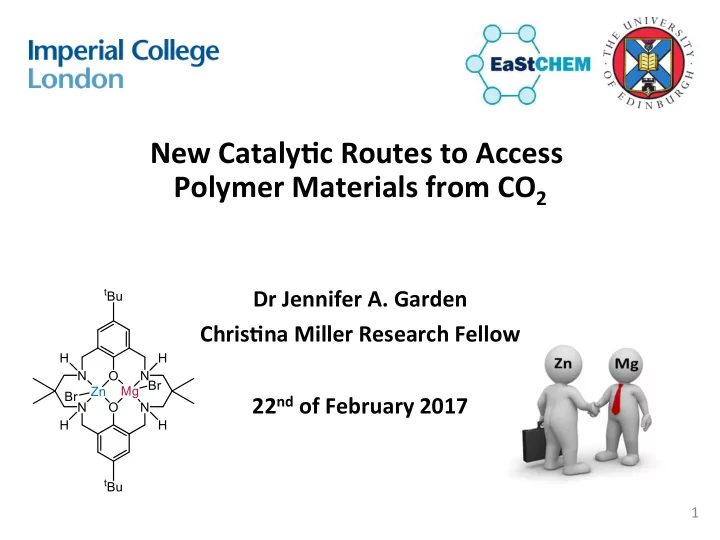
New Cataly*c Routes to Access Polymer Materials from CO2

Dr Jennifer A. Garden Chris*na Miller Research Fellow 22nd of February 2017

1
slide-2
SLIDE 2

Polycarbonate material applica*ons: Packaging Coa,ngs

Polyme mers from m CO2

2

Binders

2

slide-3
SLIDE 3

Polyurethane material applica*ons: Appliances Automo,ve Construc,on Furniture

Polyme mers from m CO2

2

Footwear

3

slide-4
SLIDE 4

Williams et al, ACS Catal., 2015, 5, 1581; von der Assen, Bardow, Green Chem., 2014, 16, 3272

Polyme mers from m CO2

2

Conversion of waste CO2 20% CO2 = 11 – 19% greenhouse gas reduc,on Life cycle analysis - energy reduc*on

4

slide-5
SLIDE 5

Catalyst Developme ment

  • D. J. Darensbourg, Acc. Chem.

Res., 2004, 37, 836–844; Chem. Rev., 2007, 107, 2388

salens β-diiminates

  • G. W. Coates, Angew. Chem. Int.

Ed., 2002, 41, 2599; Rieger,

  • Chem. Commun., 2014, 51, 4579
  • C. K. Williams, J. Am. Chem.

Soc., 2012, 134, 15676;

  • Chem. Sci., 2012, 3, 1245;

PCT Int. Appl., 2013, WO 2013034750

macrocycles

5

slide-6
SLIDE 6

Catalyst Developme ment

6

  • Ac,ve at 1 bar CO2 pressure
  • No co-catalyst needed
  • Robust (air, unpurified CHO)
  • Alterna,ng copolymer (˃99 % carbonate linkages)
  • Good copolymer selec,vity (˂5 % cyclic carbonate)
  • Low Mn PCHC

ANrac*ve Catalysts:

  • C. K. Williams et al., JACS, 2012

2012, 134, 15676; Angew. Chem. Int. Ed., 2009, 48 48, 931; Macromolecules, 2010 2010, 43, 2291; Chem. Commun., 2011 2011, 47, 212; WO 2013034750; WO 2009130470

macrocycles

slide-7
SLIDE 7

rate = kp [CHO][catalyst][CO2]0

  • C. K. Williams, Macromolecules, 2010, 43, 2291; J. Am. Chem. Soc., 2011, 133, 17395

Target

Mec MechanisKc hanisKc Under Understanding anding

7

slide-8
SLIDE 8
  • J. A. Garden, P. K. Saini, C. K. Williams, J. Am. Chem. Soc., 2015, 137, 15078;
  • J. A. Garden, C. K. Williams et al., patent applica,on number 1308978.4

Ca Catalyst S Syn ynthes esis

Synthe*c challenge:

  • Symmetrical ligand
  • Labile metals of similar proper,es
  • Successfully synthesised heterodinuclear catalyst
  • Homodinuclear analogues prepared

8

slide-9
SLIDE 9

Ca Catalyst An Analysis

  • J. A. Garden, P. K. Saini, C. K. Williams, J. Am. Chem. Soc., 2015, 137, 15078;
  • J. A. Garden, C. K. Williams et al., patent applica,on number 1308978.4

9

slide-10
SLIDE 10

Ca Catalyst An Analysis

  • J. A. Garden, P. K. Saini, C. K. Williams, J. Am. Chem. Soc., 2015, 137, 15078;
  • J. A. Garden, C. K. Williams et al., patent applica,on number 1308978.4

10

slide-11
SLIDE 11

Heterodinuclear catalyst:

  • 5 x faster than 1:1 ratio of homodinuclear
  • 2 x faster than homodinuclear Mg catalyst
  • Zn analogue - completely inactive

CO CO2/CHO Copolyme merisaKons

X = TON

11

slide-12
SLIDE 12

12

Reac,on condi,ons: 10 h, 80 oC, cat. loading 0.1 mol% vs CHO, 1 bar

Catalyst TON TOF (h-1) CO2 (%) Mn [Ð] MgZn 344 34 >99 3100 [1.14] 1:1 Mg2:Zn2 72 7 >99 < 500 Mg2 151 15 >99 840 [1.13] Zn2

  • CO

CO2/CHO Copolyme merisaKons

12

slide-13
SLIDE 13

*Reac,on condi,ons: 5 h, 120 oC, cat. loading 0.01 mol% vs CHO, 50 bar

13

Catalyst TON TOF (h-1) CO2 (%) Mn [Ð] MgZn* 3118 624 >99 18090 [1.05], 7270 [1.10] 1:1 Mg2:Zn2 72 7 >99 < 500 Mg2 151 15 >99 840 [1.13] Zn2

  • TOF = 1300 h-1

Darensbourg et al.,

  • Inorg. Chem.,

2007, 46, 5474 TOF = 21 h-1 Sugimoto, Kuroda, Macromolecules, 2008, 41, 312 TOF = 107 h-1 Williams et al.,

  • Chem. Commun.,

2011, 47, 212

CO CO2/CHO Copolyme merisaKons

TOF = 210 h-1 Nozaki et al., Macromolecules, 2009, 42, 6972

13

slide-14
SLIDE 14

14

40 x reac*vity enhancement

1:1 ra,o of Mg2:Zn2

PA/CHO Copolyme merisaKons

14 +

slide-15
SLIDE 15

Titanium m systems ms

Titanium – akrac,ve metal for catalysis

  • Abundant
  • Inexpensive
  • Non-toxic

High ac,vity catalysts for olefin polymerisa,on Recently applied to CO2/epoxide copolymerisa,on

15

  • K. Nozaki, J. Am. Chem. Soc.,

2011, 133, 10720

  • T. J. Marks, J. Am. Chem. Soc., 2013, 135, 8830;
  • J. Am. Chem. Soc., 2014, 136, 10460
slide-16
SLIDE 16

Heterome metallic Titanium m Catalysts

16

  • Ac,ve at 1 bar CO2 pressure
  • No co-catalyst required
  • α-propoxide, ω-hydroxide end-capped polymers

10 20 30 40 50 60 Ti Zn TiZn Conversion (%) homometallic analogues are inac*ve

  • J. A. Garden, A. J. P. White, C. K. Williams, Dalton Trans., 2017, DOI: 10.1039/C6DT04193K
slide-17
SLIDE 17

Con Concl clusion

  • ns

17

  • Development of new heterobimetallic catalysts
  • High ac,vity and selec,vity
  • Successful within CO2/epoxide copolymerisa,on
  • Outperform homometallic analogues
slide-18
SLIDE 18

Thank you for listening!

Acknowledgeme ments

18

Collaborators Academics and Colleagues

  • Prof. Charloke Williams
  • Dr Andrew J. P. White
  • Dr Charles Romain
  • Dr Prabhjot Saini
  • All Williams group members

Funding