New-age thermobarometry techniques The association of indicator - - PDF document

new age thermobarometry techniques
SMART_READER_LITE
LIVE PREVIEW

New-age thermobarometry techniques The association of indicator - - PDF document

Lecture IV: Application of modern indicator techniques to data from Greenland and Ontario Herman Grtter UBC Lectures - Mantle Indicators in modern use 30 October 2013 New-age thermobarometry techniques The association of indicator


slide-1
SLIDE 1

1

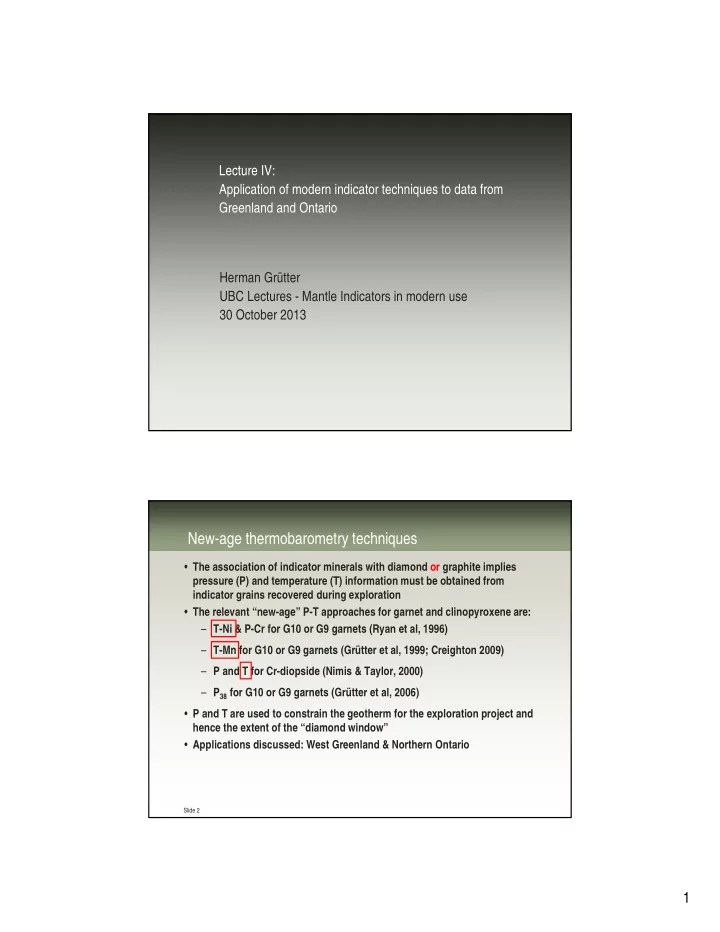
Lecture IV: Application of modern indicator techniques to data from Greenland and Ontario Herman Grütter UBC Lectures - Mantle Indicators in modern use 30 October 2013

Slide 2

New-age thermobarometry techniques

  • The association of indicator minerals with diamond or graphite implies

pressure (P) and temperature (T) information must be obtained from indicator grains recovered during exploration

  • The relevant “new-age” P-T approaches for garnet and clinopyroxene are:

– T-Ni & P-Cr for G10 or G9 garnets (Ryan et al, 1996) – T-Mn for G10 or G9 garnets (Grütter et al, 1999; Creighton 2009) – P and T for Cr-diopside (Nimis & Taylor, 2000) – P38 for G10 or G9 garnets (Grütter et al, 2006)

  • P and T are used to constrain the geotherm for the exploration project and

hence the extent of the “diamond window”

  • Applications discussed: West Greenland & Northern Ontario
slide-2
SLIDE 2

2

Slide 3 20 30 40 50 60 70 600 800 1000 1200 1400

Temp (° C) P (kbar)

GIBEON N LESOTHO KIMBERLEY MINES

P NT00 & T NT00

35 40 45 50

Pyroxene thermobarometry: Kaapvaal (Grp 1’s)

20 30 40 50 60 70 600 800 1000 1200 1400

Temp (° C) P (kbar) P NG85 & T NT00

35 40 45 50

GIBEON N LESOTHO KIMBERLEY MINES

Xenolith P-T: Opx + Cpx + Gt Cpx single-grain P-T

  • Kaapvaal Grp1 kimberlites show little variation from “classic” 40 mW/m2 geotherm
  • Cpx single-grain P-T results similar to xenoliths, but with larger scatter

Grütter (2009) Lithos 112S 1167–1178

Slide 4

Xenolith P-T: Opx + Cpx + Gt Cpx single-grain P-T

  • Canadian geotherms are separated: cold, normal and hot (37, 40 and 43 mW/m2)
  • Separated P-T arrays also obtained using Cpx, with slightly larger scatter

20 30 40 50 60 70 600 800 1000 1200 1400

Temp (° C) P (kbar) P NG85 & T NT00

35 40 45 50

20 30 40 50 60 70 600 800 1000 1200 1400

Temp (° C) P (kbar)

SOMERSET ISLAND KIRKLAND LAKE N & C SLAVE

P NT00 & T NT00

35 40 45 50

Pyroxene thermobarometry: Canada

P NT00 & T NT00 P NG85 & T NT00

SOMERSET ISLAND KIRKLAND LAKE SLAVE LdG & N SOMERSET ISLAND KIRKLAND LAKE SLAVE LdG & N

Grütter (2009) Lithos 112S 1167–1178

slide-3
SLIDE 3

3

Slide 5 24 32 40 48 56 64 600 800 1000 1200 1400

Temp (° C) P (kbar)

SOMERSET ISLAND KIRKLAND LAKE C & N SLAVE GREENLAND

CPX: P NT00 & T NT00

Cpx geotherm – Safartoq (Kangerlussuaq), West Greenland

Data from Jensen et al (2004) GEUS Report 2004/117

Cpx from till samples

  • Safartoq geotherm is cold (~ 36 mW/m2)
  • Inside diamond field at T > 850 to 900°

C

  • Whole mantle section sampled by kimberlite sources

Grütter & Tuer (2009) Lithos 112S 124–129

Slide 6

2 4 6 8 10 12 14 16 2 4 6 8 10 12 CaO (wt%) Cr2O3 (wt%) TILL G10 G9

24 32 40 48 56 64 600 800 1000 1200 1400

Temp (° C) P (kbar)

SOMERSET ISLAND KIRKLAND LAKE C & N SLAVE GREENLAND

CPX: P NT00 & T NT00

Merging cpx P-T with garnet compositions

Data from Jensen et al (2004) GEUS Report 2004/117

CPX: P-T space No compositional information

0 3.38 6 CA_INT

GAR: Compositional space (Cr-Ca) No P-T information

Grütter & Tuer (2009) Lithos 112S 124–129

slide-4
SLIDE 4

4

Slide 7

500 600 700 800 900 1000 1100 1200 1300 1400 1 2 3 4 5 6 CA_INT (wt%) GAR T-Mn G10 G9

Apply T-Mn to Cr-pyrope garnet to obtain mantle section

T-Mn from Grutter et al (1999) 7IKC Proc V2: 307

GAR T-X section n = 5921

500 600 700 800 900 1000 1100 1200 1300 1400 1 2 3 4 5 6 CA_INT (wt%) GAR T-Mn G10 G9

19% 29% 9% 22% 4% 15% <1% 2% 32% 68% SHALLOW DSF T<900° C GSF DEEP DSF

Slide 9

Safartoq mantle tenor; ≥ 4 garnets / sample

60 km

Many GSF grains (yellow) Variable deep mantle tenor Source-specific ♦ potential in six distinct areas Isolated samples of interest

slide-5
SLIDE 5

5

Slide 10

Safartoq mantle tenor; ≤ 3 garnets / sample

60 km

Many GSF grains (yellow) Low-count and high-count anomalies correspond Subtle low-count anomalies

Slide 11

Garnet Lake focus area

Garnet Lake Itisooq

Deep mantle tenor has best ♦ potential No mixing in elevated areas of felsenmeer Mixing into valleys

slide-6
SLIDE 6

6

Slide 12

Prevalence of P38 ≥ 51, G10D and G10 garnets in till samples

2 4 6 8 10 12 14 16 2 4 6 8 10 12 CaO (wt%) Cr2O3 (wt%) TILL G10 G9

60 km

1568 samples 5921 garnets 32% are G10 n=1906 11% are G10D n=627 0.6% have P38 ≥ ≥ ≥ ≥ 51

Slide 13

Summary: Sarfartoq

  • Cpx and garnet well preserved in cold climate
  • New-age P-T techniques easily applied to high quality probe data
  • ~ 6000 garnets in ~ 1500 samples sufficient to pinpoint diamond

potential across property (1st phase follow-up data set)

  • T-Mn applied to G10 and G9 garnets provides statistical leverage
  • Very high % G10 garnets. Most are graphite-facies on a cold

geotherm (T < 900° C) => substantial shallow mantle sampling

  • Diamond potential related to deep mantle sampling of G10D grains
  • Microdiamond results reflect highly variable diamond potential

Grütter & Tuer (2009) Constraints on deep mantle tenor of Sarfartoq-area kimberlites (Greenland), based on modern thermobarometry of mantle-derived xenocrysts. Lithos 112S: 124–129

slide-7
SLIDE 7

7

Slide 14

Northern Ontario kimberlites

1076 1123 Kyle Lake 175-180 156 Attawapiskat U-Pb age (Ma) Rb-Sr age (Ma) Kimberlite Province

100 km

Slide 15

2 4 6 8 10 12 14 16 2 4 6 8 10 12 CaO (wt%) Cr2O3 (wt%) Attawapiskat G10 G9

Which do you prefer ?

Data from Sage (2000) OGS Open File Report 6019

Attawapiskat province n = 3664

2 4 6 8 10 12 14 16 2 4 6 8 10 12 CaO (wt%) Cr2O3 (wt%) Kyle Lake G10 G9

Kyle Lake 1 n = 250

slide-8
SLIDE 8

8

Slide 16

Data from Sage (2000) OGS Open File Report 6019 24 32 40 48 56 64 600 800 1000 1200 1400

Temp (° C) P (kbar)

SOMERSET ISLAND KIRKLAND LAKE C & N SLAVE ATTAWAPISKAT

CPX: P NT00 & T NT00

Cpx P-T: Attawapiskat, Ontario

Cpx from Victor, Charlie, Gulf & X-Ray Geotherm is “normal” and enters DSF at T ~ 1000° C, like Kaapvaal craton

Slide 17

500 600 700 800 900 1000 1100 1200 1300 1400 1 2 3 4 5 6 CA_INT (wt%) GAR T-Mn G10 G9 2 4 6 8 10 12 14 16 2 4 6 8 10 12 CaO (wt%) Cr2O3 (wt%) Attawapiskat G10 G9

Attawapiskat garnet Cr-Ca & T-Mn

Data from Sage (2000) OGS Open File Report 6019

Normal geotherm, but very limited diamond-facies mantle sampling profile Diamond potential decoupled from G10 grains ? - check low-Cr garnets

slide-9
SLIDE 9

9

Slide 18

2 4 6 8 10 12 14 16 2 4 6 8 10 12 CaO (wt%) Cr2O3 (wt%) Attawapiskat G10 G9 0.4 0.8 1.2 1.6 0.05 0.1 0.15 0.2 0.25 GT Na2O (wt%) GT TiO2 (wt%) Attawapiskat

Attawapiskat low-Cr garnets

Data from Sage (2000) OGS Open File Report 6019

Diamond potential related to low-Cr eclogitic / websteritic grains

  • see AT-56 interpretation (Armstrong et al. 8IKC Proc., 2004)

Slide 19

Attawapiskat summary

  • Jurassic kimberlites cutting carbonate host rocks
  • “Normal” cratonic geotherm
  • “Normal” diamond window (1000 - 1250°

C)

  • Low % G10 garnets and most are graphite-facies
  • Significant content of G3 (ECL) & G4 (WEB) garnets, with high Na2O

content – probable source of high-quality, coarse diamonds

Background image courtesy of De Beers Canada (with permission)

Victor rough diamonds

slide-10
SLIDE 10

10

Slide 20

24 32 40 48 56 64 600 800 1000 1200 1400

Temp (° C) P (kbar)

SOMERSET ISLAND KIRKLAND LAKE C & N SLAVE KYLE LAKE

CPX: P NT00 & T NT00

Cpx P-T: Kyle Lake, Ontario

Data from Sage (2000) OGS Open File Report 6019

Cpx from core samples Elevated geotherm enters DSF at T ~ 1220° C What is the impact of an elevated geotherm ?

Slide 21

Kyle Lake garnet Cr-Ca & T-Mn

2 4 6 8 10 12 14 16 2 4 6 8 10 12 CaO (wt%) Cr2O3 (wt%) Kyle Lake G10 G9 500 600 700 800 900 1000 1100 1200 1300 1400 1 2 3 4 5 6 CA_INT (wt%) GAR T-Mn G10 G9

Deep mantle sampling profile for G10 and G9 grains Elevated geotherm restricts diamond window Deep eclogite could make a big difference – no low-Cr garnet data

Data from Sage (2000) OGS Open File Report 6019

slide-11
SLIDE 11

11

Slide 22

Summary: Kyle Lake

  • Mid-Proterozoic kimberlites underlying Ordovician carbonates
  • Very high % G10 garnets; all would fall inside diamond window
  • n a normal geotherm
  • Cpx data show an elevated geotherm and define a restricted,

high-T diamond window (1220 - 1350° C)

  • Content of low-Cr G3, G4 & G5 garnets unknown
  • Microdiamonds are present
  • Macrodiamond content being tested (Metalex Ventures / KWG)

Slide 23

Conclusions

New-age clinopyroxene and garnet thermobarometry techniques

  • Permit prioritization of indicator source(s) prior to discovery.

Integrate the data streams to simplify the message

  • Bring into sharp focus the mantle sampling profile and thus the

likely presence / absence of diamond

  • Help to constrain G10-related diamond potential. Hence

highlights the relative importance of low-Cr (eclogitic and possibly websteritic) sources for diamond

slide-12
SLIDE 12

12

Questions ?