NETWORKING EVENTS Once the webinar begins, the sound will come from - - PowerPoint PPT Presentation

networking events
SMART_READER_LITE
LIVE PREVIEW

NETWORKING EVENTS Once the webinar begins, the sound will come from - - PowerPoint PPT Presentation

The SIG Webinar will begin shortly. NETWORKING EVENTS Once the webinar begins, the sound will come from your computer GLOBAL SUMMIT speakers. Mar 13-16 - Amelia Island, FL SYMPOSIUM In the meantime, please take a look at Jan 18 - San


slide-1
SLIDE 1

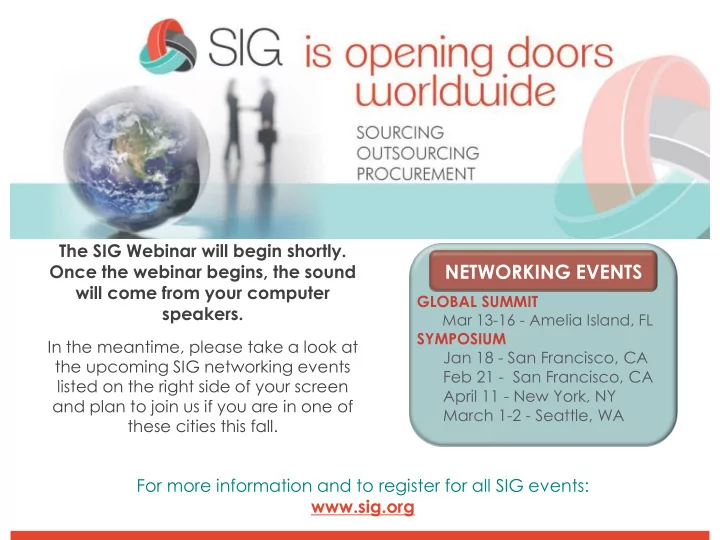
The SIG Webinar will begin shortly. Once the webinar begins, the sound will come from your computer speakers.

In the meantime, please take a look at the upcoming SIG networking events listed on the right side of your screen and plan to join us if you are in one of these cities this fall.

For more information and to register for all SIG events: www.sig.org

NETWORKING EVENTS

GLOBAL SUMMIT Mar 13-16 - Amelia Island, FL SYMPOSIUM Jan 18 - San Francisco, CA Feb 21 - San Francisco, CA April 11 - New York, NY March 1-2 - Seattle, WA

slide-2
SLIDE 2

Networking and sharing thought leadership are part of SIG membership

Global Summits – attend two large events with 50+ breakouts, 5-8 keynotes and unlimited networking opportunities Global events in North America, EMEA, APAC – attend SIGnature events, GBS Roadmap series, Challenge awards Weekly Webinars and Monthly Town Hall Teleconferences – access virtual thought leadership Peer2Peer Resource – ask top-of-mind questions for instant responses SIG Resource Center – access 5,000+ presentations, research,

whitepapers, tools, templates and more

Career Network – post and find jobs or internships Student Talent Outreach – meet students interested in a career in supply chain, sourcing or services

bit.ly/SIGLinkedIn @SIGinsights bit.ly/SIGfacebook bit.ly/SIGYouTube

Stay connected with

  • ther SIG members

through various social media channels

bit.ly/SIGBlog

slide-3
SLIDE 3

SIG Global Summits are semi-annual events with 350-400 decision-makers in attendance

Global Summits

  • 3 ½ days of networking in a non-

commercial environment

  • 5 keynote sessions
  • Global brands
  • Executive Roundtables
  • Over 50 breakout sessions
  • Hundreds of industry thought leaders with a

buy-side ratio of 70:30

Amelia Island, FL March 13-16, 2017

67% of delegates are director level or above, of which 43% are VP/C-level

Recent speakers include:

slide-4
SLIDE 4

We are bringing SIG to you…all over the globe

GLOBAL EVENTS

Symposiums

Feb 1 – London, England GBS ROADMAP SERIES Mar 2 – Zurich, Switzerland CHALLENGE THE FUTURE AWARDS PROGRAM Feb 2-3 – London, England

slide-5
SLIDE 5

For more information go to: www.siguniversity.org

  • Online learning environment with multiple eLearning
  • ptions: Cohort, Self-Paced and Custom Solutions
  • Modules with lessons, formative assessments, and NO

final exam

  • Certification good for 5 years
  • Early enrollment options that can save you up to 25%
  • Certified Sourcing Executive program coming in 2017
  • Updated governance, risk and compliance program

coming in 2017

Certified Sourcing Professional starting January 30th, 2017!

slide-6
SLIDE 6

SIG Webinar: Contracting for Agile Software Development

Derek Schaffner

+1 202 263 3732

dschaffner@mayerbrown.com

Dan Masur

+1 202 263 3226

dmasur@mayerbrown.com

December 6, 2016

slide-7
SLIDE 7

7

Presenters

Dan Masur is the partner-in-charge of Mayer Brown's Washington, D.C. office and is recognized as one of the leading lawyers in the outsourcing field by Chambers Global, Chambers USA and Legal 500. Chambers has described Dan as “phenomenal” and the "expert of experts," noting clients say he "has incredible knowledge of outsourcing, inspires confidence in others and has great business intelligence.” He has represented national and international clients in a broad range of on-shore, near-shore, and offshore information technology and business process sourcing transactions involving global and niche sourcing providers, offshore captives and various hybrid structures.

Dan Masur

Partner Mayer Brown +1 202 263 3226 dmasur@mayerbrown.com

Derek Schaffner

Counsel Mayer Brown +1 202 263 3732 dschaffner@mayerbrown.com

Derek Schaffner is counsel in Mayer Brown's Washington DC office and a member of the Business & Technology Sourcing practice. He represents clients in a wide variety of information technology and business process outsourcing transactions and other information technology licensing and development

  • transactions. Chambers noted that the support Derek provides clients on the

most critical deals “earns him the respect of clients, who give him ten out of ten."

slide-8
SLIDE 8

8

  • More than 50 lawyers around the world focused
  • n helping clients improve their business
  • perations by sourcing services

and technology

  • Advised on more than 300 significant outsourcing

transactions valued at an aggregate of more than $100 billion

Recognized Market Leader

“Band 1” ranking

in IT/Outsourcing for 13 consecutive years (Chambers 2004-2016)

Named “MTT Outsourcing Team of the Year”

in 2014 and ranked in the top tier from 2010 through 2016

Ranked as one of the top law firms in 2009

through 2016 on The World’s Best Outsourcing Advisors list for The Global Outsourcing 100™

About Mayer Brown’s Business & Technology Sourcing Practice

“They're very practical in terms of trying to identify solutions and giving very good advice on areas where it's reasonable for us to compromise or, alternatively, where to hold our ground.” ~ Chambers USA 2015 “An excellent team of people for

  • utsourcing agreements globally -

pragmatic in their approach, with a wealth

  • f experts they can call on.”

~ Chambers Global 2014 “They are very good at being able to communicate and synthesize information in a useful and easily understandable way.” ~ Chambers USA 2016 “Their knowledge in this area is

  • tremendous. They know us so well they

blend into our deal teams and become a natural extension to our in-house team.” ~ Chambers USA 2014
slide-9
SLIDE 9

9

Agenda

  • Overview of Agile Software Development

– What is it? – Waterfall explained – Agile Software Development process

  • Top 7 Challenges of contracting for Agile Software Development

– Pricing – Termination Rights – Assurances the “thing” will be built – IP Rights – Warranties – Client obligations – Documentation

  • Final Thoughts
slide-10
SLIDE 10

10

Overview: What is Agile Software Development?

  • A way to create software based on closer collaboration between

developers and business stakeholders.

  • Emphasizes frequent delivery of business value by small, self-organizing,

cross-functional teams.

  • Does not rely on detailed specifications created at the outset.
  • Instead, the teams work from a concept of the “thing” to be built and

refine as the work progresses.

  • Agile is a umbrella term for a set of methods and practices based on The

Agile Manifesto.

– But there are many frameworks to develop software using an agile approach, such as Scrum, Lean, and Extreme Programming (XP).

  • Does it produce better results?
slide-11
SLIDE 11

11

Term Meaning Scrum The most widely-used Agile framework. Product Owner The single person on a Scrum team who is responsible for project ROI, has the high-level vision of the product to be built, and has final call on requirements. Scrum Master The facilitator on a Scrum development team who removes roadblocks, but has no management authority and does not perform project management functions. Scrum Development Team A self-organizing, self-managed cross-functional team responsible for delivering commitments from the Product Backlog. User Stories Describe what the end product and its components should accomplish at the end of development. A product will usually have multiple user stories. Product Backlog A list of features or technical tasks which the team maintains and which, at a given moment, are known to be necessary and sufficient to complete a project

  • r a release. The Product Backlog can be updated as features and functionality

are added or removed. Sprint (aka Iteration) A time box of usually 2-4 weeks when the Scrum Dev Team develops items from the Product Backlog.

Overview: Key Terms

slide-12
SLIDE 12

12

Polling Question

  • Which statement best describes your organization’s experience with agile

software development?

a) None, but we are considering it b) Some, but no great impetus to push c) Some, and looking to do more d) The majority of our projects use agile

slide-13
SLIDE 13

13

The Waterfall Approach

Requirements/ Planning Design Coding Implementation Testing

slide-14
SLIDE 14

14

Criticisms of the Waterfall Approach

  • Not appropriate if project requirements are uncertain or fluid.
  • Does not promote (and perhaps discourages) creativity during the process.
  • Business owner has little interaction with development team after initial

specifications are created.

  • Problems may not be discovered for a long time (e.g., in testing).
  • Client does not receive value until the end of the process.
  • Difficulty of specifying all requirements upfront, combined with a rigid

change management process and frequent change order and price adjustments leads to disappointment.

slide-15
SLIDE 15

15

Overview of Agile Software Development

Requirements/ Planning Design Coding Implementation Testing Waterfall

Requirements/ Planning

Design Coding

Implementation

Testing Iteration #2

Requirements/ Planning

Design Coding

Implementation

Testing Iteration #1

Requirements/ Planning

Design Coding

Implementation

Testing Iteration #3 Agile: 2-4 weeks Agile: 2-4 weeks Agile: 2-4 weeks

slide-16
SLIDE 16

16

Why Do Developers Like Agile?

  • The software development process is more fluid, requiring greater

interaction between business and technical teams as the project moves through the development life cycle.

  • Agile enables software to be developed in continuous cycles based on short

iterations, which developers find more efficient and creative (i.e., more quick wins, fewer long slogs).

  • Focus is placed on producing working code (fun) and not on documentation

and testing (dull).

  • The need to test the entire system is minimized since testing (and

acceptance) occurs at each iteration.

  • More client participation throughout the process.
slide-17
SLIDE 17

17

Making the Shift to Agile

  • How do you deal with the client concern that the contractual clarity and

upfront planning /milestones under waterfall are absent under agile?

– Not truly a leap of faith – Each party’s interests are more aligned; at a well-run scrum meeting, you cannot tell which sides the members are from

  • Clients need to have some people trained in an agile methodology

– But don’t need to know how to program; agile brings developers and business teams closer together via iterations/sprints

  • Does agile scale for large, mission-critical projects?

– Yes (e.g., SITA) – Some enterprises are moving away from an annual IT project funding process to a quarterly process thereby matching the speed at which software is developed and the agile iterative approach.

slide-18
SLIDE 18

18

  • CORE ISSUE: How do you structure the pricing model to motivate the

right behavior and the desired result?

  • Waterfall projects: Because the deliverables, requirements and scope
  • f work are defined upfront, the parties can agree to a fixed price, with

payment tied to the successful completion of defined milestones.

  • Agile projects present greater contracting challenges from a pricing

perspective

  • Agile projects are lighter on upfront specifications, and rely more on

collaboration and trust

  • As a result, it is difficult for a provider to estimate the required level of

effort and commit to a fixed price

  • And, clients are reluctant to agree to an uncertain price for a loosely-

defined product.

Contractual Issue #1: Pricing

18

slide-19
SLIDE 19

19

Summary of Agile Pricing Models

Pricing Model Pros Cons T&M

  • Supports fluid work flow
  • Total project fee

uncertain

  • Increased monitoring
  • Incentive to rack up

hours Fixed Fee (Entire Project)

  • Fee certainty
  • Difficult to estimate

given lack of specs

  • Scope changes more

difficult Fixed Fee (Per Iteration)

  • Fee certainty (but only for

that Iteration)

  • Total project fee

uncertain

  • Continual negotiations
slide-20
SLIDE 20

20

Contractual Issue #1: Effective Pricing Options

  • T&M pricing, with bonuses tied to early or on-time completion
  • T&M pricing, with hold back of defined percentage (e.g., 25%) of fees until

entire project or defined project segments completed

  • Commitment that project can be completed by specific date or within

defined number of sprints (with free or discounted sprints if more required)

  • Pool of development hours for discounted fixed price
  • Fixed price per iteration/sprint
  • Fixed price for “must-haves”
  • Use of milestones/outcome-based contracting to align interests (tied to

known outcomes or set on sprint-by-sprint basis)

  • Flexible termination rights (but also a risk)
slide-21
SLIDE 21

21

Contractual Issue #1: Use of Outcomes in T&M

  • Outcome-based contracting via milestones can be used under agile T&M

projects; for example,

– Create a milestone tied to payment when your application successfully connects to Google Maps – Contract for a certain outcome by the 3rd sprint, but provide an incentive if completed by the 2nd

  • Three options to pay T&M upon milestone completion:

– Pay all T&M charges upon completion – Holdback a defined percentage until completed – Pay T&M weekly, but contract for a bonus mechanism weighted for early delivery

  • In the end, trusted, frequent partners may offer the greatest assurances

– Highly motivated to perform well and keep price in check

slide-22
SLIDE 22

22

Contractual Issue #2: Termination Rights

  • T&M is palatable under Agile Software Development due to more relaxed

termination rights.

– Remember, the goal of each agile iteration is to produce workable code.

  • The typical Agile Software Development agreement allows the client to

terminate at the end of each iteration with no termination charges.

– If the client does not see value, it can walk away.

  • No termination charges due to lack of future requirements, so bench costs

should be minimal.

– But a client should weigh stranded/bench costs against the need for developer personnel continuity.

slide-23
SLIDE 23

23

Contractual Issue #2: Termination Rights (cont’d)

  • To fully take advantage of this termination right, the client should contract

for other protections such as:

– Limiting the developer to only use tools and code that the client can license from third parties or the developer; and – Commitments from the developer to conduct knowledge transfer. – Risk: Agile Software Development involves minimal software documentation, so restarting a terminated agile project may be more costly since new developers will need to get up to speed.

  • Developers know switching costs are high and will try to lock in clients

throughout the project.

slide-24
SLIDE 24

24

Contractual Issue #3: Delivery Commitments

  • Risk: Lack of clearly-defined specs and easier termination rights jeopardize

final delivery of the “thing.”

  • An agile project begins with a high-level concept of the product to be

developed (the “product vision”).

  • The product vision is used as a guide to create “user stories” and eventually

the “product backlog” - a list of items to be developed during the project.

  • The parties decide on prioritization of items from the product backlog and

define what the successful completion of each iteration means.

  • The lack of milestones and continual re-assessment allows the parties to

adjust on the fly; the final product may be very different than what was

  • riginally envisioned.
slide-25
SLIDE 25

25

  • Developers will offer fixed fee for agile projects …

– But may add a risk premium to deal with uncertainty and ask for more money upfront to understand the unknowns; – And will seek to include a light-weight change control mechanism to modify the price as it learns more.

  • Use the agile process to reduce the “cone of uncertainty” to plan and

contract for outcomes:

– Each party needs to understand the broad business outcomes and divide into smaller projects; – The agile team should then create high level specs for each project (“epics”) and then define the technical architecture; – With this information, the developer can provide “indicative” pricing; the client can then contract for “not to exceed” or fixed-fee pricing for these

  • utcomes to be further refined as code is developed.

Contractual Issue #3: Delivery Commitments (cont’d)

25

slide-26
SLIDE 26

26

Contractual Issue #4: IP Rights

  • More complicated due to client/developer collaboration.

– Scrum masters should create a journal with notes on all code and

  • wnership rights

– Need to track daily and close out at the end of each iteration/sprint

  • At a minimum, the client should have an unrestricted license to the

developed product (including pre-existing materials brought by developer).

  • Also, potentially seek restrictions on the developer’s use of

proprietary ideas contributed by the client.

slide-27
SLIDE 27

27

Contractual Issue #5: Warranties

  • Lack of project specs, but the developer could warrant that the

working code produced during each iteration meets the specs for that iteration.

  • As more working code is built in later iterations, include warranties

that (i) the integrated pieces will work together and (ii) the entire product will perform in accordance with the summation of the specifications from each iteration.

slide-28
SLIDE 28

28

Contractual Issues #6 & 7: Other Concerns

  • Client Obligations:

– Increased collaboration with the client throughout an agile project increases the probability that the developer can blame the client for a failed project. – E.g., weak/inexperienced scrum leader or the client tries to manage the development like a waterfall project.

  • Sufficiency of Documentation:

– Agile prioritizes working code over all else, which means deliverables like documentation may be less than what the client is accustomed to under a waterfall approach. – Therefore, include a contractual provision that commits to a certain level of documentation detail and quality.

slide-29
SLIDE 29

29

Conclusion

  • Agile Software Development is the future.
  • Contracting for software development projects using agile is not as

simple as a waterfall approach.

  • However, contract levers exist to motivate the right behavior under

agile projects.

slide-30
SLIDE 30

30

Resources

  • Agile manifesto available at http://www.agilemanifesto.org
  • CIO.com “How to contract for outsourcing agile development” available at

http://www.cio.com/article/3090569/outsourcing/how-to-contract-for-

  • utsourcing-agile-development.html
  • Law360: “Agile Software Development Brings New Contracting Issues”

available at http://www.law360.com/articles/809900/agile-software- development-brings-new-contracting-issues

  • Agile Contracts: Creating and Managing Successful Projects with Scrum,

Opelt et al (ISBN: 978-1118630945)

slide-31
SLIDE 31

QUESTIONS

Derek Schaffner, Counsel

+1 202 263 3732

dschaffner@mayerbrown.com

Dan Masur, Partner

+1 202 263 3226

dmasur@mayerbrown.com

slide-32
SLIDE 32

Mayer Brown is a global legal services provider comprising legal practices that are separate entities (the "Mayer Brown Practices"). The Mayer Brown Practices are: Mayer Brown LLP and Mayer Brown Europe–Brussels LLP, both limited liability partnerships established in Illinois USA; Mayer Brown International LLP, a limited liability partnership incorporated in England and Wales (authorized and regulated by the Solicitors Regulation Authority and registered in England and Wales number OC 303359); Mayer Brown, a SELAS established in France; Mayer Brown JSM, a Hong Kong partnership and its associated legal practices in Asia; and Tauil & Chequer Advogados, a Brazilian law partnership with which Mayer Brown is associated. Mayer Brown Consulting (Singapore) Pte. Ltd and its subsidiary, which are affiliated with Mayer Brown, provide customs and trade advisory and consultancy services, not legal services. "Mayer Brown" and the Mayer Brown logo are the trademarks of the Mayer Brown Practices in their respective jurisdictions.