NET 2-20 per 10 Intermed. 3-20 Carcinoid, Neuroendocrine tumor, - - PowerPoint PPT Presentation

net
SMART_READER_LITE
LIVE PREVIEW

NET 2-20 per 10 Intermed. 3-20 Carcinoid, Neuroendocrine tumor, - - PowerPoint PPT Presentation

3/7/2015 GI and Pancreatic NETs Disclosures Ipsen NET Advisory Board The Postgraduate Course in Breast and Endocrine Surgery Marines Memorial Club and Hotel San Francisco, CA Treatment of GI and Pancreatic Neuroendocrine Tumors Eric


slide-1
SLIDE 1

3/7/2015 1

The Postgraduate Course in Breast and Endocrine Surgery

Marines’ Memorial Club and Hotel San Francisco, CA Treatment of GI and Pancreatic Neuroendocrine Tumors

Eric K. Nakakura San Francisco, CA

March 6, 2015

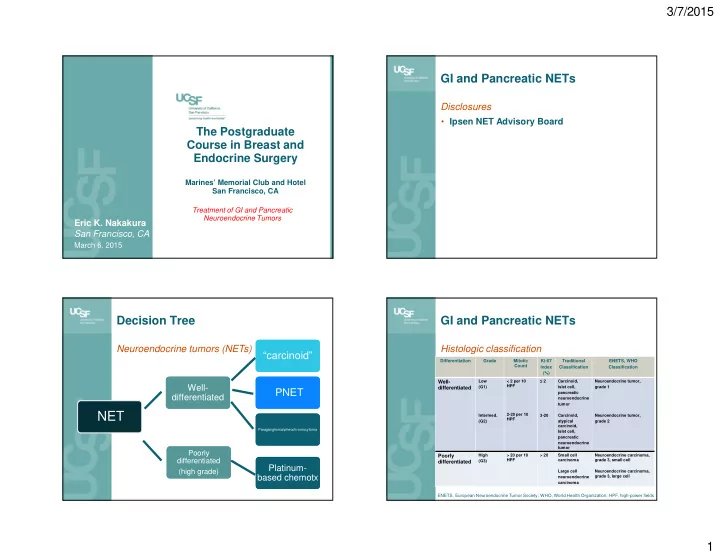
GI and Pancreatic NETs

  • Ipsen NET Advisory Board

Disclosures

Decision Tree

NET

Well- differentiated Well- differentiated

“carcinoid” “carcinoid” PNET PNET

Paraganglioma/pheochromocytoma Paraganglioma/pheochromocytoma

Poorly differentiated (high grade) Poorly differentiated (high grade)

Platinum- based chemotx Platinum- based chemotx

Neuroendocrine tumors (NETs)

GI and Pancreatic NETs

Histologic classification

Differentiation Grade Mitotic Count Ki-67 index (%) Traditional Classification ENETS, WHO Classification

Well- differentiated

Low (G1) Intermed. (G2) < 2 per 10 HPF 2-20 per 10 HPF ≤ 2 3-20 Carcinoid, islet cell, pancreatic neuroendocrine tumor Carcinoid, atypical carcinoid, Islet cell, pancreatic neuroendocrine tumor Neuroendocrine tumor, grade 1 Neuroendocrine tumor, grade 2

Poorly differentiated

High (G3) > 20 per 10 HPF > 20 Small cell carcinoma Large cell neuroendocrine carcinoma Neuroendocrine carcinoma, grade 3, small cell Neuroendocrine carcinoma, grade 3, large cell ENETS, European Neuroendocrine Tumor Society; WHO, World Health Organization; HPF, high-power fields

slide-2
SLIDE 2

3/7/2015 2 GI and Pancreatic Neuroendocrine tumors (NETs)

  • Insulinoma
  • Gastrinoma
  • Small intestine NET (carcinoid)
  • Nonfunctioning pancreatic NET (NF-PNET)
  • Others…

Diverse diseases

CASE 1

  • Pancreas
  • Specimen

Laparoscopic enucleation of insulinoma Multifocal NETs (N = 18) in ileum (carcinoid)

CASE 2

Duodenal gastrinoma

CASE 3

  • Duodenum
  • Specimen
slide-3
SLIDE 3

3/7/2015 3 CASE 4

Whipple procedure for NF-PNET Total pancreatectomy for NF-PNET (12 cm)

CASE 5

  • Focus on a very confusing issue in NETs

– NETs of Unknown Primary

  • It’s not so confusing after all
  • History and experience have shone us the

light

  • Seeing is believing

Overview

GI and Pancreatic Neuroendocrine tumors (NETs) Neuroendocrine Tumors

  • f Unknown Primary:

Is the Primary Tumor Site Really Not Known?

Eric K. Nakakura San Francisco, CA

March 6, 2015

slide-4
SLIDE 4

3/7/2015 4

If you remember only two things

  • NETs of unrecognized primary site are

typically hiding in the ileum

  • NETs of the ileum are often multifocal

must palpate

GI and Pancreatic Neuroendocrine tumors (NETs) NETs of Unknown Primary

What does “unknown primary” mean?

NETs of Unknown Primary

  • Well-differentiated NET liver metastases
  • Where did the tumor originate?

NETs of Unknown Primary

  • The location where the NET originated is not

known.

What does “unknown primary” mean?

slide-5
SLIDE 5

3/7/2015 5 NETs of Unknown Primary

  • The location where the NET originated is not

known

  • Possible primary sites:
  • Small intestine (ileum, jejunum, duodenum)
  • Pancreas
  • Colon/rectum
  • Bronchopulmonary
  • Stomach…

What does “unknown primary” mean?

NETs of Unknown Primary

Does finding the primary tumor matter?

NETs of Unknown Primary

Reasons for finding the primary tumor

  • Symptoms
  • Abdominal pain, weight loss
  • Asymptomatic
  • Resect the primary as part of surgery to

remove all gross disease

  • Prevent bowel obstruction
  • Prevent ischemia
  • Improve outcome?

Hellman et al. World J Surg 2002 Boudreaux et al. Ann Surg 2005 Givi et al. Surgery 2006 .

Small intestine (ileum) NET

Intestinal ischemia

slide-6
SLIDE 6

3/7/2015 6 Small intestine (ileum) NET

Intestinal ischemia

Small intestine (ileum) NET

Intestinal obstruction

Small intestine (ileum) NET

Intestinal ischemia and obstruction

NETs of Unknown Primary

Reasons for finding the primary tumor

  • Treatment increasingly depends on site
  • Everolimus, sunitinib for pancreatic NETs
  • Octreotide for well differentiated midgut

NETs

  • Lanreotide for well-differentiated NF GI and

pancreatic NETs

  • Systemic chemotherapy for pancreatic NETs
  • Participation in clinical trials

Bergsland and Nakakura. JAMA Surg 2014 .

slide-7
SLIDE 7

3/7/2015 7 NETs of Unknown Primary

What tests should be done to find it?

NETs of Unknown Primary

  • Currently, there is no consensus on what

minimum tests should be done before the primary site is considered unknown

What tests should be done to find it?

NETs of Unknown Primary

What tests should be done to find it?

  • CT?
  • MRI?
  • OctreoScan?
  • 68Ga-DOTA-TATE or 68Ga-DOTA-NOC PET-CT
  • Upper/lower endoscopy?
  • Endoscopic ultrasound?
  • Enteroclysis?
  • Capsule endoscopy?
  • Double-balloon enteroscopy?
  • Gene expression profiling?

NETs of Unknown Primary

  • Study design: Pathology database (1993-2008)
  • Setting: UCSF
  • Patients: 123 patients with NET liver metastases
  • Outcomes: 1) Detection of primary tumor preop

2) Laparoscopic or open surgery to find and remove an unknown primary tumor

Wang et al. Arch Surg 2010 .

UCSF study

slide-8
SLIDE 8

3/7/2015 8 NETs of Unknown Primary

Wang et al. Arch Surg 2010 .

  • Despite extensive

evaluation, 13.8% had occult primary tumors.

UCSF study

NETs of Unknown Primary

Where is the primary site likely to be?

Siegfried Oberndorfer

  • 1907: Pathological Institute of Geneva
  • 1) multiple tumors in submucosa of ileum
  • 2) slow growth
  • 3) borders sharply circumscribed
  • 4) (do not metastasize)
  • Karzinoide: “carcinoma-like”
  • 1929: He recognized potential to metastasize

Modlin et al. Hum Path 2004 .

(1876-1944)

Gastrointestinal NETs Epidemiology

Modlin et al. Cancer 2003 .

Carcinoid site (1950-1971) (1973-1999) (no islet cell) n = 2425 n = 6996 % % Stomach 2.5 7 Small intestine 25 44 Appendix 48 7 Colon 8 13 Rectum 17 24

slide-9
SLIDE 9

3/7/2015 9 NETs of Unknown Primary

Wang et al. Arch Surg 2010 .

  • Primary site found in 13/15 patients (87%) by

surgery

  • All primary tumors in small intestine

(12 ileum, 1 jejunum)

  • Primary tumors small (1.4 cm) and often

multifocal (54%)

  • Careful palpation of small intestine is essential

UCSF study results

NETs of Unknown Primary

Multicenter results

~ 84% success in finding primary Bergsland and Nakakura. JAMA Surg 2014 . Wang et al. Arch Surg 2010 .

NETs of Unknown Primary

Laparoscopic identification of tumor in ileum

Karnovsky Memorial Lecture

  • Small intestine NETs

– Most (193/209; 92%) arise from ileum – Multifocal (46/183; 25%)

  • Primary tumors small, deep mucosal site of origin
  • Nature of spread

– First invades muscle layerserosamesentery (outward spread)

  • Nature of obstruction

– Fibroblastic reaction in mesenterybuckling of bowel wallkinking of bowel wall (like an accordian)

An Odyssey in the Land of Small Tumors

Moertel CG. J Clin Oncol 1987 .

slide-10
SLIDE 10

3/7/2015 10 NETs of Unknown Primary

Laparoscopic identification of tumor in ileum

NETs of Unknown Primary

Laparoscopic identification of tumor in ileum with Meckel’s diverticulum

NETs of Unknown Primary

Laparoscopic identification of tumor in ileum with regional adenopathy

NETs of Unknown Primary

Multifocal primary tumors (N = 11) in ileum

slide-11
SLIDE 11

3/7/2015 11 NETs of Unknown Primary

Multifocal primary tumors (N = 11) in ileum

NETs of Unknown Primary

Multifocal primary tumors (N = 11) in ileum

NETs of Unknown Primary

Multifocal primary tumors (N = 11) in ileum (#2)

NETs of Unknown Primary

Multifocal primary tumors (N = 11) in ileum (#2)

slide-12
SLIDE 12

3/7/2015 12 NETs of Unknown Primary

  • CT scan: chest, abdomen/pelvis (multiphase, thin slice)
  • Somatostatin receptor scintigraphy (OctreoScan)
  • Urine 24-h 5-HIAA
  • Upper and lower endoscopy
  • Immunohistochemical markers (TTF-1, CDX2, PAX8,

Islet 1)

  • Careful review by multidisciplinary team

What tests should be done to find it?

Finding the Primary Tumor

Potentially seen on colonoscopy

  • terminal ileum NET
  • terminal ileum NET

Finding the Primary Tumor

Potentially seen on colonoscopy

NETs of Unknown Primary

  • For most patients with WD-NETs and unknown

primary the primary site is most likely in the ileum

  • If surgery planned, appropriate preoperative tests

should be done

  • Many other tests (enteroclysis, capsule endoscopy,

double-balloon enteroscopy, and endoscopic ultrasound) unnecessary since will not affect patient care and only delay treatment

  • Must carefully palpate small intestine because ileum

NETs are frequently multifocal

Take home points

slide-13
SLIDE 13

3/7/2015 13

  • A 60-year-old man
  • Fall 2008: abdominal pain
  • Evaluated at a local hospital

NETs of Unknown Primary

Patient example

  • Bilobar liver masses
  • Core needle biopsy: CgA +, Syn +
  • Well-differentiated NET
  • Unknown primary site

NETs of Unknown Primary

Patient example

  • A 60-year-old man with NET liver

metastases and unknown primary

  • Fall 2008: Started Sandostatin
  • Patient informed his disease was inoperable
  • UCSF for second opinion by

multidisciplinary GI oncology group

NETs of Unknown Primary

Patient example

  • Winter 2008:
  • Laparoscopic identification and resection of

ileum primary tumor

Wang et al. Arch Surg 2010 .

NETs of Unknown Primary

slide-14
SLIDE 14

3/7/2015 14

  • A 60-year-old man with NET liver

metastases and unknown primary

  • Fall 2008: Started Sandostatin
  • Winter 2008: Primary found and removed
  • Fall 2009: Carcinoid syndrome

Liver metastases stable

NETs of Unknown Primary

Patient example

  • Winter 2009:
  • Right hepatectomy and microwave ablation
  • f two left lobe tumors
  • Carcinoid syndrome resolved

NETs of Unknown Primary

Patient example

  • A 60-year-old man with NET liver metastases

and unknown primary

  • Fall 2008: Started Sandostatin
  • Winter 2008: Primary found and removed
  • Winter 2009: Resection/ablation of liver mets
  • Dec. 2014: No evidence of disease

NETs of Unknown Primary

Patient example

NETs of Unknown Primary NET(s) arising from the ileum NETs of Unrecognized Primary

slide-15
SLIDE 15

3/7/2015 15