NEOLITHIC AGE Desklo settlement (c. 10 Kyrs ago) Some 10,000 yrs - - PowerPoint PPT Presentation

neolithic age
SMART_READER_LITE
LIVE PREVIEW

NEOLITHIC AGE Desklo settlement (c. 10 Kyrs ago) Some 10,000 yrs - - PowerPoint PPT Presentation

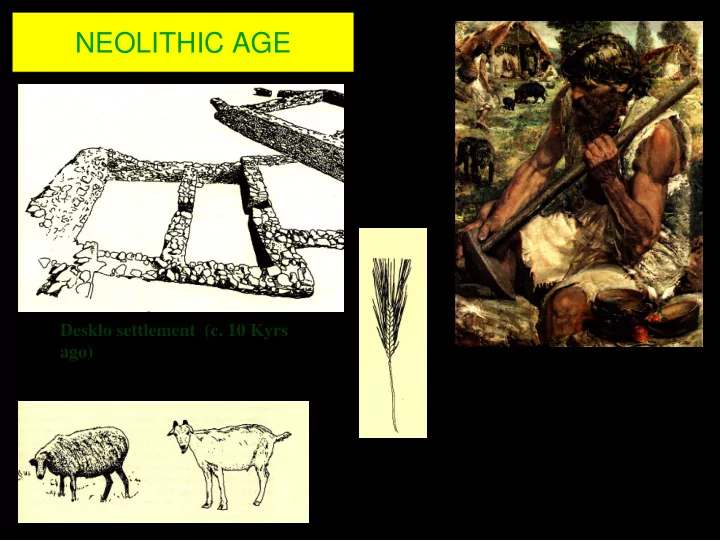
PCES 1.6 NEOLITHIC AGE Desklo settlement (c. 10 Kyrs ago) Some 10,000 yrs ago as the last ice age finished, a revolution began- in the form of settlements based around cultivated land (depending on wheat and barley) and on the


slide-1
SLIDE 1

NEOLITHIC AGE

Some 10,000 yrs ago as the last ice age finished, a revolution began- in the form of settlements based around cultivated land (depending

  • n wheat and barley) and on the

exploitation of domestic animals.

Desklo settlement (c. 10 Kyrs ago)

PCES 1.6

slide-2
SLIDE 2

EARLY CHINESE CIVILISATION

Yangshao (4600 BC) Jade ‘π−disc’ (1650 BC) Gold dagger handle (350 BC) Great Wall (begun 400 BC) Bronze, W. Shan dynasty (1050 BC)

at RIGHT The earliest civilisation was in China, some 7,000 yrs ago. Already emperors ruled over kingdoms from 2850 BC, and in 2205 BC the 1st (Xia) dynasty began. Chinese technology was many centuries ahead of the West until the late Renaissance. In 651 BC, Confucius was born- his ideas would eventually influence the imperial bureaucracy for 2000 yrs. Indian civilisation also rose quickly, and in 1500 BC the world’s first great religion (Hinduism) began.

PCES 1.7

slide-3
SLIDE 3

Akkadian mask (2200 BC) Plan of Ziggurat at Ur (2100 BC)

MIDDLE EAST & EGYPT

The earliest Middle Eastern civilisation was the Sumerian, with settlements in 5000 BC in the Tigris & Euphrates flood plains, and in 2300 BC, their unification by Sargon. In 1792 BC Babylon took over & devised a system of laws, mathematics, time keeping, &

  • Astronomy. This

great civilisation fell to the Persians (6th century BC) The Egyptian civilisation began in 3100 BC with the unification

  • f several provinces, remaining

united for 3000 yrs. A very complex society produced little science but remarkable artistic

  • works. The great pyramid

complexes were tombs for the Pharoahs.

TOP: mask of Tutenkhamen MIDDLE: Gizeh pyramid (2532 BC). BOTTOM: tomb

  • f Phahhotep

(2400 BC)

PCES 1.8

slide-4
SLIDE 4

Above: Friezes from Akrotiri in Santorini (c. 1500 BC) Mycenaen bronze and goldwork (c. 1250 BC)

The Mycenean civilisation flourished from 1600-800 BC in N Greece. The explosion of Santorini in 1470 BC completely destroyed the Minoan civilisation in Crete (founded Earlier, c. 2000 BC).

GREECE: MINOAN & MYCANEAN Periods

PCES 1.9

slide-5
SLIDE 5

The REST of the WORLD

Stonehenge; major construction c 2300 & 1000 BC

Remains of ancient cultures have been found in Peru, Mexico, Nth America, Western Europe, Africa, all across Asia, and Australia- only New Zealand was untouched by Man (until 1040 AD). However these cultures were significantly less advanced, and much less is known about them. In Nth America the Olmec civilisation occupied the region from Mexico to El Salvador in 1200-400 BC, to be followed by the great civilisations of the Mayans & Aztecs. In most of the rest of the world, life was organised tribally. In W Europe, from Malta & Spain up to Scotland and Sweden, huge numbers of ‘megaliths’, or standing stones, mark the passing of a semi-organised culture going back to 4000 BC. The most famous is Stonehenge, made from 50-ton stones, moved from 30 km away, & shaped & placed in ways which suggest astronomical & religious purposes.

PCES 1.10