Near-Duplicate Detection for eRulemaking Hui Yang, Jamie Callan - - PDF document

near duplicate detection for erulemaking
SMART_READER_LITE
LIVE PREVIEW

Near-Duplicate Detection for eRulemaking Hui Yang, Jamie Callan - - PDF document

Near-Duplicate Detection for eRulemaking Hui Yang, Jamie Callan Language Technologies Institute School of Computer Science Carnegie Mellon University Stuart Shulman Library and Information Science School of Information Sciences University of


slide-1
SLIDE 1

1

dg.o conference 2006

Near-Duplicate Detection for eRulemaking

Hui Yang, Jamie Callan

Language Technologies Institute School of Computer Science Carnegie Mellon University

Stuart Shulman

Library and Information Science School of Information Sciences University of Pittsburgh

dg.o conference 2006

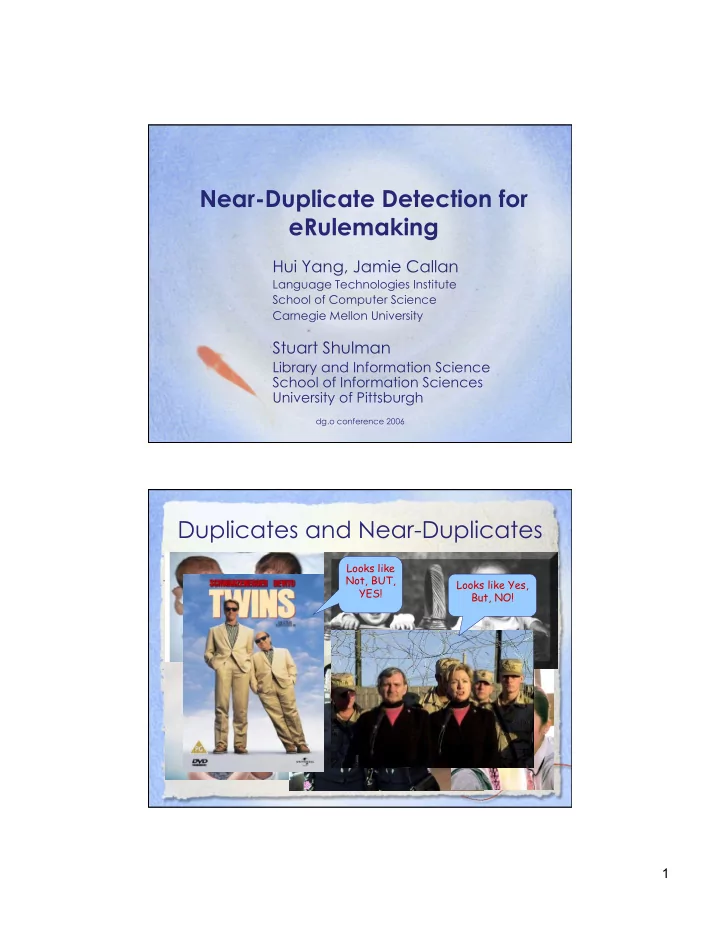
Duplicates and Near-Duplicates

Looks like Not, BUT, YES! Looks like Yes, But, NO!

slide-2
SLIDE 2

2

dg.o conference 2006

Duplicates and Near-Duplicates in eRulemaking

  • U.S. regulatory agencies must solicit,

consider, and respond to public comments.

  • Special interest groups make form letters

available for generating comments via email and the Web – Moveon.org, http://www.moveon.org – GetActive, http://www.getactive.org

  • Modifying a form letter is very easy

dg.o conference 2006

  • Insert screen shot of moveon.org,

showing form letter and enter-your- comment-here

Form Letter Individual Information Personal Notes

slide-3
SLIDE 3

3

dg.o conference 2006

Duplicates and Near-Duplicates in eRulemaking

  • Some popular regulations attract

hundreds of thousands of comments

  • Very labor-intensive to sort through

manually

  • Goal:

– Achieve highly effective near-duplicate detection by incorporating additional knowledge; – Organize duplicates for browsing.

dg.o conference 2006

What is a Duplicate in eRulemaking ? (Text Documents)

slide-4
SLIDE 4

4

dg.o conference 2006

Duplicate and Near-Duplicates

  • Exact Copies of a form letter are easy

to detect

  • Non-Exact Copies are modified form

letters are harder to process – They are similar, but not identical

  • “near duplicates”

dg.o conference 2006

Duplicate - Exact

The EPA should require power plants to cut mercury pollution by 90% by

  • 2008. These reductions are

consistent with national standards for other pollutants and achievable through available pollution-control technology. The EPA should require power plants to cut mercury pollution by 90% by

  • 2008. These reductions are

consistent with national standards for other pollutants and achievable through available pollution-control technology.
slide-5
SLIDE 5

5

dg.o conference 2006

Near Duplicate - Block Edit

The EPA should require power plants to cut mercury pollution by 90% by 2008. These reductions are consistent with national standards for other pollutants and achievable through available pollution- control technology. I urge the EPA to require controls at all power plants to stop mercury pollution. The health of our air and water, and especially our children is by far more important than any political agenda. The EPA should require power plants to cut mercury pollution by 90% by 2008. These reductions are consistent with national standards for other pollutants and achievable through available pollution- control technology. dg.o conference 2006

Near Duplicate - Minor Change

I am writing to urge you to take prompt action to clean up mercury and other toxic air pollution from power plants. EPA's current proposals allow far ore mercury pollution than what the Clean Air Act allows, while at the same time fail to address over sixty other hazardous air pollutants like dioxin. I am writing to urge you to take prompt action to clean up mercury and

  • ther toxic air pollution from the power
  • plants. EPA’s proposals permit far more

mercury pollution than what the Clean Air Act allows, while at the same time fail to address over sixty other hazardous air pollutants like dioxin.

slide-6
SLIDE 6

6

dg.o conference 2006

Minor Change + Block Edit

As someone who cares about protecting the health

  • f children and our

environment, I am deeply concerned about the mercury contamination of our lakes and streams. Mercury descends from polluted air into water and then works its way up the food chain. It is especially dangerous to people and wildlife that consume large amounts of fish. I urge you to reconsider your agency’s approach and require power plants to reduce their emissions of mercury to the greatest extent

  • possible. his is what the federal law requires, and

also what the people and wildlife of this country deserve. Thank you for your consideration. As someone who cares about protecting our wildlife and wild places, I am deeply upset about the mercury contamination of our lakes and streams. Mercury descends from polluted air into water and then works its way up the food chain. It is especially dangerous to people and wildlife that consume large amounts of fish. Specifically, I am concerned that EPA is proposing a cap-and- trade system to manage mercury emissions. Under such a system, not all plants would have to reduce their harmful missions of mercury and some could even increase! This approach =s unacceptable for dealing with such a toxic pollutant – which is precisely why the Clean Air Act does not allow it. I urge you to reconsider your approach and require power plants to reduce heir emissions of mercury to the greatest extent possible. This is what the federal law requires, and also what the people and wildlife of this country deserve. Thank you for your consideration.

dg.o conference 2006

Near Duplicate - Block Reordering

Dear Environmental Protection Agency, The EPA should require power plants to cut mercury pollution by 90% by 2008. These reductions are consistent with national standards for

  • ther pollutants and achievable through available

pollution-control technology. I urge the EPA to require controls at all power plants to stop mercury pollution. The health of our air and water, and especially our children is by far more important than any political agenda. Dear Environmental Protection Agency, I urge the EPA to require controls at all power plants to stop mercury pollution. The health of our air and water, and especially

  • ur children is by far more important than any political agenda.

The EPA should require power plants to cut mercury pollution by 90% by 2008. These reductions are consistent with national standards for other pollutants and achievable through available pollution-control technology.

slide-7
SLIDE 7

7

dg.o conference 2006

Near Duplicate - Key Block

The EPA should require power plants to cut mercury pollution by 90% by 2008. These reductions are consistent with national standards for other pollutants and achievable through available pollution-control technology. American citizens need to stand up for their

  • rights. Which means the

freedom to pursue life, liberty, health, and

  • happiness. Everybody has the right to wake up

each morning and breath the freshest air that this green earth can provide us, not what some government organization says that we need to put up with because they want their standards so

  • lax. This is a democracy, by the people, for the

people, not what Bush decides because it suits his mood. It concerns me to see so many people that I care about every day trying so hard to live with the mental and neurological problems that they have acquired, or were born with due to mercury poisoning. The EPA should require power plants to cut mercury pollution by 90% by 2008. These reductions are consistent with national standards for other pollutants and achievable through available pollution-control technology. dg.o conference 2006

How Can Near-Duplicates Be Detected?

slide-8
SLIDE 8

8

dg.o conference 2006

Related Work

  • Duplicate Detection Using Fingerprints

– Hashing functions [SHA1][Rabin] – Fingerprint granularity [Shivakumar et al.’95] [Hoad & Zobel‘03] – Fingerprint size [Broder et al. ’97] – Substring selection strategy

  • position-based [Brin et al. ’95]
  • hash-value-based [Broder et al. ’97]
  • anchor-based [Hoad & Zobel‘03]
  • frequency-based [Chowdhury et al. ’02]
  • Duplicate Detection Using Full-Text [Metzler

et al. ’05]

dg.o conference 2006

Our Detection Strategy

  • Group Near-duplicates based on

– Text similarity

– Editing patterns – Metadata

slide-9
SLIDE 9

9

dg.o conference 2006

Document Clustering

  • Put similar documents together
  • How is text similarity defined?

– Similar Vocabulary – Similar Word Frequencies

  • If two documents similarity is above a

threshold, put them into same cluster )) || ( ), || ( min( ) , (

a b b a b a

p p KL p p KL d d dist =

dg.o conference 2006

Incorporating Instance-level Constraints in Clustering

  • Key Block are very common
  • Typical text similarity doesn’t work

– Different words, different frequencies

  • Solution: Add instance-level

constraints

– Example: must-link, cannot-link, family- link – These provide hints to the clustering algorithm about how to group documents

slide-10
SLIDE 10

10

dg.o conference 2006

Must-links

  • Two instances must be in the same

cluster

  • Created when

– complete containment of the reference copy (key block), – word overlap > 95% (minor change).

dg.o conference 2006

Cannot-links

  • Two instances cannot be in the same

cluster

  • Created when two documents

– cite different docket identification numbers

  • People submitted comments to wrong

place

slide-11
SLIDE 11

11

dg.o conference 2006

Family-links

  • Two instances are likely to be in the

same cluster

  • Created when two documents have

– the same email relayer, – the same docket identification number, – similar file sizes, or – the same footer block.

dg.o conference 2006

How to Incorporate Instance- level Constraints?

  • When forming clusters,

– if two documents have a must-link, they must be put into same group, even if their text similarity is low – if two documents have a cannot-link, they cannot be put into same group, even if their text similarity is high – if two documents have a family-link, increase their text similarity score, so that their chance of being in the same group increases.

slide-12
SLIDE 12

12

dg.o conference 2006

Evaluation

dg.o conference 2006

Evaluation Methodology

  • We created three 1,000 email subsets

– Two from the EPA’s Mercury dataset docket: (USEPA-OAR-2002-0056) – One from DOT’ SUV dataset docket: (USDOT-2003-16128)

  • Assessors manually organized

documents into near-duplicate clusters

  • Compare human-human agreement

to human-computer agreement

slide-13
SLIDE 13

13

dg.o conference 2006

Experimental Setup

  • Sample Name:

NTF

  • # of Docs:

1000

  • # of Docs (duplicates removed): 275
  • # of Known form letters: 28
  • # of Assessors:

2

  • Assessor 1:

UCSUR13

  • Assessor 2:

UCSUR16

dg.o conference 2006

Experimental Setup

  • Sample Name:

NTF2

  • # of Docs:

1000

  • # of Docs (duplicates removed): 270
  • # of Known form letters: 26
  • # of Assessors:

2

  • Assessor 1:

UCSUR8

  • Assessor 2:

UCSUR9

slide-14
SLIDE 14

14

dg.o conference 2006

Experimental Setup

  • Sample Name:

DOT

  • # of Docs:

1000

  • # of Docs (duplicates removed): 270
  • # of Known form letters: 4
  • # of Assessors:

2

  • Assessor 1:

SUPER (Stuart)

  • Assessor 2:

G (Grace)

dg.o conference 2006

Experimental Results

Macro Average (Averaged by Cluster) Micro Average (Averaged by Document) NTF NTF2 DOT NTF NTF2 DOT Coder A / Coder B 0.93 0.90 0.95 0.99 0.95 0.96 Coder A / DURIAN 0.92 0.80 0.86 0.93 0.90 0.88 Coder B / DURIAN 0.90 0.82 0.94 0.91 0.91 0.98

  • Comparing with human-human intercoder

agreement (measured in AC1)

slide-15
SLIDE 15

15

dg.o conference 2006

Experimental Results

NTF NTF2 DOT Full 0.96 0.96 0.96 DSC 0.81 0.80 0.70 I-Match 0.69 0.70 0.65 DURIAN 0.98 0.98 0.97

  • Comparing with other duplicate detection

Algorithms (measured in F1)

dg.o conference 2006

Impact of Instance-level Constraints

  • Number of Constraints vs. F1.

NTF

0.75 0.8 0.85 0.9 0.95 1 1 5 10 15 20 25 30 35 40 45 50 F1

NTF2

0.75 0.8 0.85 0.9 0.95 1 1 5 10 15 20 25 30 35 40 45 50

F1

slide-16
SLIDE 16

16

dg.o conference 2006

Impact of Instance-level Constraints

  • Number of Constraints vs. F1.
  • Number of Constraints vs. F1.

DOT

0.75 0.8 0.85 0.9 0.95 1 1 5 10 15 20 25 30 35 40 45 50

F1

baseline must cannot family must+cannot all dg.o conference 2006

slide-17
SLIDE 17

17

dg.o conference 2006 dg.o conference 2006

Conclusion

  • Near-duplicate detection on large

public comment datasets is practical – Automatic metadata extraction – Feature-based document retrieval – Instance-based constrained clustering

  • Efficient
  • Easily applied to other datasets
slide-18
SLIDE 18

18

dg.o conference 2006

Please come to our demo (or ask us for one) Questions?