www.navsaria.com facebook.com/DrLibrarian twitter.com/navsaria - - PowerPoint PPT Presentation

navsaria com facebook com drlibrarian twitter com
SMART_READER_LITE
LIVE PREVIEW

www.navsaria.com facebook.com/DrLibrarian twitter.com/navsaria - - PowerPoint PPT Presentation

This PDF document contains slides presented by Dipesh Navsaria and is provided for informational purposes. You are free to share this document with others as long as you are not using it for commercial purposes and respect the licensing of the


slide-1
SLIDE 1

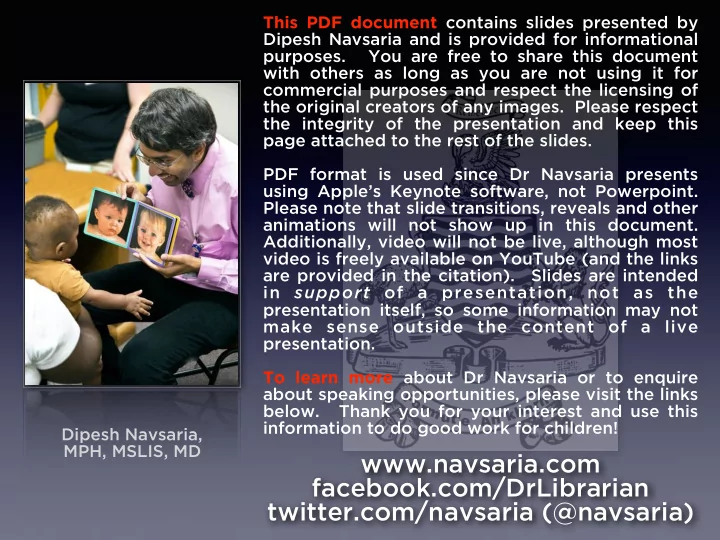
This PDF document contains slides presented by Dipesh Navsaria and is provided for informational

  • purposes. You are free to share this document

with others as long as you are not using it for commercial purposes and respect the licensing of the original creators of any images. Please respect the integrity of the presentation and keep this page attached to the rest of the slides. PDF format is used since Dr Navsaria presents using Apple’s Keynote software, not Powerpoint. Please note that slide transitions, reveals and other animations will not show up in this document. Additionally, video will not be live, although most video is freely available on YouTube (and the links are provided in the citation). Slides are intended in support of a presentation, not as the presentation itself, so some information may not make sense outside the content of a live presentation. To learn more about Dr Navsaria or to enquire about speaking opportunities, please visit the links

  • below. Thank you for your interest and use this

information to do good work for children!

www.navsaria.com facebook.com/DrLibrarian twitter.com/navsaria (@navsaria)

Dipesh Navsaria, MPH, MSLIS, MD

slide-2
SLIDE 2

E A R L Y

EARLY BRAIN & CHILD DEVELOPMENT

AND THE FUTURE OF SOCIETY

EXPERIENCES E L E V A T E EVERYTHING

www.facebook.com/DrLibrarian Twitter: @navsaria

Live-tweeting encouraged!

DIPESH NAVSARIA, MPH, MSLIS, MD

DEPARTMENT OF PEDIATRICS UW SCHOOL OF MEDICINE & PUBLIC HEALTH MEDICAL DIRECTOR, REACH OUT AND READ WISCONSIN VICE-CHAIR, BOARD OF DIRECTORS, REACH OUT AND READ

slide-3
SLIDE 3

DISCLOSURE

I have no relevant financial relationships to disclose. I will not discuss

  • ff-label use or investigational use

in my presentation. Although…

slide-4
SLIDE 4

I don’t know if “mouthing” is an FDA–approved use of board books.

Image courtesy of Dipesh Navsaria

slide-5
SLIDE 5

“Oh, that’s so nice…”

C R I T I C A L

slide-6
SLIDE 6

Detail from The Departure of Odysseus from the Land of the Phaeacians by Claude Lorrain, Louvre Museum. Public domain.

The Science The Result The Solution? The Call

slide-7
SLIDE 7

First, a story…

slide-8
SLIDE 8

A Stroll Through the Early Brain

Pa! One

slide-9
SLIDE 9

EARLY BRAIN AND CHILD DEVELOPMENT

from The Science of Early Childhood Development National Scientific Council on the Developing Child, 2007

Creative Commons-licensed work by flickr user tj.blackwell

slide-10
SLIDE 10

EARLY BRAIN AND CHILD DEVELOPMENT

1 Child development is a foundation for

community development and economic development, as

capable children become the foundation of a prosperous and sustainable society.

Creative Commons-licensed work by flickr user Andrew Mace—

2 Brains are built over time.

slide-11
SLIDE 11

The 3-legged stool for developmental and health trajectories

Socio- economic environment Genetic, Prenatal & Neuro- developmental Factors Attachment and Relationship Patterns

slide-12
SLIDE 12

EARLY BRAIN AND CHILD DEVELOPMENT

3 The interactive influences of

genes and experience

literally shape the architecture

  • f the developing brain

Creative Commons-licensed work by flickr user Misko13

and the active ingredient is the “serve and return” nature

  • f children’s engagement in

relationships with their

parents and other caregivers in their family or community.

slide-13
SLIDE 13

The Face to Face Paradigm Edward Z Tronick

Video from Zero to Three / UMass Boston. Accessible at http://youtu.be/apzXGEbZht0

slide-14
SLIDE 14
slide-15
SLIDE 15

EARLY BRAIN AND CHILD DEVELOPMENT

4 Both brain architecture and developing abilities are built “from the bottom up” with simple circuits and skills providing the

scaffolding for more advanced

circuits and skills over time.

Creative Commons-licensed work by flickr user Liz Henry

“Play is the work of infancy”

— T B e r r y B r a z e l t

  • n
slide-16
SLIDE 16

EARLY BRAIN AND CHILD DEVELOPMENT

5 Toxic stress in early childhood is associated with persistent effects on the nervous system and stress hormone systems that can

damage developing brain architecture and lead to

lifelong problems in learning, behavior and both physical and mental health.

Creative Commons-licensed work by flickr user Pedro Klien

slide-17
SLIDE 17

Image from Bruce Perry, MD, PhD, ChildTrauma Academy

slide-18
SLIDE 18

THE STRESS RESPONSE:

increases in cortisol and epinephrine

slide-19
SLIDE 19

Toxic

Prolonged activation of stress response systems in the absence of protective relationships.

Three Levels of Stress Response Tolerable

Serious, temporary stress responses, buffered by supportive relationships.

Positive

Brief increases in heart rate, mild elevations in stress hormone levels.

Source: Center on the Developing Child at Harvard University
slide-20
SLIDE 20

Adversity & Toxic Stress

Social-emotional buffering is the primary factor distinguishing level of stress.

Andy Garner, MD

Toxic stress is the

key intergenerational transmitter

  • f social and health disparities
slide-21
SLIDE 21

What if it’s worse? What if there’s no supportive relationships? Child abuse Parental substance abuse Homelessness

TOXIC STRESS

slide-22
SLIDE 22

Chronic “fight or flight” increased cortisol / norepinephrine Changes in Brain Architecture Hyper-responsive stress response decreased calm/coping

CHILDHOOD STRESS

slide-23
SLIDE 23

The Result

EARLY BRAIN AND CHILD DEVELOPMENT

slide-24
SLIDE 24

THE ADVERSE CHILDHOOD EXPERIENCES STUDY

The Most Important Study You’ve (Probably) Never Heard Of. In 1985, Dr Vincent Felitti noticed many patients in his obesity treatment programs had prior history of abuse or trauma The CDC worked with Kaiser Permanente and looked retrospectively at over 17,000 patients. This was the first study to simultaneously assess childhood exposure to multiple types of abuse, neglect, domestic violence and serious household dysfunction.

slide-25
SLIDE 25

Study participants were middle-class Americans from San Diego, 80% white, 74% attended college, average age of 57, split evenly between men and women.

Not exactly an improverished, “at-risk” population. THE ADVERSE CHILDHOOD EXPERIENCES STUDY

slide-26
SLIDE 26

THE ADVERSE CHILDHOOD EXPERIENCES STUDY

Emotional abuse Physical abuse Sexual abuse Emotional neglect Physical neglect Mother treated violently Household substance abuse Household mental illness Parental separation or divorce Incarcerated household member 10% 26% 21% 15% 10% 13% 28% 20% 24% 6%

slide-27
SLIDE 27

ACE Score

(one point for each category listed)

Prevalence in study 33% 1 26% 2 16% 3 10% 4 6% 5 5% 6 6%

Not only are they unexpectedly common… …their effects are cumulative.

}

slide-28
SLIDE 28

Significant Adversity Impairs Development in the First Three Years

Number of Risk Factors

Source: Barth, et al. (2008) via Center on the Developing Child at Harvard University

Children with Developmental Delays

1-2 3 5 4 6 7 20% 40% 60% 80% 100%

slide-29
SLIDE 29

Risk Factors for Adult Heart Disease are Embedded in Adverse Childhood Experiences

Adverse Experiences Source: Dong, et al. (2004) via Center on the Developing Child at Harvard University Odds Ratio

1 2 3 4 5,6 7,8 0.5 1 1.5 2 2.5 3 3.5

slide-30
SLIDE 30

EARLY BRAIN AND CHILD DEVELOPMENT

6 Creating the right conditions for early childhood development is likely to be

more effective and less costly

than addressing problems at a later age.

Creative Commons-licensed work by flickr user River Beach

slide-31
SLIDE 31

Three Promising Domains for EBCD Innovation

Jack Shonkoff, MD

Reduce emotional and behavioral barriers to learning. Enhance the healthy development of children by transforming the lives of their parents. Reconceptualize the health dimension of early childhood policy and practice.

slide-32
SLIDE 32

NUMBERS TO REMEMBER

slide-33
SLIDE 33

700

New Neural Connections per Second

slide-34
SLIDE 34

PLASTICITY

Variation in Strength of connections Variation in Number of Connections

Synaptic Cellular

“A whisper to a shout” “One shout to a stadium shouting.” Lifelong Declining by age 5! Diminishing Cellular Plasticity Limits Remediation

slide-35
SLIDE 35

18 Months:

Age at Which Disparities in Vocabulary Begin to Appear

From Risley, T & Hart, B, 1995

slide-36
SLIDE 36

$4–$9

in Returns for Every Dollar Invested in Early Childhood Programs

Creative Commons-licensed work by flickr user Tracy O

slide-37
SLIDE 37

The Heckman Equation

slide-38
SLIDE 38

“It is easier to build strong children than to repair broken men.”

— Frederick Douglass (1817–1895)

Public-domain image

slide-39
SLIDE 39

The Reality of Now

slide-40
SLIDE 40

Families Face Challenges

slide-41
SLIDE 41
slide-42
SLIDE 42

Number of Families in the United States (in millions)

slide-43
SLIDE 43

Struggles have always been present. But now they’re laid bare.

slide-44
SLIDE 44
slide-45
SLIDE 45

My ideal doctor would be my Virgil, leading me through my purgatory or inferno, pointing

  • ut the sights as we go. He would resemble

Oliver Sacks, the neurologist who wrote ''Awakenings'' and ''The Man Who Mistook His Wife for a Hat.'' I can imagine Dr. Sacks entering my condition, looking around at it from the inside like a benevolent landlord with a tenant, trying to see how he could make the premises more livable for me. He would see the genius of my illness. He would mingle his daemon with mine; we would wrestle with my fate together. — Anatole Broyard

slide-46
SLIDE 46

Dante and Virgil in the Second Circle of Hell by Joseph Anton Koch (1823)

slide-47
SLIDE 47

Dante and Virgil in Hell by Eugène Delacroix (1798–1863)

slide-48
SLIDE 48

What can we do about it?

slide-49
SLIDE 49

The Solution P r i n c i p l e s

  • f

s

slide-50
SLIDE 50

We need solutions which…

Build capacities Build capabilities Are based in homes & communities Address root causes Have long-term effects Are scalable Address prevention Leverage the first 1000 days Are evidence-guided

slide-51
SLIDE 51
slide-52
SLIDE 52

Productive, happy adults

slide-53
SLIDE 53

Educationally successful

slide-54
SLIDE 54

Brain circuitry primed for school success

slide-55
SLIDE 55

Early experiences molding brain for learning

slide-56
SLIDE 56

Nurturing, responsive interactions with children

slide-57
SLIDE 57

Adults with the ability to put these skills into action

slide-58
SLIDE 58

Adults with capability and capacity to interact well with children

slide-59
SLIDE 59

Programs, policies, and advice Intensive but small initiatives Broader but scalable, larger initiatives

slide-60
SLIDE 60

Images from Reach Out and Read National Center

slide-61
SLIDE 61

Image courtesy of Dipesh Navsaria

slide-62
SLIDE 62

Public domain work by Itcho Hanabusa

a book giveaway a relational assessment tool developmental surveillance an educational intervention a parental capacity-builder a public health approach a scalable, evidence-based model a toxic stress- buffering routine

It’s All These Things.

slide-63
SLIDE 63

Available now…

THE ELEPHANT IN THE CLINIC

EARLY LITERACY AND FAMILY WELL-BEING

DIPESH NAVSARIA, MPH, MSLIS, MD AMY SHRIVER, MD

slide-64
SLIDE 64

The Reach Out and Read Podcast

www.reachoutandread.org/podcast

slide-65
SLIDE 65

Not merely advice

  • r a book giveaway…

…but rather a process of parental skill-building and support… by already-existing, skilled, trusted professionals.

slide-66
SLIDE 66

Used with permission from echoparenting.org

slide-67
SLIDE 67

Used with permission from echoparenting.org

slide-68
SLIDE 68

A Solution for Now

slide-69
SLIDE 69

Families Need Support

slide-70
SLIDE 70

Supporting Relational Health

slide-71
SLIDE 71

Shared Reading as a Scaffold

slide-72
SLIDE 72

Virgil and Dante meeting Homer, Horace, Ovid, and Lucan by Nicola Consoni (1814–1884)

slide-73
SLIDE 73

Dante and Virgil in the Ninth Circle of Hell by Gustave Doré (1832–1883)

slide-74
SLIDE 74
slide-75
SLIDE 75

The Call

EARLY BRAIN AND CHILD DEVELOPMENT

slide-76
SLIDE 76

Using A Public Health Approach to Building Healthy Brains

Image from Andy Garner, MD

Universal Primary Preventions Anticipatory Guidance Bright Futures Reach Out and Read Social Supports Relational Health High Quality Child Care

Everyone

Screening/Targeted Interventions Developmental/Risk Screening Home Visiting Head Start Parenting Education/Support Early Intervention

At-risk

Evidence-Based Treatments CPP, COS, PCIT, TB-CBT Intensive Home Visting Intensive Parenting Education Care Coordination

Symptomatic

slide-77
SLIDE 77
slide-78
SLIDE 78

Public Investment in Children by Age

slide-79
SLIDE 79

LRB−3486/1 SRM:eev:ev

2013 − 2014 LEGISLATURE

2013 SENATE JOINT RESOLUTION 59

November 4, 2013 − Introduced by Senators LASSA, OLSEN, HARRIS, DARLING, LEHMAN, L. TAYLOR, RISSER and C. LARSON, cosponsored by Representatives BALLWEG, PASCH, KESTELL, SARGENT, MASON, JOHNSON, BARNES, WRIGHT, OHNSTAD, GOYKE, WACHS, SPIROS, KRUG and HULSEY. Referred to Committee on Senate Organization. Relating to: early childhood brain development. 1

Resolved by the senate, the assembly concurring, That policy decisions enacted by the Wisconsin state legislature will acknowledge and take into account the principles of early childhood brain development and will, whenever possible, consider the concepts of toxic stress, early adversity, and buffering relationships, and note the role of early intervention and investment in early childhood years as important strategies to achieve a lasting foundation for a more prosperous and sustainable state through investing in human capital.

(END)

slide-80
SLIDE 80

Change the First Five Years and You Change Everything Ounce of Prevention Fund

Accessible at http://youtu.be/GbSp88PBe9E

slide-81
SLIDE 81

“While schools can do much to raise achievement among children who initially lag behind their peers, all too often pre-school gaps set in train a pattern of ever increasing

inequality during school years and beyond.

Any drive to improve social mobility must begin with an effective strategy to nurture

the fledgling talent in young children

so often lost before it has had a chance to flourish.” The Sutton Trust

slide-82
SLIDE 82 T

Questions?

facebook.com/DrLibrarian twitter.com/navsaria dnavsaria@pediatrics.wisc.edu

THE END

Image courtesy of Dipesh Navsaria

Public-facing Social Media Please follow along!