
SLIDE 1
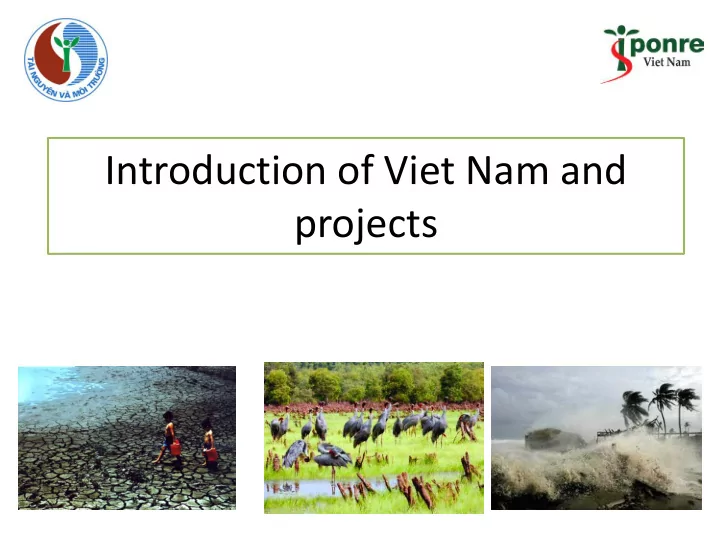
Introduction of Viet Nam and projects The Socialist Republic of - - PowerPoint PPT Presentation
Introduction of Viet Nam and projects The Socialist Republic of Viet Nam Population: 87,840,000 (2011) Total areas: 331,212 km Capital: Ha Noi GDP: 124 billion USD (2011) Ratification of 3 Rio Conventions UNFCCC UNCCD UNCBD
UNCBD Vietnam ratified the Convention in November 1994 UNFCCC Viet Nam signed on 11 June 1992, ratified it on 16 November 1994 and this became effective on 14 February 1995 UNCCD Ratified on 25 August 1998, to be in force on 23 November of the same year
Ministry of Natural Resources and Environment (MONRE) Ministry of Agriculture and Rural Development (MARD) UNCBD UNFCCC UNCCD GEF Focal Points
Funding for implementation of 3 Rio Conventions Technical knowledge and capacity to implementation of the Conventions Communication and collaboration Reporting requirements Synergies among Conventions’ activities Challenges
.
Project for Ecosystem Services (2010 – 2014)
Objective and Components To reduce threats to globally important biodiversity through integrating the findings and tools of ecosystem service assessments in policy and decision making at various scales. This will be achieved by:
integrate it with conventional measures of performance like national income. Methods: spatial mapping of ES; estimation of supply response functions for selected ES; trade-off matrices across ES, competing natural uses and human well-being; development of scenarios.
policies with the ecosystems and biodiversity. Methods: decision support systems; systematic outreach and dissemination strategy on ES; mapping and valuation of ES to inform development planning; strategies for SME’s; pilot studies on investment in ecological infrastructure
Methods: horizontal and vertical information exchange on ES science, tools and policy responses; systematic outreach and dissemination.
EBA demonstrated as a cost effective and sustainable strategy for mitigating CC impacts and promoting development goals Guiding Principles in mainstreaming EBA in the government policies and planning processes EBA mainstreamed in adaptation policies and practices in Lao/Vietnam and ultimately in the GMS region Operational Framework on How to implement EBA Draft Framework on How to implement EBA Review of literatures and consultations with experts Lessons from the field-testing incorporated in the draft framework Review and analysos of policy and institutional framework Stakeholder consultations and lessons from the field Study area Comparative Analysis of different Adaptation Options including Economic analysis Adaptation Strategies identified Assessment of Vulnerability and Risks to Ecosystems and Communities Analysis of role of ecosystems in reducing vulnerabilities Consultation with focus groups, VA analysis Modeling, Spatial Analysis Mapping of Ecosystems and their services