Resources for Cities in Viet Nam Joo Aleluia Project Coordinator - - PowerPoint PPT Presentation

resources for cities in viet nam
SMART_READER_LITE
LIVE PREVIEW

Resources for Cities in Viet Nam Joo Aleluia Project Coordinator - - PowerPoint PPT Presentation

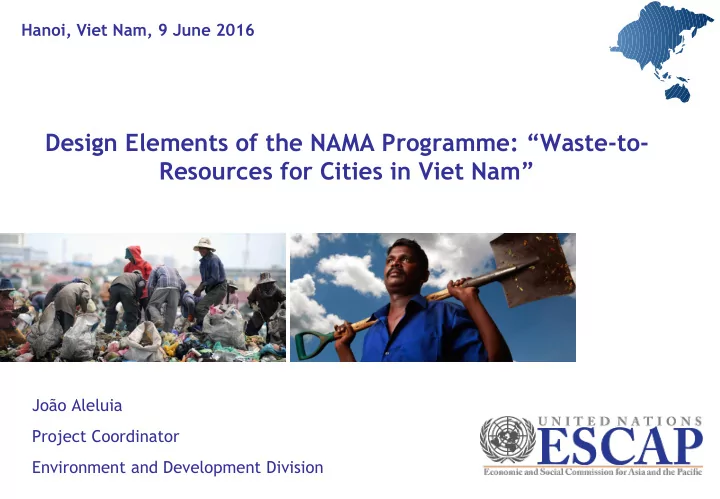
Hanoi, Viet Nam, 9 June 2016 Design Elements of the NAMA Programme: Waste -to- Resources for Cities in Viet Nam Joo Aleluia Project Coordinator Environment and Development Division The concept of NAMA Nationally appropriate


slide-1
SLIDE 1

João Aleluia Project Coordinator Environment and Development Division Hanoi, Viet Nam, 9 June 2016

Design Elements of the NAMA Programme: “Waste-to- Resources for Cities in Viet Nam”

slide-2
SLIDE 2

2

The concept of NAMA

“Nationally appropriate mitigation actions by developing country Parties in the context of sustainable development, supported and enabled by technology, financing and capacity building, in a measurable, reportable and verifiable manner”

  • Greenhouse gas emission reductions should be achieved alongside strong

sustainable development benefits

  • NAMAs should support a transformational change and a paradigm shift
  • NAMAs require strong national-level support
  • NAMAs should address clearly identified barriers
slide-3
SLIDE 3

3

Solid waste management in Viet Nam

Solid waste generation rates are increasing in Viet Nam, with waste disposal being the common practice

  • Disposal of waste in landfill sites and
  • pen dumps is the current practice
  • Solid waste collection rates are 83-85%
  • f total generation
  • Informal sector active along the waste

management value chain

  • Biodegradable organics are typically not

recovered, leading to the emission of greenhouse gases

Source: “Waste-to-Resource” NAMA Design Study

slide-4
SLIDE 4

4

Policy framework

The policy framework on solid waste management and climate change is supportive of waste recovery approaches and the principles of Reducing, Reusing and Recycling (3R)

National Strategy for Integrated Management of Solid Waste up to 2025 and Vision towards 2050 (2009)

  • By 2050, all types of waste are to be collected, reused, recycled and treated
  • 100% waste collection rates in urban areas by 2025, with 90% of collected waste to be treated in

an environmental friendly manner by 2025

National Climate Change Strategy (2011)

  • By 2020, 90% of the total volume of urban waste domestic waste should be collected and

treated, of which 85% it to be recycled and reused

Intended Nationally Determined Contribution of Viet Nam (2015)

  • Recognizes the need to develop enhanced waste management capacities and the

promotion of 3Rs

slide-5
SLIDE 5

5

Barrier analysis

Several barriers hinder the implementation of “waste-to-resource” initiatives in Viet Nam

  • Lack of guidelines and regulations to stimulate and/or enforce the implementation of

national targets

  • Insufficient policy, regulatory and market incentives for stimulating investments in solid

waste management

  • Institutional arrangements for the climate change and waste sectors in Viet Nam are

complex, often unclear, and suffer from overlapping roles and responsibilities

  • Limited availability of funds to finance “waste-to-resource” initiatives at the local level
  • Lack of capacities, know-how and expertise along the development cycle of “waste-to-

resource” initiatives

slide-6
SLIDE 6

6

Aim of the NAMA

The Waste-to-Resource NAMA aims to…

Support Viet Nam in reducing greenhouse gas emissions from the solid waste sector through the implementation of waste management approaches that are in line with the principles of Reducing, Reusing, Recycling (3R) and the recovery

  • f resources from waste, while at the same time contributing to sustainable

development in Viet Nam.

slide-7
SLIDE 7

7

Key measures to address identified barriers

The NAMA will address the barriers hindering the solid waste sector of Viet Nam through the establishment of a policy and institutional framework that will:

  • Encourage cities to voluntarily propose their own targets for reusing, reducing

and recycling solid waste, based on those laid out on the National Strategy for Integrated Management of Solid Waste up to 2025 and Vision towards 2050

  • Establish a NAMA Management Board to operate as a “one-stop shop” and steering

committee for the activities under the NAMA

  • Set up a dedicated financing vehicle to mobilize and channel funds from international

and national sources to the implementation of measures aligned with those endorsed by the NAMA

  • Create incentive schemes at national, provincial and city level that enable the

financial and economic viability of “waste-to-resource” initiatives

  • Provide technical, operational and managerial support to officials and practitioners
slide-8
SLIDE 8

8

Scope of the NAMA

Eligible measures of the NAMA include the following:

  • Reduction of solid waste generated and implementation of waste segregation practices;
  • Diversion of waste streams from final disposal sites, with diverted waste being treated

through the following approaches:

  • Biological treatment of the organic component of waste (composting and anaerobic digestion)
  • Recovery, reuse and recycling of inorganic waste
  • Physical and pelletization methods such as the production of refuse-derived fuel (RDF)
  • Implementation of integrated and sustainable waste management approaches along the

waste management value chain in line with the principles of 3R, including “good practices” identified in Viet Nam

  • Strategies and policies designed at city or provincial level for “zero waste” or a “carbon neutral

waste sector”.

slide-9
SLIDE 9

9

Good practices are supported by the NAMA

The NAMA will support the dissemination of good practices for solid waste management in Viet Nam, one of them being the Integrated Resource Recovery Center (IRRC) model, which has been piloted in the cities of Quy Nhon and Kon Tum

Composting boxes of IRRC in Quy Nhon Composting bags of IRRC in Kon Tum

slide-10
SLIDE 10

10

Top-down and bottom-up approach

The NAMA was conceptualized as an articulation of both “top-down” and “bottom- up” measures….

  • Establishment of a NAMA Management Board to act as a “one-stop shop” for the NAMA (DSTE,

MoC)

  • Establishment of a dedicated financial vehicle to fund activities of the NAMA (VEPF, MoNRE)
  • Climate change core expertise and assistance to be provided by national level entities
  • Cities and provinces voluntarily take part on the NAMA and propose to come up with their own

targets on 3R based on national plans and strategies

  • Implementation of activities at sub-national level, which are subsequently subject to Monitoring,

Reporting and Verification (MRV)

Waste-to-Resource NAMA

slide-11
SLIDE 11

11

Project Development Process

The NAMA programme will be developed along the following main steps:

NAMA is endorsed/approved at national level Establishment of NAMA Management Board and capacity building City and provincial government authorities are informed about the NAMA Cities agreeing to join the NAMA submit detailed plan Plan is evaluated by NAMA Management Board Activities eligible as part of the NAMA are communicated to cities Eligible activities are implemented and subject to MRV

1 2 3 4 5 6 7

slide-12
SLIDE 12

Institutional arrangements

MoNRE MoC MARD MoIT DMHCC DSTE VEA VEPF

NAMA Facility Green Climate Fund Development Banks Other international donors

Provincial Governments Municipal Governments Project Developers URENCOs

National Level Sub-national Level

slide-13
SLIDE 13

13

NAMA Financing Options

The full implementation of the measures proposed under the NAMA are estimated to require an average minimum investment of 2.4 trillion VND per year

Waste-to-Resource NAMA Unilateral (Domestic) Supported (International)

National government

Sources of Funding

Provincial and city governments Private Sector Banks Private Sector (FDI) Climate financing

60-80% 20-40%

slide-14
SLIDE 14

14

Greenhouse gas emission reductions

The full implementation of the NAMA could reduce GHG emissions from the solid waste sector in 71% by 2030 in relation to a business-as-usual scenario

10 20 30 40 50 60 70 2015 2016 2017 2018 2019 2020 2021 2022 2023 2024 2025 2026 2027 2028 2029 2030

CO2eq (million tons)

Year

PE y ER comp,y ER paper recycling,y ER RDF,y ER AD,y

slide-15
SLIDE 15

15

Sustainable development benefits

Economic benefits

  • Reduced costs with landfilling
  • Extended landfill life
  • Reduced subsidies on chemical

fertiliser

  • Improved crop yield

Social benefits

  • Improved living conditions
  • Better job opportunities
  • Reduced disease spread
  • Better environmental awareness

Environmental benefits

  • Reduced soil and water pollution
  • Reduced GHG emissions
  • Improved soil quality
  • Production of low-carbon fuel(s)
slide-16
SLIDE 16

16

Relevance to the 2030 Agenda for Sustainable Development

The “Waste-to-Resource” NAMA can support Viet Nam achieving some of its Sustainable Development Goals…

slide-17
SLIDE 17

17

Next steps

  • Obtain national endorsement and

support for the NAMA

  • Formal approval of the NAMA
  • Identify cities that could pilot the

NAMA

  • Seek international support for

piloting and full implementation

  • Further elaborate on some of the

NAMA elements

NAMA Design Piloting and testing NAMA up-scaling

1 2 3

slide-18
SLIDE 18

18

Issues for discussion

  • Thoughts and considerations from workshop participants on NAMA design

elements

  • Process for national level endorsement and approval of the NAMA

programme

  • Next steps, including the interest of cities in piloting the programme
slide-19
SLIDE 19

Thank you for the attention!

19

http://www.unescap.org/our-work/environment-development/urban-development