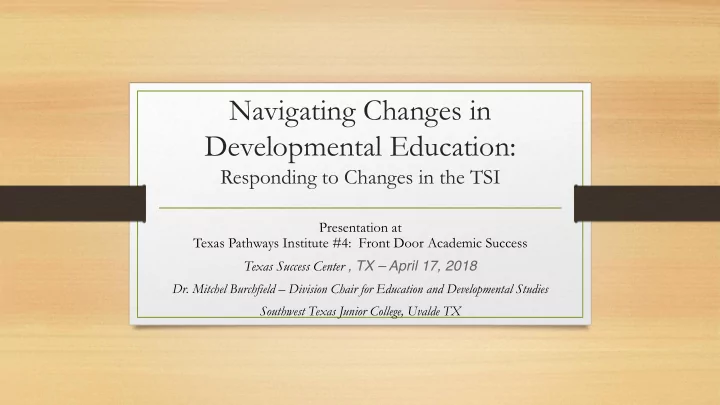
Navigating Changes in Developmental Education: Responding to - - PowerPoint PPT Presentation

navigating changes in developmental education
SMART_READER_LITE
LIVE PREVIEW

Navigating Changes in Developmental Education: Responding to - - PowerPoint PPT Presentation

Navigating Changes in Developmental Education: Responding to Changes in the TSI Presentation at Texas Pathways Institute #4: Front Door Academic Success Texas Success Center , TX April 17, 2018 Dr. Mitchel Burchfield Division Chair for


slide-1
SLIDE 1

Navigating Changes in Developmental Education:

Responding to Changes in the TSI

Presentation at Texas Pathways Institute #4: Front Door Academic Success Texas Success Center , TX – April 17, 2018

  • Dr. Mitchel Burchfield – Division Chair for Education and Developmental Studies

Southwest Texas Junior College, Uvalde TX

slide-2
SLIDE 2
slide-3
SLIDE 3
slide-4
SLIDE 4

Partial List of Initiatives

  • Digital Literacy
  • Student Success and Accreditation
  • 60X30TX: Workforce and

Marketable Skills

  • Dual Credit and Success in College
  • Guided Pathways: Building

Programs that Work for Students

  • Quality Enhancement Plan
  • Using Data to Improve Student

Outcomes

  • 4DX – The Four Disciplines of

Execution

  • HB 5 & HB 2223
  • SACSCOC
  • Achieving The Dream
slide-5
SLIDE 5

Summary

In today’s world of new initiatives and changes for developmental education, it is important for faculty and administrators to adapt and redesign their courses and

  • programs. This breakout session will provide a

framework for exploring how you can address the needs

  • f your students and institution by finding solutions that

incorporate the Four Pillars of Guided Pathways.

slide-6
SLIDE 6

Summary (continued)

  • Create clear curricular pathways to employment

and further education.

  • Help students choose and enter their pathway
  • Help students stay on their path.
  • Ensure that learning is happening with intentional
  • utcomes.
slide-7
SLIDE 7

A Brief History of Developmental Education in Texas

  • Prior to 1989, developmental education was not mandated by the state.
  • Counselors and students decided if courses were needed to prepare the student.
  • TASP (Texas Academic Skills Program) 1989 – 2000
  • Statewide TASP test that was developed with input from many educators in Texas
  • Mandatory placement in courses for Mathematics, Reading, and Writing Deficiencies
  • Closing the Gaps 2000 – 2013 ( THEA & a variety of assessment instruments)
  • Several Developmental Education Demonstration Projects Funded
slide-8
SLIDE 8

A Brief History of Developmental Education in Texas

  • TSIA (Texas Success Initiative Assessment) 2013 – 2018
  • Holistic Counseling
  • Integrated reading and writing (IRW) for all exit (highest) level courses
  • Noncourse competency-based options (NCBOs) in each content area
  • mainstreaming (coenrollment in DE and college-credit course
  • Today 2018 – 2030
  • 60x30TX
  • HB 2223
slide-9
SLIDE 9

Where Does Developmental Education Fit on the Guided Pathway?

  • Every student should be on a guided pathway
  • Some students may take Developmental Education

Classes as part of their path.

  • Some students may take AEL courses as part of their

path

slide-10
SLIDE 10

Promising Practices in Developmental Education Programs in Texas

  • Faculty Development
  • Comprehensive, year-long professional development program for faculty and

staff supporting integrated reading/writing

  • Program-specific faculty and advisor training and professional development
  • Alignment with Adult Education
  • Intensive workforce training with integrated basic reading, writing, and math

skills

slide-11
SLIDE 11

Promising Practices in Developmental Education Programs in Texas

  • Accelerated Instructional Strategies
  • Integrated reading/writing or Non-course competency-based options

(also known as non-course based or nonsemester length options and interventions)

  • Mainstreaming (also known as “blended,” “co-requisite,” and

“concurrent” enrollment models)

  • Intensive bridge/college readiness programs
slide-12
SLIDE 12

Group Work

  • Form into groups of 7-10 people. (choose members from the group to fill at

least four roles: Facilitator, Recorder, Summarizer, Presenter

  • Use the following questions (from Stasis theory) to guide your discussions:
  • What is it?
  • How did it get that way?
  • Is it good or bad?
  • What should we do or not do about it?
slide-13
SLIDE 13

Group Work (example of using questions)

  • Use these questions to generate ideas for solutions
  • In what ways can your institution incorporate developmental education into

program maps to align the math and English skills to specific programs or meta majors?

  • What academic supports are available to students transitioning from dev ed

into their programs? How are students made aware of the supports, and are some students required to use those supports?

slide-14
SLIDE 14

Group Work (example of using questions)

  • How and when do your institutions identify students who are

struggling in their college-level courses, and what practices are in place to get them resources to help?

  • What are some ways your institutions can contextualize dev ed

courses to add program content to dev ed learning?

slide-15
SLIDE 15

Group Work

  • Each group’s presenter and other members if needed, will present to the

large group their findings.

  • Successful approaches to address the change/initiative at your institution?
  • Advice to the whole group about incorporating a change in developmental education.

How you made sure it worked with Guided Pathways.

slide-16
SLIDE 16

Questions and Discussion

  • Questions from the Audience.
slide-17
SLIDE 17

Presenter’s Contact Information Southwest Texas Junior College in Uvalde Texas

  • Dr. Mitchel Burchfield

Division Chair of Developmental Studies mtburchfield@swtjc.edu 830.591.7325