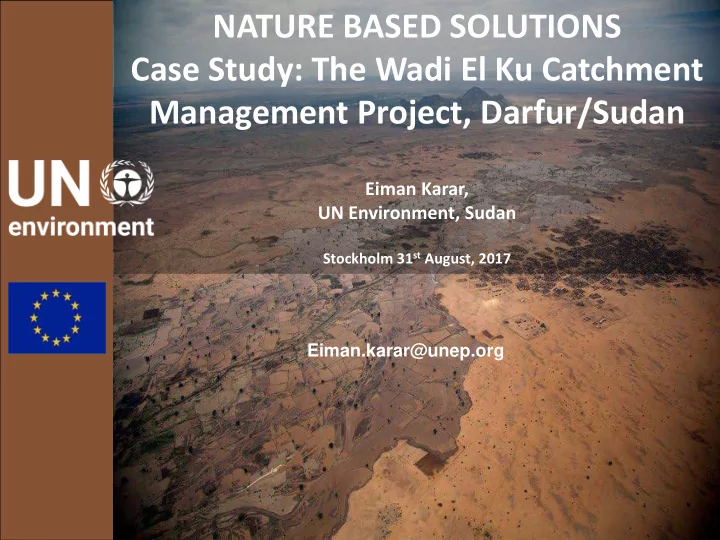
NATURE BASED SOLUTIONS Case Study: The Wadi El Ku Catchment - - PowerPoint PPT Presentation

nature based solutions case study the wadi el ku
SMART_READER_LITE
LIVE PREVIEW

NATURE BASED SOLUTIONS Case Study: The Wadi El Ku Catchment - - PowerPoint PPT Presentation

NATURE BASED SOLUTIONS Case Study: The Wadi El Ku Catchment Management Project, Darfur/Sudan Environment Programme Eiman Karar, UN Environment, Sudan Stockholm 31 st August, 2017 Eiman.karar@unep.org Michael Brown, Senior Mediation Expert


slide-1
SLIDE 1

Environment Programme

Michael Brown, Senior Mediation Expert Kulmiye Mohamed, DPA David Jensen, UNEP Dag Seierstad, UNEP

NATURE BASED SOLUTIONS Case Study: The Wadi El Ku Catchment Management Project, Darfur/Sudan

Eiman Karar, UN Environment, Sudan

Stockholm 31st August, 2017

Eiman.karar@unep.org

slide-2
SLIDE 2
slide-3
SLIDE 3
slide-4
SLIDE 4
slide-5
SLIDE 5
slide-6
SLIDE 6
slide-7
SLIDE 7
slide-8
SLIDE 8
slide-9
SLIDE 9
slide-10
SLIDE 10
slide-11
SLIDE 11
slide-12
SLIDE 12

Most activities focus on a 50 km stretch near El Fasher, from the village of Sarafaya upstream, to the village of Qoz Beina downstream (34 village councils) Reason for selection: Accessibility, security, sufficient settled population - decision made by state government and donor. The project is funded by the EU at a total value of 6.8 million Euro. It is implemented as a partnership between UNEP , Practical Action, communities, and the Government of North Darfur. The project started in August 2013 and ends in 31 March 2017.

slide-13
SLIDE 13
slide-14
SLIDE 14
slide-15
SLIDE 15
slide-16
SLIDE 16
slide-17
SLIDE 17
slide-18
SLIDE 18
slide-19
SLIDE 19
slide-20
SLIDE 20
slide-21
SLIDE 21
slide-22
SLIDE 22
slide-23
SLIDE 23
slide-24
SLIDE 24
slide-25
SLIDE 25
slide-26
SLIDE 26
slide-27
SLIDE 27
slide-28
SLIDE 28
slide-29
SLIDE 29
slide-30
SLIDE 30
slide-31
SLIDE 31
slide-32
SLIDE 32
slide-33
SLIDE 33
slide-34
SLIDE 34
slide-35
SLIDE 35
slide-36
SLIDE 36
slide-37
SLIDE 37
slide-38
SLIDE 38
slide-39
SLIDE 39
slide-40
SLIDE 40
slide-41
SLIDE 41
slide-42
SLIDE 42
slide-43
SLIDE 43

The gender dimension

slide-44
SLIDE 44

Main messages

  • Through understanding how nature works, science is the impartial partner,

competing users can start from a common ground to working out how they can all benefit from natural resources.

  • This is the first step in establishing trust between competing users even in conflict

situations

  • Make sure that all affected are part of the process and ensure communities have a

voice specially women.

  • The project contributed to lifting the blinkers in both temporal (sustainability) and

spatial (catchment) scales.

  • Darfur and other conflict prone locations are inhabited by people who have no

political interests and capable of responding positively to development projects.

  • So to the development community do not shy away from conflict-prone areas.
slide-45
SLIDE 45

THANK YOU

http://www.unep.org/disastersandconflicts/where-we-work/republic-sudan