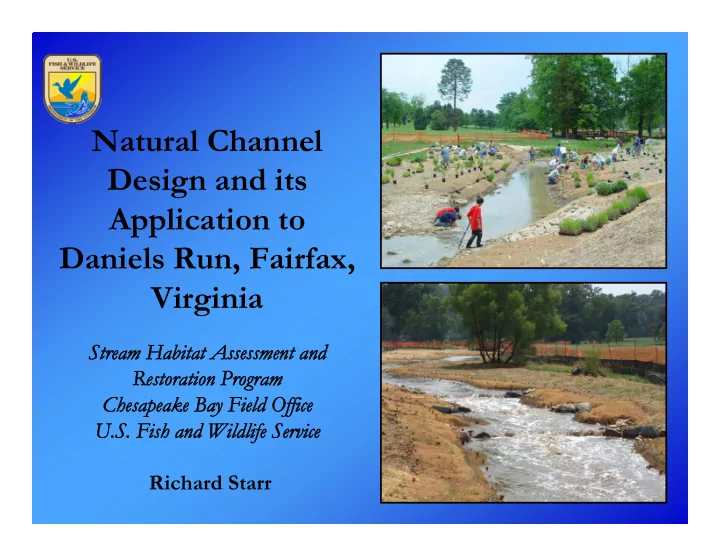
Natural Channel Design and its Application to Daniels Run, - - PowerPoint PPT Presentation

natural channel design and its application to daniels run
SMART_READER_LITE
LIVE PREVIEW

Natural Channel Design and its Application to Daniels Run, - - PowerPoint PPT Presentation

Natural Channel Design and its Application to Daniels Run, Fairfax, Virginia Stream Habitat Assessment and Stream Habitat Assessment and Restoration Program Restoration Program Ch Chesapeake B esapeake Bay Field Office ay Field Office


slide-1
SLIDE 1

Natural Channel Design and its Application to Daniels Run, Fairfax, Virginia

Stream Habitat Assessment and Stream Habitat Assessment and Restoration Program Restoration Program Ch Chesapeake B esapeake Bay Field Office ay Field Office U.S. Fish U.S. Fish and Wildlife Service and Wildlife Service Richard Starr

slide-2
SLIDE 2

Presentation Overview

  • Daniels Run Stream

Restoration Project

  • Watershed and Stream

Assessments

  • Natural Channel Design

Methodology (NCD)

  • Construction

Management

  • Monitoring
slide-3
SLIDE 3

Daniels Runs Stream Restoration Project

  • Partnership Between the U.S. Fish and

Wildlife Service and Army Navy Country Club (ANCC), Fairfax, Virginia

  • Restoration Objective – return 2,500

linear feet of Daniels Run to a stable, self- maintaining state, while meeting the aesthetic and golf playability goals of the Country Club

  • Project completed July 2007
slide-4
SLIDE 4

Watershed and Stream Assessment

  • Watershed Assessment

– Stream-based and land-based assessments – Stream-based - visual assessment of stream character and stability condition – Land-based – land use/land cover, geology, soils, hydrology, basin conditions, and development trends

  • Stream Assessment

– Bankfull determination – Limited Rosgen Levels II and III – Level II – stream type and character (width, depth, pattern, profile, substrate) – Level III – stream stability (incision, entrenchment, confinement, vegetation, erosion potential, shear and critical shear stresses, deposition pattern, meander pattern, channel evolution)

  • Determine interrelationship of watershed and stream processes

(“cause and effect” relationships)

slide-5
SLIDE 5

Watershed Boundary Daniels Run

slide-6
SLIDE 6
  • Drainage Area – 1.88 square miles
  • Rosgen valley type VIII
  • Basin relief – 1 percent
  • Land use/Land cover - highly developed

– 45% medium density residential – 20% industrial/commercial – 35% forested and grass areas (mostly located on ANCC property) – Development located in upper two-thirds of watershed – New development potential low

  • Geology and soils – poorly to moderately well drained
  • Hydrology – flashy flow regime due to development,

high density storm drains, and lack of flood storage capacity

  • Stream Condition – stable to unstable conditions

Daniels Run Watershed Condition

slide-7
SLIDE 7

Stream Condition

  • Rosgen Stream

Types – Reach 1-C4 and Reach 2-F4

  • Approximately 60%

banks eroding

  • Riparian vegetation –

primarily mowed grass

  • Widespread

instability

  • Stability trend -

degrading

Reach 1 Reach 1 Reach 2 Reach 2

slide-8
SLIDE 8

Natural Channel Design Methodology

  • Restoration objectives
  • Design criteria
  • Form - channel dimension, pattern, and

profile

  • Process – hydraulic and hydrologic

analyses

  • Structures
  • Iterative Analysis
  • Plantings
slide-9
SLIDE 9

Natural Channel Design Methodology Definition

slide-10
SLIDE 10

Natural Channel Design Methodology Definition

The creation of a stable dimension, pattern, and profile for a stream type and channel morphology appropriate to its landform and valley, designed such that

  • ver time, is self-maintaining meaning its

ability to transport the flow and sediment of its watershed without aggrading or degrading.

slide-11
SLIDE 11

Daniels Run Restoration Objectives

  • Restore a natural, self-sustaining stream
  • Apply natural channel design principles
  • Maintain golf course playability
  • Improve in-stream habitat (i.e., diversity and

quality)

  • Establish a native riparian buffer without

affecting golfing activities

  • Improve water quality (e.g., reduce

temperatures and sediment)

  • Require low maintenance
slide-12
SLIDE 12

Restoration Strategy

  • Total stream

reconfiguration

  • Two Rosgen stream

types – C4 and B4c

  • Structures and soil

fabric lifts

slide-13
SLIDE 13

Design Criteria

  • Reference Reach
  • Ratios based on

bankfull dimensions

  • Data range
  • Defines channel

form and substrate

  • Used as

monitoring performance measures

2.5 1.9 n/a n/a Max 2.2 1.7 4.7 n/a Mean ft dmax Riffle Bankfull Maximum Depth 7 n/a n/a n/a n/a Max n/a n/a n/a n/a Min 33.8 29.3 179.3 n/a Mean ft2 Abkf Riffle Bankfull Cross Sectional Area 6 17.2 18.0 n/a 27.0 Max 12.4 9.0 n/a 9.0 Min 14.6 15.0 11.2 15.0 Mean W/dbkf Width/Dept h Ratio 5 n/a n/a n/a n/a Max n/a n/a n/a n/a Min 21.0 19.0 44.8 n/a Mean ft Wbkf Riffle Bankfull Width 4 1.2 0.7 n/a n/a Max 1.7 2.1 n/a n/a Min 1.4 1.3 4.0 n/a Mean ft dbkf Riffle Bankfull Mean Depth 3 n/a n/a n/a n/a Max n/a n/a n/a n/a Min 1.9 1.9 27.0 n/a Mean mi

2

Drainage Area 2 B4/1c C4 B4/1c C4 Stream Type 1 Proposed Reference Data Units Symbol Variable No.

Daniels Run Reference Reach Design Criteria

slide-14
SLIDE 14

Form – Cross Section

5 10 10 20 30 40 50 60 70

Construct Toe Benches to Narrow Low Flow Channel Deepen Low Flow Channel Fill Cut Existing Section Proposed Section (a) Cross Section Adjustments

slide-15
SLIDE 15

Form – Plan Form

slide-16
SLIDE 16

Form – Profile

slide-17
SLIDE 17

Process – Hydraulic and Hydrologic Analyses

  • Sediment transport

– Critical shear stress analysis – Entrainment calculations – Modeling

  • Flood analysis

– FEMA – 5 yr, 10 yr, 25 yr, and 50 yr

slide-18
SLIDE 18

Structures

  • Purpose
  • Type
  • Location
slide-19
SLIDE 19

Daniels Run Stream Restoration Log-Rock Cross Vanes

Plan View Profile View

slide-20
SLIDE 20

Daniels Run Stream Restoration Rock J-hook Vane

Plan View

slide-21
SLIDE 21

Daniels Run Stream Restoration Rock W-Weir

Plan View Cross Section View Profile View

slide-22
SLIDE 22

Daniels Run Stream Restoration Soil Lifts

Cross Section View

slide-23
SLIDE 23

Planting

  • Design objectives
  • Planting

Requirements

slide-24
SLIDE 24

Planting Plan

slide-25
SLIDE 25

Planting Typical

slide-26
SLIDE 26

Planting

  • Design objectives
  • Planting

Requirements

  • Planting zones
  • Typicals
  • Volunteers
slide-27
SLIDE 27

Construction Management

  • Stakeout
  • Structures
  • Grading
  • Materials
  • Specifications
  • Stabilization
slide-28
SLIDE 28

Monitoring

  • 3 to 5 yrs
  • Quantitative performance standards
  • As-built drawings
  • Monumented cross sections
  • Structure evaluation standards
  • Photo documentation
  • Vegetation success
slide-29
SLIDE 29

Daniels Run Stream Restoration Before and After

slide-30
SLIDE 30

Daniels Run Stream Restoration Before and After

slide-31
SLIDE 31

U.S. Fish & Wildlife Service - Chesapeake Bay Field Office

177 Admiral Cochrane Drive Annapolis, Maryland 21401 www.chesapeakebay.fws.gov Richard Starr (410) 573-4518 rich_starr@fws.gov Daniels Run Reports and Design: http://www.fws.gov/chesapeake bay/streampub.htm