
SLIDE 1
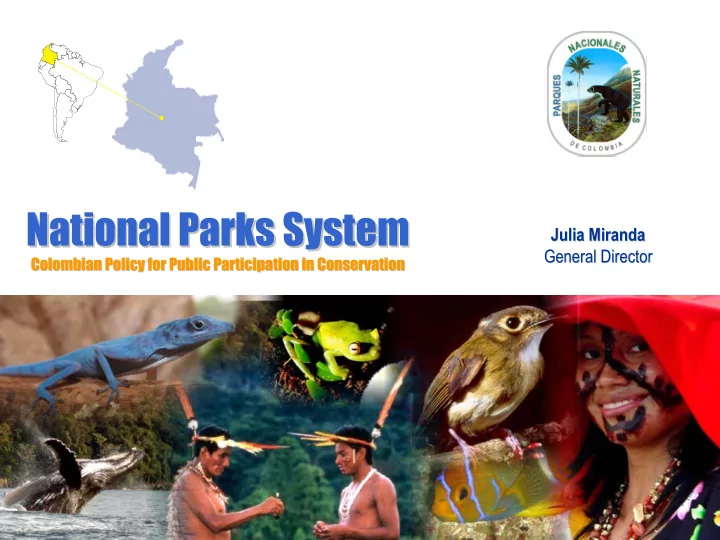
National Parks System National Parks System
Colombian Colombian Policy for Public Participation in Conservation Policy for Public Participation in Conservation
Julia Miranda Julia Miranda General Director General Director
National Parks System National Parks System Julia Miranda Julia - - PowerPoint PPT Presentation
National Parks System National Parks System Julia Miranda Julia Miranda General Director General Director Colombian Policy for Public Participation in Conservation Colombian Policy for Public Participation in Conservation Colombia Colombia
Colombian Colombian Policy for Public Participation in Conservation Policy for Public Participation in Conservation
Julia Miranda Julia Miranda General Director General Director
Natural National Parks
10% of national territory
51 protected areas 10’409.721 hectares
114’748.800 Ha continental area More than 9´000.000 Ha marine area
10% of the global biodiversity is found in Colombia
and amphibians diversity (+600 sp)
COLOMBIAN NATIONAL NATURAL PARKS
Policies and legislation
National Constitution: Protects the right to a healthy environment. Recognizes the ethnic and cultural diversity of the country. Law 99 (1993): Creates the Ministry of Environment, the National Parks Agency and the Regional Autonomous Agencies as environmental authorities and 5 Research Institutes .It also creates a new category of protected areas: The Civil society natural reserves. Biodiversity Conservation Convention Law (1994). National Policy for Biodiversity (1996). National action plan for biodiversity. Establishes national guidelines and strategies which include: Parks management, sustainable renewable resource management plans, assesments of economic potential to ensure equitable use and benefit sharing, legislative and institutional strengthening, technology transfer, biodiversity information systems and community training and participation.
Policies and legislation
National Development Plan (2003-2006): Goals: the consolidation of the National Parks System, the declaration of new parks in high biodiversity zones (164.000 has) and the development of ecoturism activities with the participation of the private sector and local communities. Protection of indigenous rights: Territorial authorities with their own legislation for internal matters, authority on the indigenous reserves, overlapping of reserves and national parks. Management Special Regime in overlapped national parks. Co- management of 2 national paks. Law 70 (1993): Collective property of territories asigned to afro colombian communities. Traditional uses allowed in national parks.
National Parks System Agency
(Decree No 216 / 2003) The Natural National Parks Agency is an institution with financial and administrative autonomy, which is in charge of the management and administration of the Colombian Natural Parks System and the coordination of the National Protected Areas System.
Mision
To guarantee the in situ conservation and ecological representativity of the biophysical and cultural diversity of the country, through the administration of the Natural National Parks System and the coordination, and management of the parks, in order to address the sustainability of the natural, cultural, social and economical values of the country, with the aim of maintaining the ecosystems offer environmental services to sustain the development of the human communities.
Some services provided by National Parks:
benefits 25 millions of Colombians (50% population)
National Parks Staff
40,000 hectares
Institutional Presence in the national territory
Social Participation in Conservation Policy:
Consolidation of the National Park System
Conservation as social investment
ecosystems with areas affected by internal conflict
more effective when local communities and society at large capture the benefits of conservation.
Consolidation of the National Parks System
Inclusive National Protected Areas System, including national parks, nature private reserves and traditional lands (resguardos) . Coordination. National Parks Authority coordinates the National Protected Areas System with other institutions and social
Resguardos Indígenas Comunidades Negras
Paeces Authorities Agreement Environmental and Productive Planning North of Cauca Tandachiridu Iganokuna. Coordination Management 68.000 has. Ingas Bota Caucana Caildos (Indigenous Authority) And Peasant Communities Landscape Planning 160.000 has in Churumbelos ACATISEMA – Plante – Incora. Agreement: 16 Reserves, Peasants Protection of 1’100.000 has in Mataven Etnua Puinave Compromised Management 1’092.500 has RNN Puinawai Miraña Authority Coordinated Defense of 507.500 has and 320 km of Caquetá River OREWA, ACIESCA, ACIESNA, OIA, ONIC Territorial Protection Regional Agreement Scope: 1’600.000 has. Paeces PNN Munchique Attention, Production, Commercialization Etnia Motilón Barí PNN Catatumbo and Indigienous Reserves Overlap GONAWINDUA Sierra North Sector Intercultural Management Amacayacu Ecotourism Project 6 Indigenous Communities Puerto Nariño Afro-Colombian Communities Process Regional Agenda Afro-Colombian Communities For protection of territories
Conservation opportunities with ethnic groups
ACIN North of Cauca Industrial Compromises “Ley Paez” and GEF Project – Scope: 190.000 has. 110.000 families PMA in the Sierra Nevada PNN Galeras PNN Picachos
Areas with Special Management Regimen
Islas del Rosario and San Bernardo Voluntary Management Agreement Agreement Parks – Plante – PMA. Peasant Sustainable Agrarian Systems In 13 Counties – Macizo- Ciénaga, Salamanca Advances in Management and Fishing Planning Afro-Colombian Communities Process Regional Agenda Afro- Colombian Communities For protection of territories CARS, ONG, UNIVERSIDADES, INSTITUTOS Environmental Planning Eje Cafetero AMAI, GEA, AGROS Attention 13 Counties Serranía Yariguíes ECOAN Peasant Web of the High Moors AMCOP y and other Peasant Organizations Productive Planning in Picachos FARALLONES Productive Process Peasant Communities ACATAM Environmental Re-arrangement Guayabero River Territory - Tinigua PARAMILLO Attention to 2600 displaced families KATIOS - AMED Fishing Planning Ciénaga SANQUIANGA Compromised Research and Management Of Fishing Resources. Property Owners, Government, District Ecotourism Promoter of Tayrona
Conservation Opportunities with Peasant and Fishing Organizations, and Local Authorities
ASCAL – G – Plante - Cormacarena Attention 1600 peasant families
Sustainable Systems Strategy for Conservation in National Parks
compatible with biodiversity conservation and sustainable use.
alternative productive activities that improve communities' quality of life, thus gaining a greater commitment towards the protection of National Parks.
Main results in the last 4 years
Parks.
peasant families have participated in the development and implementation of this strategy.
environmental authorities, 7 NGOs and
ecosystem recovery, soil and water conservation.
related to food security and ecotourism 50.860 people
The National Parks System and illicit crops
National Parks coca plantations dinamics
1000 2000 3000 4000 5000 6000 7000 1 2 3 4 Years Plantations area
6057 4617 3790 5364 2001 2002 2003 2004 Total Protected Area of the National Natural Parks System: 10.409.721 hectares, 10% of the Total National Territory. National Natural Parks area affected by coca plantations, 2004: 0.05% Source: SIMCI Project, July, 2005
Total Protected Area of the National Natural Parks System: 10.409.721 hectares, 10% of the Total National Territory. National Natural Parks affected area by poppy plantations, 2004: 0.001% Source: DIRAN, June, 2005
National Parks and Poppy Plantations
205 hectares Total 15 Purace 92 Nevado del Huila 82 Hermosas 14 Los Nevados
Strategy for the management of human settlements and Illicit uses inside the National Parks and their buffer zones
General Objective of the Strategy To guide and coordinate the institutional actions and orientations in order to prevent, mitigate and reduce the general impacts caused by human settlements and illicit plantations inside the parks and their buffer zones. Specific Objectives
actions of the environmental authorities and institutions
and human settlements conflicts in territories of local communities and the areas of the National Parks System
Strategy Criteria Inter- agency cooperation: The strategy develops a cooperative framework between different governmental agencies for the development
Local participation and community capacity building processes: Based on the knowledge of the communities including their problems, solutions and proposals. Cultural diversity of the different stakeholders: Overlapping of the indigenous and afro-Colombian territories implies the understanding of
Social Participation: Agreements for the land use planning of areas with illicit crops. Conservation as a development strategy: A National Park must generate productive options and concrete benefits for local communities.
What is the National Parks Agency Doing?
associations, etc.) they have invest $ 800,000 dollars.
sustainable projects for families located inside the Sierra Nevada de Santa Marta National Park.
Nevada de Santa Marta, Tayrona, Tinigua and Sierra de La Macarena.
cartography of illicit plantations and uses inside the National Parks, including social and environmental information. (with SIMCI and Antinarcotics Police Department).
Santa Marta, PNN Catatumbo y PNN Serranía de La Macarena, and working on RNN Nukak, RNN Puinawai, PNN La Paya y PNN Paramillo.
What is the National Parks Agency Doing?
the priorization
plantations.
for the manual eradication of coca plantations in the PNN Tayrona, finished on August 2004.
Defense Minister and the General Operation chiefs of the Army.
High Advisor for Social Actions in order to establish special work teams for manual eradication inside the Natural National Parks in 2005.
developed by the Navy finished in October 2005. In 2006 restoration of those areas will be undertaken with the support of the Netherlands Embassy.
What is the National Parks Agency Doing?
Financial strategy
Financial resources for conservation
– Own Resources
International Cooperation; 30% Own resources; 35% National government 35%
Financial situation of the Parks Agency The National Parks Agency projected deficit for 2005 and 2006 is US$ 4.6 and US$ 3.7 million respectively, taking into account increasing NNPS resources, stable government and cooperation resources, and the cost of Management Plan implementation.
Activities developed to supply the financial needs of the NATIONAL Parks authority
– Eco-tourism services fees – Implementation of eco-tourism services through the concessions of six mayor areas of tourism – Collecting money for environmental services with emphasis in water
Activities developed to supply the financial needs of the National Parks System
national parks, buffer zones and ecological corridors. US$ 10 million
Areas Conservation Trust Fund Project
Creation of the COLOMBIAN BIODIVERSITY AND PROTECTED AREAS Trust Fund
Succesful International experience with Protected Areas Conservation Trust Funds
and protected areas management
supporting 23 such funds around the world and investing US$596 million
in the Colombian Fund’s legal and operational structure.
Why is a Conservation Fund useful for Colombia?
Institutional capability Colombia has a well-developed legal framework for conservation, and solid institutional capacity, from both the public sector and civil society organizations. Potential areas: National Parks, Regional and local public protected areas (3,5% of the national territory) Indigenous and afrocolombian territories, private reserves (more than 400). Financial Constraints of the national parks system and other public and private institutions
Colombian Biodiversity and Protected Areas Trust Fund
The fund is capable of leveraging and attracting additional financial resources that builds upon the national institutional capacity and contributes to the national conservation goals, in the frame of the public conservation policies.
Background
– This initiative is part of the Strategy for Financial sustainability of the National Parks System
– Desing and establishment of the Fund (project under implementation) – US$15 million grant (currently under approval) – Support from experience and lessons learned from international funds
– Signed in 2004 for US$ 10 million.
The Fund
The fund will be a long – term financial mechanism specialized in channeling resources to both private and public Protected Areas as well as complementary conservation and biodiversity sustainable use strategies.
consolidation and sustainability of the National Protected Areas System, by negotiating, administering, coordinating and allocating national and international financial resources for different types of protected areas and strategies, and strengthening the relations between different stakeholders.
American Funds and the GEF supported Fund experiences.
experience from similar funds in various countries, including Madagascar, Brazil, Mexico, Ecuador and Bolivia.
environmental and public sectors
the country
Activities undertaken for the Fund's design
Colombian Biodiversity and Protected Areas Trust Fund
The fund is being designed as a foundation operating under a private-sector legal regime, with a public- private board composition and a mandate to contribute to public-sector conservation policies related to the National Protected Areas System.
contribution; This structure promotes a shared responsibility in conservation and complementarities of conservation actions with diverse approaches, jurisdictions and forms of governance. The private legal regime is intended to guarantee agile and transparent administrative procedures and flexible financial managent. The Fund will be established by november 2005.
Administrative and Financial Structure
and long-term financial needs of the National Protected Areas System
Sub-Accounts, if so requested, to finance specific protected areas or conservation strategies. – At the donor’s request, the fund will have Sub-Accounts may contain independent Steering Committees and will maintain independent financial statements and monitoring mechanisms so that the various donors can keep track of their contributions and evaluate their impact.
areas
► A National Park has an average operational cost of US$140.000. ► 60% is currently covered by government allocation.
strategies
Administrative arrangements and financial management
– Institucional capacity assesment from the World Bank
– Competitive selection of an asset manager, following World Bank investment and procurement guidelines
– Financial expert qualified to assist the executive director and the management board with the definition of an asset allocation and overall investment strategy
– Audit reports – The Fund will collect experience of an organization with more than 4 years on the field of projects execution and monitoring for the National Parks System
Uses of the interest generated by the endowment account (after the third year)
– Maintaining the investment.
Endowment Account GEF: US$7.5m
+ US$2.5 m
Sinkimg Account GEF: US$7.5m
World Bank Project /GEF US$ 15 millions
World Bank Project/ GEF US$ 15 millones
Biodiversity and Protected Areas Trust Fund
ENDOWMENT ACCOUNT SINKING ACCOUNT
– Establishment of an endowment account:
– 3 to 4 protected areas with GEF endowment resources
9 CONSERVATION MOSAICOS Galeras Farallones de Cali Sanquianga Orquideas Utria Corales del Rosario Old Providence Cahuinarí Puinawai
CONSERVATION AREAS:
Ecological functionality Relation between different stake holders Maintenance and restoration of landscape biological connectivity and ecological integrity;
World Bank Project/GEF: Investment Resources
Territorial ordering processes in buffer zones National Park – core area sustainable production systems Natural private reserves conservation initiatives in ethnic territories
Potential support to the
– Resource Managament through the sinking account:
Conservation – Implementation of National Parks Management Plans – Implementation of the Strategy of Sustainable Systems for conservation: restoration and buffer zone management – Development of the Strategy of illciit use and occupation – Co-management agreements with indigenpus authorities in Parks overlapped with resguardos
– Conservation, restoration and ecological connectivity in rural landscapes – Support to territorial ordering processes and conservation in ethnic territories – Donations Endowment account :.
the order of US$50.5 million.