National Mission For National Mission For Sustainable Agriculture - - PowerPoint PPT Presentation

national mission for national mission for sustainable
SMART_READER_LITE
LIVE PREVIEW

National Mission For National Mission For Sustainable Agriculture - - PowerPoint PPT Presentation

National Mission For National Mission For Sustainable Agriculture Sustainable Agriculture Strategies for Meeting the Challenges of Climate Change Strategies for Meeting the Challenges of Climate Change Department of Agriculture and Cooperation


slide-1
SLIDE 1

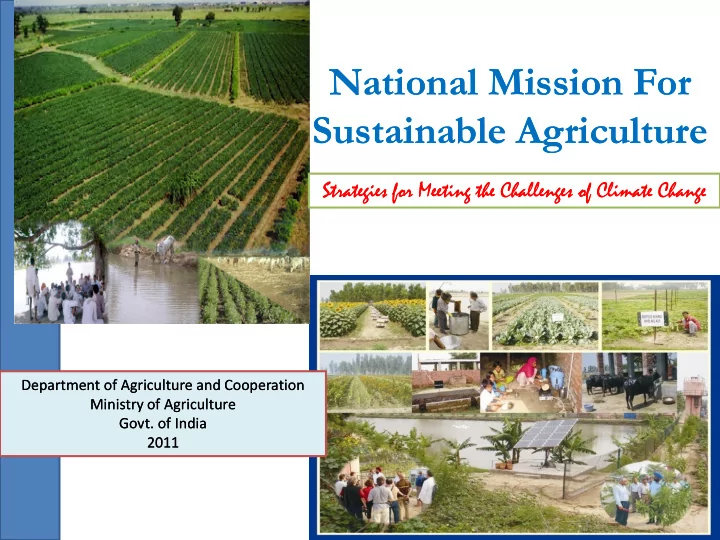
National Mission For National Mission For Sustainable Agriculture Sustainable Agriculture

Strategies for Meeting the Challenges of Climate Change Strategies for Meeting the Challenges of Climate Change

Department of Agriculture and Cooperation Department of Agriculture and Cooperation Ministry of Agriculture Ministry of Agriculture

  • Govt. of India
  • Govt. of India

2011 2011

slide-2
SLIDE 2

2

National Mission For Sustainable Agriculture

Climate change is no more an environmental concern. It has emerged as the biggest developmental challenge for the planet.

( UNDP 2009)

slide-3
SLIDE 3

3

Climatic Variability and Extreme Events

Food System Food System Farm or Farm or Cropping Cropping System System

Crop and Crop and Livestock Livestock

Interplay Interplay Interplay Interplay Risks

National Mission For Sustainable Agriculture Agriculture sector being closely tied to natural resource base is more vulnerable to climate change (NAPCC)

slide-4
SLIDE 4
  • Lower

Productivity

  • Poor quality of

Produce

Crops

  • Degradation and

Depletion

Soil and Water Resources

  • Additional Heat

Stress

  • Impact on

Aquatic Habitat Livestock and Fisheries Affects Livelihood Food Security and Economy

Risks on Agriculture Risks on Agriculture Risks on Agriculture Risks on Agriculture

Agrarian Agrarian Distress Distress

4

National Mission For Sustainable Agriculture

slide-5
SLIDE 5

Risks From Agriculture Risks From Agriculture Risks From Agriculture Risks From Agriculture

5

National Mission For Sustainable Agriculture

Million Tonnes of CO2 Equivalent Source: MoEF, 2010

  • 17.6% of total GHG is

from Agriculture

  • 63.4% contributed by

Livestocks and 20.9% by Rice Cultivation

slide-6
SLIDE 6
  • Climatic Variability and Extreme Events

– Temperature Rise: 0.2 degree Centigrade per decade – Mean Summer Rainfall to increase – Frequent and Longer dry spells – Shorter but Heavier Precipitation Events – Hot Extremes, Heat Waves to be more common – Contraction of Snow Cover – Rise in Sea Levels

  • Degradation of Natural Resources

(Land/Water/Bio- diversity)

6

Climate Change Projections Climate Change Projections Climate Change Projections Climate Change Projections

National Mission For Sustainable Agriculture

IPCC-2007 IPCC-2007

slide-7
SLIDE 7

Reduction of Agriculture Yields in Long Term: Upto 40% by 2100 Impacts Impacts Impacts Impacts

If no adaptation and mitigation measures are taken

National Mission For Sustainable Agriculture

7

(NAPCC)

slide-8
SLIDE 8

Conceptualizing Conceptualizing NMSA NMSA Conceptualizing Conceptualizing NMSA NMSA

National Mission For Sustainable Agriculture

8

  • Brain-Storming Session

chaired by Hon’ble AM Beginning the Process

  • Stakeholders Ministries

and Departments

  • Knowledge Institutions

(TERI, ICRISAT, CRIDA)

  • State Governments

Consultations

  • Dr. K Kasturirangan
  • Dr. M S Swaminathan
  • Prof. Abhijit Sen
  • Dr. G S Kalkat

Expert Review

Formulation of Approach Paper Preliminary Draft Document Final Draft Document

slide-9
SLIDE 9

Ensure Food Security and Equitable Access to Food Resources Enhance Livelihood Opportunities

Transform Transform Agriculture into Agriculture into Climate Resilient Climate Resilient Production system Production system

Grow and Ecologically Sustain agricultural production to its Fullest Potential Contribute to Economic Stability at the National Level

Vision Vision Vision Vision

9

National Mission For Sustainable Agriculture

slide-10
SLIDE 10

Focus Focus Focus Focus

Dryland Farming Strategic Planning at Agro Climatic Zone Level Customized interventions to enhance productivity Easy access to Information and Institutional Support Linking Laboratory to Land

National Mission For Sustainable Agriculture

  • To realize the enormous agricultural growth potential
  • f the drylands and secure farm-based livelihoods

through customized crop varieties and practices

  • To contextualize action plans to regional scales for

improving efficiency and effectiveness in R&D, Technology, Product & Practices, Capacity building

  • Use of Bio Technology, Management of heat stress in

livestock, Improving water use efficiency, Soil conservation, Capacity building

  • Access to information, Risk Management, Market

Infrastructure

  • Institutional Linkages with stakeholders, civil society
  • Model Village and Farm Units
  • Establishing Linkages between Research, Industry and

Farmers

slide-11
SLIDE 11

Technology, Products and Practices Capacity Building Infrastructure

Dimensions Dimensions

Research and Development

Functional Areas Functional Areas

Approach Approach Approach Approach

11

National Mission For Sustainable Agriculture

slide-12
SLIDE 12

12

Functional Areas Functional Areas Functional Areas Functional Areas

  • Biotechnology, Drought resistant Crops
  • Livestock
  • Research on Dryland Agriculture

Research and Development

  • Resource Conservation Technology
  • Agricultural Mechanization
  • Integrated Farming

Technology, Product and Practices

  • Financial Infrastructure (Insurance,

Credit)

  • Market Infrastructure
  • Information Network

Infrastructure

  • Farmer-Industry-Institution Linkage
  • Knowledge Management

Capacity Building

slide-13
SLIDE 13

Programme Programme of Action

  • f Action

Programme Programme of Action

  • f Action

Mainstreaming adaptation and Mainstreaming adaptation and mitigation measures in ongoing mitigation measures in ongoing Interventions through Interventions through upscaling upscaling and and course course-correction correction Introduction of new programmatic Introduction of new programmatic interventions interventions

13

National Mission For Sustainable Agriculture

Policy Instruments and Convergence Policy Instruments and Convergence

slide-14
SLIDE 14

14

National Mission For Sustainable Agriculture

  • Agricultural inputs, Farm

mechanization, Organic Farming , Micro Irrigation (NHM NHM, , NFSM NFSM, , RKVY RKVY, , NPMSF NPMSF)

  • Research on Crop, Livestock,

Agriculture Census (NAIP NAIP, , FFDS FFDS, , NPCBB NPCBB)

  • Markets, Insurance, Credit

(TMC TMC, , WBCIS WBCIS, , NAIS NAIS, , KCC KCC) )

  • Extension (RKVY

RKVY, , ATMA ATMA, , KVK KVK)

Mainstreaming, Embedding and Upscaling

  • Agricultural Intelligence System
  • Market research (Production-Retail

chain)

  • Resource Conservation Technologies

(RCT)

  • Management of feeding schedule for

livestock

  • Web based digitized climatic

information and forecasting system

New Interventions

slide-15
SLIDE 15

15

National Mission For Sustainable Agriculture

  • Crop insurance
  • Financial incentives for Resource

Conservation

  • Water policies and pricing
  • Agriculture Power, Renewable Energy

Policy Instruments

  • Agro

Agro-Forestry Forestry- National Mission for a “Green India”

  • Water Pricing, Water Efficiency

Water Pricing, Water Efficiency- National Water Mission

  • Energy Pricing for Irrigation, Energy

Energy Pricing for Irrigation, Energy Efficiency Efficiency- National Mission for Enhanced Energy Efficiency

  • Knowledge Management

Knowledge Management- National Mission on Strategic Knowledge for Climate Change

Convergence

slide-16
SLIDE 16

Institutional Framework Institutional Framework Institutional Framework Institutional Framework

Intra- Ministerial Co-Ordination

  • Dept. of Agriculture & Cooperation,

Animal Husbandry & Dairying, Agricultural Research & Education, NGO’s, Civil Society, Private Partners and Other Stakeholders

Inter- Ministerial Co-Ordination

Knowledge Institutions, Stakeholder Ministries (Min. of Water Resources; Power; Environment and Forest; Rural Development; Earth Sciences; Science and Technology, Finance, etc.)

National Level National Level Co-Ordination

Central and State Governments

16

National Mission For Sustainable Agriculture

slide-17
SLIDE 17

17 234.3 240.1 251.9 261.6 271.2 281 217.90 223.29 238.82 243.29 247.75 252.22 257.05 261.33 248.00 271.10 286.20 301.00

200 220 240 260 280 300 320

2010-2011 2011-12 12 2012-13 13 2013-14 14 2014-15 15 2015-16 16 2016-17 17 2017-18 18 2018-2019 2019-2020 2020-21 21

in Million Tonnes

Probable yield loss due to Probable yield loss due to climate change climate change Projected Projected total total foodgrain foodgrain productions that productions that could be achieved after could be achieved after proposed proposed interventions interventions Projected Projected total total foodgrain foodgrain production to production to meet demand meet demand

Outcome Outcome Outcome Outcome

slide-18
SLIDE 18

Scenario 2020: Foodgrain Demand- 281 Million Tonnes

18

  • Climate Change impacts Food Grains

Productions and ‘No Adaptation & Mitigation Measures’ are taken

  • Food Grain Production: 261 Million

Tonnes (Shortfall: 20 Million Tonnes)

Worst Case Scenario

  • Climate Change impacts agriculture but

‘Adaptation and Mitigation Measures’ are implemented

  • Food Grain Production: 281 Million

Tonnes (Shortfall: NIL)

Optimum Scenario

  • Food grain production surpasses target

and reaches 301 Million Tonnes (Excess: 20 Million Tonnes)

Best Case Scenario

Outcome Outcome Outcome Outcome

slide-19
SLIDE 19

Research and Development (6%) Technology, Product and Practices (60%) Infrastructure (29%) Capacity Building (5%)

  • Rs. 1,08,000 Crores in form additional budgetary support

(Upto 2016-17 at current prices)

Financial Implication Financial Implication Financial Implication Financial Implication

19

National Mission For Sustainable Agriculture

slide-20
SLIDE 20
  • Genesis of

Proposed Interventions

  • Rationale for

Repetitions of

  • ngoing schemes
  • Risk and Insurance

Model

  • Strategy Document that

identifies adaptation and mitigation measures

  • [
  • Plan of Action envisages

both Upscaling and New Interventions

  • Revisiting existing

model and Piloting new model

20

Specific Issues Specific Issues Specific Issues Specific Issues

slide-21
SLIDE 21
  • Automatic Weather

Stations

  • Role of

Panchayat/Local Govt and State Govt.

  • More Carbon

Sequestration

  • Convergence with IMD
  • Proposed active

Participation as implementing agency

  • Research and promotion of

higher carbon (C4) pathways in low carbon (C3) plants, genetic manipulation of enzymes such as RuBisco for effectiveness of use of CO2

21

Specific Issues Specific Issues Specific Issues Specific Issues

slide-22
SLIDE 22
  • Creating pool of

trained Manpower, Changing the Mindset and Capacity Building

  • Engaging Private

Partners

  • Limited absorbing

Capacity of Implementing agencies.

  • Capacity Building is one
  • f the Functional Areas;

Sensitization of stakeholders through creating awareness and capacity building

  • Creating Conducive

Environment for Private Sector, PPP

  • Multi-Agency Framework,

Horizontal Expansion, less vertical loading

22

Specific Issues Specific Issues Specific Issues Specific Issues

slide-23
SLIDE 23

Specific Issues Specific Issues Specific Issues Specific Issues

  • Linkage with ICAR

and Dept of Animal Husbandry, Dairying and Fisheries

  • Financial

Procedures

  • Prioritization of

Proposed Interventions

  • Active Participations

and consultations

  • EFC /RKVY on need

basis

  • Identification of Annual

Deliverables

23

slide-24
SLIDE 24

Annual Deliverables Annual Deliverables Annual Deliverables Annual Deliverables

24 Goals, Stepwise Timeframe and Annual Deliverables of National Mission for Sustainable Agriculture Stepwise Time Frame and Annual Deliverables ** ( Cumulative progress in % or quantified units)

  • Sl. No

Goals Activities Deliverables (2011-2017) 2011- 2012 2012- 2013 2013- 2014 2014- 2015 2015- 2016 2016- 2017

1 Developm ent of Natural Resources Water Harvesting, Watershed Development, Development of degraded/Saline/Sodic agricultural land. Area Coverage: 3 mha

  • 0.25

mha 0.25 mha 1.0 mha 1.0 mha 0.5 mha 2 Improving Water Use Efficiency Promoting Micro Irrigation (Drip, Sprinkler), providing last mile connectivity from water source, adoption of efficient irrigation technology. Area Coverage: 12.5 mha

  • 1.0

mha 3.0 mha 3.0 mha 3.0 mha 2.5 mha 3 Developm ent of Horticultur al Sector Promoting new technologies e.g., poly house etc, Dissemination of improved farm practices, Reduction of post harvest losses through strengthening cold chain etc. Area Coverage: 1 mha. 0.1 mha 0.15 mha 0.15 mha 0.2 mha 0.2 mha 0.2 mha 4 Productivit y enhancem ent in Crop Sector Promoting crop diversification, adoption of hybrid rice, System of Rice Intensification (SRI), Contingency Cropping etc. Area Coverage: 10 mha. 1.0 mha 1.0 mha 2.0 mha 2.0 mha 2.0 mha 2.0 mha

slide-25
SLIDE 25

Annual Deliverables Annual Deliverables Annual Deliverables Annual Deliverables

25 Goals, Stepwise Timeframe and Annual Deliverables of National Mission for Sustainable Agriculture Stepwise Time Frame and Annual Deliverables ** ( Cumulative progress in % or quantified units)

  • Sl. No

Goals Activities Deliverables (2011-2017) 2011- 2012 2012- 2013 2013- 2014 2014- 2015 2015- 2016 2016- 2017

11 Developing Safety Net National Agricultural Insurance Scheme(NAIS) and Modified National Agricultural Insurance Scheme(MNAIS) Scheme with desirable improvements in assessment/ calculation of threshold yield/ guarantee yield, reducing the ‘insurance unit’ to village level etc. Coverage: 350 districts with 25% penetration by 2017. 25 districts 25 districts 50 districts 75 districts 75 districts 100 districts Extension of Weather Based Crop Insurance Scheme (WBCIS) to remaining states and UT's. Coverage: 300 districts by 2017. 10 districts 20 districts 50 districts 70 districts 75 districts 75 districts 12 Improved Access to Insurance and Credit Provision for interest holiday for farmers affected by extreme events. A special corpus would be created which would be managed by Financial Institutions (FI) for this purpose. 5% 25% 65% 100 %

slide-26
SLIDE 26

Annual Deliverables Annual Deliverables Annual Deliverables Annual Deliverables

26 Goals, Stepwise Timeframe and Annual Deliverables of National Mission for Sustainable Agriculture Stepwise Time Frame and Annual Deliverables ** ( Cumulative progress in % or quantified units)

  • Sl. No

Goals Activities Deliverables (2011-2017) 2011- 2012 2012- 2013 2013- 2014 2014- 2015 2015- 2016 2016- 2017

15 Capacity Building of Stakeholders Expansion

  • f

farmer

  • institution –industry interface

mechanism; Frontline Demonstration

  • f

resource conserving technology; Introducing vocational courses for land based and non-land based income generating activities to supplement livelihoods.; Strengthening and expanding the coverage

  • f

Training Institutions including Farmers’ schools; Knowledge Management and dissemination of best practices; Organization of Model Training courses for climate risk management and sustainable agriculture. Providing 200 additional demonstrations in each block per annum. 200/ block 200/ block 200/ block 200/ block 200/ block 200/ block Addition of 5 Farmer Field Schools (FFS) per block per annum. 5 FFS/ Block 5 FFS/ Block 5 FFS/ Block 5 FFS/ Block 5 FFS/ Block 5 FFS/ Block Training of additional one crore farmers with special focus on sustainable agriculture and climate change under National Skill Development Mission 5 lakhs 15 lakhs 20 lakhs 20 lakhs 20 lakhs 20 lakhs

slide-27
SLIDE 27

Summing Up Summing Up Summing Up Summing Up

Ecologically S Ecologically Sustainable Agricultural ustainable Agricultural Growth through progressive Growth through progressive Adaptation and Mitigation Adaptation and Mitigation

27

Livelihood Opportunities Equitable Access to Food Food Security Economic Stability

National Mission For Sustainable Agriculture

slide-28
SLIDE 28

28

National Mission For Sustainable Agriculture

Thanks