Visit Dutch delegation UKCIP, Oxford 14th september 2009 Climate - - PowerPoint PPT Presentation

visit dutch delegation ukcip oxford 14th september 2009
SMART_READER_LITE
LIVE PREVIEW

Visit Dutch delegation UKCIP, Oxford 14th september 2009 Climate - - PowerPoint PPT Presentation

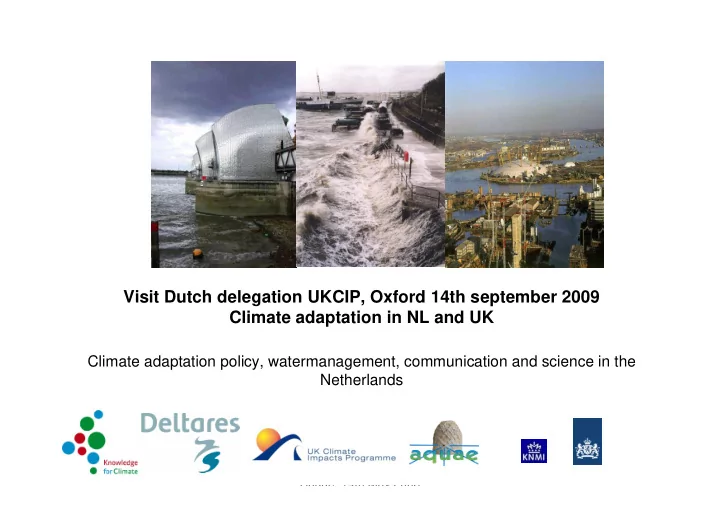
Visit Dutch delegation UKCIP, Oxford 14th september 2009 Climate adaptation in NL and UK Climate adaptation policy, watermanagement, communication and science in the Netherlands 9/30/2009 EU Espace: Adapting to climate 1 change: a spatial


slide-1
SLIDE 1

9/30/2009 EU Espace: Adapting to climate change: a spatial challenge!, The Hague, 14th May 2008 1

Visit Dutch delegation UKCIP, Oxford 14th september 2009 Climate adaptation in NL and UK

Climate adaptation policy, watermanagement, communication and science in the Netherlands

slide-2
SLIDE 2

9/30/2009 EU Espace: Adapting to climate change: a spatial challenge!, The Hague, 14th May 2008 2

Dutch delegation

  • Ministry of transportation and water

management (V&W, Rijkswaterstaat)

  • Ministry of housing, spatial planning and

environment (VROM)

  • KNMI (Met. Office)
  • Province of Groningen
  • Wageningen university and research centre

(WUR)

  • Deltares
slide-3
SLIDE 3

9/30/2009 EU Espace: Adapting to climate change: a spatial challenge!, The Hague, 14th May 2008 3

Content

  • Adaptation challenges
  • Current policy
  • Communication
slide-4
SLIDE 4

9/30/2009 EU Espace: Adapting to climate change: a spatial challenge!, The Hague, 14th May 2008 4

Climate change: what is the challenge?

Climate scenarios for The Netherlands (KNMI)

Based on IPPC, specified for the Netherlands

slide-5
SLIDE 5

9/30/2009 EU Espace: Adapting to climate change: a spatial challenge!, The Hague, 14th May 2008 5

Likely consequences for watermanagement

  • Sea level rise
  • Higher river discharges in winter and much

lower discharges in summer

  • Higher water temperatures
  • Increase of summer droughts
  • Increase of precipitation, peak showers in

summer

  • Increase of salination of surface water
slide-6
SLIDE 6

9/30/2009 EU Espace: Adapting to climate change: a spatial challenge!, The Hague, 14th May 2008 6

Status of the climate projections

  • Reasonable agreement on the trends
  • Much less agreement on the speed and

magnitude.

  • Certainly too little agreement to design water

management systems according to classical approaches (WMO, 1987)

  • Continuous effort to improve the projections is

needed for the sake of science. HOWEVER the potential that point 3 will be solved in the next 5- 10 years is VERY LOW

slide-7
SLIDE 7

9/30/2009 EU Espace: Adapting to climate change: a spatial challenge!, The Hague, 14th May 2008 7

Quality and Value of a climate change projection (free after Micha Werner)

Climate change scientist Get data

Discharge Lobith

2000 4000 6000 8000 10000 12000 14000 16000 18000 21-1 23-1 25-1 27-1 29-1 31-1 2-2 4-2 date discharge [m3/s]

Provide climate projections Change my strategy? Risk of too few / too much measures

Water manager

Inform people Projection Quality Can I provide a more accurate projection Hydrologist Projection Value Should I make another decision Improve models Improve downscaling Understand natural processess Run models

slide-8
SLIDE 8

9/30/2009 EU Espace: Adapting to climate change: a spatial challenge!, The Hague, 14th May 2008 8

Adaptation tipping points

Tipping points

Deltares visit Oxford, 14th september 2009

slide-9
SLIDE 9

9/30/2009 EU Espace: Adapting to climate change: a spatial challenge!, The Hague, 14th May 2008 9

Adaptation tipping points (ATP)

What if climate changes according to scenario x? How much climate change can we cope with? How vulnerable are we for climate change and sea level rise and what adaptation measures should we take ?

Pressures: Climate change & sea level rise State: water quantity & water quality Impact: safety, nature, agriculture etc.

Response: adaptation measures Are objectives achieved?

No Yes

Response: no measures needed

classical approach tipping point approach Pressures: corrensponding climate & sea level State: relevant boundary conditions: water quantity & water quality Impact:

  • bjectives for sectors

Durability of current measures: Under which climate conditions are

  • bjectives not achieved anymore?

When does this occur according to scenario a,b,c,d? Response: adaptation measures in year z
slide-10
SLIDE 10

9/30/2009 EU Espace: Adapting to climate change: a spatial challenge!, The Hague, 14th May 2008 10

Type of conclusions: example Summary of list for impacts in coastal areas (years based on most extreme scenario’s)

  • Current strategy aimed at nature conservation is not sustainable under the climate

changes (Now already an issue)

  • Fresh water supply will be severely hindered through salt water intrusion through

the rivers (becomes an issue not before 2040)

  • Drainage under gravity from Lake IJssel possible up to SLR 35 cm (becomes an

issue not before 2040)

  • Spatial planning in urban areas along tidal rivers (becomes an issue not before

2050)

  • Estimated speed of sea level rise according to higher SLR-scenario’s is very close or

exceeds natural adaptive capacity of the Wadden sea and SW-Delta (sedimentation rates / erosion) Drowning of plates (with rise > 3 mm/year) (issue not before 2050).

  • Storm surge barrier (Maeslantkering) designed for SLR up to 50cm (becomes an

issue not before 2060)

  • Accessibility Rotterdam Harbour hindered (Storm surge barrier needs to close

more than once a year at SLR 75cm (becomes an issue not before 2080))

  • Coastal flood defence through sand supply (becomes an issue not before 2100 / or

if sand cannot anymore be collected from the North Sea)

  • Salt water upward seepage through the groundwater (minor effect)
  • No limitations to technical adaptation measures, but increasingly expensive

and/or need more space

slide-11
SLIDE 11

9/30/2009 EU Espace: Adapting to climate change: a spatial challenge!, The Hague, 14th May 2008 11

ATP’s in watermanagement

  • Nature conservation
  • Fresh water supply hampered by salt

intrusion in West NL

  • Drainage of the IJssel lake using gravity
  • Design criteria of storm surge barrier

exceeded

slide-12
SLIDE 12

9/30/2009 EU Espace: Adapting to climate change: a spatial challenge!, The Hague, 14th May 2008 12

SS 30 40 50 60

  • merafvoer Rijn+Maas

interafvoer Maas interafvoer Rijn 1 ZWV Holland te vaak te zout 2 IJsselmeer winterpeil niet te handhaven via drainage onder vrij verval 3 ZSS hoger dan SVK ontwerp 4 SVK sluit frequentie >1/jr 5 SVK ontwerp niet geschikt voor sluitfrequentie (> 10x / jaar Op zijn vroegst 1990 2029 2042 2055 2061 p z'n laatst 1990 2110 2120 2130 2140 1 NWW afsluiten 2 IJsselmeer

  • pzetten

SVK+ IJsselmeer pompen Gebruik aanpassen 3 IJsselmeer

  • pzetten

Alternatieve aanvoer Afsluiten NWW 2 IJsselmeer

  • pzetten

IJsselmeer pompen Dijkversterking beneden rivieren

slide-13
SLIDE 13

9/30/2009 EU Espace: Adapting to climate change: a spatial challenge!, The Hague, 14th May 2008 13

Key areas

slide-14
SLIDE 14

9/30/2009 EU Espace: Adapting to climate change: a spatial challenge!, The Hague, 14th May 2008 14

Situation ‘Rijnmond’

slide-15
SLIDE 15

9/30/2009 EU Espace: Adapting to climate change: a spatial challenge!, The Hague, 14th May 2008 15

Climate adaptation policy

  • Long term tradition in watermanagement
  • Assessment of long term climate

robustness by 2nd Delta committee (water management national scale)

  • Climate proofing spatial planning, long

term investments (local to national scale)

slide-16
SLIDE 16

9/30/2009 EU Espace: Adapting to climate change: a spatial challenge!, The Hague, 14th May 2008 16

The Netherlands: a long tradition fighting floods

Below sea-level:

  • Approximately 9 mln people and 70% of GDP
  • 60% of the land
  • Amsterdam, Rotterdam, and Schiphol Airport

Flooding along the Rhine and Meuse rivers

slide-17
SLIDE 17

9/30/2009 EU Espace: Adapting to climate change: a spatial challenge!, The Hague, 14th May 2008 17

The Netherlands: a long tradition fighting floods

The 1953 storm surge disaster

  • 1800 casualties,

1800 sq. kms flooded

  • Trigger for the Deltaplan:
  • Closure of estuaries
  • Safety standards on an

economic basis

  • National dike improvement

scheme

slide-18
SLIDE 18

9/30/2009 EU Espace: Adapting to climate change: a spatial challenge!, The Hague, 14th May 2008 18

The Netherlands: a long tradition fighting floods

Deltares visit Oxford, 14th september 2009

High river discharges – Giving space to the river Rhine

Pannerdensche Kop

slide-19
SLIDE 19

9/30/2009 EU Espace: Adapting to climate change: a spatial challenge!, The Hague, 14th May 2008 19

Policy

The Flood Protection Act defines:

  • Safety standards per ‘dike ring’

area (freq. of exceeding of design water level)

  • Responsibilities of parties

involved

  • A 5-yearly safety assessment of

all primary flood defences

  • Guidelines for safety assessment

& design of flood defences

slide-20
SLIDE 20

9/30/2009 EU Espace: Adapting to climate change: a spatial challenge!, The Hague, 14th May 2008 20

Policy

National Adaptation Strategy

  • Societal, governmental and spatial adjustments necessary to make

The Netherlands climate proof

  • Strategy is aimed at
  • safety
  • biodiversity
  • economy
  • quality of the living environment
  • Distinction is being made between potential effects that:
  • may lead to societal disruption (flood risks, diseases)
  • nuissance (drainage, floods, heat stress, ecosystems
slide-21
SLIDE 21

9/30/2009 EU Espace: Adapting to climate change: a spatial challenge!, The Hague, 14th May 2008 21

Policy

3-way approach (under development):

  • legal incorporation (existing EIA)
  • Assessment of national spatial challenges
  • “Klimaatwijzer” (Guidelinese for climate adaptation)

Available tools (a.o)

  • Regional climate predictions (Climate effect sketchbooks)
  • Opportunity mapping
  • Adaptation scan
  • Expert panels
slide-22
SLIDE 22

9/30/2009 EU Espace: Adapting to climate change: a spatial challenge!, The Hague, 14th May 2008 22

Policy

Delta Committee (2008)

  • Long term protection against

sea level rise and river discharge:

  • Safety standards / super levies
  • Localization urban developments
  • Beach nourishments
  • IJsselmeer
  • Rijnmond (Rotterdam area)
slide-23
SLIDE 23

9/30/2009 EU Espace: Adapting to climate change: a spatial challenge!, The Hague, 14th May 2008 23

Policy

National Water Plan

  • End of 2009:

– Final NWP – Deltalaw – Concept Deltaprogramme

  • NWP anchors policy, Deltaprogramme is for

the implementation and sets agenda for the next NWP

  • ‘Resilient when possible, Resistive when

needed’

slide-24
SLIDE 24

9/30/2009 EU Espace: Adapting to climate change: a spatial challenge!, The Hague, 14th May 2008 24

Delta programme

slide-25
SLIDE 25

9/30/2009 EU Espace: Adapting to climate change: a spatial challenge!, The Hague, 14th May 2008 25

Science

Knowledge for climate

  • Research programme with mission:

Development and transfer of scientific and applied knowledge on climate in its relation to spatial planning, infrastructure and sustainability, for government and business sectors towards “climate proofing” the Netherlands.

slide-26
SLIDE 26

9/30/2009 EU Espace: Adapting to climate change: a spatial challenge!, The Hague, 14th May 2008 26

Science – Knowledge for Climate

Approach

  • Climate knowledge facility
  • Knowledge transfer, including international hotspots
  • Hotspots en regional program lines
slide-27
SLIDE 27

9/30/2009 EU Espace: Adapting to climate change: a spatial challenge!, The Hague, 14th May 2008 27

Communication

  • No common portal/organisation like UKCIP
  • Climate communication through:
  • Adaptation programme climate and spatial planning
  • Existing ‘water communication’
  • Knowledge programmes (KfC,PCC,KCSP)
slide-28
SLIDE 28

9/30/2009 EU Espace: Adapting to climate change: a spatial challenge!, The Hague, 14th May 2008 28

Communication

Platform communication on Climate Change (PCCC)

  • The Platform Communication on Climate Change (PCCC) was

established by the Dutch climate research community to improve the quality, efficiency and effectiveness of the communication of Dutch climate research.

  • The institutes making up the PCCC are:

– Netherlands Environmental Assessment Agency (MNP) – Royal Netherlands Meteorological Institute (KNMI) – Climate Change and Biosphere Centre, Wageningen UR (CCB) – Energy Research Centre of the Netherlands (ECN) – Climate Centre VU University Amsterdam (VU University) – Utrecht University – Deltares – Netherlands Organisation for Scientific Research (NWO)

slide-29
SLIDE 29

9/30/2009 EU Espace: Adapting to climate change: a spatial challenge!, The Hague, 14th May 2008 29

Communication

Platform communication on Climate Change (PCCC)

The activities of the PCCC include:

  • Providing actual and background information via the portal

www.klimaatportaal.nl

  • Making materials and knowledge available for communicating the

science of climate and climate change to target groups by – writing popular science reports – organising annual climate updates and climate days – organising ad hoc symposia and dialogue workshops on topical issues

  • Informing the public through contacts with the media
  • Maintaining and publishing a climate diary on www.klimaatportaal.nl
  • Supplying information on international activities (IPCC, Kyoto and

Montreal Protocols)

slide-30
SLIDE 30

9/30/2009 EU Espace: Adapting to climate change: a spatial challenge!, The Hague, 14th May 2008 30

Communication

slide-31
SLIDE 31

9/30/2009 EU Espace: Adapting to climate change: a spatial challenge!, The Hague, 14th May 2008 31

Questions?