
SLIDE 1
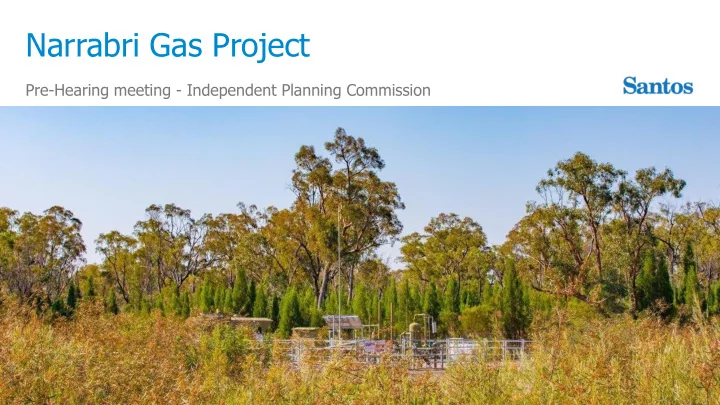
Narrabri Gas Project
Pre-Hearing meeting - Independent Planning Commission
1
Narrabri Gas Project Pre-Hearing meeting - Independent Planning - - PowerPoint PPT Presentation
Narrabri Gas Project Pre-Hearing meeting - Independent Planning Commission 1 Overview + Introduction to Santos + Strategic Overview + Project Overview + Key Technical Areas + Economics + Water + Drilling & Well Integrity +
Pre-Hearing meeting - Independent Planning Commission
1
+ Introduction to Santos + Strategic Overview + Project Overview + Key Technical Areas
+ Economics + Water + Drilling & Well Integrity + Hazard & Risk Assessment + Ecology
Overview
About Santos
A proudly Australian company, Santos is a leading supplier of natural gas, a fuel for the future providing cleaner energy to improve the lives of people in Australia and Asia. Santos aims to be Australia’s leading domestic gas supplier and a leading Asia-Pacific LNG supplier. For 65 years, Santos has been working in partnership with local communities, providing jobs and safely and sustainably developing Australia’s natural gas resources. Santos’ strategy is centred on five core long- life natural gas and LNG assets: the Cooper Basin, Queensland and New South Wales, Western Australia, Northern Australia and Papua New Guinea.
3 *P’nyang (PRL 3) farm-in subject to the execution of a sale and purchase agreement
“…the Department has concluded that the project would not adversely affect the region’s valuable groundwater resources; that the project can be designed to avoid and/or minimise impacts, including reducing the predicted footprint by as much as 30%; and that any residual impacts can be reduced to an acceptable level through effective community engagement, compliance with strict conditions and prompt action to address any problems. Consequently, the project is unlikely to result in any significant impacts on the local community or the environment.”
The Department of Planning, Industry and Environment (DPIE) has concluded that the project is in the public interest and is approvable subject to strict conditions
(Executive Summary, pXIX)
4
Assessment Report
+ The project is critical for energy security and reliability in NSW + Supplying up to half of NSW's future gas needs + Enabling critical extensions gas pipeline network to the northern parts NSW, connecting major gas users + Increasing competition in the domestic gas market and put downward pressure on gas prices + The project delivers significant economic benefits to NSW and the Narrabri region and would stimulate economic recovery from the effects of COVID-19 + The project is designed to minimise any impacts on the region’s significant water resources, including the Great Artesian Basin (GAB), the biodiversity and heritage values of the Pilliga State Forest, and the health and safety of the local community
The DPIE Assessment Report was informed by extensive community consultation and advice from the Narrabri Shire Council, government agencies and independent experts, including a Water Expert Panel established specifically for this investigation.
Assessment Report – Key Findings
+ Project area: ~ 95,000 ha + Total Footprint: ~ 1% (Up to 1,000 ha) + Project Life: 25-year approval + Wells: Up to 850 wells (new & existing) drilling on a maximum of 425 new well pads + Water use: on average 1.5 GL/year produced water extracted from deep coal seams + Salt removed from the environment: ~47.5 tonnes/day, beneficial reuse or disposal to a licensed facility + Leewood (existing + new ponds, water treatment, gas treatment and compression)
Narrabri Gas Project – Overview
Since September 2014, we have engaged extensively with the community: + More than 5,000 individual consultations with landholders, stakeholders and community members + More than 6,000 visitors to our Shopfronts + Over 310 site tours with more than 2,600 participants + 136 contractor and supplier forums and information sessions + 43 Narrabri Gas Project Community Consultative Committee meetings + 15,700 Monthly Activity Update reports distributed to individual stakeholders + Over $1 million on 350 sponsorships for the local community
Community engagement
+ There are 114 landholders in the project area. + Agricultural land in the area is mainly used for dryland cropping and grazing.
9
Landholders
More than 13,000 hours of on the ground environmental surveys to produce detailed vegetation and habitat mapping.
10
Environmental commitment
+ The Project is located in largely dry scrub land that is currently used for industry like timber harvesting. + The Project area does not include pristine forest, National Parks or Nature Reserves. + Our operations will be located on about 1,000ha
At full production, project activities will cover less than half a percent of the Pilliga’s 500,000ha.
11
The Pilliga
+ The Field Development Protocol for the project incorporates: + An ecological scouting framework consisting
+ desktop assessment, + in-field micro-siting and + post-field micro-siting; + Pre-clearing and clearing procedures to minimise risk to fauna. + The Field Development Protocol sets ‘rules’ for avoiding impacts on threatened species and key habitat. Santos will implement a Field Development Protocol to determine where to place gas field infrastructure.
12
Field Development Protocol
+ The EIS includes a Cultural Heritage Management Plan that has been developed after extensive consultation that will allow the Project to be developed without impact on any significant cultural heritage sites. + There are 90 known Aboriginal cultural heritage sites. The Project would completely avoid all of these. + The Assessment Report shows Santos’ commitments to avoidance would appropriately mitigate the project’s potential Aboriginal cultural heritage impacts. Conditions are proposed to ensure this occurs, including requiring Santos to establish an Aboriginal Cultural Heritage Advisory Group for the Project.
Santos has a deep respect for the Aboriginal communities across Australia and we acknowledge their rich and diverse histories and their connection to the land.
Cultural Heritage for the Project
+ Natural gas has a key role to play in a lower-carbon future as it produces less greenhouse gas emissions than coal when used to generate electricity, can significantly improve air quality and is the perfect partner for renewable energy sources. + The Assessment Report concludes that there is a demonstrable need for the gas generated by the project, and that the Project is consistent with NSW’s and Australia’s commitments to a low carbon future.
Greenhouse Gas Emissions
+ The Project footprint is located in an area where sensitive receptors are sparsely located and well-spaced. + The Assessment Report found the air and noise emissions of the project would comfortably comply with the relevant criteria (incremental and cumulative) set by the EPA at all residences, and construction dust and noise impacts could be reduced to acceptable levels with the implementation of standard controls. + The Air Quality Impact Assessment for the Project found that the Project is unlikely to cause an adverse impact to air quality in the region.
Noise monitoring & air quality
Economics
Alan Smart Senior Associate ACIL Allen
+ Alan Smart is a Senior Associate in the Sydney office of ACIL Allen Consulting. He advises on economics policy and strategy in the resources, energy, and infrastructure
policy consulting with ACIL Allen Consulting and a further 27 years’ experience in the Senior Executive Service of Departments concerned with resources and energy He was the CEO of the then Pipeline Authority in the early 1990s. + Alan is an expert in energy market analysis and advises the petroleum, gas and electricity industries on market
energy market advisor for numerous strategy and due diligence assignments in Australia and New Zealand.
Benefit cost analysis
+ The benefit cost analysis focussed on the project specific benefits and costs to NSW without accounting for flow-on macroeconomic benefits + Net present value and Benefit Cost Ratio over 25 years at 7% real discount rate for the base case + Sensitivity tests of key assumptions was also undertaken
Macroeconomic analysis
+ The macroeconomic analysis was carried out using a Computable General Equilibrium (CGE) model of the Australian economy + Tasman Global - a large-scale CGE model designed to account for all sectors within the economy. + Assessment of impacts on output, incomes and employment for NSW as well as the Narrabri region + Assumption of no overall growth in national employment – reflecting the tight labour market at the time
Approach included a Benefit Cost Analysis and a Macroeconomic analysis
Methodology
+ “I believe that the new assessment together with the supplemental report now meets the reporting guidelines.” + “In my opinion, it is highly likely, if the project were to be approved, that the net benefits to the NSW community flowing from the development would be positive. I believe that the ACIL ALLEN report on the local effects of the project containing a general equilibrium analysis has been carefully done and gives plausible estimates of the likely impacts of the project (given the assumptions made).”
Dr Brian Fisher, CEO of BAEconomics
Independent Assessment
Department’s Assessment Report
General findings
The assessment report and independent expert advice released by the Department concludes: + The project would deliver significant economic benefits for NSW and the local community + Attracting $3.5 billion of capital investment to the region + Creating up to 1,300 jobs during construction and 200 jobs during operations The Department also concluded that the Narrabri Gas Project would be critical for energy security and reliability in NSW: + The Australian Energy Market Operator and the ACCC have both foreshadowed a gas shortfall in the south eastern Australia market emerging in the 2024 to 2026 period + Gas is used by around 500 heavy industrial facilities, 33,000 business, gas-fired power stations, and 1.4 million households and it supports around 300,000 jobs. Energy security is critical to the NSW economy + The project will also increase competition in the domestic gas market and put downward pressure on gas prices
+ Net economic benefit of $1.5 - $1.6 billion in net present value terms at a 7 per cent discount rate + Benefit/cost ratio of between 1.39 and 1.43 (depending on which electricity option as used) + The evaluation used a real gas price of $8.7/GJ delivered + Spot prices fell in the last few months, but gas futures see them rising again over the next 12 months + Current contract pricing for industry are higher than these spot prices
Benefit Cost Analysis Results
+ Real economic output of $11.9 billion for NSW (around $5.1 billion net present value or around 1 per cent of Gross State Product) including + $11 billion (around $4.5 billion net present value) in the Moree Narrabri SA3 region + Real income of $6 billion (around $2.8 billion net present value), including + $605 million (around $307 million net present value) in the Moree Narrabri SA3 region + Narrabri and surrounds and the rest of NSW also benefit
Key findings – CGE modelling of regional and state impacts
Regional and State impacts
Real economic output Total (2017 to 2042) Net present value* 4% 7% 2016 A$m 2016 A$m 2016 A$m Moree-Narrabri SA3 region 11,058 6,450 4,516 Rest of NSW 864 674 583 Total NSW 11,926 7,125 5,100 Real income Total (2017 to 2042) Net present value* 4% 7% 2016 A$m 2016 A$m 2016 A$m Moree-Narrabri SA3 region 605 397 307 Rest of NSW 5,388 3,324 2,450 Total NSW 5,993 3,722 2,757
+ Royalty and other contributions of $3.1 billion (around $1.165 billion in present value terms) to Government over the 25-year project assessment period + Royalties and payroll tax to NSW Government amount to $950 million ($353 million in present value terms) + Average direct and indirect additional employment + Average of 512 full time equivalent jobs in NSW + Average 190 FTE in the Moree Narrabri region + Assumption of no net increase in employment nationally meant that some sectors declined relatively to others + e.g. employment in Manufacturing in the Moree-Narrabri region is projected to grow by 8.36 per cent over the life
+ Relaxing that constraint would produce a higher result
Key findings – CGE modelling of regional and state impacts (continued)
Department’s Assessment Report
Total (2017 to 2042) Net present value 4% 7% 2016 A$m 2016 A$m 2016 A$m Project company taxes 1,386 745 456 Project royalties 821 462 293 NSW payroll taxes 129 83 60 Other taxes on income 294 178 120 Other taxes 503 330 237 TOTAL 3,133 1,799 1,165
Other measures + Gas Community Benefit Fund which would receive an estimated $120 million through the life of the project + Support to local businesses and contractors throughout the construction and operation of the project in accordance with Santos’ Procurement and Logistics Policy + Compensation agreements with landholders, in accordance with the Santos Landholder and Community Compensation Scheme In summary
+ The net present value of the project is strongly positive and will deliver net benefits to the Narrabri region as well as the state of NSW + The project will also help to moderate the rise in gas prices in NSW, introduce more competition into the south eastern gas market and will provide additional opportunities for industrial loads in NSW to contract gas supply agreements
Other measures and summary
Department’s Assessment Report
Water Assessment Findings
+ 8 years providing water advice to Narrabri Gas Project + 11 years working on coal seam gas + 2011-2013 on the Commonwealth Expert Panel for Large Coal Seam Gas Projects + 20 years as a practicing hydrogeologist at the Bureau of Rural Sciences, CSIRO and as a consultant + 25 years working on the Great Artesian Basin + 36 years working on radio-isotopes + 41 years working on being a geologist
Dr Richard Cresswell Principal Hydrogeologist Dr Detlef Bringemeier Principal Hydrogeologist
+ 23 years' experience consulting + Groundwater modelling, coal hydrogeology and groundwater management + Third party review of groundwater studies and due diligence, acquisition and divestment reviews + Groundwater impact and risk assessments for various levels of planning studies to major mining and resource companies + 7 years as Adjunct Professor at the University of Queensland School of Civil Engineering
DPIE Final Assessment Report (Section 6.2)
The Water Expert Panel (WEP) did not identify any land and water issues that were likely to result in significant impacts
Baseline groundwater resources
GAB – basin scale
NGP
Baseline groundwater resources
GAB – basin scale
NGP
A A’ A A’
Baseline groundwater resources
A A’
No evidence of groundwater connectivity
Tight aquitard inhibits vertical connectivity
Risk of unintended groundwater movement, contamination or gas leakage remains small
Groundwater model is fit for the purpose for identifying formations where drawdown and leakage effects may occur
Groundwater model process
37.5 GL water extraction over 25 years
Coal seam water production rates are low
1 2 3 4 5 1 2 3 4 5 6 7 8 9 10 11 12 13 14 15 16 17 18 19 20 21 22 23 24 25
Water Production [GL/year] Year
1.5 GL/year Average rate
Bohena Seams Hoskissons Seam
35
Model predicts small effects on aquifers
Water Sharing Plan NGP effect Extraction Limit (GL/yr) Induced Water Take (GL/yr) Time to peak (yr) Upper Namoi Alluvium 122 0.001 >200 Lower Namoi Alluvium 86 0.0042 >200 NSW Great Artesian Basin 30 0.058 >150 Gunnedah- Oxley-Basin 127 1.5 <25 Effects on aquifers will be very small and would not occur until many years after the project commences
Existing Namoi Alluvium water level fluctuations
Model prediction very small aquifer drawdown
0.0 0.5 1.0 1985 1990 1995 2000 2005 2010 2015 Bore Water Level Deviation from Longterm Mean (m) Year
5
1975 1980 1985 1990 1995 2000 2005 2010 2015 Bore Water Level Deviation from Longterm Mean (m)
Year
Site: GW036124
Existing Pilliga Sandstone water level fluctuations
+ Less than 0.5m drawdown + Less than natural variation and hard to detect
Adaptive Groundwater Management
GAB and alluvial aquifers, and surface water
a) Climate variability and consumptive use of water means any effects on water quality and quantity associated with NGP gas extraction will likely not be discernable b) Monitoring will take place at these water sources, including groundwater levels/pressures, surface water flows, and water quality c) Climate and consumptive use data will also be used
Gunnedah-Oxley Basin (Triassic)
a) Not directy effected by consumptive water extractions and use b) Long delayed response to climate variability c) Unlikely large pressure changes in response to minot coal seam depressurisation in Hoskissons seam, or propogation of depressurisation from the underlying Maules Creek Formation d) FOCUS of monitoring efforts - early warning e) Monitoring of groundwater pressures and quality
Gunnedah-Oxley Basin (Permian)
a) Coal seams targeted for gas production b) Depressurisation of caol seams will be significant, as expected / predicted c) Monitoring of groundwater pressures will take place within this water source
GAB and alluvial aquifers
+ No measurable effect
Gunnedah-Oxley Basin
+ Small but measurable change
Gunnedah-Oxley Basin
+ Early valuable data
Small number of uncertainties can be managed through on- going monitoring and adaptive management
The Narrabri Gas Project will be a relatively low water producer
38
Produced water management
NSW NGP Average Produced Water (GL/year) 1.5 Total Produced water (GL) 37.5 Water to energy ratio (ML/PJ) 50 Santos WTP capacity (ML/day) 14
Likelihood of potential harm to humans and the environment from potential spills is low Effective treatment and responsible re-use of produced water is well known
Irrigation is the favoured re-use option
40
There is a pathway for the removal of salt
Amendment to manage high sodium
Treated and amended water management Drilling needs
0.04 t/day
Managed irrigation
(up to 500ha)
2 t/day
Dust suppression
Non-forested tracks Pilliga roads 6.5 kg/km/day 4 kg/km/day
Managed release to Bohena Creek
2 t/day IF flow > 100 ML/day
Every day Up to 321 days/year Landfill disposal or reuse Average ~47.5 t/day < 44 days/year
Produced water management & treatment
Modular water treatment system by Reverse Osmosis Produced water storage pond at Leewood Irrigation of lucerne with treated water
+ With more than 15 years’ experience in the oil and gas industry + Held a number of well engineering roles across both conventional and coal seam gas operations + Currently responsible for the management of drilling and completions operations in New South Wales and supporting Santos’ coal seam gas operations in Queensland
Michael Zed Santos CSG D&C Project Lead BEng (Hons), MIEAust, CPEng, NER
Drilling and Well Integrity
June 2020
Regulatory Assurance
+ Coal Seam Gas industry in NSW is regulated by State / Commonwealth
agencies with multiple approvals required prior to the commencement of drilling and completion operations
+ NSW
Petroleum (Onshore) Act (1991), NSW Petroleum (Onshore) Regulation (2016)
+ NSW Work Health and Safety (Mines and Petroleum Sites) Act 2014 + NSW Code of Practice for Coal Seam Gas, Well Integrity (2012) + Industry standards - American Petroleum Institute (API) standards
Santos standards meet or exceed the Australian regulatory requirements
NSW Code Of Practice for CSG Well Integrity
+ The Well Integrity Code outlines a range of mandatory best practice standards for the design, construction, operation, maintenance and, ultimately, decommissioning of coal seam gas wells + The Water Expert Panel concluded that “the current regulatory framework for coal seam gas well integrity provides reassurance that the likelihood for potential harm to humans and the environment is low, subject to the implementation and enforcement of these regulations” DPIE Assessment Report
How We Extract Coal Seam Gas
Surface cement Production casing Surface casing Production cement
Well Design Considerations
+ Consideration of drilling risks in design + Aquifer isolation / swelling formations + Local considerations in location for activity + Sensitive receptors (waterways / vegetation / public) + Well type (vertical / horizontal / surface to in-seam) + Material selection + Casing depths, sizes and numbers of drilling strings decided accordingly + Total depth based on target coal horizon depths and requirements for well completion / production + Engineered cement to meet isolation compliance
Wells are designed for anticipated pressure regimes present across the life of the well
Operating Excellence and Well Integrity
The outcome of operating excellence across our fields is managing and preserving the well’s integrity throughout well lifecycle
+ Well design element verification methodology during well construction process + Engineering team dedicated to asset integrity independent of, but working closely with Drilling and Completion team + Mechanisms that impact asset integrity are well understood + Structured monitoring and maintenance program + Well Integrity Principal Control Plan outlines + Emergency management + Well lifecycle and standards + Regular integrity and maintenance inspections
Decommissioning/Abandonment of a Well
+ Plug and abandonment relies on a robust lifecycle approach + Reviewing well history, well integrity and operating data + Plug and abandonment designs are reviewed and approved by
NSW Resources Regulator
+ The abandonment process involves filling the wellbore from total
depth to surface with pumping pressured cement ‘plugs’
+ Cement slurries are engineered and tested to specific parameters
to ensure consistent performance and isolation without cement degradation
+ Post abandonment monitoring for pressure build-up or gas flow
"The water expert panel believes that long term risks to groundwater resources after decommissioning are low… and that the primary strategy for decommissioning should be to ensure that wells are plugged and abandoned using the best available technology, and to the satisfaction of the regulator" DPIE assessment
Plug and abandonment designs are submitted to the NSW Resources Regulator and approved before commencing any activity
Rehabilitating the Site
+ Manage the impact of our operations on the
environment
+ Working with landholder to determine the
rehabilitation strategy
+ The site is rehabilitated back to its original use; + Wellhead and casing(s) are cut off below ground
level
+ Abandonment marker is welded to the casing + All the infrastructure is removed from site + Revegetation of the site + NSW Resources Regulator finally signs off on the
rehabilitate site
Santos will work pro-actively and collaboratively with our stakeholders and the communities in which we operate
+ 34 years' experience in relevant industries including coal seam gas (CSG), oil and gas production, refining, chemicals & petrochemicals and hazardous materials storage and transport + Extensive consulting experience involving qualitative and quantitative risk analysis, process and operational risk management, Major Hazard Facility Safety Cases + Experienced Preliminary Hazard Assessment (PHA) leader, including facilitator for numerous HAZID, HAZOP, CHAZOP, FMECA studies + Currently an Approved PHA Study Facilitator, NSW DPIE + GHD Representative on the Queensland CSG Industry Safer Together Forum, member of the Process Safety Working Group
Russell Mills BSc (Hons) Chem, PhD (Eng Sci)
Hazards and Risk – Technical Assessment
+ Preliminary risk screening for transport, handling and use of dangerous goods using NSW State Environmental Planning Policy (SEPP 33) guidelines + Hazard identification leading to selection of loss
gases, liquid chemicals and large quantities of water + Preliminary Hazards Analysis of hazardous events using NSW Hazardous Industry Planning Advisory Papers (HIPAP) 6 and HIPAP 4 guidelines + Bushfire risk assessment, project impact on people, property and biophysical environment
Hazards and Risk Assessment
Assessment approach – complied with SEARs
Source: Multi-level Risk Assessment Guidelines (New South Wales Department of Planning 2011)
+ Preliminary risk screening showed dangerous goods activities comply with SEPP 33, and the presence of methane gas triggers a PHA covering all dangerous goods + The PHA provided a rigorous assessment for all dangerous goods classes present in the project + Methane gas releases included likelihood and worst case consequence analysis + The project is compliant with HIPAP 4 criteria for individual fatality, injury (thermal radiation and explosion
+ There is no cumulative risk to a given sensitive receiver from multiple production wells; they are spaced well
Protocol, which requires at least 750 m separation + Bushfire risk was medium during the construction and operational phases of the project, based on a remote likelihood of the project to start a fire, but with the potential for a major consequence Note: Five natural bushfire events in Pilliga identified by Santos, notification to RFS and Forestry: November 2014, November 2015, February 2017, January 2018 and January 2020
Key Findings
Hazards and Risk Assessment
Assessment Report Mr Skinner and the Department’s Hazard Unit are satisfied that hazards can be appropriately managed, and have recommended a number of conditions to manage these risks Independent Expert Review The ‘Public Safety’ aspects of the proposed NGP appear to have been addressed in the EIS (Principally Chapter 25 and Appendix S) and in the applicant’s responses to the questions raised during the review + A Final Hazard Analysis (FHA) is required. Scope of the FHA to include: + Quantitative Risk Assessment, including risk contours for Leewood central gas processing facility (CGPF) + HAZOP of the detailed design + Confirmation of setbacks for well heads and Leewood CGPF from their boundaries + Optimisation of well pad layouts to minimize safety risks + Independent and periodic hazard audits to be undertaken + Safety Management Systems to be developed + A Bushfire Management Plan (BMP) is to be prepared, including an independent audit of the controls prior to commissioning
Assessment Report and Independent Expert Review
Hazards and Risk Assessment Findings
Cumulative risk contours – Leewood CGPF and Medium Pressure Pipeline
PLOT 1
Leewood Facility Individual Fatality Risk Contours
PLOT 2
Medium Pressure Pipeline Individual Fatality Risk Contours
PLOT 3
Leewood Facility Injury Risk Contours (4.7 kW/m2)
Conclusions:
1. Leewood facility, individual fatality risk at nearest sensitive receiver is <1 x 10⁻⁶ per year (meets HIPAP 4 criteria) 2. Medium pressure pipeline from Bibblewindi to Leewood, individual fatality risk at nearest sensitive receiver is <1 x 10⁻⁶ per year (meets HIPAP 4 criteria) 3. Leewood facility, heat radiation injury risk at nearest sensitive receiver is < 5 x 10⁻⁵ per year (meets HIPAP 4 criteria)
Compliance with HIPAP 4 Risk Criteria
Leewood CGPF and MP Trunkline (Bibblewindi to Leewood) (1, 3)
Exposure Type Risk Criteria Compliance with HIPAP 4? Individual fatality risk 3 Hospitals, schools, child-care facilities and old age housing developments Half in a million per year (5 x 10⁻⁷ per year) Yes Residential developments and places of continuous occupancy (hotels/resorts) One in a million per year (1 x 10⁻⁶ per year) Yes Commercial developments, incl. offices, retail centres, warehouses with showrooms, restaurants, entertainment centres Five in a million per year (5 x 10⁻⁶ per year) Yes Sporting complexes and active open space areas Ten in a million per year (1 x 10⁻⁵ per year) Yes Industrial sites 2 Fifty in a million per year (5 x 10⁻⁵ per year) Yes 4 Heat radiation and explosion overpressure injury risk Incident heat flux at residential and sensitive use areas should not exceed 4.7 kW/m2 Fifty in a million per year (5 x 10⁻⁵ per year) Yes Incident explosion over pressure at residential and sensitive use areas should not exceed 7 kPa Fifty in a million per year (5 x 10⁻⁵ per year) Yes Notes: 1. There are no sensitive receivers near well pads and the gathering network, and the Bibblewindi Medium Pressure Station 2. There are no nearby industrial facilities for which HIPAP 4 property damage risk criteria apply 3. Individual fatality risk based on fires and explosions 4. The industrial risk contour exceeds the site boundary on the eastern side, however does not reach any sensitive receptors
Ecology and Biodiversity – Technical Assessment
+ 15+ years’ experience in biodiversity impact assessment, vegetation mapping and conservation assessment. + Led all aspects of the biodiversity assessment of the Narrabri Gas Project (since 2010). + Technical lead for a national team of more than 80 ecologists at Eco Logical Australia. + Regularly engaged by the Department of Planning, Industry and Environment to produce landscape scale vegetation maps for the National Parks estate.
Martin Sullivan B.Sc Biodiversity Conservation, Principal Ecologist, National Discipline Lead Ecology & Impact Assessment
Summary
+ More than half of the project area is located within the Pilliga + The part of the Pilliga in which the project is located has a long history of forestry activities and was specifically zoned for extractive industries including petroleum activities + At full production, project activities will cover less than half a percent of the Pilliga’s half a million hectares + Biodiversity impacts can be avoided and minimised at the site scale by micro-siting surface infrastructure + The species and ecosystems of the Pilliga will continue to function as they currently do, without habitat fragmentation and without significant impacts to species or ecosystems + When infrastructure is decommissioned, the land will be returned to its natural state
Landscape Context
Key findings
+ No significant impacts on threatened species, populations or ecological communities + Removal of approximately 1.5% of native vegetation in the project area, half
+ Impacts on threatened flora populations <1.6% + Impacts to threatened communities <1% + Impacts on threatened fauna habitat <2% + Residual impacts will be offset
Baseline data and results
+ The EIS draws upon more than 13,000 hours of on the ground survey effort + Threatened flora survey and population modelling
+ 10 threatened flora species
+ Threatened fauna survey, including specific targeted survey for a range of key species
+ 18 threatened birds, 11 threatened mammals and one threatened reptile
+ Threatened ecological community survey and assessment
+ Four threatened ecological communities
+ Key mapping and modelling datasets
Approach to impact assessment
+ Robust approach to biodiversity impact assessment was undertaken - Framework for Biodiversity Assessment + Precise location of most surface infrastructure is still to be determined using Field Development Protocol - conservative ‘upper disturbance limits’ have been set + Avoidance of significant ecological values prioritised + The assessment approach is conservative and robust and ensures that Santos will not need to increase disturbance limits
Biodiversity Offset Package
+ Biodiversity offset package compensates for residual impacts = no net loss to biodiversity + Offsets provided for indirect and cumulative impacts (not required by policy) + Offset credits required:
+ 66,633 ecosystem credits ~6,400 hectares of land + 1,418,928 flora species credits + 138,806 fauna species credits + 1:1 offset for hollows greater than 300 mm diameter
+ Progressive rehabilitation can reduce offset liability + Package includes land, supplementary measures, fund contributions
Conclusion
+ The project is consistent with strategic land use planning objectives in the region + Biodiversity Assessment is comprehensive and has been prepared in accordance with relevant guidelines, methodologies and policies + The Field Development Protocol avoids and minimises impacts to biodiversity values at the specific site level + Upper Disturbance Limits are conservative and robust + The project will not have a significant impact on any threatened entities + All residual biodiversity impacts will be offset in accordance with policy
The project is in the public interest and is approvable subject to strict conditions.