Napolon Bonaparte Napolon was born in 1769 in Corsica, only a few - - PDF document

napol on bonaparte
SMART_READER_LITE
LIVE PREVIEW

Napolon Bonaparte Napolon was born in 1769 in Corsica, only a few - - PDF document

Napolon Bonaparte Napolon was born in 1769 in Corsica, only a few months after its annexation by France. His father came from minor nobility in Italy, but the family was not rich. Napolon was talented, however, and won a scholarship to a


slide-1
SLIDE 1

Napoléon was born in 1769 in Corsica, only a few months after its annexation by France.

Napoléon Bonaparte

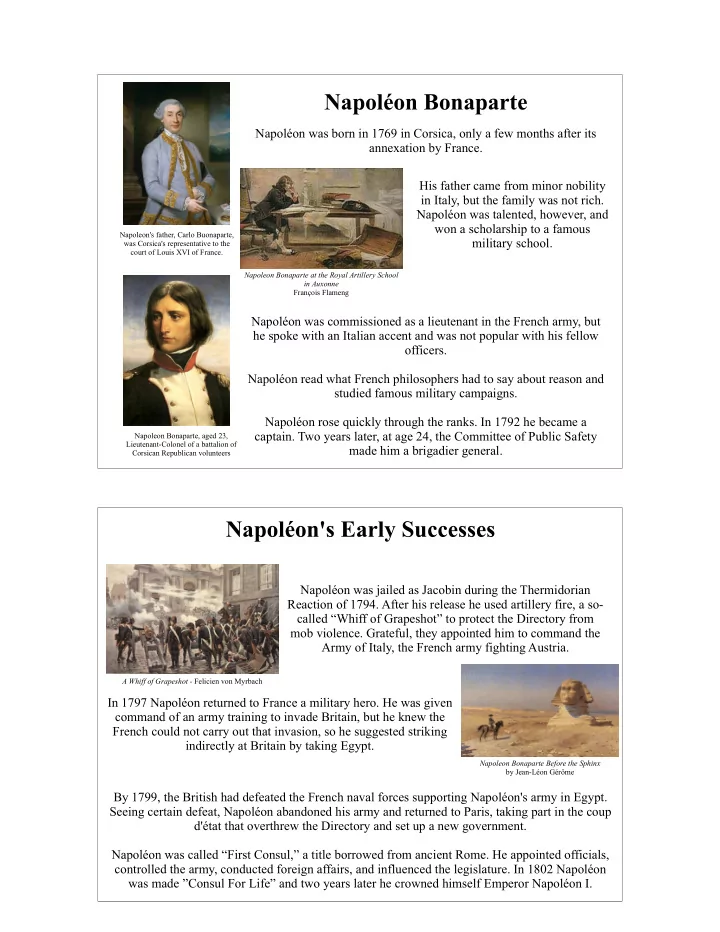
Napoleon's father, Carlo Buonaparte, was Corsica's representative to the court of Louis XVI of France. Napoleon Bonaparte, aged 23, Lieutenant-Colonel of a battalion of Corsican Republican volunteers Napoleon Bonaparte at the Royal Artillery School in Auxonne François Flameng

Napoléon was commissioned as a lieutenant in the French army, but he spoke with an Italian accent and was not popular with his fellow

  • fficers.
  • Napoléon read what French philosophers had to say about reason and

studied famous military campaigns.

  • Napoléon rose quickly through the ranks. In 1792 he became a
  • captain. Two years later, at age 24, the Committee of Public Safety

made him a brigadier general. His father came from minor nobility in Italy, but the family was not rich. Napoléon was talented, however, and won a scholarship to a famous military school. Napoléon was jailed as Jacobin during the Thermidorian Reaction of 1794. After his release he used artillery fire, a so- called “Whiff of Grapeshot” to protect the Directory from mob violence. Grateful, they appointed him to command the Army of Italy, the French army fighting Austria.

Napoléon's Early Successes

By 1799, the British had defeated the French naval forces supporting Napoléon's army in Egypt. Seeing certain defeat, Napoléon abandoned his army and returned to Paris, taking part in the coup d'état that overthrew the Directory and set up a new government.

  • Napoléon was called “First Consul,” a title borrowed from ancient Rome. He appointed officials,

controlled the army, conducted foreign affairs, and influenced the legislature. In 1802 Napoléon was made ”Consul For Life” and two years later he crowned himself Emperor Napoléon I. In 1797 Napoléon returned to France a military hero. He was given command of an army training to invade Britain, but he knew the French could not carry out that invasion, so he suggested striking indirectly at Britain by taking Egypt.

Napoleon Bonaparte Before the Sphinx by Jean-Léon Gérôme A Whiff of Grapeshot - Felicien von Myrbach

slide-2
SLIDE 2

One of Napoléon’s first actions as the new leader of France was to establish peace with the Catholic Church.

  • In 1801 Napoléon came to an agreement with the pope:

Catholicism was recognized as the religion of a majority of the French people. In return, the pope would not ask for the return of the church lands seized in the revolution.

  • With this agreement, the Catholic Church was no longer an enemy
  • f the French government, and people who had acquired church

lands in the revolution became avid supporters of Napoléon.

Napoléon’s Domestic Policies

Bonaparte, First Consul by Jean Auguste Dominique Ingres

Napoléon placed the French educational system under the control of federal government and created lycees (high schools), universities, and technical schools.

  • He created the Bank of France and required every French citizen

to pay taxes (all of which were deposited into the Bank of France).

Napoleon Crossing the Alps by Jacques-Louis David, 1805

Napoléon’s most famous domestic achievement was to codify the laws.

  • Before the revolution, France had almost 300 different legal

systems.

  • Seven law codes were created, but the most important was the

Civil Code, or Napoléonic Code.

The Napoléonic Code

This 1804 code preserved equality of all citizens before the law, the right of the individual to choose a profession, religious toleration, and the abolition of serfdom and all feudal

  • bligations.

During the revolution, women had gained new rights. The Civil Code undid these laws. Women were legally “less equal than men:” all their property belonged to their husbands they could not testify in court it became more difficult for them to get a divorce

slide-3
SLIDE 3

Napoléon Builds An Empire

The Coronation of Napoleon by Jacques-Louis David

Napoléon’s Grand Empire was composed of three major parts:

  • the French Empire: the inner core; an enlarged France extending to

the Rhine in the east and including the western half of Italy north

  • f Rome
  • dependent states: kingdoms in Spain, Holland, and Italy and the

Swiss Republic, the Grand Duchy of Warsaw, and the Confederation of the Rhine (German states)

  • allied states: countries defeated by Napoléon and then forced to

join his struggle against Britain, such as Prussia, Austria, Russia, and Sweden When Napoléon became consul in 1799, France was at war with a European coalition. Napoléon realized the need for a pause in the war.

  • In 1802 a peace treaty was signed, but war broke out

with Britain again in 1803. Britain was joined by Austria, Russia, Sweden, and Prussia. Napoléon’s Grand Army defeated the Austrian, Prussian, and Russian armies.

  • Napoléon was never able to conquer Great Britain because of its sea power. Napoléon hoped to invade Britain, but the British

defeated the combined French-Spanish fleet at Trafalgar in 1805. This battle ended Napoléon's plans for invasion.

The aim of the Continental System was to stop British goods from reaching the European

  • continent. By weakening Britain economically, Napoléon would destroy its ability to wage war.

Napoléon’s Continental System

"Who shaved as well as any Man, almost not quite” September 1806

Napoleon is the barber who shaves the powers of Europe in his shop. John Bull (England) looks in through a window.

  • A bill on the wall: 'Nap. Boney shaver general to

most of the Sovereigns on the Continet [sic] - shaves expeditiously and clean a few Gashes excepted, is ready to undertake any new Customer who is willing to submit to the above.’ The Continental System failed. Allied states resented being told by Napoléon that they could not trade with the British. Some smuggled, others

  • resisted. And new markets in the Middle East and

Latin America gave Britain new outlets for its goods.

slide-4
SLIDE 4

Finally reaching Moscow, the Grand Army found the city ablaze. With no food or supplies for his army, Napoléon abandoned the Russian capital in late October. As the winter snows began, Napoléon led the “Great Retreat” west across Russia. Soldiers starved and froze along the way and fewer than 40,000 of the

  • riginal 600,000 soldiers arrived back in Poland in January 1813.

The Fall of Napoléon

The Moscow Fire unknown German artist Nationalism, the sense of unique identity of a people based on common language, religion, and symbols, was one of the most important forces of the nineteenth century. European peoples conquered by Napoléon became united in their hatred.

  • The Russians ignored the Continental System and Napoléon knew that if he did not punish them
  • ther nations would ignore it as well. In June 1812, a Grand Army of more than 600,000 French

soldiers entered Russia, but the Russians refused to do battle, retreating for hundreds of miles, burning their own villages to keep Napoléon's army from finding food.

Napoleon's withdrawal from Russia by Adolph Northen

This led other European states to rise up and attack the crippled French army. Paris was captured in March 1814 and the victorious powers exiled Napoléon to the island

  • f Elba and restored Louis XVIII, brother of the

executed king, Louis XVI, to the monarchy to France. New French king Louis XVIII had little support and Napoléon was not ready to give up. He left the island of Elba and slipped back into France.

The Return (and defeat) of Napoléon

The king sent troops to capture Napoléon, who

  • pened his coat and addressed them:

“Soldiers of the 5th regiment, I am your Emperor… If there is a man among you [who] would kill his Emperor, here I am!” No one fired a shot. Shouting ”Long live the Emperor!” the troops took his side.

  • On March 20, 1815, Napoléon entered Paris in

triumph. Russia, Great Britain, Austria, and Prussia again pledged to defeat the man they called the “Enemy and Disturber of the Tranquility of the World.” Meanwhile, Napoléon raised another French army of devoted veterans who rallied from all over France.

  • At Waterloo in Belgium on June 18, 1815, Napoléon met a combined British and Prussian army

under the Duke of Wellington and suffered a bloody defeat. This time, the victorious allies exiled him to St. Helena, a small island in the south Atlantic. Napoléon remained in exile until his death in 1821, but his memory haunted French political life for many decades.

Napoleon returned from Elba, by Karl Stenben