Napoleon Bonaparte (1769 - 1821) "On Judgement Day, before - - PowerPoint PPT Presentation

napoleon bonaparte
SMART_READER_LITE
LIVE PREVIEW

Napoleon Bonaparte (1769 - 1821) "On Judgement Day, before - - PowerPoint PPT Presentation

Napoleon Bonaparte (1769 - 1821) "On Judgement Day, before God's throne, There stood at last Napoleon, The Devil had his list-begun Of crime the Bonaparte had done. When God the Father, or God the Son Cut Satan short, before Gods throne!


slide-1
SLIDE 1

"On Judgement Day, before God's throne, There stood at last Napoleon, The Devil had his list-begun Of crime the Bonaparte had done. When God the Father, or God the Son Cut Satan short, before Gods throne! "Don't bore us all to death with reading A German professorial pleading! If you are bold enough to face him In your Kingdom you may place him"

  • ----(Goethe)

Napoleon Bonaparte

(1769 - 1821)

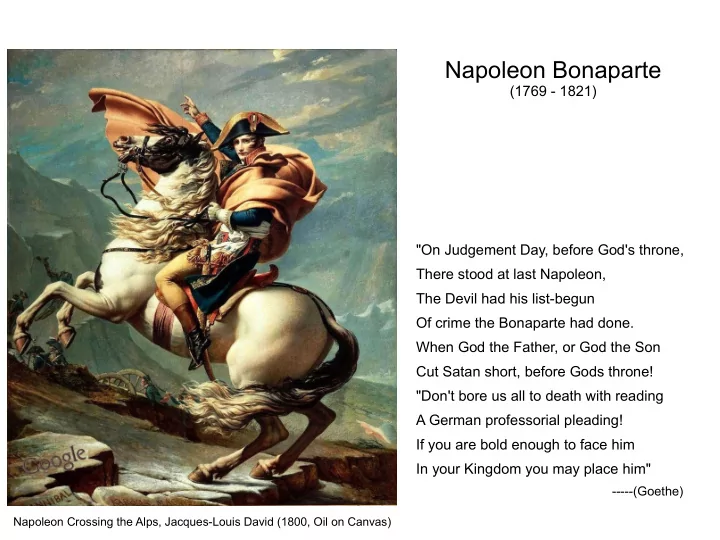
Napoleon Crossing the Alps, Jacques-Louis David (1800, Oil on Canvas)

slide-2
SLIDE 2

Personal Life

  • Born in Corsica on 15th August 1769
  • Son of Carlo Buonaparte and Maria Letizia Ramolino
  • Siblings – Joseph, Lucien, Louis, Elisa, Pauline, Caroline

and Jerome

  • Attended the military academy at Brienne-le-Chateau
  • Married to Josephine de Beauharnais
  • Later divorced due to a lack of children and married to

Marie-Louise, Duchess of Parma (of the Austrian noble family)

slide-3
SLIDE 3

Rise to Power

  • As an artillery captain, rose to fame during the French

revolution and was promoted to Brigadier General

  • Successful stints in Nice, Italy and Egypt established his

credentials as a strategist and leader of men

  • On returning to France, there was a power vacuum caused

by the collapse of the revolution and internal unrest

  • Coup to take power and declared First Consul for Life
  • Later, became Napoleon I, Emperor of France
slide-4
SLIDE 4

Napoleonic Wars (1800 - 1815)

  • Series of wars fought between France and her kingdoms

against various coalitions of European states

  • Coalition at different times included Austria, Prussia,

Russia, Sweden and Great Britain

  • Napoleon was responsible for establishing France as the

most powerful nation in Europe

  • Also responsible for having Europe up in flames for the

better part of a decade

  • Finally concluded with his defeat at Waterloo in 1815
slide-5
SLIDE 5

The Third Coalition

  • Spanned from 1803 to 1806
  • France vs. Austria, Portugal, Russia
  • Great Britain also fought France, but was not part of the

coalition

  • Effectively ended with the Treaty of Pressburg, which

ceded control of Austria to France

  • At the end, only Britain remained fighting Napoleon
  • Two famous battles – the Battle of Trafalgar and the Battle
  • f Austerlitz
slide-6
SLIDE 6

The Battle of Trafalgar (1805)

  • France was the pre-eminent power on soil, but Britain

remained control of the seas

  • Napoleon wanted to have naval supremacy to launch an

invasion of Britain

  • Pierre Villeneuve was in command of the French forces (33

ships) while Nelson was leading the British forces (27 ships)

  • End result – Decisive British victory (23 ships sunk without

losing a single one) ensuring that France never got a chance to invade Britain

  • Nelson divided his forces into two columns, while

concentrating his attack on the rear of his enemies forces

slide-7
SLIDE 7

Trafalgar Square

  • Trafalgar Square in London

was named to commemorate this battle

  • Lord Nelson was mortally

wounded in it – as a homage, the central attraction of Trafalgar Square is Nelson's Column, a 5.5 m sculpture of Nelson atop a 146 m high granite column

slide-8
SLIDE 8

The Battle of Austerlitz (1805)

  • Considered to be one of Napoleon's greatest victories
  • 66,000 French troops battled 85,000 Russo-Austrian troops
  • Napoleon intentionally exposed a weak right flank to draw

the enemy attack over there, sucking troops out of the centre

  • Once the enemy was committed, he had reinforcements

bolster the right, and then attacked the centre, splitting the enemies army into two parts

  • Comprehensive victory – French losses (8000) vs. Russo-

Austrian (27,000)

slide-9
SLIDE 9

The Fourth Coalition (1806-1807)

  • Immediately followed the Third Coalition, no real time of

peace in between

  • Coalition consisted of Prussia, Russia, Sweden and Britain
  • Prussian forces under Frederick Willhelm III soundly

defeated at the Battle of Jena-Auerstedt, 19 days after the formation of the coalition

  • Russian forces defeated at Friedland
  • Once again, only Britain remained to appose Napoleon
slide-10
SLIDE 10

The Battle of Jena-Auerstedt (1806)

  • Twin battles between the French forces under Napoleon

(Jena)/Davout (Auerstedt) against the Prussian forces

  • At Jena, the French attacked under cover of the morning

mist

  • Little initial success, but later, more concentrated attacks

led to the flank being captured and encircling the centre

  • Marshall Ney's attack without orders proved near

catastrophic

  • Adaptability of the single chain of command in the French

army

  • At Auerstedt, Davout attacked a much larger Prussian

force destroying it completely

slide-11
SLIDE 11

The Russian Invasion (1812)

  • Napoleon attacked Russia with around 500,000 men
  • Russians set up strong fortifications along the way to slow

Napoleon, but retreated past Moscow, after setting it to flame

  • French occupied a burning Moscow, then started to retreat

in the bitter Russian winter

  • Army was devastated by a lack of supplies
  • Hitler made a similar mistake in WWII
slide-12
SLIDE 12

Tchaikovsky's 1812 Overture

  • Composed in 1880, commemorates the Battle of Bordino in

1812

  • Highlights include a volley of cannon fire
  • Antal Dorati's classical recording in 1954, used real

cannons instead of the simulated shots that earlier versions had used

  • Tchaikovsky himself hated this piece of music since it was

much more loud and violent than most of his work

slide-13
SLIDE 13

The Battle of Waterloo (1815)

  • French forces led by Napoleon attacked the Anglo-Prussian

forces under the command of the Duke of Wellington and Marshall Blucher

  • Fought near Waterloo, just south of Brussels
  • Napoleon attacked both parties individually hoping to be

able to defeat them before they could combine forces

  • Delayed attack due to bad weather may have ended up

costing the French army dearly, and Napoleon his crown

  • Historical event which ended up adding to the English

lexicon

slide-14
SLIDE 14

Death

  • Requested asylum from the British after the Battle of

Waterloo

  • Controversy in the British Parliament, before finally

deciding to exile him to St. Helena

  • Numerous plots from ex-Grand Armee veterans to try and

free him

  • In 1821, health began to decline rapidly and died shortly

thereafter

  • Official cause of death was stomach cancer
slide-15
SLIDE 15

Controversies

  • Body was found to be in remarkably good condition when

moved to France

  • Autopsies revealed arsenic concentration of around 100

times the normal levels in Napoleon's hair

  • Controversies abound as to whether Napoleon was

deemed too dangerous to let live and murdered by arsenic poisoning in his food

  • Modern research seems to agree with the original cause

stating that high arsenic levels were probably due to prolonged exposure in life

slide-16
SLIDE 16

Some Quotable Quotes

Honest to a fault -

  • “The best way to keep one's word is not to give it.”
  • “I can no longer obey; I have tasted command, and I

cannot give it up.” Not prone to generalizations -

  • “England is a nation of shopkeepers.”
  • “The French complain of everything, and always. “

And also, at the forefront of women's emancipation -

  • “Women are nothing but machines for producing children.”
slide-17
SLIDE 17

Other Fun Stuff

  • Napoleon's sister Pauline Borghese, nee Bonaparte,

became Princess Borghese via marriage to Camillo Borghese

  • Amongst other things, scandalized society by posing for art

Pauline Borghese as Venus, Canova, 1808

slide-18
SLIDE 18

Trivia

  • Around the Napoleonic era, succession issues in Sweden
  • Elect someone who was a soldier and friendly with

Napoleon

  • One of Napoleon's marshals, Jean Baptiste Bernadotte,

who had Swedish ancestry was voted King of Sweden

  • The House of Bernadotte is still the ruling house of Sweden
slide-19
SLIDE 19

Nostradamus and Napoleon

  • Did Nostradamus predict Napoleon? - The prophecy and the facts....
  • An Emperor will be born near Italy, He will cost his Empire very

dearly... Napoleon was born in Corsica off the Italian coast.

  • From simple soldier he will attain to Empire...Italy, Spain, and the

English tremble; he will be greatly attentive to foreign women.. Rose from an artillery captain to Emperor. Josephine was born in the Carribean, Marie-Louise Austrian

  • For fourteen years he will hold his tyranny...

Napoleon ruled from 1800 to 1815

  • ...the chief adversary will be victorious. The rear guard will make a

defense, those who falter dying in the white country. The Russian campaign....

  • The great empire will be exchanged for a little...petty place...[to]

which he will come to lay down his scepter Exile and death in St. Helena