Napolon Bonaparte early life born in 1769 in Corsica to a - - PDF document

napol on bonaparte
SMART_READER_LITE
LIVE PREVIEW

Napolon Bonaparte early life born in 1769 in Corsica to a - - PDF document

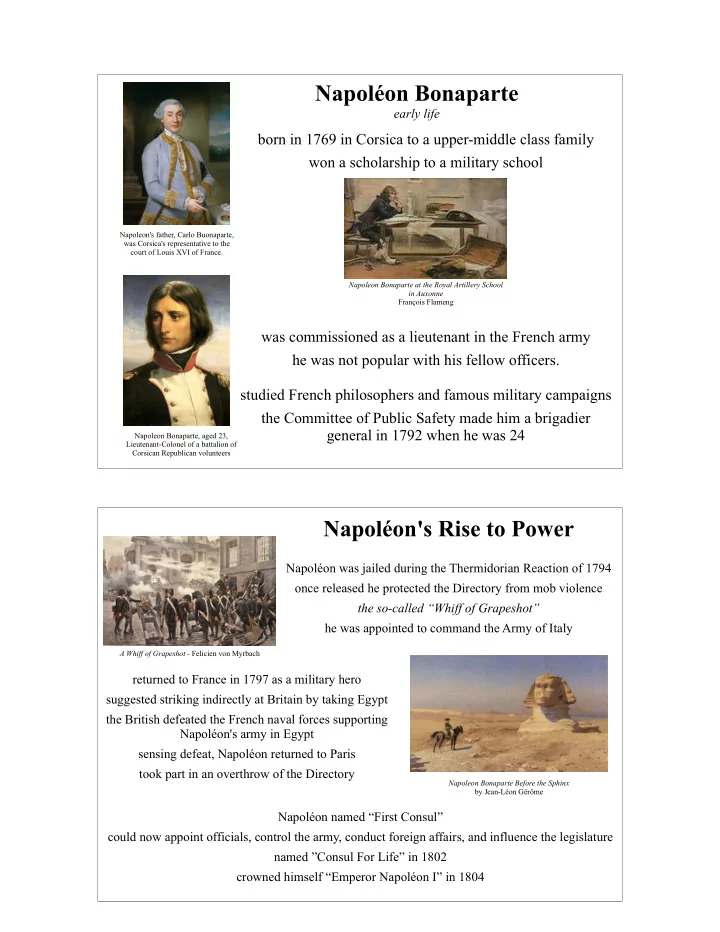
Napolon Bonaparte early life born in 1769 in Corsica to a upper-middle class family ! won a scholarship to a military school Napoleon's father, Carlo Buonaparte, was Corsica's representative to the court of Louis XVI of France. Napoleon


slide-1
SLIDE 1

Napoléon Bonaparte

early life

Napoleon's father, Carlo Buonaparte, was Corsica's representative to the court of Louis XVI of France. Napoleon Bonaparte, aged 23, Lieutenant-Colonel of a battalion of Corsican Republican volunteers Napoleon Bonaparte at the Royal Artillery School in Auxonne François Flameng

was commissioned as a lieutenant in the French army

!

he was not popular with his fellow officers.

!

studied French philosophers and famous military campaigns

!

the Committee of Public Safety made him a brigadier general in 1792 when he was 24 born in 1769 in Corsica to a upper-middle class family

!

won a scholarship to a military school

Napoléon was jailed during the Thermidorian Reaction of 1794 !

  • nce released he protected the Directory from mob violence

! the so-called “Whiff of Grapeshot” ! he was appointed to command the Army of Italy

Napoléon's Rise to Power

Napoléon named “First Consul” ! could now appoint officials, control the army, conduct foreign affairs, and influence the legislature ! named ”Consul For Life” in 1802 ! crowned himself “Emperor Napoléon I” in 1804 returned to France in 1797 as a military hero ! suggested striking indirectly at Britain by taking Egypt ! the British defeated the French naval forces supporting Napoléon's army in Egypt ! sensing defeat, Napoléon returned to Paris ! took part in an overthrow of the Directory

Napoleon Bonaparte Before the Sphinx by Jean-Léon Gérôme A Whiff of Grapeshot - Felicien von Myrbach

slide-2
SLIDE 2

Religion: Catholicism was recognized as the majority religion ! the pope agreed that church lands seized in the revolution would not have to be returned ! Education: placed the French educational system under the control of the federal government ! created lycees, universities, and technical schools. ! Economy: created the Bank of France ! required every French citizen to pay taxes ! created the Continental System: forbid British goods from reaching the European continent (it eventually failed) ! Laws: in 1804 Napoléon condensed the almost 300 different French legal systems into seven law codes ! called the Civil Code, or Napoléonic Code ! preserved equality of all citizens the right of the individual to choose a profession religious toleration abolition of serfdom

Napoléon’s Domestic Policies

Bonaparte, First Consul by Jean Auguste Dominique Ingres Napoleon Crossing the Alps by Jacques-Louis David, 1805

Napoléon Builds An Empire

The Coronation of Napoleon by Jacques-Louis David

Napoléon’s Grand Empire was composed of three major parts: ! from France to the Rhine in the east including the western half of Italy north of Rome ! dependent states in Spain, Holland, Italy, the Swiss Republic, the Grand Duchy of Warsaw, and several German states ! allied states, or countries defeated by Napoléon and then forced to join his side in the wars Napoleonic Wars ! when he became consul in 1799, France was already at war with a European coalition ! he signed a peace treaty in 1802, but war broke out with Britain again in 1803 ! Britain was soon joined by Austria, Russia, Sweden, and Prussia ! Napoléon’s Grand Army defeated the Austrian, Prussian, and Russian armies

slide-3
SLIDE 3

Moscow was ablaze when the Napoleon’s army arrived ! with no food or supplies, Napoléon fled in late October in what became known as the “Great Retreat” ! thousands of soldiers starved and froze along the way ! fewer than 40,000 of the original 600,000 soldiers survived

The Fall of Napoléon

The Moscow Fire

the Russians ignored the Continental System and imported goods from Britain ! Napoléon had to punish them so that other nations would not ignore it as well ! he invaded Russia in June of 1812 ! the Russians retreated for hundreds of miles ! burned their own villages to keep Napoléon's army from finding food

Napoleon's withdrawal from Russia by Adolph Northen

  • ther countries began to attack the crippled French army

! after one day of fighting, the Sixth Coalition - consisting of Russia, Austria, and Prussia - won The Battle of Paris ! the French surrendered on on March 31, 1814, ending the War of the Sixth Coalition and forcing ! Emperor Napoleon was forced to abdicate and go into exile

  • n the island of Elba

! Louis XVIII to the monarchy to Fra

  • ther countries began to attack the crippled French army

! after one day of fighting, the Sixth Coalition - Russia, Austria, and Prussia - won The Battle of Paris ! the French surrendered on on March 31, 1814, ending the War of the Sixth Coalition and forcing ! Emperor Napoleon was forced to abdicate and go into exile on the island of Elba ! Louis XVIII to the monarchy to France ! Napoléon soon escaped the island and slipped back into France ! when captured by French troops he opened his coat and said: “Soldiers of the 5th regiment… if there is a man among you [who] would kill his Emperor, here I am!” ! Shouting “Long live the Emperor!” the troops took his side - Napoléon entered Paris in triumph

The Return (and Defeat) of Napoléon

devoted veterans from all over France rallied around Napoléon ! Napoléon met a combined British and Prussian army at The Battle of Waterloo in Belgium on June 18, 1815 ! he suffered a bloody defeat ! the victorious allies exiled him to St. Helena ! he remained there in exile until his death in 1821

Napoleon returned from Elba, by Karl Stenben