P LANS TO M INE & FRACK COX PENINSULAR & D UNDEE , BELYUEN - - PowerPoint PPT Presentation

p lans to m ine frack cox peninsular d undee belyuen
SMART_READER_LITE
LIVE PREVIEW

P LANS TO M INE & FRACK COX PENINSULAR & D UNDEE , BELYUEN - - PowerPoint PPT Presentation

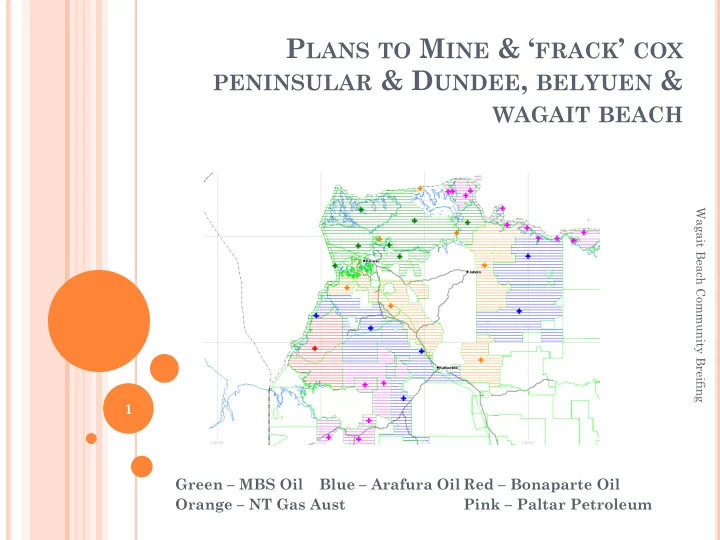
P LANS TO M INE & FRACK COX PENINSULAR & D UNDEE , BELYUEN & WAGAIT BEACH Wagait Beach Community Breifing 1 Green MBS Oil Blue Arafura Oil Red Bonaparte Oil Orange NT Gas Aust Pink Paltar Petroleum R


slide-1
SLIDE 1

PLANS TO MINE & ‘FRACK’ COX

PENINSULAR & DUNDEE, BELYUEN & WAGAIT BEACH

Green – MBS Oil Blue – Arafura Oil Red – Bonaparte Oil Orange – NT Gas Aust Pink – Paltar Petroleum

Wagait Beach Community Breifing

1
slide-2
SLIDE 2

RISKS FROM SHALE OIL AND GAS IN THE TERRITORY

¢ Major dirty fossil fuel source in shale rocks 1-3km

underground

¢ Usually needs horizontal fracking to crack deep shale

rocks

¢ Pollution of aquifers and drinking water with fracking

chemicals

¢ Pollution of aquifers leaking and failed wells ¢ Water use for fracking deep shale rocks, salty ‘produce

water’

¢ Land clearing fragments landscapes for roads,

exploration, pipes

¢ Damage to farmland, pastoral lands, cultural sites,

fishing, Nat Parks

slide-3
SLIDE 3

LANDSCAPES FROM QUEENSLAND CSG FIELDS

slide-4
SLIDE 4

¢ Seismic exploration and oil spills in the marine environment — Loud underwater noise bursts scare fish and marine wildlife — Impacts on dreaming places and sacred sites for Indigenous

communities

¢ Health impacts for land holders due to water & air pollution? ¢ Reduced value of properties? ¢ Beauty of our land and sea marred by ugly gas

industrialisation

¢ Major carbon pollution contributing to global warming from

¢

fugitive methane emissions from leaking/failed wells and cracked shale rocks

¢

LNG or oil production

¢

transport by trucks

¢

burning the gas for electricity in Australia and abroad.

¢ A large NT shale gas industry will prevent NT carbon

pollution falling for decades, & delay transition to large scale renewable energy production.

RISKS FROM SHALE OIL AND GAS IN THE TERRITORY, 2

slide-5
SLIDE 5

Hydraulic fracturing, or “fracking”, is the

process of drilling and injecting fluid into the ground at a high pressure in

  • rder to fracture shale rocks to

release natural gas inside.

Wagait Beach Community Breifing

5

slide-6
SLIDE 6

Wagait Beach Community Breifing

6

slide-7
SLIDE 7

Wagait Beach Community Breifing

7

NT Gas Aus Pty Ltd has made an application EP 255 to extract gas from our area

slide-8
SLIDE 8

WHAT IS FRACKING?

¢ It takes 1-8 million gallons of water to complete each

fracturing job.

¢ The water is mixed with sand and chemicals to create

fracking fluid. Approximately 40,000 gallons of chemicals are used per fracturing.

¢ Up to 600 chemicals used in fracking fluid including

lead, uranium, mercury, ethylene glycol, radium, methanol, hydrochloric acid, formaldehyde, arsenic

¢ Fracking fluid then pressure injected into ground

via drilled pipeline

¢ The mixture reaches the end of the well where high

pressure causes the shale rock to crack, creating fissures where natural gas flows into the well.

Wagait Beach Community Breifing

8

slide-9
SLIDE 9

Wagait Beach Community Breifing

9

slide-10
SLIDE 10

RISKS OF FRACKING

¢ During process both methane gas and toxic chemicals leach

  • ut from the system and contaminate nearby groundwater.

¢ Methane concentrations have been found 17x higher in some

drinking water bores near fracking sites than normal bores

¢ There have been cases of sensory, respiratory and

neurological damage due to ingesting contaminated water

¢ Some of the fracking fluid is not recovered [20% left behind is

industry best practice, in some sites it’s as high as 70%]. The rest of the toxic non biodegradable fluid is left in the ground. Long term impacts of this are unknown.

¢ Waste fluid that is recovered is either left in open air pits to

evaporate releasing harmful VOCs [volatile organic compounds] into atmosphere including contaminated air & acid rain OR transported and treated/stored elsewhere. In QLD it has been dumped on dirt roads as dust management!

Wagait Beach Community Breifing

10

slide-11
SLIDE 11

WHAT CAN COUNCILS DO?

¢ As a council, actively defend our community

against oil & shale gas exploration

¢ Move a motion noting council opposition to

petroleum [oil & gas] exploration

¢ Contact relevant department heads and

ministers re: EP 255

¢ Help ratepayers get informed & connected with

resources and information. Contact ‘Don’t Frack the Territory’ campaigner Emma Murphy on 8981 8003

Wagait Beach Community Breifing

11

slide-12
SLIDE 12

LEGAL RIGHTS OF LANDOWNERS

¢ The NT has a very weak regulatory framework ¢ Landowners do not have to be advised that an

application for exploration is being considered

  • ver their land

¢ Landowners are not able to prevent exploration

  • n their land

¢ Activities under the Petroleum Act are not

subject to the Water Act or Waste Management and Pollution Control Act

¢ There are limits to the time you can object to

applications [2 months]- It is important to get

  • rganised and informed early.

Wagait Beach Community Breifing

12

slide-13
SLIDE 13

PETROLEUM ACT - SECT 18

Notice of application for exploration permit (1AA) This section applies as soon as practicable: (a) after the Minister has received an application for an exploration permit under section 16(1); or (b) if the Minister has made a request under section 16(5)(a) – after the Minister has received all relevant information; or (c) if the Minister has made a request under section 16(5)(b)– after all matters relevant to the amendment or variation have been completed in accordance with the guidelines issued under section 21E. (1) The Minister must cause to be published, at the expense of the applicant, in a newspaper circulating in the part of the Territory in which the application area is situated, or in any other publication that the Minister thinks fit, a notice containing: (c) the name of the applicant; (d) a description of the application area sufficient to enable it reasonably to be identified or a map upon which the proposed boundaries of the application area are indicated by reference to named geographical features; and (e) a statement to the effect that a person who has an estate or interest in relation to land comprised in,

  • r land contiguous with land comprised in, an application area may, within 2 months after the notice is

published in the newspaper or other publication, lodge in writing with the Minister an objection to the grant. (1A) If Part IIA or IIB applies, the relevant registered native title claimants, registered native title bodies corporate and representative Aboriginal/Torres Strait Islander bodies are to be served with notice in accordance with section 57F or 57T, as the case requires. (2) The Minister may direct an applicant to serve a copy of a notice under subsection (1) on a person named in the direction. (3) A person who does not have an estate or interest in relation to land comprised in, or land contiguous with land comprised in, an application area is not entitled to lodge an objection to the granting of an exploration permit in respect of the application area .

Wagait Beach Community Breifing

13

slide-14
SLIDE 14

RIGHTS OF PETROLEUM TITLE HOLDER

The holder of a petroleum title has the right to:

¢ Occupy land for the purpose of exploring for

petroleum in the title area (s29)

¢ Access the title area by the shortest practical route

and construct a road or carry out other works to ensure access to the title area. (s65)

¢ May enter land with such machinery, equipment and

workmen as is necessary to mark out and construct the road (s65)

¢ Use the water resources of the title area for his

domestic use and for any purposes in connection with his approved technical works programme and other exploration (s29), but must not use water artificially conserved by the landowner without consent.

Wagait Beach Community Breifing

14

slide-15
SLIDE 15

OBLIGATIONS OF PETROLEUM TITLE HOLDER (S58)

¢ On entering the land the explorer should make all reasonable

attempts to again contact the landowner or occupier of the land prior to commencing authorised activities.

¢ Fact sheets on petroleum exploration activities and procedures which

explorers must follow can be found at:

http://www.nt.gov.au/d/Minerals_Energy/index.cfm?header=Energy%20Forms%20and %20Guidelines#pa

¢ A person shall not explore for, or engage in operations for the recovery

  • f petroleum unless that person does so under and in accordance with

a petroleum title. (s105)

¢ Conduct his operations and activities in relation to the title in such a

way as not to interfere with the lawful rights or activities of any other person.

¢ Conduct all operations in relation to the title with reasonable

diligence and in accordance with Good oil field practices, the approves work program

¢ Carry out the technical works program in such a way as to cause as

little disturbance as practicable.

¢ Not interfere with existing roads, railways, telephone lines, power

lines and cables, water pipelines, dams, reservoirs or energy pipelines, tailing pipelines, storage containers.

Wagait Beach Community Breifing

15

slide-16
SLIDE 16

OBLIGATIONS OF PETROLEUM TITLE HOLDER (S58)

¢ Comply with lawful direction in relation to the protection of

environment

¢ After the activities have been completed, the exploration company

must rehabilitate the affected area, the Government holds a rehabilitation security against the activity which will not be released until satisfied that appropriate levels of rehabilitation have been proven to be a positive effect on the land.

¢ Not erect a permanent structure or facility unless approved. ¢ Comply with Land Rights Act and other Acts. ¢ No title holder or operator may carry out operations upon land that is: —

within 50 meters of land used as a residence, yard, garden, orchard or cultivated field.

—

within 200 metres of a cemetery.

—

within 200 metres of any artificial accumulation of water or outlet.

without the express written approval of the landowner, registered native title body corporate or Board of Trustees of a cemetery, as the case maybe.

Wagait Beach Community Breifing

16

slide-17
SLIDE 17

COMPENSATION

A land owner is entitled to compensation under section 81 & 82 of the Act for; a) Deprivation of use or enjoyment of the land, including improvements on the land b) Damage, caused by the exploration company to the land or improvements on the land. Further, if any land over which a right to construct a road or carry out other works for access to an exploration permit or license area is diminished in value as a result of that access, the landowner is entitled to compensation from the exploration company for the loss or damage in respect of the

  • wner’s and occupier’s interest in the land.

Wagait Beach Community Breifing

17

slide-18
SLIDE 18

18

Wagait Beach Community Breifing