N328 Visualizing Information Multiple Views + Interactions Week 9: - - PowerPoint PPT Presentation

n328 visualizing information
SMART_READER_LITE
LIVE PREVIEW

N328 Visualizing Information Multiple Views + Interactions Week 9: - - PowerPoint PPT Presentation

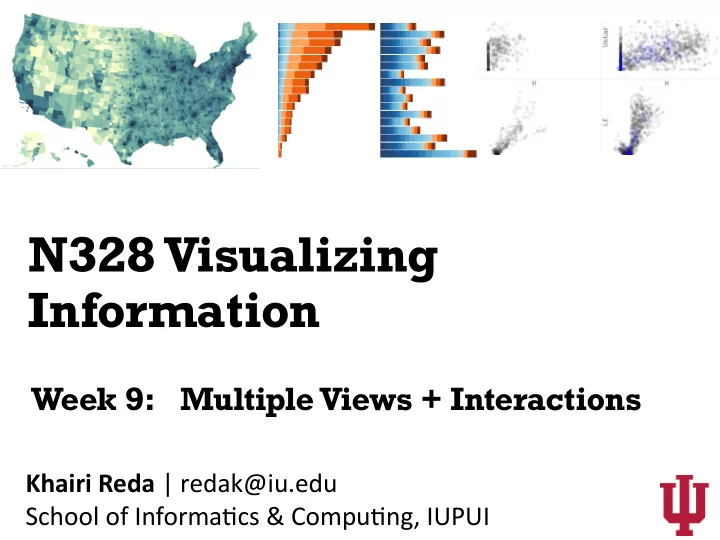
N328 Visualizing Information Multiple Views + Interactions Week 9: Khairi Reda | redak@iu.edu School of Informa5cs & Compu5ng, IUPUI Multiple views Views Varia+on: show the data in different ways Eye over memory: use display space instead


slide-1
SLIDE 1

N328 Visualizing Information

Khairi Reda | redak@iu.edu School of Informa5cs & Compu5ng, IUPUI

Multiple Views + Interactions Week 9:
slide-2
SLIDE 2

Multiple views

slide-3
SLIDE 3

Views

Varia+on: show the data in different ways Eye over memory: use display space instead of working memory

slide-4
SLIDE 4

One form, multiple views

Par55on data into subsets and distribute among different views Visual Encoding is the same in all views

Small Multiples

Nick Elprin, Domino

slide-5
SLIDE 5

Small-Multiples

Spark Lines

Viz Wiz

slide-6
SLIDE 6

Small-Multiples

Drought, 1898-2012

Mike Bostock

slide-7
SLIDE 7

Small-Multiples

ScaFerplot Matrix

Mike Bostock

x y z w w z y x

Example: dataset with four variables: X, Y, Z, W Par55on aFributes (or variables) and distribute them among different views

slide-8
SLIDE 8

Multi form

Show mul5ple representa5ons of the data Usually the views share the same data Views have different visual encoding (and oQen depict different aFributes) Ra+onale: it is difficult to show all aFributes in a single monolithic view. Mul5form views give us freedom to use different visual encodings for different aFributes.

slide-9
SLIDE 9

Multi form

Based on a slide by Miriam Meyer and Alex Lex

slide-10
SLIDE 10

Multi form

MizBee

Meyer, 2009

Same data, but different scales

slide-11
SLIDE 11

View Linking

Views cab be linked implicitly through interac5ons Changes in one view are coordinated to all

  • ther views
slide-12
SLIDE 12

Brushing and Linking

Mike Bostock

slide-13
SLIDE 13

Brushing and Linking

slide-14
SLIDE 14

Explicit Linking

Views can be linked explicitly through visual links Links typically connect the same (or similar) data items in different views Limita+ons: can occlude and lead to visual cluFer, although smart algorithms can route links to minimize side effects

Steinberger et al., 2011 Geymayer et al, 2014

slide-15
SLIDE 15

Details on Demand

Showing addi5onal informa5on with popup views

slide-16
SLIDE 16

Layering

Embedding Views in the same space

NodeTrix, Henry abd Fekete, 2007

slide-17
SLIDE 17

Layering: Treemap

http://ukdataexplorer.com/co2/

slide-18
SLIDE 18

Layering: Treemap

https://finviz.com/map.ashx

slide-19
SLIDE 19

Disk Inventory X

Layering: Treemap

slide-20
SLIDE 20

Domino

Graz et al, 2014

Dynamic View creation and linking

slide-21
SLIDE 21

Interaction

slide-22
SLIDE 22
slide-23
SLIDE 23

Why interact with visualizations?

  • Explore data that is big / complex
  • Won’t fit within the visualiza5on
  • Look at different representa5ons of the same

data

  • Interac+on engages our cogni+on
  • We understand things beFer when we “play”

with them

  • Allows us to observe cause-and-effect

rela5onships beFer

Based on a slide by Alex Lex

slide-24
SLIDE 24

Types of Interaction

Based on a slide by Alex Lex

Single View

  • Naviga5on
  • Focus+Context
  • Filtering and

Querying

Mul+ple Views

  • Brushing & Linking
  • Details on Demand
slide-25
SLIDE 25

Navigation

slide-26
SLIDE 26

Navigation

Pan and Zoom

slide-27
SLIDE 27

Navigation

Pan, Zoom, Rotate

slide-28
SLIDE 28

Semantic Zoom

  • Content updates as

you zoom in

  • More detail as more

space becomes available

[McLachlan 2008] Via Alex Lex

slide-29
SLIDE 29

Overview+Detail

slide-30
SLIDE 30

Overview+Detail

slide-31
SLIDE 31

Limitations of Pan and Zoom Navigation

  • Pros
  • Intui5ve and familiar
  • Fast to use if you know the target
  • Cons
  • Can get lost in the details and loose track of context
  • Visually disrup5ve to the “mental map”
slide-32
SLIDE 32

Focus+Context

slide-33
SLIDE 33

Fisheye lenses

slide-34
SLIDE 34

Fisheye lenses

slide-35
SLIDE 35

Fisheye lenses

slide-36
SLIDE 36

Distortion

  • Pros
  • Context plus Focus
  • Less disrup5ons to the “mental map”
  • Cons
  • Not suitable for rela5ve spa5al judgments
  • Target Acquisi5on problem
  • Not intui5ve compared to pan-and-zoom interfaces

Based on a slide by Alex Lex

slide-37
SLIDE 37
slide-38
SLIDE 38

Information Seeking Mantra

Overview first, zoom and filter, then details on demand Overview first, zoom and filter, then details on demand Overview first, zoom and filter, then details on demand Overview first, zoom and filter, then details on demand Overview first, zoom and filter, then details on demand Overview first, zoom and filter, then details on demand Ben Shneiderman

slide-39
SLIDE 39

Information Seeking Mantra

Ben Shneiderman