N Z Q R CS340-Discrete Structures Section 1.2 Page 2 Power - - PowerPoint PPT Presentation

n z q r
SMART_READER_LITE
LIVE PREVIEW

N Z Q R CS340-Discrete Structures Section 1.2 Page 2 Power - - PowerPoint PPT Presentation

Section 1.2: Sets A set is a collection of things. If S is a set and x is a member or element of S, we write x S If x is not a member of S, we write x S The set with elements x 1 , x 2 , x n is { x 1 , x 2 , x n } The empty set - A


slide-1
SLIDE 1

Section 1.2 CS340-Discrete Structures Page 1
Section 1.2: Sets

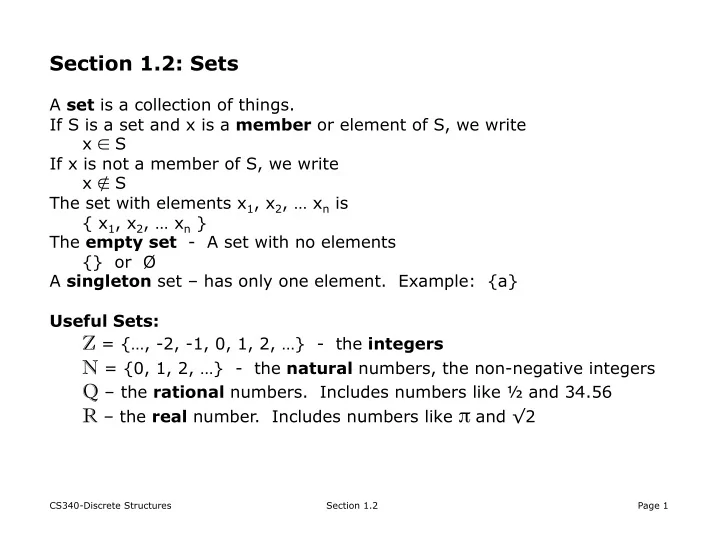
A set is a collection of things. If S is a set and x is a member or element of S, we write x ∈ S If x is not a member of S, we write x ∉ S The set with elements x1, x2, … xn is { x1, x2, … xn } The empty set - A set with no elements {} or Ø A singleton set – has only one element. Example: {a} Useful Sets: Z = {…, -2, -1, 0, 1, 2, …} - the integers N = {0, 1, 2, …} - the natural numbers, the non-negative integers Q – the rational numbers. Includes numbers like ½ and 34.56 R – the real number. Includes numbers like π and √2

slide-2
SLIDE 2

Section 1.2 CS340-Discrete Structures Page 2

Set Equality

Two sets A and B are equal iff they have the same elements. A = B Examples: {a, b, c} = {c, b, a}

  • rder does not matter

{a, a, b, c} = {a, b, c} repetitions are ignored, no repetitions Sets can also be described this way: { x | P } = the set of all elements that satisfy P where P is a property.

Example:

The set of all odd natural numbers: {1,3,5,7,…} = { x | x = 2k+1 for some k ∈ N } Subsets Set A is a subset of B iff every element in A is also in B. A ⊆ B Note, for any set S: S ⊆ S Ø ⊆ S N ⊆ Z ⊆ Q ⊆ R

slide-3
SLIDE 3

Section 1.2 CS340-Discrete Structures Page 3

Power Sets:

The power set of a set S power(S) is the set of all subsets of S. Example: power({a,b}) = { Ø, {a}, {b}, {a,b} }

Comparing Sets:

Let A = { 2k+7 | k ∈ Z } and B = { 4k+3 | k ∈ Z } Question: Is A ⊆ B? Answer: No. For example, 9 ∈ A but 9 ∉ B. Question: Is B ⊆ A? Answer: Yes. Let x ∈ B. Then x = 4k+3 for some integer k. We can write x = 4k+3 = 4k-4+7 = 2(2k-2) + 7 Since 2k-2 ∈ Z, it follows that x ∈ A. Therefore B ⊆ A. QED

slide-4
SLIDE 4

Section 1.2 CS340-Discrete Structures Page 4

Equality in terms of subsets:

A = B iff A ⊆ B and B ⊆ A Example: Let A = { 2k+5 | k ∈ Z } and B = { 2k+3 | k ∈ Z } Show that A = B. Proof: First show A ⊆ B. Then show B ⊆ A. To show A ⊆ B, Let x ∈ A. So x = 2k+5 for some integer k. We can write x = 2k+5 = 2k+2+3 = 2(k+1)+3 Since k+1 is an integer, if follows that x ∈ B. Therefore, A ⊆ B. In-class quiz: Show B ⊆ A.

slide-5
SLIDE 5

Section 1.2 CS340-Discrete Structures Page 5

Operations on Sets

Union A ∪ B = { x | x ∈ A or x ∈ B } Intersection A ∩ B = { x | x ∈ A and x ∈ B } Difference A - B = { x | x ∈ A and x ∉ B } Symmetric Difference A ⊕ B = {x | x ∈ A or x ∈ B, but not both } = (A – B) ∪ (B – A) = (A ∪ B) – (A ∩ B) Universal Complement Given a universe U and A ⊆ U, we can write
 Aʼ = U - A U
 A
 Venn Diagrams A
 B
 A
 B
 A
 B
 A
 B


slide-6
SLIDE 6

Section 1.2 CS340-Discrete Structures Page 6

Example: For each n ∈ N let Dn = {x ∈ N | x divides n } So Dn is the set of positive divisors of n. Here are some expressions involving these sets: D0 = {1, 2, 3, … } = N – {0} D5 = {1, 5} D6 = {1, 2, 3, 6} D9 = {1, 3, 9} D5 ∪ D6 = {1, 2, 3, 5, 6} D5 ∩ D6 = {1} D9 – D6 = {9} D5 ⊕ D6 = {2, 3, 5, 6} Let N be the universe. D0’ = N – D0 = {0} {0}’ = D0 In-class quiz: Draw a Venn Diagram for three sets A, B, C with some areas shaded. Then find an expression to represent the shaded area.

slide-7
SLIDE 7

Section 1.2 CS340-Discrete Structures Page 7

Properties of Set Operations Union and intersection are commutative A ∪ B = B ∪ A A ∩ B = B ∩ A associative (A ∪ B) ∪ C = A ∪ (B ∪ C) (A ∩ B) ∩ C = A ∩ (B ∩ C) They distribute over each other A ∪ (B ∩ C) = (A ∪ B) ∩ (A ∪ C) A ∩ (B ∪ C) = (A ∩ B) ∪ (A ∩ C) Absorption A ∪ (A ∩ B) = A ∩ (A ∪ B) = A De Morgan’s Law (A ∪ B)’ = A’ ∩ B’ (A ∩ B)’ = A’ ∪ B’ Set Algebra Given an expression over sets, you can rewrite it.

slide-8
SLIDE 8

Section 1.2 CS340-Discrete Structures Page 8

Counting Sets The cardinality of a set S is denoted by |S|. If the sets are finite, you can use these rules:

Inclusion-Exclusion or Union Rule:

|A ∪ B| = |A| + |B| - |A ∩ B| Difference Rule: |A – B| = |A| - |A ∩ B| In-class Quiz: Find a rule for the union of 3 sets. In-Class Quiz: Three programs use a collection of CPUs in the following way: There are 100 CPUs, shared among the programs. Each CPU may be used by 0,1,2, or all 3 programs. A,B,C represent the sets of CPUs used by each program. |A|=20, |B|=40, |C|=60, |A ∩ B|=10, |A ∩ C|=8, |B ∩ C|=6. What value could |A ∩ B ∩ C| have? Answer: 100 ≥ |A ∪ B ∪ C| = 20 + 40 + 60 – 10 – 8 – 6 + |A ∩ B ∩ C| |A ∩ B ∩ C| ≤ 4 A B


slide-9
SLIDE 9

Section 1.2 CS340-Discrete Structures Page 9

|A ∪ B ∪ C| = |A| + |B|+ |C|– |A ∩ B| – |B ∩ C| – |C ∩ D| + |A ∩ B ∩ C| A
 B
 C


slide-10
SLIDE 10

Section 1.2 CS340-Discrete Structures Page 10

Bags (also called Multisets) Like sets but can contain repeated elements. [a,b,c,c,b] = [c,b,a,b,c] Order is unimportant. Union is defined by taking the maximum number of occurencences. [a,b,c,c,c] ∪ [a,a,a,c,dd] = [a,a,a,b,c,c,c,d,d] Intersection is defined by taking the minimum number of occurencences. [a,b,c,c,c] ∩ [a,a,a,c,dd] = [a,c,] In-class Quiz: Let A = [m,i,s,s,i,s,s,i,p,p,i] B = [s,i,p,p,i,n,g] What is A ∪ B? What is A ∩ B?