A few words on Assignment 2 Question 2: D is the set of all students - - PowerPoint PPT Presentation

a few words on assignment 2
SMART_READER_LITE
LIVE PREVIEW

A few words on Assignment 2 Question 2: D is the set of all students - - PowerPoint PPT Presentation

A few words on Assignment 2 Question 2: D is the set of all students M ( s ) : s is a math major. C ( s ) : s is a computer science student. E ( s ) : s is an engineering student. There is an engineering student who is a


slide-1
SLIDE 1

A few words on Assignment 2

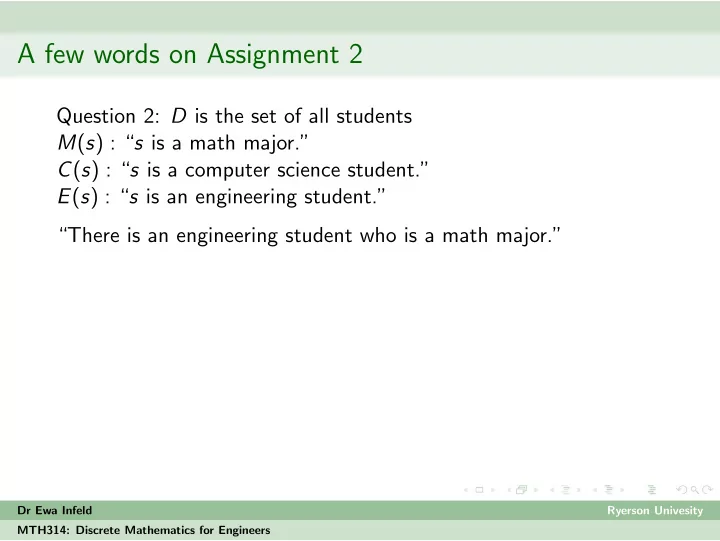
Question 2: D is the set of all students M(s) : “s is a math major.” C(s) : “s is a computer science student.” E(s) : “s is an engineering student.” “There is an engineering student who is a math major.”

Dr Ewa Infeld Ryerson Univesity MTH314: Discrete Mathematics for Engineers

slide-2
SLIDE 2

A few words on Assignment 2

Question 2: D is the set of all students M(s) : “s is a math major.” C(s) : “s is a computer science student.” E(s) : “s is an engineering student.” “There is an engineering student who is a math major.” ∃s ∈ D, E(s) ∧ M(s)

Dr Ewa Infeld Ryerson Univesity MTH314: Discrete Mathematics for Engineers

slide-3
SLIDE 3

A few words on Assignment 2

Question 2: D is the set of all students M(s) : “s is a math major.” C(s) : “s is a computer science student.” E(s) : “s is an engineering student.” “There is an engineering student who is a math major.” ∃s ∈ D, E(s) ∧ M(s) “No computer science students are engineering students.”

Dr Ewa Infeld Ryerson Univesity MTH314: Discrete Mathematics for Engineers

slide-4
SLIDE 4

A few words on Assignment 2

Question 2: D is the set of all students M(s) : “s is a math major.” C(s) : “s is a computer science student.” E(s) : “s is an engineering student.” “There is an engineering student who is a math major.” ∃s ∈ D, E(s) ∧ M(s) “No computer science students are engineering students.” ¬(∃s ∈ D, C(s) ∧ E(s)) ∀s ∈ D, C(s) → ¬E(s) ‘

Dr Ewa Infeld Ryerson Univesity MTH314: Discrete Mathematics for Engineers

slide-5
SLIDE 5

A few words on Assignment 2

Question 2: D is the set of all students M(s) : “s is a math major.” C(s) : “s is a computer science student.” E(s) : “s is an engineering student.” “There is an engineering student who is a math major.” ∃s ∈ D, E(s) ∧ M(s) “No computer science students are engineering students.” ¬(∃s ∈ D, C(s) ∧ E(s)) ∀s ∈ D, C(s) → ¬E(s)

Dr Ewa Infeld Ryerson Univesity MTH314: Discrete Mathematics for Engineers

slide-6
SLIDE 6

A few words on Assignment 2

Question 2: D is the set of all students M(s) : “s is a math major.” C(s) : “s is a computer science student.” E(s) : “s is an engineering student.” “There is an engineering student who is a math major.” ∃s ∈ D, E(s) ∧ M(s) “No computer science students are engineering students.” ¬(∃s ∈ D, C(s) ∧ E(s)) ∀s ∈ D, C(s) → ¬E(s) “Some computer science students are engineering students and some are not.”

Dr Ewa Infeld Ryerson Univesity MTH314: Discrete Mathematics for Engineers

slide-7
SLIDE 7

A few words on Assignment 2

Question 2: D is the set of all students M(s) : “s is a math major.” C(s) : “s is a computer science student.” E(s) : “s is an engineering student.” “There is an engineering student who is a math major.” ∃s ∈ D, E(s) ∧ M(s) “No computer science students are engineering students.” ¬(∃s ∈ D, C(s) ∧ E(s)) ∀s ∈ D, C(s) → ¬E(s) “Some computer science students are engineering students and some are not.” ∃s, t ∈ D, (C(s) ∧ E(s)) ∧ (C(t) ∧ ¬E(t))

Dr Ewa Infeld Ryerson Univesity MTH314: Discrete Mathematics for Engineers

slide-8
SLIDE 8

MTH314: Discrete Mathematics for Engineers

Lecture 3: Set Theory and Pigeonhole Principle Dr Ewa Infeld

Ryerson Univesity

25 January 2017 Dr Ewa Infeld Ryerson Univesity MTH314: Discrete Mathematics for Engineers

slide-9
SLIDE 9

Sets

A set is a collection of objects. It is determined by the elements that belong to it. S x y z So let the letter S denote a set. x ∈ S reads as “x is an element of S.” or “x belongs to S.”

Dr Ewa Infeld Ryerson Univesity MTH314: Discrete Mathematics for Engineers

slide-10
SLIDE 10

Sets

A set is a collection of objects. It is determined by the elements that belong to it. S x x y z So let the letter S denote a set. x ∈ S reads as “x is an element of S.” or “x belongs to S.” x / ∈ S reads as “x is not an element of S.” or “x does not belong to S.”

Dr Ewa Infeld Ryerson Univesity MTH314: Discrete Mathematics for Engineers

slide-11
SLIDE 11

Sets

A set is a collection of objects that obeys Axioms of Set Theory. It is determined by the elements that belong to it. S x x y z So let the letter S denote a set. x ∈ S reads as “x is an element of S.” or “x belongs to S.” x / ∈ S reads as “x is not an element of S.” or “x does not belong to S.”

Dr Ewa Infeld Ryerson Univesity MTH314: Discrete Mathematics for Engineers

slide-12
SLIDE 12

Sets

A set is a collection of objects that obeys Axioms of Set Theory. It is determined by the elements that belong to it. Axiom of Extensionality: We think of two sets that have the same elements as the same set. Example: The set of natural numbers that are multiples of 2, and the set of even numbers are the same set.

  • 8
  • 6
  • 4
  • 2

2 4 6 8 Why does it matter? If two different programs compute the same thing, are they the same program?

Dr Ewa Infeld Ryerson Univesity MTH314: Discrete Mathematics for Engineers

slide-13
SLIDE 13

Set Notation

x ∈ S reads as “x is an element of S.” or “x belongs to S.” x / ∈ S reads as “x is not an element of S.” or “x does not belong to S.” If the set S is a set of breakfast options, and you can pick eggs,

  • atmeal or fruit, we use this notation:

S = {eggs, oatmeal, fuit} Sometimes we see “:=” as in, S := {eggs, oatmeal, fuit}. This usually happens when you define something. You can think of a parallel with programming - the first time you declare S to be something (S := {eggs, oatmeal, fuit}), vs when you simply state a fact about S, (S = {eggs, oatmeal, fuit}.) You don’t always need to “declare” it in math though.

Dr Ewa Infeld Ryerson Univesity MTH314: Discrete Mathematics for Engineers

slide-14
SLIDE 14

Set Notation

T ⊆ S reads as “T is a subset of S.” It means that every element

  • f T is also an element of S

T ⊆ S ↔ ∀t ∈ T, ∃s ∈ S, t = s ∀t ∈ T, t ∈ S T ⊆ S means T is not a subset of S, i.e. some element in T is not an element in S. T ⊆ S ↔ ∃t ∈ T, ∀s ∈ S, t = s ∃t ∈ T, t / ∈ S If we write T = S, we say T and S are equal, so T = S ↔ (T ⊆ S) ∧ (S ⊆ T).

Dr Ewa Infeld Ryerson Univesity MTH314: Discrete Mathematics for Engineers

slide-15
SLIDE 15

Set Notation

If we write T ⊂ S, we say T is a subset of S AND it is not equal to S. Notice that, T ⊂ S ↔ (T ⊆ S) ∧ (S ⊆ T). Then T is a strict or proper subset of S. If T is a subset of S, then S is a superset of T. Example: T = {t ∈ Z | s = 12n + 6 for some n ∈ Z} S = {s ∈ Z | s = 6m for some m ∈ Z} Then T ⊆ S, but S ⊆ T.

Dr Ewa Infeld Ryerson Univesity MTH314: Discrete Mathematics for Engineers

slide-16
SLIDE 16

Set Notation

If we write T ⊂ S, we say T is a subset of S AND it is not equal to S. Notice that, T ⊂ S ↔ (T ⊆ S) ∧ (S ⊆ T). Then T is a strict or proper subset of S. If T is a subset of S, then S is a superset of T. Example: T = {t ∈ Z | t = 12n + 6 for some n ∈ Z} S = {s ∈ Z | s = 6m for some m ∈ Z} Then T ⊆ S, but S ⊆ T. Proof outline: If t = 12n + 6, then t = 6(2n + 1). So m = 2n + 1 ∈ Z exists, and t ∈ S. On the other hand, 12 ∈ S is not of the form 12n + 6 for any n ∈ Z.

Dr Ewa Infeld Ryerson Univesity MTH314: Discrete Mathematics for Engineers

slide-17
SLIDE 17

Some Useful Sets

N = {0, 1, 2, 3, . . . } Z = {0, 1, −1, 2, −2, 3, −3, . . . } Every natural number is an integer: N ⊆ Z But there exist integers that are not natural numbers, like -1: N ⊂ Z

Dr Ewa Infeld Ryerson Univesity MTH314: Discrete Mathematics for Engineers

slide-18
SLIDE 18

Examples of sets

size {0, 1, 314} ∅ = {} (the empty set) {0} {{}, {0, 1, 2, 3}, {0}} {x ∈ Z | x is a multiple of 314} {x ∈ Z | ∃p, (p is prime ∧ (x = p + p2)) {(x, y) ∈ R | x2 + y2 = 1}

Dr Ewa Infeld Ryerson Univesity MTH314: Discrete Mathematics for Engineers

slide-19
SLIDE 19

Examples of sets

size {0, 1, 314} ∅ = {} (the empty set) {0} {{}, {0, 1, 2, 3}, {0}} {x ∈ Z | x is a multiple of 314} {x ∈ Z | ∃p, (p is prime ∧ (x = p + p2)) {(x, y) ∈ R | x2 + y2 = 1} The size of a set is the number of elements in the set.

Dr Ewa Infeld Ryerson Univesity MTH314: Discrete Mathematics for Engineers

slide-20
SLIDE 20

Examples of sets

size {0, 1, 314} 3 ∅ = {} (the empty set) {0} 1 {{}, {0, 1, 2, 3}, {0}} 3 {x ∈ Z | x is a multiple of 314} ∞ {x ∈ Z | ∃p, (p is prime ∧ (x = p + p2))} ∞ {(x, y) ∈ R × R | x2 + y2 = 1} ∞ The size of a set is the number of elements in the set.

Dr Ewa Infeld Ryerson Univesity MTH314: Discrete Mathematics for Engineers

slide-21
SLIDE 21

Examples of sets

size {0, 1, 314} 3 ∅ = {} (the empty set) {0} 1 {{}, {0, 1, 2, 3}, {0}} 3 {x ∈ Z | x is a multiple of 314} ∞ {x ∈ Z | ∃p, (p is prime ∧ (x = p + p2))} ∞ {(x, y) ∈ R × R | x2 + y2 = 1} ∞ The size of a set is the number of elements in the set. Sets with a finite number of elements are called finite. Sets with an infinite number of elements are called infinite.

Dr Ewa Infeld Ryerson Univesity MTH314: Discrete Mathematics for Engineers

slide-22
SLIDE 22

Examples of sets

size {0, 1, 314} FINITE 3 ∅ = {} (the empty set) FINITE 0 {0} FINITE 1 {{}, {0, 1, 2, 3}, {0}} FINITE 3 {x ∈ Z | x is a multiple of 314} INFINITE ∞ {x ∈ Z | ∃p, (p is prime ∧ (x = p + p2))} INFINITE ∞ {(x, y) ∈ R × R | x2 + y2 = 1} INFINITE ∞ The size of a set is the number of elements in the set. Sets with a finite number of elements are called finite. Sets with an infinite number of elements are called infinite.

Dr Ewa Infeld Ryerson Univesity MTH314: Discrete Mathematics for Engineers

slide-23
SLIDE 23

Relations and Maps

A relation is the truth set of a predicate that takes two inputs.

Dr Ewa Infeld Ryerson Univesity MTH314: Discrete Mathematics for Engineers

slide-24
SLIDE 24

Relations and Maps

A relation is the truth set of a predicate that takes two inputs. 1 1 2 2 3 3 4 4 5 5 6 6 (1,1) (1,2) (1,3) (1,4) (1,5) (1,6) (2,1) (2,2) (2,3) (2,4) (2,5) (2,6) (3,1) (3,2) (3,3) (3,4) (3,5) (3,6) (4,1) (4,2) (4,3) (4,4) (4,5) (4,6) (5,1) (5,2) (5,3) (5,4) (5,5) (5,6) (6,1) (6,2) (6,3) (6,4) (6,5) (6,6) S = T = {1, 2, 3, 4, 5, 6} (x, y) ∈ S × T P(x, y) : x + y = 7

Dr Ewa Infeld Ryerson Univesity MTH314: Discrete Mathematics for Engineers

slide-25
SLIDE 25

Relations and Maps

A relation is the truth set of a predicate that takes two inputs. 1 1 2 2 3 3 4 4 5 5 6 6 S = T = {1, 2, 3, 4, 5, 6} (x, y) ∈ S × T P(x, y) : x + y = 7

Dr Ewa Infeld Ryerson Univesity MTH314: Discrete Mathematics for Engineers

slide-26
SLIDE 26

Relations and Maps

A relation is the truth set of a predicate that takes two inputs. A relation could be a function or a map from A to B as long as every element in set A “goes” to exactly one element in the set B. S x x y z A = {x, y, z} B = {1, 2, 3, 4} 1 2 4 3

Dr Ewa Infeld Ryerson Univesity MTH314: Discrete Mathematics for Engineers

slide-27
SLIDE 27

Relations and Maps

A relation is the truth set of a predicate that takes two inputs. A relation could be a function or a map from A to B as long as every element in set A “goes” to exactly one element in the set B. S x x y z A = {x, y, z} B = {1, 2, 3, 4} 1 2 4 3 A function/map from A to B that only assigns at most one element of A to each element of B is called one-to-one (1-1).

Dr Ewa Infeld Ryerson Univesity MTH314: Discrete Mathematics for Engineers

slide-28
SLIDE 28

Relations and Maps

A relation is the truth set of a predicate that takes two inputs. A relation could be a function or a map from A to B as long as every element in set A “goes” to exactly one element in the set B. S x x y z A = {x, y, z} B = {1, 2, 3, 4} 1 2 4 A function/map from A to B assigns at least one element of A to each element of B is called onto.

Dr Ewa Infeld Ryerson Univesity MTH314: Discrete Mathematics for Engineers

slide-29
SLIDE 29

Relations and Maps

A relation is the truth set of a predicate that takes two inputs. A relation could be a function or a map from A to B as long as every element in set A “goes” to exactly one element in the set B. S x x y z A = {x, y, z} B = {1, 2, 3, 4} 1 2 4 A function/map from A to B that is both one-to-one (1-1) and

  • nto is called a bijection.

Dr Ewa Infeld Ryerson Univesity MTH314: Discrete Mathematics for Engineers

slide-30
SLIDE 30

Venn Diagrams

some general set U we’re working in set A set B The intersection of A and B A ∩ B is the set of elements that belong to both sets.

Dr Ewa Infeld Ryerson Univesity MTH314: Discrete Mathematics for Engineers

slide-31
SLIDE 31

Venn Diagrams

some general set U we’re working in set A set B The intersection of A and B A ∩ B is the set of elements that belong to both sets.

Dr Ewa Infeld Ryerson Univesity MTH314: Discrete Mathematics for Engineers

slide-32
SLIDE 32

Venn Diagrams

some general set U we’re working in set A set B The intersection of A and B A ∩ B is the set of elements that belong to both sets. The union of A and B A ∪ B is the set of elements that belong to at least one

  • f the two sets.

Dr Ewa Infeld Ryerson Univesity MTH314: Discrete Mathematics for Engineers

slide-33
SLIDE 33

Operations on Sets

Intersection: A ∩ B The set of elements x ∈ U such that x ∈ A and x ∈ B. Union: A ∪ B The set of elements x ∈ U such that x ∈ A or x ∈ B. Complement: AC The set of elements x ∈ U such that x ∈ A. Set difference: A − B The set of elements x ∈ U such that x ∈ A and x ∈ B.

Dr Ewa Infeld Ryerson Univesity MTH314: Discrete Mathematics for Engineers

slide-34
SLIDE 34

Operations on Sets

Intersection: A ∩ B The set of elements x ∈ U such that x ∈ A and x ∈ B. some general set U we’re working in set A set B

Dr Ewa Infeld Ryerson Univesity MTH314: Discrete Mathematics for Engineers

slide-35
SLIDE 35

Operations on Sets

Union: A ∪ B The set of elements x ∈ U such that x ∈ A or x ∈ B. some general set U we’re working in set A set B

Dr Ewa Infeld Ryerson Univesity MTH314: Discrete Mathematics for Engineers

slide-36
SLIDE 36

Operations on Sets

Complement: AC The set of elements x ∈ U such that x ∈ A. some general set U we’re working in set A set B

Dr Ewa Infeld Ryerson Univesity MTH314: Discrete Mathematics for Engineers

slide-37
SLIDE 37

Operations on Sets

Set difference: A − B The set of elements x ∈ U such that x ∈ A and x ∈ B. some general set U we’re working in set A set B

Dr Ewa Infeld Ryerson Univesity MTH314: Discrete Mathematics for Engineers

slide-38
SLIDE 38

Observations

For all sets A, B over a universal set U we have: A ∪ B = B ∪ A and A ∩ B = B ∩ A A ∪ A = A ∩ A = A A ∩ U = A ∪ ∅ = A A ∩ B ⊆ B (A ⊆ B) ∧ (B ⊆ C) → (A ⊆ C)

Dr Ewa Infeld Ryerson Univesity MTH314: Discrete Mathematics for Engineers

slide-39
SLIDE 39

Observations

For a universal set U, and sets A and B in U: a) A ∪ U = U b) A ∩ ∅ = ∅ c) (AC)C = A d) (A ∪ B)C = AC ∩ BC ← DeMorgan’s Laws! e) (A ∩ B)C = AC ∪ BC ← DeMorgan’s Laws! f) UC = ∅ g) ∅C = U h) A ∪ AC = U i) A ∩ AC = ∅ Notice that these work very similarly to relations in propositional

  • logic. Can you explain why?

Dr Ewa Infeld Ryerson Univesity MTH314: Discrete Mathematics for Engineers

slide-40
SLIDE 40

Proving that two sets are equal, or one is a subset of the

  • ther.

To prove that two sets A and B are equal we need both A ⊆ B and B ⊆ A. So we need to show that Every element of A is also in B. Every element of B is also in A. There are two types of such problems you might see.

1 A set identity, for example A ∪ (A ∩ B) = A. 2 You may be given definitions of two sets, for example:

A = {m ∈ N | ∃t ∈ N, m = 6t} B = {n ∈ N | ∃r, s ∈ N, n = 2r = 3s} We will now see proofs in these two cases.

Dr Ewa Infeld Ryerson Univesity MTH314: Discrete Mathematics for Engineers

slide-41
SLIDE 41

Proving a set identity

Let A, B be subsets of some unversal set U. Show that A ∪ (A ∩ B) = A Proof: First we need to show that if x ∈ A ∪ (A ∩ B), then x ∈ A. Set union acts like an “or” statement, so we know that at least one

  • f x ∈ A or x ∈ (A ∩ B) has to be true. If it’s the former, we’re
  • done. If the latter, we have (A ∩ B) ⊆ A and we’re also done.

Now we need to show that if x ∈ A, then x ∈ A ∪ (A ∩ B). As in an “or” statement, it’s enough if one of x ∈ A or x ∈ (A ∩ B) is true, so we’re done!

  • Dr Ewa Infeld

Ryerson Univesity MTH314: Discrete Mathematics for Engineers

slide-42
SLIDE 42

Proving a set identity (using contradiction)

Let A, B be subsets of some unversal set U. Show that A ∪ (A ∩ B) = A Proof: First we need to show that if x ∈ A ∪ (A ∩ B), then x ∈ A. Suppose for contradiction that x / ∈ A. x ∈ A ∪ (A ∩ B) means “either x ∈ A or x ∈ (A ∩ B). We assumed that x / ∈ A, so we’re left with the x ∈ (A ∩ B) option. But since A ∩ B ⊆ A by definition, that is also imposssible! We arrive at a contradiction and conclude that A ∪ (A ∩ B) ⊆ A. Now we need to show that if x ∈ A, then x ∈ A ∪ (A ∩ B). As in an “or” statement, it’s enough if one of x ∈ A or x ∈ (A ∩ B) is true, so we’re done!

  • Dr Ewa Infeld

Ryerson Univesity MTH314: Discrete Mathematics for Engineers

slide-43
SLIDE 43

Proving inclusion (from set definitions)

Let: A = {m ∈ N | ∃t ∈ N, m = 6t} B = {n ∈ N | ∃r, s ∈ N, n = 2r = 3s} We want to show that A ⊆ B. Proof: We want to show that for any m ∈ A, we have m ∈ B. So take any m ∈ A. There exists t ∈ N such that m = 6t. Then m = 2(3t), so 3t can serve as r and m = 3(2t), so 2t can serve as

  • s. Therefore m ∈ B for any m ∈ B, and so A ⊆ B.
  • How would you show that B ⊆ A?

Dr Ewa Infeld Ryerson Univesity MTH314: Discrete Mathematics for Engineers

slide-44
SLIDE 44

Proving inclusion (from set definitions)

Let: A = {m ∈ N | ∃t ∈ N, m = 6t} B = {n ∈ N | ∃r, s ∈ N, n = 2r = 3s} We want to show that A ⊆ B. Proof: We want to show that for any m ∈ A, we have m ∈ B. So take any m ∈ A. There exists t ∈ N such that m = 6t. Then m = 2(3t), so 3t can serve as r and m = 3(2t), so 2t can serve as

  • s. Therefore m ∈ B for any m ∈ B, and so A ⊆ B.
  • How would you show that B ⊆ A? We’ll get to that when we do

number theory. (Or induction.)

Dr Ewa Infeld Ryerson Univesity MTH314: Discrete Mathematics for Engineers

slide-45
SLIDE 45

Statements About Sets

Let A, B, C be any sets in a universal set U. A ⊆ B ∧ B ⊆ C C → A ∩ C = ∅ What does this say?

Dr Ewa Infeld Ryerson Univesity MTH314: Discrete Mathematics for Engineers

slide-46
SLIDE 46

Statements About Sets

Let A, B, C be any sets in a universal set U. A ⊆ B ∧ B ⊆ C C → A ∩ C = ∅ A B C A ⊆ B

Dr Ewa Infeld Ryerson Univesity MTH314: Discrete Mathematics for Engineers

slide-47
SLIDE 47

Statements About Sets

Let A, B, C be any sets in a universal set U. A ⊆ B ∧ B ⊆ C C → A ∩ C = ∅ A B C A ⊆ B B ⊆ C C

Dr Ewa Infeld Ryerson Univesity MTH314: Discrete Mathematics for Engineers

slide-48
SLIDE 48

Statements About Sets

Let A, B, C be any sets in a universal set U. A ⊆ B ∧ B ⊆ C C → A ∩ C = ∅ A B C A ⊆ B B ⊆ C C ( ) ∧ ( )

Dr Ewa Infeld Ryerson Univesity MTH314: Discrete Mathematics for Engineers

slide-49
SLIDE 49

Statements About Sets

Let A, B, C be any sets in a universal set U. A ⊆ B ∧ B ⊆ C C → A ∩ C = ∅ Proof: Assumptions: A ⊆ B, B ⊆ C C Want: ¬∃x ∈ U, (x ∈ A) ∧ (x ∈ C) Suppose that x ∈ A. Then since A ⊆ B is true, x ∈ B. But then by B ⊆ C C, we have x ∈ C C and therefore, x / ∈ C. We get that if x ∈ A, then ¬(x ∈ C) and therefore (x ∈ A) ∧ (x ∈ C) is false.

  • Dr Ewa Infeld

Ryerson Univesity MTH314: Discrete Mathematics for Engineers

slide-50
SLIDE 50

Disjoint Sets

Two sets A and B are disjoint if A ∩ B = ∅. Which of these are pairs of disjoint sets? Odd and even integers. Odd integers and the empty set. Even integers and prime numbers. Positive numbers and negative numbers. Odd numbers and perfect squares. Socks and trees.

Dr Ewa Infeld Ryerson Univesity MTH314: Discrete Mathematics for Engineers

slide-51
SLIDE 51

Power Set

For every set A, the power set P(A) of A is the set of subsets of A.

Dr Ewa Infeld Ryerson Univesity MTH314: Discrete Mathematics for Engineers

slide-52
SLIDE 52

Power Set

For every set A, the power set P(A) of A is the set of subsets of A. Example: Let A = {0, 1}. The possible subsets of A are:

Dr Ewa Infeld Ryerson Univesity MTH314: Discrete Mathematics for Engineers

slide-53
SLIDE 53

Power Set

For every set A, the power set P(A) of A is the set of subsets of A. Example: Let A = {0, 1}. The possible subsets of A are: ∅ {0} {1} {0, 1}

Dr Ewa Infeld Ryerson Univesity MTH314: Discrete Mathematics for Engineers

slide-54
SLIDE 54

Power Set

For every set A, the power set P(A) of A is the set of subsets of A. Example: Let A = {0, 1}. The possible subsets of A are: ∅ {0} {1} {0, 1} Suppose you have a set B with k ∈ N elements. How many elements does P(B) have?

Dr Ewa Infeld Ryerson Univesity MTH314: Discrete Mathematics for Engineers

slide-55
SLIDE 55

Power Set

For every set A, the power set P(A) of A is the set of subsets of A. Example: Let A = {0, 1}. The possible subsets of A are: ∅ {0} {1} {0, 1} Suppose you have a set B with k ∈ N elements. How many elements does P(B) have? 2k Every element can either be in a subset or not. You can encode the subset in a string of k bits. There are 2k different strings of k bits.

Dr Ewa Infeld Ryerson Univesity MTH314: Discrete Mathematics for Engineers

slide-56
SLIDE 56

Power Set

For every set A, the power set P(A) of A is the set of subsets of A. Example: Let A = {0, 1}. The possible subsets of A are: ∅ 00 {0} 10 {1} 01 {0, 1} 11 Suppose you have a set B with k ∈ N elements. How many elements does P(B) have? 2k Every element can either be in a subset or not. You can encode the subset in a string of k bits. There are 2k different strings of k bits.

Dr Ewa Infeld Ryerson Univesity MTH314: Discrete Mathematics for Engineers

slide-57
SLIDE 57

Set Partition

Dr Ewa Infeld Ryerson Univesity MTH314: Discrete Mathematics for Engineers

slide-58
SLIDE 58

Pigeonhole Principle

Dr Ewa Infeld Ryerson Univesity MTH314: Discrete Mathematics for Engineers

slide-59
SLIDE 59

Pigeonhole Principle

If four pigeons are in 3 pidgeonholes, then there exists a pigeonhole with at least 2 pigeons.

Dr Ewa Infeld Ryerson Univesity MTH314: Discrete Mathematics for Engineers

slide-60
SLIDE 60

Pigeonhole Principle

If four pigeons are in 3 pidgeonholes, then there exists a pigeonhole with at least 2 pigeons. Pigeonhole Principle: If we partition a set of n + 1 ∈ N elements into n parts, at least one part will have at least two elements.

Dr Ewa Infeld Ryerson Univesity MTH314: Discrete Mathematics for Engineers

slide-61
SLIDE 61

Pigeonhole Principle

If four pigeons are in 3 pidgeonholes, then there exists a pigeonhole with at least 2 pigeons. Pigeonhole Principle: If we partition a set of n + 1 ∈ N elements into n parts, at least one part will have at least two elements. If you have a drawer full of unpaired socks, and they come in 4 different colors, how many at least do you need to pull out to be sure you have a matching pair?

Dr Ewa Infeld Ryerson Univesity MTH314: Discrete Mathematics for Engineers

slide-62
SLIDE 62

Pigeonhole Principle

1 Show that if seven distinct numbers are selected from

{1, 2, 3, 4, 5, 6, 7, 8, 9, 10, 11}, then some two of these numbers sum up to 12.

Dr Ewa Infeld Ryerson Univesity MTH314: Discrete Mathematics for Engineers

slide-63
SLIDE 63

Pigeonhole Principle

1 Show that if seven distinct numbers are selected from

{1, 2, 3, 4, 5, 6, 7, 8, 9, 10, 11}, then some two of these numbers sum up to 12.

2 Show that any collection of eight distinct integers contains

distinct integers x and y such that x − y is a multiple of 7.

Dr Ewa Infeld Ryerson Univesity MTH314: Discrete Mathematics for Engineers

slide-64
SLIDE 64

Pigeonhole Principle

1 Show that if seven distinct numbers are selected from

{1, 2, 3, 4, 5, 6, 7, 8, 9, 10, 11}, then some two of these numbers sum up to 12.

2 Show that any collection of eight distinct integers contains

distinct integers x and y such that x − y is a multiple of 7. What if the “distinct” condition wasn’t there?

Dr Ewa Infeld Ryerson Univesity MTH314: Discrete Mathematics for Engineers