Announcements ICS 6B Quiz schedule online * Will allow you to drop - - PDF document

announcements ics 6b
SMART_READER_LITE
LIVE PREVIEW

Announcements ICS 6B Quiz schedule online * Will allow you to drop - - PDF document

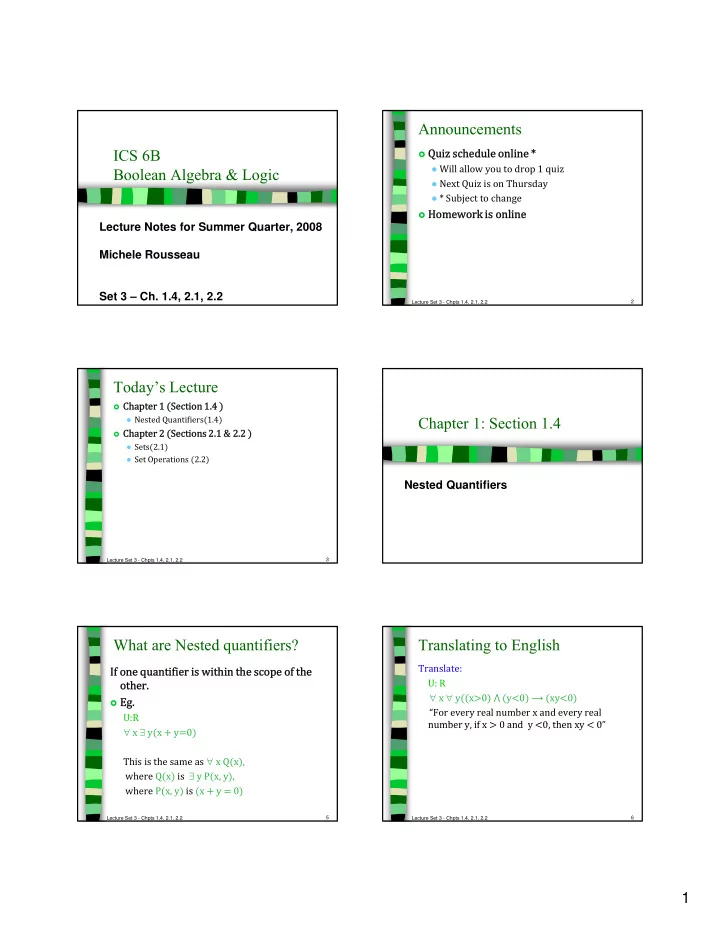
Announcements ICS 6B Quiz schedule online * Will allow you to drop 1 quiz Boolean Algebra & Logic Next Quiz is on Thursday * Subject to change Homework is online Lecture Notes for Summer Quarter, 2008 Michele Rousseau


slide-1
SLIDE 1

1

ICS 6B Boolean Algebra & Logic

Lecture Notes for Summer Quarter, 2008 Michele Rousseau Set 3 – Ch. 1.4, 2.1, 2.2

Announcements

Quiz schedule online *

  • Will allow you to drop 1 quiz
  • Next Quiz is on Thursday
  • * Subject to change

Homework is online

Lecture Set 3 - Chpts 1.4, 2.1, 2.2 2

Today’s Lecture

Chapter 1 Section 1.4

  • Nested Quantifiers1.4

Chapter 2 Sections 2.1 & 2.2

  • Sets2.1
  • Set Operations 2.2

Lecture Set 3 - Chpts 1.4, 2.1, 2.2 3

Chapter 1: Section 1.4

Nested Quantifiers

What are Nested quantifiers?

If one quantifier is within the scope of the

  • ther.

Eg.

U:R ∀ x ∃ yx y0 This is the same as ∀ x Qx, where Qx is ∃ y Px, y, where Px, y is x y 0

Lecture Set 3 - Chpts 1.4, 2.1, 2.2 5

Translating to English

Translate: U: R ∀ x ∀ yx0 y0 xy0 “For every real number x and every real number y if x 0 and y 0 then xy 0” number y, if x 0 and y 0, then xy 0

Lecture Set 3 - Chpts 1.4, 2.1, 2.2 6

slide-2
SLIDE 2

2

Switching order

If the quantifiers are the same switching

  • rder doesn’t matter
  • ie. All ∀’s or all ∃’s
  • ∀ x ∀ y Px,y ∀ y ∀ x Px,y
  • ∃ x ∃ y Px,y ∃ y ∃ x Px,y

If the quantifiers are different then order

matters

  • ∀ x ∃ y Px,y ∃ y ∀ x Px,y

Lecture Set 3 - Chpts 1.4, 2.1, 2.2 7

NOT Equivalent

Thinking of Quantification as Loops

To prove or disprove nested quantifications think in terms of nested loops

∀ x ∀ y Px, y

Loop through x values Loop through x values For each x value loop through the y values If we find that Px, y is true for all values of y for every x, then ∀ x ∀ y Px, y is True If we find one y for any x such that Px,y is False then ∀ x ∀ y Px, y is False

Lecture Set 3 - Chpts 1.4, 2.1, 2.2 8

Thinking of Quant. as Loops (2)

∀ x ∃ y Px, y Loop through x values For each x value loop through the y values If we find one y for each x such that Px, y is true then ∀ x ∃ y Px, y is True If for any one x we can’t find a y such that Px,y is true th ∀ ∃ P i F l then ∀ x ∃ y Px, y is False

∃ x ∀ y Px, y

Loop through x values For each x value loop through the y values If we find an x such Px, y is true for all y’s then ∃ x ∀ y Px, y is True If we can’t find such an x then ∃ x ∀ y Px, y is False

9

Thinking of Quant. as Loops (3)

∃ x ∃ y Px, y Loop through x values For each x value loop through the y values If we find one y for one x such that Px, y is true then ∃ x ∃ y Px, y is True If we can’t fine one x and one y such that Px y is true If we can t fine one x and one y such that Px,y is true then ∃ x ∃ y Px, y is False

Lecture Set 3 - Chpts 1.4, 2.1, 2.2 10

∀x ∀y

P(x, y) is true for every x, y pair There is an x, y pair for which P(x,y) is false For every x There is an x such that

Quantification of Two Variables

State- ment When True? When False?

∀x ∃y

For every x, there is at least one y for which P(x, y) is true There is an x such that P(x, y) is false for every y

∃x ∀y

There is an x for which P(x, y) is true for every y For every x there is at least one y for which P(x,y) is false

∃x ∃y

There is at least one x, y pair for which P(x, y) is true P(x, y) is false for every x, y pair

11

Note: These are not equivalent

Translating from English to Nested Quantifiers

“The product of two positive numbers is positive.”

Lecture Set 3 - Chpts 1.4, 2.1, 2.2 12

slide-3
SLIDE 3

3

Translating from English to Nested Quantifiers (2)

“Given a number, there is a number greater than it.”

Lecture Set 3 - Chpts 1.4, 2.1, 2.2 13

Homework for Section 1.4

3b,f 5b,f 9b,d,h,j 11b,f,h

, ,

15b,d,f Feel free to do more if you need the practice

Lecture Set 3 - Chpts 1.4, 2.1, 2.2 14

Chapter 2: Section 2.1

Sets

What is a Set?

Set : An unordered collection of objects

  • The point to group objects together
  • Often objects have some similar properties

Objects : elements or members of the set

  • A set is said to contain its element

Universal Set U

U

Lecture Set 3 - Chpts 1.4, 2.1, 2.2 16

A

Set A Objects, Elements, or Members Venn Diagram

2 8 5 1 10 15

Universal Set U

Some Notations

a A a is an element of the set A b A a is not an element of the set A

Lecture Set 3 - Chpts 1.4, 2.1, 2.2 17

A

a b U

Describing sets

denote all the elements in the set

Eg. Va,e,i,o,u Set V elements Sets can also have unrelated objects O26, Paul, Pot, a … ‐ ellipses denote a pattern I2,4,6,…,98

Lecture Set 3 - Chpts 1.4, 2.1, 2.2 18

Set V elements

slide-4
SLIDE 4

4

Set Builders (describing sets)

You can also use set builders so that you

don’t have to name every element

  • Just state the properties

Ix | x is a positive even integer less than 100 Or Or Ix Z | x is even and x100

You can also use Predicates

Ix | Px I contains all elements from U which make P true

Lecture Set 3 - Chpts 1.4, 2.1, 2.2 19

All integers All positive

Common Universal Sets

N 0,1,2,3,…, the set of natural numbers Z …,‐2,‐1,0,1,2,…, the set of integers Z 1,2,3,…, the set of positive integers Q p/q | p Z , q Z, and q 0, the set Q p/q | p , q , q ,

  • f rational numbers

R, the set of real numbers

Lecture Set 3 - Chpts 1.4, 2.1, 2.2 20

Note: Sometimes 0 is not considered a part of the set of natural numbers.

Special Sets

The empty set , void set ,or null set

  • A set with no elements
  • Notation: Ø or
  • The assertion x Ø is always false

The singleton set

  • A set with one element

Is this the empty set? Ø No! It is the singleton set with the empty set as its element Think of the empty set as an empty folder Think of this Ø as a folder with only an empty folder in it

Lecture Set 3 - Chpts 1.4, 2.1, 2.2 21

Subsets

In other words A is a subset of B iff

∀x x A x B.

A is a subset of B iff every element of A is also an element of B.

Notation

A B

Example:

A 2,4,6 B1,2,3,4,5,6,7,8 A B

Lecture Set 3 - Chpts 1.4, 2.1, 2.2 22

B

U

A Proper Subsets

A proper subset is a subset in which A B In other words A is a proper subset of B iff

  • ∀x x A x B ∃x x B x A
  • Notation: A B

Eg Eg. A1,2,3 B0,1,2,3,4,5,6 A B because B has more elements than A If A0,1,2,3,4,5,6 then A B, but A B What if A1,2,9?

Lecture Set 3 - Chpts 1.4, 2.1, 2.2 23

Theorem 1

Proof

Let S be a set To show that Ø S we must show that ∀x x Ø x S is true

For every set S, (1) Ø S and (2) S S

  • Because Ø contains no elements,

it follows that x Ø is always false. It follows that x Ø x S is always true, because its hypothesis is always false and a conditional statement with a false hypothesis is always true. Therefore ∀x x Ø x S is true

24

slide-5
SLIDE 5

5

Equal Sets

In other words A and B are equal iff

∀x x A x B.

Notation

Two sets are equal iff they have the same elements. AB

Eg. Ax, y, z Bz, x, y Cz,z,z,z,z,y,y,y,y,y,y,y,y,x ABC

25

Equal Sets (2)

We can prove 2 sets A & B are equal if we can show:

A B and B A Remember : A B is the same as ∀x x A x B and B A is the same as ∀x x B x A Which is the same as saying ∀x x A x B

Lecture Set 3 - Chpts 1.4, 2.1, 2.2 26

Sets as Elements/Members

Sets may have other sets as elements

Like with the empty set … AØ, a, b, a,b Is a A? Is a A? Is Bx | x is a subset of the set a,b equivalent to A?

Lecture Set 3 - Chpts 1.4, 2.1, 2.2 27

Cardinality, Finite & Infinite Sets

Notation for cardinality: |S|

Let S be a set. If there is exactly n distinct elements in S where n is a nonnegative integer, we say that S is a finite set and that N is the cardinality of S.

Notation for cardinality: |S|

Eg. Let V be the set of vowels in the alphabet |V| 5

Lecture Set 3 - Chpts 1.4, 2.1, 2.2 28

A set is infinite if it is not finite.

The Power Set

Given a set S, the power set is the set of all subsets of S.

Notation

PS

Eg

Lecture Set 3 - Chpts 1.4, 2.1, 2.2 29

Eg. Let Sa,b,c What is PS? How many elements does PS have if |S| is 6?

Ordered n-tuples

Sometimes order matters

  • Sets are unordered
  • We use ordered n‐tuples

The ordered n‐tuple a1, a2,…, an is the ordered

  • They are equal iff each corresponding pair of

elements is equal.

  • a1, a2,…, an b1, b2,…, bn iff ai bi

Lecture Set 3 - Chpts 1.4, 2.1, 2.2 30

collection that has a1 as its first element, a2 as its 2nd element ,…, and an as its nth element.

slide-6
SLIDE 6

6

Cartesian Product

Notation

A x B Let A & B be sets. The Cartesian product of A and B is the set of all

  • rdered pairs a,b where a A and b B.

A x B

Eg. Let A1,2 and B a,b,c What is A x B?

Lecture Set 3 - Chpts 1.4, 2.1, 2.2 31

Cartesian Product (2)

Some things to note:

A x B B x A unless

  • A Ø or B Ø thus A x B Ø or
  • AB

Lecture Set 3 - Chpts 1.4, 2.1, 2.2 32

Relations

A subset R of the Cartesian product A x B is called a relation from set A to set B. The elements of R are ordered pairs where the 1st element belongs to A and the 2nd to B.

Lecture Set 3 - Chpts 1.4, 2.1, 2.2 33

Eg. Let A1,2 and B a,b,c

R 1,a, 1,b, 1,c, 2,a, 2,b, 2,c

R is a relations from Set A to Set B

Cartesian Product: More than 2 sets

Notated

A1 x A2 x … x An

The Cartesian product of the sets A1, A2, … , An is the set of ordered n‐tuples a1, a2, … , an, where aibelongs to Ai for i1,2,…,n Eg. Let A1,2 , B a,b,c, C y,z What is A x B x C

34

Thus A x B x C is all possible ordered tuples (a,b,c) where a A , b B , and c C

Homework for Section 2.1

1, 3, 5, 7, 13, 17, 23, 25, 27, 31

Lecture Set 3 - Chpts 1.4, 2.1, 2.2 35

Chapter 2: Section 2.2

Set Operations

slide-7
SLIDE 7

7

Union

Let A & B be sets.

The union of the sets A & B is the set that contains those elements in either A or B

  • r both.

Notation: A B Notation: A B

  • In other words: x|x A x B

Eg A1,2,3 B3,4,5

Lecture Set 3 - Chpts 1.4, 2.1, 2.2 37

Union – Venn Diagram

U

Lecture Set 3 - Chpts 1.4, 2.1, 2.2 38

A B

  • Intersection

Let A & B be sets.

The intersection of the sets A & B is the set that contains those elements in both A and B.

Notation: A B Notation: A B

  • In other words: x|x A x B

Eg A1,2,3 B3,4,5

Lecture Set 3 - Chpts 1.4, 2.1, 2.2 39

Intersection – Venn Diagram

U

A B

Lecture Set 3 - Chpts 1.4, 2.1, 2.2 40

Intersection

Intersection

  • Disjoint

Let A & B be sets.

A & B are disjoint if the intersection of the sets A & B is the empty set. Eg Eg A1,2,3 B4,5,6

Lecture Set 3 - Chpts 1.4, 2.1, 2.2 41

Disjoint – Venn Diagram

U

A B

Lecture Set 3 - Chpts 1.4, 2.1, 2.2 42

slide-8
SLIDE 8

8

Difference / Complement

Let A & B be sets.

The difference in A & B is the set containing those elements that are in A, but not in B. AKA the complement of B with respect to A.

Notation: A ‐ B

  • In other words: x|x A x B

Eg A1,2,3 B3,4,5,6

43

Difference / Complement – Venn Diagram

U

A B

Lecture Set 3 - Chpts 1.4, 2.1, 2.2 44

(Absolute) Complement

Once the universal set U can be specified, the

complement can be defined Let U be the universal set. The absolute complement of set A, is the complement of A with respect to U. In other words In other words, the absolute complement of set A is U‐A

Notation: A or Ac

  • In other words: x|x A or x| x A

Eg U2,4, 6,8,10 A2,4,6

45

  • Complement

– Venn Diagram

U

A B

Lecture Set 3 - Chpts 1.4, 2.1, 2.2 46

Symmetric Difference

Let A & B be sets.

The symmetric difference in A & B is the set containing those elements that are in A, but not in B and the elements in B, that are not in A.

Notation: A B

  • In other words: A B B

A

  • In other words: A ‐ B B – A

Eg A1,2,3 B3,4,5,6

47

Examples

U 0, 1, 2, 3, 4, 5, 6, 7, 8, 9, 10 A 1, 2, 3, 4, 5 B 4, 5, 6, 7, 8 A B A B A B Ac Bc A ‐ B B ‐ A AB

Lecture Set 3 - Chpts 1.4, 2.1, 2.2 48

slide-9
SLIDE 9

9

Lecture Set 3 - Chpts 1.4, 2.1, 2.2 49

More Set Identities

Lecture Set 3 - Chpts 1.4, 2.1, 2.2 50