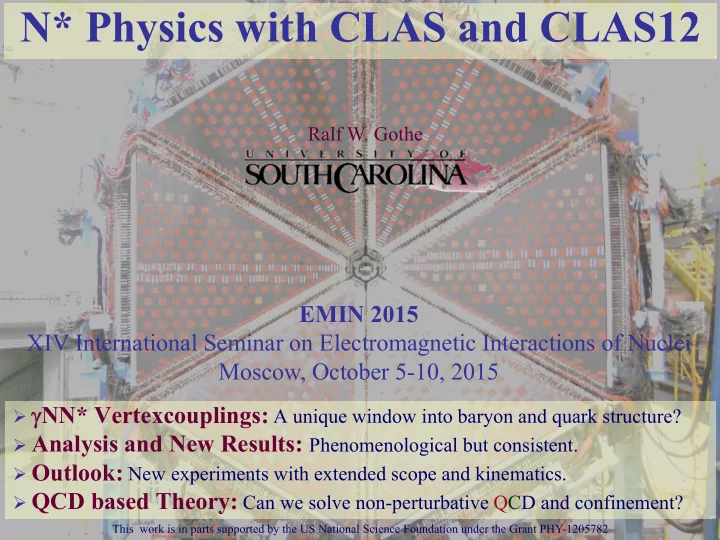
N* Physics with CLAS and CLAS12 Ralf W. Gothe EMIN 2015 XIV - - PowerPoint PPT Presentation

n physics with clas and clas12
SMART_READER_LITE
LIVE PREVIEW

N* Physics with CLAS and CLAS12 Ralf W. Gothe EMIN 2015 XIV - - PowerPoint PPT Presentation

N* Physics with CLAS and CLAS12 Ralf W. Gothe EMIN 2015 XIV International Seminar on Electromagnetic Interactions of Nuclei Moscow, October 5-10, 2015 NN* Vertexcouplings: A unique window into baryon and quark structure? Analysis and


slide-1
SLIDE 1

Ralf W. Gothe EMIN 2015, Moscow, Russia October 5-10, 2015 1

N* Physics with CLAS and CLAS12

  • NN* Vertexcouplings: A unique window into baryon and quark structure?
  • Analysis and New Results: Phenomenological but consistent.
  • Outlook: New experiments with extended scope and kinematics.
  • QCD based Theory: Can we solve non-perturbative QCD and confinement?

EMIN 2015 XIV International Seminar on Electromagnetic Interactions of Nuclei Moscow, October 5-10, 2015

This work is in parts supported by the US National Science Foundation under the Grant PHY-1205782

Ralf W. Gothe

slide-2
SLIDE 2

Ralf W. Gothe EMIN 2015, Moscow, Russia October 5-10, 2015 2

Spectroscopy

slide-3
SLIDE 3

Ralf W. Gothe EMIN 2015, Moscow, Russia October 5-10, 2015 3

Hadron Spectroscopy: Meson, Baryons, …

Q C D

slide-4
SLIDE 4

Ralf W. Gothe EMIN 2015, Moscow, Russia October 5-10, 2015 4

N and  Excited Baryon States …

  • Orbital excitations

(two distinct kinds in contrast to mesons)

  • Radial excitations

(also two kinds in contrast to mesons)

Simon Capstick

slide-5
SLIDE 5

Ralf W. Gothe EMIN 2015, Moscow, Russia October 5-10, 2015 5

h

1

h

2

h

3

h

1 2 3

3q (56,0+) (56,0+) (70,0+) (70,1-) (20,1+) (56,1-) (70,1-) (70,1-) (20,1-) (70,2-) (70,2+) (56,2+) (56,3-) (70,3-) (20,3-)

L

Particle Data Group

(1135 MeV) (1545 MeV) (1839 MeV) (2130 MeV)

N (Mass)

3/2 3/2 1/2 1/2 3/2 5/2 5/2 1/2 7/2

*** **** ** Lowest Baryon Supermultiplets SU(6)xO(3) Symmetry

Quark Model Classification of N*

(1232) D13(1520) S11(1535) Roper P11(1440) + q³g + q³qq + N-Meson + …

  • q2q

1135 MeV 1545 MeV 1839MeV 2130 MeV Mass

Dietmar Menze

slide-6
SLIDE 6

Ralf W. Gothe EMIN 2015, Moscow, Russia October 5-10, 2015 6

h

1

h

2

h

3

h

1 2 3

3q (56,0+) (56,0+) (70,0+) (70,1-) (20,1+) (56,1-) (70,1-) (70,1-) (20,1-) (70,2-) (70,2+) (56,2+) (56,3-) (70,3-) (20,3-)

L

Particle Data Group

(1135 MeV) (1545 MeV) (1839 MeV) (2130 MeV)

N (Mass)

3/2 3/2 1/2 1/2 3/2 5/2 5/2 1/2 7/2

*** **** ** Lowest Baryon Supermultiplets SU(6)xO(3) Symmetry

Quark Model Classification of N*

1135 MeV 1545 MeV 1839MeV 2130 MeV Mass

Dietmar Menze

2010

slide-7
SLIDE 7

Ralf W. Gothe EMIN 2015, Moscow, Russia October 5-10, 2015

2012

7

h

1

h

2

h

3

h

1 2 3

3q (56,0+) (56,0+) (70,0+) (70,1-) (20,1+) (56,1-) (70,1-) (70,1-) (20,1-) (70,2-) (70,2+) (56,2+) (56,3-) (70,3-) (20,3-)

L

Particle Data Group

(1135 MeV) (1545 MeV) (1839 MeV) (2130 MeV)

N (Mass)

3/2 3/2 1/2 1/2 3/2 5/2 5/2 1/2 7/2

*** **** ** Lowest Baryon Supermultiplets SU(6)xO(3) Symmetry

Quark Model Classification of N*

1135 MeV 1545 MeV 1839MeV 2130 MeV Mass

Dietmar Menze

BnGa energy-dependent coupled-channel PWA of CLAS K+Λ and other data

slide-8
SLIDE 8

Ralf W. Gothe EMIN 2015, Moscow, Russia October 5-10, 2015

2012

8

h

1

h

2

h

3

h

1 2 3

3q (56,0+) (56,0+) (70,0+) (70,1-) (20,1+) (56,1-) (70,1-) (70,1-) (20,1-) (70,2-) (70,2+) (56,2+) (56,3-) (70,3-) (20,3-)

L

Particle Data Group

(1135 MeV) (1545 MeV) (1839 MeV) (2130 MeV)

N (Mass)

3/2 3/2 1/2 1/2 3/2 5/2 5/2 1/2 7/2

*** **** ** Lowest Baryon Supermultiplets SU(6)xO(3) Symmetry

Quark Model Classification of N*

1135 MeV 1545 MeV 1839MeV 2130 MeV Mass

Dietmar Menze

BnGa energy-dependent coupled-channel PWA of CLAS K+Λ and other data naive q2q model 

slide-9
SLIDE 9

Ralf W. Gothe EMIN 2015, Moscow, Russia October 5-10, 2015

N/Δ Spectrum in RPP 2012

9

  • V. Crede & W. Roberts, Rep. Prog. Phys. 76 (2013)

Are we observing parity doublets with the new states?

High-statistics and high-precision photoproduction data from JLAB, MAMI, ELSA, GRAAL

Are we observing parity doublets with the new states?

  • r not?
slide-10
SLIDE 10

Ralf W. Gothe EMIN 2015, Moscow, Russia October 5-10, 2015

New FROST Results from p 0p

10

  • FROST experiment produced 900 data points of the double-polarization observable E in

π+ photoproduction with circularly polarized beam on longitudinally polarized protons for W = 1240 - 2260 MeV.

  • Significant improvements of the description of the data in SAID, Jülich, and BnGa partial-wave

analyses after fitting.

  • New strong evidence found in this data for a ∆(2200)7/2- resonance (BnGa analysis).

before fit after fit W = 1.650 GeV W = 1.920 GeV W = 2.170 GeV

  • S. Strauch et al., arXiv:1503.05163 and A.V. Anisovich et al., arXiv:1503.05774
slide-11
SLIDE 11

Ralf W. Gothe EMIN 2015, Moscow, Russia October 5-10, 2015 11

N* Spectrum in LQCD

  • R. Edwards et al.

arXiv:1104.5152, 1201.2349 LQCD predicts states with the same quantum numbers as CQMs with underlying SU(6)xO(3) symmetry. The strong interaction physics is encoded in the nucleon excitation spectrum that spans the degrees of freedom from meson-baryon and dressed quarks to elementary quarks and gluons.

slide-12
SLIDE 12

Ralf W. Gothe EMIN 2015, Moscow, Russia October 5-10, 2015 12

N* Spectrum in LQCD

LQCD predicts hybrid baryon states replicating the negative parity multiplet structure. The strong interaction physics is encoded in the nucleon excitation spectrum that spans the degrees of freedom from meson-baryon and dressed quarks to elementary quarks and gluons.

  • R. Edwards et al.

arXiv:1104.5152, 1201.2349

slide-13
SLIDE 13

Ralf W. Gothe EMIN 2015, Moscow, Russia October 5-10, 2015 13

Transition Form Factors

slide-14
SLIDE 14

Ralf W. Gothe EMIN 2015, Moscow, Russia October 5-10, 2015

  • Study the structure of the nucleon spectrum in the domain

where dressed quarks are the major active degree of freedom.

  • Explore the formation of excited nucleon states in interactions
  • f dressed quarks and their emergence from QCD.

14

…

Q2 low high k

Hadron Structure with Electromagnetic Probes

N,N*,*… 3q-core+MB-cloud 3q-core pQCD

* N N K1 K2

Q2 K

P1 P2

2

slide-15
SLIDE 15

Ralf W. Gothe EMIN 2015, Moscow, Russia October 5-10, 2015 15

quark mass (GeV)

Quark mass extrapolated to the chiral limit, where q is the momentum variable of the tree-level quark propagator using the Asqtad action.

LQCD, DSE and …

meson dressed quark confinement current quark

…

Q2 low high q e.m. probe

Hadron Structure with Electromagnetic Probes

N,N*,*… 3q-core+MB-cloud 3q-core pQCD

  • Study the structure of the nucleon spectrum in the domain

where dressed quarks are the major active degree of freedom.

  • Explore the formation of excited nucleon states in interactions
  • f dressed quarks and their emergence from QCD.
slide-16
SLIDE 16

Ralf W. Gothe EMIN 2015, Moscow, Russia October 5-10, 2015 16

Baryon Excitations and Quasi-Elastic Scattering

Deep Inelastic Scattering

  • S. Stein et al., PR D22 (1975) 1884

hard soft hard and confined Elastic Form Factors Transition Form Factors

slide-17
SLIDE 17

Ralf W. Gothe EMIN 2015, Moscow, Russia October 5-10, 2015 17

Data-Driven Data Analyses

  • Single meson production:

Unitary Isobar Model (UIM) Fixed-t Dispersion Relations (DR)

  • Double pion production:

Unitarized Isobar Model (JM)

  • Coupled-Channel Approach:

EBAC  Argonne-Osaka JAW  Jülich-Athens-Washington BoGa  Bonn-Gatchina

  • Single meson production:

Unitary Isobar Model (UIM) Fixed-t Dispersion Relations (DR)

  • Double pion production:

Unitarized Isobar Model (JM)

  • Coupled-Channel Approach:

EBAC  Argonne-Osaka JAW  Jülich-Athens-Washington BoGa  Bonn-Gatchina

  • Int. J. Mod. Phys. E, Vol. 22, 1330015 (2013) 1-99

Hadronic production Hadronic production Electromagnetic production Electromagnetic production Data

Amplitude analysis Reaction Models

DSE LQCD N*, Δ* QCD

Consistent Results

slide-18
SLIDE 18

Ralf W. Gothe EMIN 2015, Moscow, Russia October 5-10, 2015 18

Electrocouplings of N(1440)P11 from CLAS Data

N (UIM, DR) PDG N (JM) 2012 N (JM) preliminary Consistent results obtained in the low-lying resonance region by independent analyses in the exclusive N and p+- final-state channels – that have fundamentally different mechanisms for the nonresonant background – underscore the capability of the reaction models to extract reliable resonance electrocouplings.

  • Phys. Rev. C 80, 055203 (2009) 1-22 and Phys. Rev. C 86, 035203 (2012) 1-22
  • 80
  • 60
  • 40
  • 20

20 40 60 80 1 2 3 4 Q GeV A1/2*1000 GeV Q GeV S1/2*1000 GeV 10 20 30 40 50 60 70 1 2 3 4

A1/2 S1/2

slide-19
SLIDE 19

Ralf W. Gothe EMIN 2015, Moscow, Russia October 5-10, 2015

nrQM q3G LC QM

Roper resonance P11(1440)

Transition Form Factors and QCD Models

  • A1/2 has zero-crossing near Q2=0.5 and becomes dominant amplitude at high Q2.
  • Consistent with radial excitation at high Q2 and large meson-baryon coupling at small Q2.
  • Eliminates gluonic excitation (q3G) as a dominant contribution.

+ q³g + q³qq + N-Meson + … … all have distinctively different Q2 dependencies

PDG 2013 update

19

  • q2q
  • r

q3+Nσ

slide-20
SLIDE 20

Ralf W. Gothe EMIN 2015, Moscow, Russia October 5-10, 2015

nrQM q3G LC QM

Roper resonance P11(1440)

Transition Form Factors and QCD Models

  • A1/2 has zero-crossing near Q2=0.5 and becomes dominant amplitude at high Q2.
  • Consistent with radial excitation at high Q2 and large meson-baryon coupling at small Q2.
  • Eliminates gluonic excitation (q3G) as a dominant contribution.

20

New Letter of Intend on electroexcited gluon hybrids submitted to PAC43 S.-x.Qin et al., Phys. Rev. C 84 (2011) 042202(R)

DSE running gluon mass

slide-21
SLIDE 21

Ralf W. Gothe EMIN 2015, Moscow, Russia October 5-10, 2015 21

N* Spectrum in LQCD

LQCD predicts hybrid baryon states replicating the negative parity multiplet structure. The strong interaction physics is encoded in the nucleon excitation spectrum that spans the degrees of freedom from meson-baryon and dressed quarks to elementary quarks and gluons.

  • R. Edwards et al. arXiv:1104.5152, 1201.2349

New Letter of Intend on electroexcited gluon hybrids submitted to PAC43

slide-22
SLIDE 22

Ralf W. Gothe EMIN 2015, Moscow, Russia October 5-10, 2015 22

S11 Q3A1/2 F15 Q5A3/2 P11 Q3A1/2 D13 Q5A3/2 F15 Q3A1/2 D13 Q3A1/2

Evidence for the Onset of Scaling?

  • A1/2 1/Q3
  • A3/2 1/Q5
  • Phys. Rev. C80, 055203 (2009)
slide-23
SLIDE 23

Ralf W. Gothe EMIN 2015, Moscow, Russia October 5-10, 2015

Electrocouplings of N(1520)D13

23

  • 60
  • 50
  • 40
  • 30
  • 20
  • 10

10 20 30 0.5 1 1.5 2 2.5 3 3.5 4 4.5

Q2 GeV S1/2*1000 GeV

S1/2

10-3 GeV-1/2

  • 120
  • 100
  • 80
  • 60
  • 40
  • 20

20 1 2 3 4 5

Q2 GeV2 A1/2*1000 GeV-1/2

10-3 GeV-1/2

A1/2

  • 20

20 40 60 80 100 120 140 160 180 0.5 1 1.5 2 2.5 3 3.5 4 4.5

Q2 GeV A3/2*1000 GeV

10-3 GeV-1/2

A3/2

p 2012 p 2010 N 2009

Argonne Osaka / EBAC DCC MB dressing (absolute values)

  • E. Santopinto, M. Giannini, hCQM

PRC 86, 065202 (2012)

  • S. Capstick, B.D. Keister (rCQM)

PRD51, 3598 (1995) p CLAS/Hall-C

slide-24
SLIDE 24

Ralf W. Gothe EMIN 2015, Moscow, Russia October 5-10, 2015 24

S11 Q3A1/2 F15 Q5A3/2 P11 Q3A1/2 D13 Q5A3/2 F15 Q3A1/2 D13 Q3A1/2

Evidence for the Onset of Scaling?

  • A1/2 1/Q3
  • A3/2 1/Q5
  • Phys. Rev. C80, 055203 (2009)
  • GM 1/Q4

*

q2q

slide-25
SLIDE 25

Ralf W. Gothe EMIN 2015, Moscow, Russia October 5-10, 2015 25

N →  Multipole Ratios REM , RSM

  • Phys. Rev. Lett. 97, 112003 (2006)

CLAS Hall A  Hall C MAMI Bates

Meson Cloud Effect Pascalutsa Vanderhaeghen Sato-Lee

  • New trend towards pQCD behavior does not show up
  • CLAS12 can measure GM, REM, and RSM up to Q²~12 GeV²

*

  • REM

+1 RSM const

  • GM,J.-S.

1/Q4 GM,Ash 1/Q5

* *

slide-26
SLIDE 26

Ralf W. Gothe EMIN 2015, Moscow, Russia October 5-10, 2015 26

N(1520)D13 Helicity Asymmetry

world data

10-3 GeV-1/2

N (UIM, DR) PDG estimation N, N combined analysis N (JM)

Ahel = A1/2

2 – A3/2 2

A1/2

2 + A3/2 2

  • L. Tiator
slide-27
SLIDE 27

Ralf W. Gothe EMIN 2015, Moscow, Russia October 5-10, 2015

2.5 5 7.5 10 12.5 15 17.5 20 1 2 3 4

Q GeV A1/2*1000 GeV Q GeV A1/2*1000 GeV

  • 120
  • 100
  • 80
  • 60
  • 40
  • 20

20 2 4

Interplay between Meson-Baryon Cloud and Quark Core

  • E. Santopinto and M. Giannini, PRC 86 (2012) 065202

Argonne-Osaka MB dressing (absolute values)

N(1520)3/2- N(1675)5/2-

The almost direct access to

  • quark core from the data on N(1520)3/2-
  • meson-baryon cloud from the data on N(1675)5/2-

sheds light on the transition from the confined quark to the colorless meson-baryon structure and its dependents on the N* quantum numbers.

Quark core dominance MB cloud dominance

  • K. Park et al., PRC91 (2015) 045203

27

slide-28
SLIDE 28

Ralf W. Gothe EMIN 2015, Moscow, Russia October 5-10, 2015 28

New Experimental Results & Approaches

slide-29
SLIDE 29

Ralf W. Gothe EMIN 2015, Moscow, Russia October 5-10, 2015 29

Higher-Lying Resonance Electrocouplings

Kijun Park

N(1680)F15

RPP (PDG) Phys. Rev. D 86 (2012)

  • M. Dugger Phys. Rev. C 76 (2007)

I.G. Aznauryan, Phys. Rev. C 72 (2005) NV. Mokeev (JM) N: I.G. Aznauryan (UIM & DR)

  • D. Merten, U. Löring et al.
  • Z. Lee and F. Close
  • E. Santopinto and M.M. Gianini
slide-30
SLIDE 30

Ralf W. Gothe EMIN 2015, Moscow, Russia October 5-10, 2015 30

Higher-Lying Resonance Electrocouplings

Kijun Park

N(1675)D15

RPP (PDG) Phys. Rev. D 86 (2012)

  • M. Dugger Phys. Rev. C 76 (2007)

N: I.G. Aznauryan (UIM & DR)

  • D. Merten, U. Löring et al.
  • B. Julia-Diaz, T.-S.H. Lee et al.
  • E. Santopinto and M.M. Gianini
slide-31
SLIDE 31

Ralf W. Gothe EMIN 2015, Moscow, Russia October 5-10, 2015

Q2 GeV A1/2*1000 GeV

20 40 60 80 100 120 0.2 0.4 0.6 0.8 1 1.2 1.4

Q2 GeV A3/2*1000 GeV

  • 80
  • 70
  • 60
  • 50
  • 40
  • 30
  • 20
  • 10

10 20 0.2 0.4 0.6 0.8 1 1.2 1.4

  • 60
  • 50
  • 40
  • 30
  • 20
  • 10

0.2 0.4 0.6 0.8 1 1.2 1.4

Q2 GeV S1/2*1000 GeV

(1700)3/2- A1/2 N(1720)3/2+ A3/2 (1620)1/2- S1/2 Independent fits in different W-intervals

green: 1.46<W<1.56 GeV magenta: 1.56<W<1.66 GeV red: 1.61<W<1.71 GeV blue: 1.66<W<1.76 GeV black: 1.71<W<1.81 GeV

result in consistent electrocouplings and hence

  • ffer sound evidence for their reliable extraction.

The p electroproduction channel provides first preliminary results on the (1620)1/2-, N(1650)1/2-, N(1680)5/2+, (1700)3/2- , and N(1720)3/2+ electrocouplings with good accuracy.

Higher-Lying Resonance Electrocouplings

Submitted for publication.

31

slide-32
SLIDE 32

Ralf W. Gothe EMIN 2015, Moscow, Russia October 5-10, 2015

New N’(1720)3/2+ State and its Properties

Resonance BF(), % BF(p), %

N’(1720)3/2+ electroproduction photoproduction 47-64 46-62 3-10 4-13 N(1720)3/2+ electroproduction photoproduction 39-55 38-53 23-49 31-46 (1700)3/2- electroproduction photoproduction 77-95 78-93 3-5 3-6 N* hadronic decays from JM15 that incorporates N’(1720)3/2+

Q2 GeV A1/2*1000 GeV

  • 40
  • 20

20 40 60 80 100 0.2 0.4 0.6 0.8 1 1.2 1.4

Q2 GeV S1/2*1000 GeV

  • 40
  • 20

20 40 60 0.2 0.4 0.6 0.8 1 1.2 1.4

Q2 GeV A3/2*1000 GeV

  • 50
  • 40
  • 30
  • 20
  • 10

10 0.2 0.4 0.6 0.8 1 1.2 1.4

N’(1720)3/2+ N(1720)3/2+

A successful description of +-p photo- and electro- production cross sections at Q2=0, 0.65, 0.95, and 1.30 GeV2 has been achieved by implementing a new N’(1720)3/2+ state with Q2-independent hadronic decay widths of all resonances that contribute at W~1.7 GeV, that allows us to claim the existence of a new N’(1720)3/2+ state.

Mass: 1.715-1.735 GeV Width: 120 6 MeV Mass: 1.743-1.753 GeV Width: 112 8 MeV

32

slide-33
SLIDE 33

Ralf W. Gothe EMIN 2015, Moscow, Russia October 5-10, 2015 33

Single  Electroproduction off the Deuteron

Ye Tian

slide-34
SLIDE 34

Ralf W. Gothe EMIN 2015, Moscow, Russia October 5-10, 2015 34

Single  Electroproduction off the Deuteron

Ye Tian Below a missing momentum of 0.2 GeV the measured data coincides with the resolution smeared theoretical Fermi momentum distribution.

slide-35
SLIDE 35

Ralf W. Gothe EMIN 2015, Moscow, Russia October 5-10, 2015 35

Single  Electroproduction off the Deuteron

Ye Tian

slide-36
SLIDE 36

Ralf W. Gothe EMIN 2015, Moscow, Russia October 5-10, 2015 36

W = 1350 MeV W = 1662 MeV W = 1924 MeV W = 2154 MeV W = 2362 MeV W = 2441 MeV

slide-37
SLIDE 37

Ralf W. Gothe EMIN 2015, Moscow, Russia October 5-10, 2015 37

Single  Electroproduction off the Deuteron

Ye Tian

slide-38
SLIDE 38

Ralf W. Gothe EMIN 2015, Moscow, Russia October 5-10, 2015 38

Single  Electroproduction off the Deuteron

Ye Tian W = 1125 MeV W = 1685 MeV W = 25 MeV Q2 = 0.2 GeV2 Q2 = 0.7 GeV2

slide-39
SLIDE 39

Ralf W. Gothe EMIN 2015, Moscow, Russia October 5-10, 2015 39

Single  - Electroproduction off the Deuteron

Ye Tian W = 1212 MeV W = 25 MeV Q2 = 0.2 GeV2 Q2 = 0.5 GeV2 cos() = -0.7 cos() = 0.2 cos() = 0.7  = 15o  = 30o  = 345o

slide-40
SLIDE 40

Ralf W. Gothe EMIN 2015, Moscow, Russia October 5-10, 2015 40

Single  - Electroproduction off the Deuteron

Ye Tian W = 1212 MeV W = 25 MeV Q2 = 0.2 GeV2 Q2 = 0.7 GeV2 cos() = -0.7 cos() = 0.2 cos() = 0.7  = 15o  = 30o  = 345o

slide-41
SLIDE 41

Ralf W. Gothe EMIN 2015, Moscow, Russia October 5-10, 2015 41

Single  - Electroproduction off the Deuteron

Ye Tian W = 1212 MeV W = 25 MeV Q2 = 0.2 GeV2 Q2 = 0.9 GeV2 cos() = -0.7 cos() = 0.2 cos() = 0.7  = 15o  = 30o  = 345o

slide-42
SLIDE 42

Ralf W. Gothe EMIN 2015, Moscow, Russia October 5-10, 2015 42

Single  - Electroproduction off the Deuteron

Ye Tian W = 1212 MeV W = 25 MeV Q2 = 0.2 GeV2 Q2 = 0.5 GeV2 cos() = -0.7 cos() = 0.2 cos() = 0.7  = 15o  = 30o  = 345o

slide-43
SLIDE 43

Ralf W. Gothe EMIN 2015, Moscow, Russia October 5-10, 2015 43

Single  - Electroproduction off the Deuteron

Ye Tian W = 1488 MeV W = 25 MeV Q2 = 0.2 GeV2 Q2 = 0.5 GeV2 cos() = -0.7 cos() = 0.2 cos() = 0.7  = 15o  = 30o  = 345o

slide-44
SLIDE 44

Ralf W. Gothe EMIN 2015, Moscow, Russia October 5-10, 2015 44

Single  - Electroproduction off the Deuteron

Ye Tian W = 1612 MeV W = 25 MeV Q2 = 0.2 GeV2 Q2 = 0.5 GeV2 cos() = -0.7 cos() = 0.2 cos() = 0.7  = 15o  = 30o  = 345o

slide-45
SLIDE 45

Ralf W. Gothe EMIN 2015, Moscow, Russia October 5-10, 2015 45

Single  - Electroproduction off the Deuteron

Ye Tian

slide-46
SLIDE 46

Ralf W. Gothe EMIN 2015, Moscow, Russia October 5-10, 2015

-dependent N Single-Differential Cross Sections

46

Arjun Trivedi Gleb Fedotov -integrated

slide-47
SLIDE 47

Ralf W. Gothe EMIN 2015, Moscow, Russia October 5-10, 2015

-dependent N Single-Differential Cross Sections

47

Arjun Trivedi Gleb Fedotov -integrated

slide-48
SLIDE 48

Ralf W. Gothe EMIN 2015, Moscow, Russia October 5-10, 2015

-dependent N Single-Differential Cross Sections

48

Arjun Trivedi -integrated -independent

slide-49
SLIDE 49

Ralf W. Gothe EMIN 2015, Moscow, Russia October 5-10, 2015

-dependent N Single-Differential Cross Sections

49

Arjun Trivedi

slide-50
SLIDE 50

Ralf W. Gothe EMIN 2015, Moscow, Russia October 5-10, 2015

-dependent N Single-Differential Cross Sections

50

Arjun Trivedi

slide-51
SLIDE 51

Ralf W. Gothe EMIN 2015, Moscow, Russia October 5-10, 2015 51

CLAS12

  • Luminosity > 1035 cm-2s-1
  • Hermeticity
  • Polarization
  • Baryon Spectroscopy
  • Elastic Form Factors
  • N to N* Form Factors
  • GPDs and TMDs
  • DIS and SIDIS
  • Nucleon Spin Structure
  • Color Transparency

Central Detector Forward Detector 1m

CLAS12

slide-52
SLIDE 52

Ralf W. Gothe EMIN 2015, Moscow, Russia October 5-10, 2015 52

New Forward Time of Flight Detector for CLAS12

slide-53
SLIDE 53

Ralf W. Gothe EMIN 2015, Moscow, Russia October 5-10, 2015

slide-54
SLIDE 54

Ralf W. Gothe EMIN 2015, Moscow, Russia October 5-10, 2015 54

Anticipated N* Electrocouplings from Combined Analyses of N/N

Open circles represent projections and all other markers the available results with the 6-GeV electron beam

  • Examples of published and projected results obtained within 60d for three prominent

excited proton states from analyses of N and N electroproduction channels. Similar results are expected for many other resonances at higher masses, e.g. S11(1650), F15(1685), D33(1700), P13(1720), …

  • The approved CLAS12 experiments E12-09-003 (NM, N) and E12-06-108A (KY) are

currently the only experiments that can provide data on NN* electrocouplings for almost all well established excited proton states at the highest photon virtualities ever achieved in N* studies up to Q2 of 12 GeV2, see http://boson.physics.sc.edu/~gothe/research/pub/whitepaper-9-14.pdf. S11(1535) D13(1520) P11(1440)

CLAS CLAS CLAS Hall C

slide-55
SLIDE 55

Ralf W. Gothe EMIN 2015, Moscow, Russia October 5-10, 2015 55

Dyson-Schwinger Equation (DSE) Approach

DSE approaches provide links between dressed quark propagators, form factors, scattering amplitudes, and QCD.

N* electrocouplings can be determined by applying Bethe- Salpeter / Faddeev equations to 3 dressed quarks while the properties and interactions are derived from QCD. Impact of a modified momentum dependence of the dressed-quark propagator. DSE electrocouplings of several excited nucleon states will become available as part of the commitment of the Argonne NL.

  • Int. J. Mod. Phys. E, Vol. 22, 1330015 (2013) 1-99

Data Fit

I.C. Cloet et al., arXiv:1304.0855[nucl-th]

CLAS CLAS12 EIC

Q2 = 2.75 GeV2 12 GeV2

slide-56
SLIDE 56

Ralf W. Gothe EMIN 2015, Moscow, Russia October 5-10, 2015 56

Dyson-Schwinger Equation (DSE) Approach

DSE approaches provide links between dressed quark propagators, form factors, scattering amplitudes, and QCD.

N* electrocouplings can be determined by applying Bethe- Salpeter / Faddeev equations to 3 dressed quarks while the properties and interactions are derived from QCD. DSE calculations of elastic and transition form factors are very sensitive to the momentum dependence of the dressed-quark propagator. DSE electrocouplings of several excited nucleon states will become available as part of the commitment of the Argonne NL.

  • Int. J. Mod. Phys. E, Vol. 22, 1330015 (2013) 1-99

Data Fit

I.C. Cloet et al., arXiv:1304.0855[nucl-th]

CLAS CLAS12

slide-57
SLIDE 57

Ralf W. Gothe EMIN 2015, Moscow, Russia October 5-10, 2015 57

Summary

  • First high precision photo- and electroproduction data have become available

and led to a new wave of significant developments in reaction and QCD-based theories.

  • New high precision hadro-, photo-, and electroproduction data off the proton and

the neutron will stabilize coupled channel analyses and expand the validity of reaction models, allowing us to

  • investigate and search for baryon hybrids,
  • establish a repertoire of high precision spectroscopy parameters, and
  • measure light-quark-flavor separated electrocouplings over an extended Q2-range,

both to lower and higher Q2, for a wide variety of N* states.

  • Comparing these results with DSE, LQCD, LCSR, and rCQM will

build insights into

  • the strong interaction of dressed quarks and their confinement,
  • the emergence of bare quark dressing and dressed quark

interactions from QCD, and

  • the QCD -function and the origin of 98% of nucleon mass.
  • A tight collaboration of experimentalists and theorists has formed and is

needed to push these goals, see Review Article Int. J. Mod. Phys. E, Vol. 22,

1330015 (2013) 1-99, that shall lead to a QCD theory that describes the

strong interaction from current quarks to nuclei. ECT*2015 and INT2016.