SLIDE 1 4810-6798-7536.3 4837-0540-2193.1
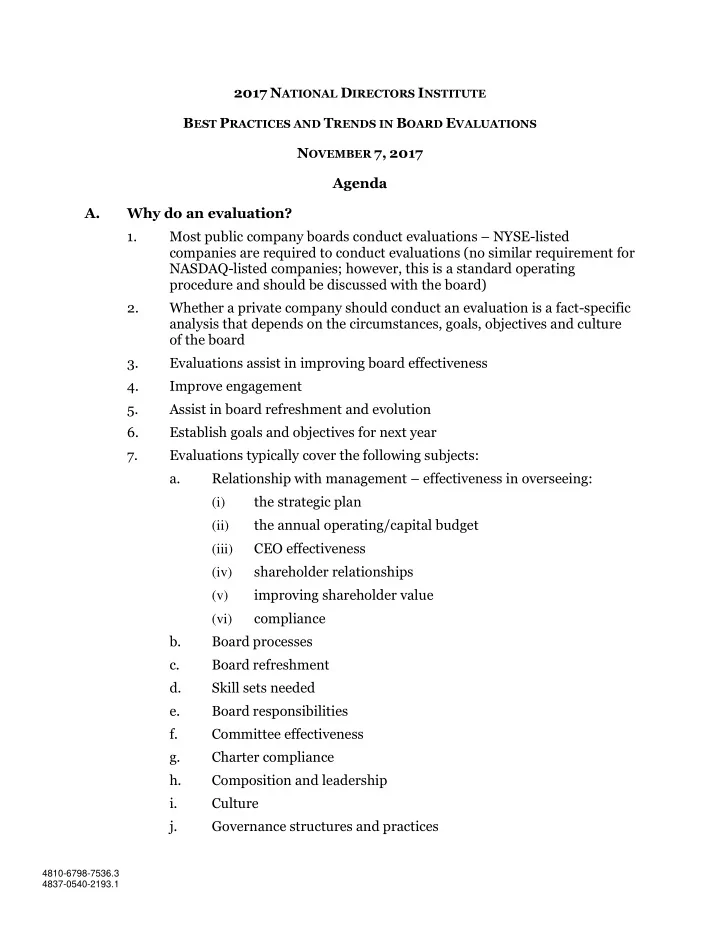
2017 NATIONAL DIRECTORS INSTITUTE BEST PRACTICES AND TRENDS IN BOARD EVALUATIONS NOVEMBER 7, 2017 Agenda A. Why do an evaluation? 1. Most public company boards conduct evaluations – NYSE-listed companies are required to conduct evaluations (no similar requirement for NASDAQ-listed companies; however, this is a standard operating procedure and should be discussed with the board) 2. Whether a private company should conduct an evaluation is a fact-specific analysis that depends on the circumstances, goals, objectives and culture
3. Evaluations assist in improving board effectiveness 4. Improve engagement 5. Assist in board refreshment and evolution 6. Establish goals and objectives for next year 7. Evaluations typically cover the following subjects: a. Relationship with management – effectiveness in overseeing: (i) the strategic plan (ii) the annual operating/capital budget (iii) CEO effectiveness (iv) shareholder relationships (v) improving shareholder value (vi) compliance b. Board processes c. Board refreshment d. Skill sets needed e. Board responsibilities f. Committee effectiveness g. Charter compliance h. Composition and leadership i. Culture j. Governance structures and practices
SLIDE 2 2
4837-0540-2193.1
8. How do you initiate a board evaluation? B. Conducting the Evaluation 1. No single correct process 2. Consider the board’s culture when selecting an evaluation method 3. Evaluations can cover the full board, board committees and/or each individual director a. NACD is an advocate for routine board, committee and individual director evaluations (i) According to the 2016-2017 NACD Public Company Governance Survey:
- 90% of respondents conduct full board evaluations
- 78% of respondents conduct committee evaluations
- 41% of respondents conduct individual director
evaluations b. Most companies evaluate the effectiveness of both the full board and its committees – this is required for NYSE-listed companies (no similar requirement for NASDAQ-listed companies) c. While not widespread, individual director evaluations are becoming more prevalent – ISS has indicated that a robust board policy on board evaluation includes individual evaluations 4. Common to have a board committee and/or the chairman or lead director facilitate the process 5. Many companies also engage an independent facilitator or outside legal counsel to lead and coordinate the evaluation process 6. Corporate governance committee of a NYSE-listed company is responsible for overseeing the process (no similar requirement for NASDAQ-listed companies) 7. Types of Evaluations a. Questionnaires (i) Overview:
- Most common method
- Questions may be prepared internally or with the
assistance of an outside party
- Should be updated on a regular basis to address new
topics/key concerns/pre-identified areas of desired improvements
SLIDE 3 3
4837-0540-2193.1
(ii) Types of questionnaires
- Long-form containing closed-ended questions –
responses often require numerical ratings
- Short-form containing open-ended questions
- Questionnaires may include a combination of the above
methods (iii) Advantages:
- Anonymity
- Easy to compare to previous years
- Low cost
(iv) Disadvantages:
- Difficult to translate into meaningful action steps
- Process may produce few new insights if used year after
year
- May be subject to discovery in litigation
b. Personal interviews (i) Overview
- Method is gaining prevalence
- Interviews may be conducted by any of the following:
(1) a director (typically the chairman or the lead director), (2) a committee chair, (3) a group of directors (could be the governance committee), (4) an attorney (either the general counsel or a member
(5) the corporate secretary, or (6) an outside consultant. (ii) Advantages:
SLIDE 4 4
4837-0540-2193.1
- Results in more candid and insightful responses
- Can yield rich and specific feedback
- More engaging for directors
- Less subject to discovery (if done right)
(iii) Disadvantages:
- Directors may not be as candid if the interview is
conducted by another director
- Time-consuming
- Expensive if done by a third party
c. Facilitated Discussion (i) Overview:
- Allows directors and committee members to share
viewpoints and discuss areas of concern
- Discussion may be led by any of the individuals who can
conduct a personal interview (ii) Advantages
- Directors can hear, learn and respond to other directors’
comments
- Can promote collegiality (if done right)
- Time-effective
(iii) Disadvantages
- May discourage candid responses
- May result in hurt feelings or demote collegiality
- No anonymity
SLIDE 5 5
4837-0540-2193.1
d. Alternatives/Combination Method (i) Alternative procedures include self-assessment questionnaires, questioning key stakeholders or questioning members of management (ii) Companies may use a combination of any one or more method 8. It is best practice to periodically utilize different approaches to achieve
- ptimal effectiveness and reach
C. Post-Evaluation 1. Follow-up with individual directors, as appropriate, to address areas of desired improvements 2. Board leadership should summarize and discuss results prior to discussing with the full board 3. Create action plan that summarizes the key findings and provides a list of action items 4. Develop board goals and objectives based on results 5. Action plan should include a strategy for implementing change to address board deficiencies and generate improved governance 6. May provide individual director feedback report 7. Dealing with significant performance issues, and conveying the issues to the board: a. Issues should be considered by the chairman, lead director or the governance committee, as appropriate b. Should consider whether coaching, additional educational
- pportunities or other support is needed
c. In unusual cases, may result in removing director or asking a director to resign from the board d. Important to create change in a positive way D. Mock Feedback Session E. Privilege Concerns 1. Assume the evaluation is not privileged, even when conducted by an attorney 2. Plaintiffs can argue that the evaluation constitutes business advice 3. Mark documentation involving an attorney as privileged and confidential 4. Retain written materials until the action plan has been prepared 5. To avoid being subject to discovery in litigation, action plans may consist
- f an oral report or a high-level presentation
SLIDE 6 1
4814-2304-4945.1
ABC CORPORATION Board of Directors’ Self-Assessment of Performance Questionnaire [DATE]
The following questions are designed to gather information regarding the performance of ABC Corp.’s Board of Directors and its Committees over fiscal [YEAR]. Following each question, there is space for you to comment on issues raised by that question. In addition, at the end of this Questionnaire, there is additional space for you to comment on other issues that you would like to raise. Please feel free to raise any and all issues that you believe could improve the performance of ABC Corp.’s Board of Directors or its Committees. To ensure the confidentiality of your answers and comments, this questionnaire will not be shared with company personnel or other directors, and none of your comments or answers will be disclosed to company personnel or other directors unless you specifically request us to do so. In addition, the individual questionnaires will be destroyed after the results are tabulated and summarized. After completing the questionnaire, please send your responses directly to _______________ prior to [DATE]. Directions: Please respond to each question below by ranking the Board’s performance using the following scale: 1 = Needs Improvement, 2 = Acceptable, 3 = Good, and 4 = Excellent. Evaluation of Chief Executive Officer
- 1. Is the Board doing an effective job of evaluating the performance of
the Chief Executive Officer on a regular basis? Comments: 1 2 3 4
- 2. Are the goals, expectations and concerns of the Board effectively
communicated to the Chief Executive Officer? Comments: 1 2 3 4
SLIDE 7 2
4814-2304-4945.1
Review, Approval and Monitoring of Strategic Plan and Operating Plan
- 3. Does the Board know and understand the Company’s values,
mission, strategies and business plans? Comments: 1 2 3 4
- 4. Does the Board apply this understanding in dealing with key issues
throughout the year? Comments: 1 2 3 4
- 5. Does the Board spend the necessary time reviewing and approving
the Company’s strategic direction, annual operating plan and annual budget? Comments: 1 2 3 4
- 6. Does the Board focus sufficiently with management on the strategic
issues and challenges that will shape the Company’s future? Comments: 1 2 3 4
- 7. Does the Board adequately monitor financial and other indicators
throughout the year to ensure that the Company is performing as planned? Comments: 1 2 3 4
SLIDE 8 3
4814-2304-4945.1
- 8. Is there an effective system of internal controls in place for
safeguarding assets, managing major risks and identifying critical issues and trends? Comments: 1 2 3 4 Review and Approval of Management Performance and Compensation
- 9. How would you rate the Board’s process for determining
management compensation? Comments: 1 2 3 4
- 10. Does the Board use clearly-stated and appropriate methods of
measuring management performance? Comments: 1 2 3 4 Review of Succession Planning
- 11. Does the Board understand, and is it comfortable with, the
management succession plan, including the Chief Executive Officer succession process? Comments: 1 2 3 4 Advise and Counsel Management
- 12. Does the Board have sufficient formal and informal contact with the
Chief Executive Officer, as well as with other members of management? Comments: 1 2 3 4
SLIDE 9 4
4814-2304-4945.1
- 13. Do Board members generally ask appropriate questions of
management and are they given sufficient opportunity to ask such questions? Comments: 1 2 3 4
- 14. Does the Board seek outside expertise and advice when appropriate?
Comments: 1 2 3 4
- 15. In your experience, are Board members generally available for
independent consultation with the Chief Executive Officer outside the context of Board/Committee meetings? Comments: 1 2 3 4
- 16. In your experience, do Board members generally respond promptly
to requests and action items from the Chief Executive Officer and
- ther members of the Company’s senior management?
Comments: 1 2 3 4 Selection and Evaluation of Board Candidates
- 17. Is the current size of the Company’s Board appropriate?
If not, then what size should it be? 1 2 3 4
- 18. Is the current proportion of outside directors to inside directors
appropriate? Comments: 1 2 3 4
SLIDE 10 5
4814-2304-4945.1
- 19. Are the outside directors appropriately independent-minded in
dealing with Company issues? Comments: 1 2 3 4
- 20. Do the individual directors, as a whole, have the right mix of
general business experience, skills, diversity and expertise in areas
- f importance to the Company’s success?
What additional characteristics, diversity or skills would be helpful? 1 2 3 4
- 21. Is the process followed to select and nominate directors satisfactory?
Comments: 1 2 3 4 Board Operations and Meetings
- 22. Are the number of Board meetings and the length of Board meetings
held during the year appropriate? Comments: 1 2 3 4
- 23. Do directors have adequate input into preparation of the Board and
Committee agendas? Comments: 1 2 3 4
- 24. Is ample time allocated at Board meetings to assure full discussion
- f important matters?
Comments: 1 2 3 4
SLIDE 11 6
4814-2304-4945.1
- 25. Are the meetings conducted in a manner that ensures open
communication and meaningful participation (i.e., collegial yet appropriately challenging)? Comments: 1 2 3 4
- 26. Does the Board generally find an effective balance between offering
constructive suggestions/contributions to management and posing challenges? Comments: 1 2 3 4
- 27. Is the information (financial or otherwise) directors receive prior to
and during the meetings, including presentations to the Board, sufficient in substance to allow them to make informed and sound decisions? Comments: 1 2 3 4
- 28. Is there sufficient time/opportunity for non-employee directors to
meet independent of the inside directors? Comments: 1 2 3 4
- 29. Is the Company’s compensation package for directors conducive to
enhancing long-term shareholder value? Comments: 1 2 3 4
SLIDE 12 7
4814-2304-4945.1
Committee Structure and Performance
- 30. Are the Company’s Committees functioning appropriately and in a
manner consistent with their respective charters and/or the authority delegated to those Committees by the Board? Audit and Finance Committee Compensation Committee Nominating and Corporate Governance Committee Comments: 1 2 3 4 1 2 3 4 1 2 3 4 1 2 3 4 1 2 3 4
- 31. Is the annual review of Committee memberships and chairmanships
satisfactory? Comments: 1 2 3 4
- 32. Are non-committee members kept well-informed of deliberations
and actions of each Committee? Comments: 1 2 3 4 Self-Assessment and Follow-Through
- 33. Does the Board have an adequate process for self-assessment of its
performance? Comments: 1 2 3 4
SLIDE 13 8
4814-2304-4945.1
- 34. Does the Board effectively follow through on its recommendations
developed during the self-assessment process? Comments: 1 2 3 4
- 35. Do you have any suggestions or comments on ways to improve the
Board’s process for self-assessment of its performance or the Company’s corporate governance? Comments:
- 36. Please assess the Board’s progress in meeting its following goals for
fiscal [YEAR]:
- a. [Insert prior year goals.]
1 2 3 4
- 37. What should be our Board’s principal goals and objectives for FYE
[YEAR]? Name: Signature: Phone: Email: Please PDF or fax to _______________ prior to _______________.
SLIDE 14
9
4814-2304-4945.1
Other Comments and Suggestions
SLIDE 15
4816-6729-6849.1
ABC CORPORATION BOARD OF DIRECTORS’ SELF-EVALUATION QUESTIONNAIRE [DATE] This questionnaire is designed to gather information regarding the performance of ABC Corp.’s Board of Directors and its Committees. Following each question, there is space for you to comment on issues raised by that question. In addition, at the end of this Questionnaire, there is additional space for you to comment on other issues that you would like to raise. If additional space is needed, please attach additional sheets of paper as necessary. Please feel free to raise any and all issues that you believe could improve the performance of ABC Corp.’s Board of Directors or its Committees. To ensure the confidentiality of your answers and comments, this questionnaire will not be shared with company personnel or other directors, and none of your comments or answers will be disclosed to company personnel or other directors unless you specifically request us to do so. In addition, the individual questionnaires will be destroyed after the results are tabulated and summarized, After completing the questionnaire, please send your responses to prior to [DATE]. 1. Please provide your self-assessment of our Board of Directors. 2. What are the strengths of our Board? 3. What are the areas in which our Board needs to improve?
SLIDE 16
2 a. What improvements would you suggest with respect to the amount, type and timing of information provided to the Board (in advance of, at and in between meetings)? b. What improvements would you suggest to the agenda and topics discussed at, and the time spent on topics, at our Board meetings? c. What are your suggestions on the number and length of our Board meetings? d. What are your suggestions on our Board size and composition?
SLIDE 17
3 4. Please assess the strengths and weaknesses of our Board Committees: a. Audit Committee b. Compensation Committee c. Nominating Committee d. Governance Committee
SLIDE 18
4 e. Strategic Planning Committee (Board as a whole) 5. What should be our Board’s principal goals and objectives for [YEAR]? 6. Please provide any other comments or suggestions to improve the effectiveness or performance of our Board and its Committees and/or our governance of ABC Corp.: Name: Signature: