
SLIDE 1
My Taxes, Your Taxes, and the Vibrant History of American Fiscal Citizenship
Joseph J. Thorndike Director, Tax History Project at Tax Analysts Contributing Editor, Tax Notes
My Taxes, Your Taxes, and the Vibrant History of American Fiscal - - PowerPoint PPT Presentation
My Taxes, Your Taxes, and the Vibrant History of American Fiscal Citizenship Joseph J. Thorndike Director, Tax History Project at Tax Analysts Contributing Editor, Tax Notes A Nation of Tax Haters? At least until 1913, America was
Joseph J. Thorndike Director, Tax History Project at Tax Analysts Contributing Editor, Tax Notes
“At least until 1913, America was brimming with tax rebels. From the time when the British tried to tax us in 1764, to the adoption of the income tax amendment in 1913, our combative anti- tax character led from one rebellion to another.” – Charles Adams, Those Dirty Rotten Taxes
Both Early … Boston Tea Party, 1773 Shay’s Rebellion, 1786-1787 Whiskey Rebellion, 1791-1794 Fries Rebellion, 1799-1800 And Late … Property tax revolts of the 1930s Income Tax Limitation Amendment of the 1950s Proposition 13 The Tea Party of 2009
high taxation.
reductive conclusion: That Americans simply don’t like taxes.
claims are typically phrased in the first person)
revolts nor the broader history of U.S. taxation.
The Four Regimes
Wars have been the inflection points
The end of fiscal history? Not likely.
The Iron Law of Tax History: Real, durable change happens when it must, not when it should. It’s not all about revenue imperatives – but revenue has determined the inflection points. Fairness has given shape to change, once revenue imperatives have made change necessary.
to claim moral legitimacy for self-interested policy preferences
the historical record.
conceptions, in many different periods.
Americans tend to think about taxes in terms of
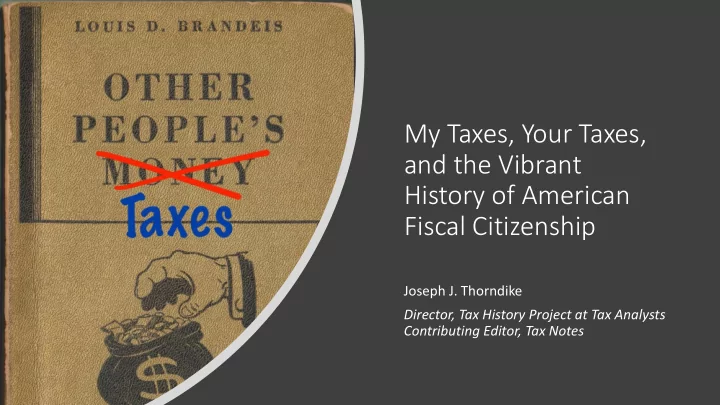
fiscal citizens. Americans talk (and complain) less about the taxes THEY are paying and more about the taxes OTHER PEOPLE are NOT paying.
The rhetoric of tax “otherness” has never been the exclusive domain of any party or ideological block. Often used to advance progressive reform: introduction of new tax instruments (the income tax), elimination of old
consumption tax). But also used to attack the income tax for its nonpayers (charges which have dogged the levy since its inception). "Other People's Taxes" is an element of fiscal citizenship: the web of rights and responsibilities that connect citizens to one another—and citizens to the state.
Several scholars have deepened our understanding
including Ajay Mehrotra, Larry Zelenak, and James Sparrow, to name just a few. My book seeks to build on these and other efforts, crafting a synthetic history of U.S. federal taxation that puts fiscal citizenship at the center
inflection point in the history of U.S. taxation.
Other People WILL pay under the new regime, but
with talk of avoidance and evasion, shirking and freeloading.
The language of fiscal citizenship
against high taxes – on tea or anything else.
Company a tax break on tea shipped to the colonies, as well as special privileges for selling that tea in America – all of which meant lower prices for colonial consumers.
favoritism and crony capitalism.
revenue
2% of gross national product to roughly 15%.
up.
federal property tax.
property tax, emphasizing its heavy burden on farmers.
would have to pay the tax.
ESCAPE the tax.
“I cannot go home, and tell my constituents that I voted for a bill that would allow a man, a millionaire, who has put his entire property into stock, to be exempt from taxation, while a farmer who lives by his side must pay a tax.”
"I ask if the farmers of this country are to have their lands pledged as security for payment of this debt, while the great stockholders, the money lenders, and the merchant princes of Wall Street, and all the great capitalists, are to go free, and bear none of these burdens?”
criticism about freeloading capitalists
some DID call it legislated envy
instrument of modern fiscal citizenship – a tool for ensuring that Americans worked together in a common fiscal enterprise.
– not a mass tax, but not a plutocrat’s tax either.
taxes to criticize the high exemptions of the post- World War I income tax
to have every citizen with a stake in his country. Nothing brings home to a man the feeling that he personally has an interest in seeing that government revenues are not squandered, but intelligently expended, as the fact that he contributes individually a direct tax, no matter how small, to his government."
John Nance Garner, D-Tex., pointed out.
shorts and underwear, on the food on the breakfast- table, on the materials of which are homes are constructed, on the furniture in them … Do not these payments entitle us to feel equally with Mr. Mellon, that we have a stake in our country?”
Democrats found compelling.
Jr.’s tax returns made national headlines.
House leaked the names of wealthy taxpayers engaged in legal but potentially embarrassing tax avoidance.
forgiveness, when FDR asked Treasury for a list of the nation’s 100 largest taxpayers (but eventually thought better of publicly shaming them).
that tax avoidance was immoral, legal niceties notwithstanding.
warned, "that is, the defeat of taxes through doubtful legal devices which have no real business utility, and to which a downright honest man would not resort to reduce his taxes.”
the United States Treasury which the revenue laws still permit.”
reveals more than a trace of demagoguery.
politically fraught transformation
War II—from “class tax” to “mass tax”
taxes made it easier to sell the idea of a middle-class income tax.
national sales tax, which FDR cast as hopelessly regressive and inconsistent with ideals of shared sacrifice and fiscal citizenship.
war
rhetorical division
movement of the 1950s
ideological edges of the tax
progression”
grand scheme of deception whereby enormous surtaxes are voted in exchange for promises that they will not be made effective.”
political resilience of the tax regime. Over the long- term, they weakened it.
believe that in both spirit and substance our tax system has come to be un-American.”
fair share or, for that matter, any share. These abuses cannot be tolerated…The free rides are over.”
VAT) that would have paid a lot of bills.
the social nature of taxpaying
persistent myth that Americans are culturally, essentially, and persistently anti-tax.
everywhere are anti-tax—and an exaggeration that distorts our view of both past and present.
remarkably willing to pay – as long as other people are paying, too.
not indicative of future results.”
unsustainable fiscal trajectory: A reckoning seems likely … someday.
both to the government and the economy as a whole, has only made that reckoning more certain (though not necessarily more imminent).
acute if its going to precipitate a shift in tax regimes.
end.
U.S. government issued debt?
regimes WITHOUT an acute crisis.
The national response to COVID-19 gives me some hope. News coverage focuses on conflict, but poll data suggests that Americans are remarkably united in their response to the pandemic. And for all the gridlock, there's been a remarkable amount of legislation. That’s the sort of unity of puroose that undergirds fiscal citizenship. The nation's long and vibrant history of fiscal citizenship may be dormant but not dead.
crisis, perhaps, but something more than handwringing about the debt.
latent and atrophied tradition of fiscal citizenship.
recognize as THEIR taxes—created by their representatives, on their behalf, to serve their interests.
suggest that people need to see everyone paying the same taxes. But they will need to see everyone paying ENOUGH taxes – “their fair share.”
be linked to health care care provision or other social welfare spending.