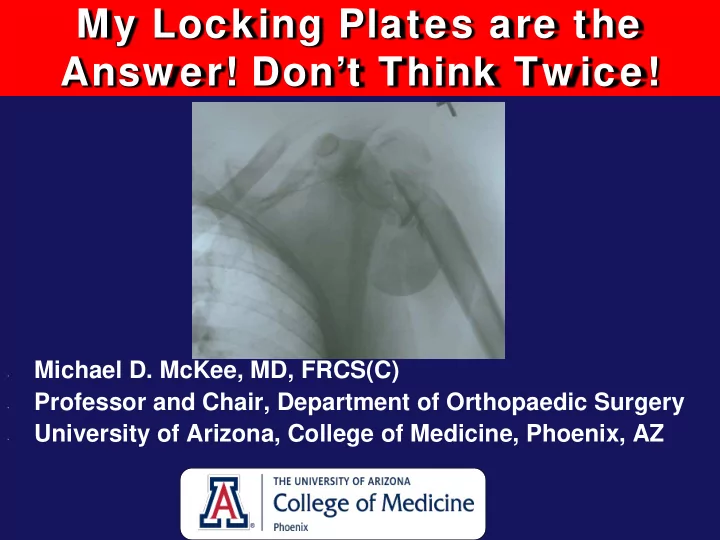
My Locking Plates are the Answ er! Dont Think Tw ice! Michael D. - - PowerPoint PPT Presentation

my locking plates are the answ er don t think tw ice
SMART_READER_LITE
LIVE PREVIEW

My Locking Plates are the Answ er! Dont Think Tw ice! Michael D. - - PowerPoint PPT Presentation

My Locking Plates are the Answ er! Dont Think Tw ice! Michael D. McKee, MD, FRCS(C) Professor and Chair, Department of Orthopaedic Surgery University of Arizona, College of Medicine, Phoenix, AZ 78 yr old female, retired


slide-1
SLIDE 1

My Locking Plates are the Answ er! Don’t Think Tw ice!

  • Michael D. McKee, MD, FRCS(C)
  • Professor and Chair, Department of Orthopaedic Surgery
  • University of Arizona, College of Medicine, Phoenix, AZ
slide-2
SLIDE 2
  • 78 yr old female, retired
  • Lives by self, stable medical conditions
slide-3
SLIDE 3
  • 10 weeks post injury
  • 130 degrees flexion
  • Minimal pain, functional, independant
slide-4
SLIDE 4

Randomized Controlled Trial

  • Gracitelli M et. al.
  • “Locking intramedullary nails compared with

locking plates for two- and three-part proximal humeral surgical neck fractures: a randomized controlled trial” JSES 2016

  • 72 patients, mean CS: 71 (plate) vs 70 (nail)
  • Re-operations, complications higher in nail group
  • “Fixation of PHFs with locking plates or locking IM

nails produces similar clinical and radiologic

  • results. Nevertheless, the complication and

reoperation rates were higher in the nail group.”

slide-5
SLIDE 5

How to Maximize Success w ith Proximal Humeral Lockimg Plates

  • 1. Calcar reduction
  • 2. No varus
  • 3. Calcar screw
  • 4. Suture / fix greater tuberosity
slide-6
SLIDE 6

Calcar Reduction

Calcar reduction

slide-7
SLIDE 7

No Varus

slide-8
SLIDE 8
slide-9
SLIDE 9

No Varus

Structural graft Compression -reduction

slide-10
SLIDE 10

Technique

slide-11
SLIDE 11

Calcar screw

Calcar screw

slide-12
SLIDE 12
slide-13
SLIDE 13

Tuberosity / Cuff

Rotator cuff fixed to shaft or plate

slide-14
SLIDE 14

What problems do you have w ith the proximal humeral locking plate you currently use?

  • 1. Tuberosity fixation 54%
  • 2. Screw penetration into the joint 22%
  • 3. Loss of reduction / fixation 16%
  • 4. Difficulty of application 5%
  • 5. Other 3%
slide-15
SLIDE 15

Tuberosity escape

slide-16
SLIDE 16

Better tuberosity fixation