Multistate tax Businesses must be vigilant and careful in managing - - PDF document

multistate tax
SMART_READER_LITE
LIVE PREVIEW

Multistate tax Businesses must be vigilant and careful in managing - - PDF document

including up-front sample period negotiation, detailed review and analysis of Prudently litigate tax assessments through all levels of appeal. Personal income tax, ment of certain high-risk audit positions and tax assessments when litigation


slide-1
SLIDE 1

mcdonaldhopkins.com Chicago | Cleveland | Columbus | Detroit | Miami | West Palm Beach

Multistate tax

Businesses must be vigilant and careful in managing their state and local tax liabilities and exposures. We understand this can be a daunting task. McDonald Hopkins Multistate Tax Services provides a broad range of state and local tax services including tax controversy, tax evaluation, tax planning, and tax policy. Our multistate tax team leverages its knowledge and experience to help clients control their complex multistate taxes.

Tax controversy

Even with thorough tax planning, some companies may find themselves under examination or in litigation with state and local governments. To minimize the impact of tax examinations and tax litigation, our professionals:

  • Work closely with tax ofgicials to reduce assessments during and afuer an audit.
  • Prudently litigate tax assessments through all levels of appeal.
  • Provide experienced negotiation services for all types of tax settlements, including “high-risk” controversies.

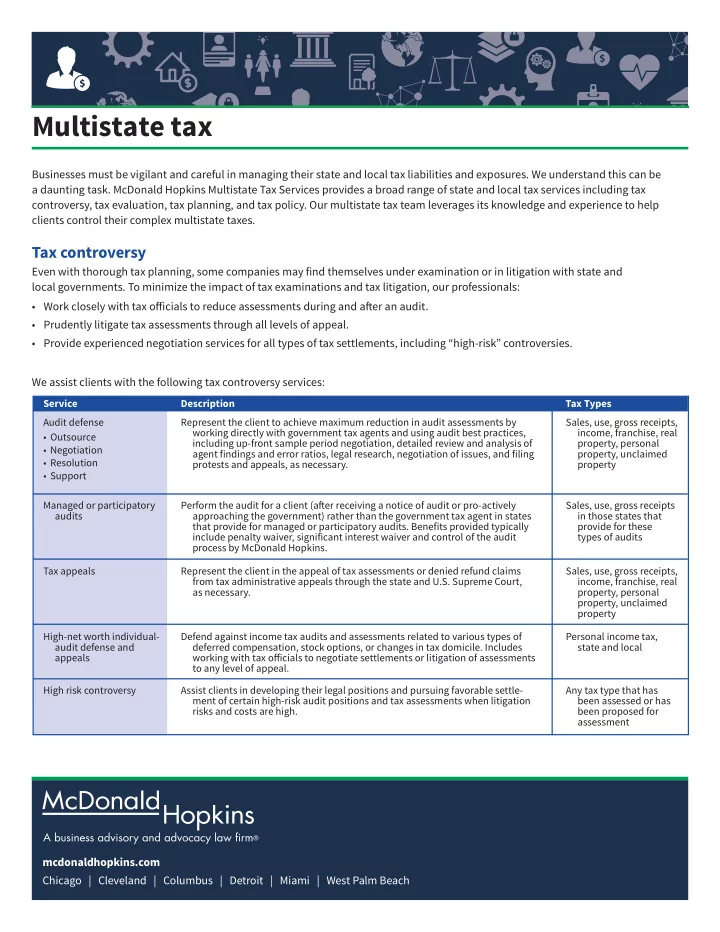
We assist clients with the following tax controversy services:

Service Description Tax Types Represent the client to achieve maximum reduction in audit assessments by working directly with government tax agents and using audit best practices, including up-front sample period negotiation, detailed review and analysis of agent findings and error ratios, legal research, negotiation of issues, and filing protests and appeals, as necessary. Audit defense

  • Outsource
  • Negotiation
  • Resolution
  • Support

Sales, use, gross receipts, income, franchise, real property, personal property, unclaimed property Perform the audit for a client (afuer receiving a notice of audit or pro-actively approaching the government) rather than the government tax agent in states that provide for managed or participatory audits. Benefits provided typically include penalty waiver, significant interest waiver and control of the audit process by McDonald Hopkins. Managed or participatory audits Sales, use, gross receipts in those states that provide for these types of audits Represent the client in the appeal of tax assessments or denied refund claims from tax administrative appeals through the state and U.S. Supreme Court, as necessary. Tax appeals Sales, use, gross receipts, income, franchise, real property, personal property, unclaimed property Defend against income tax audits and assessments related to various types of deferred compensation, stock options, or changes in tax domicile. Includes working with tax ofgicials to negotiate settlements or litigation of assessments to any level of appeal. High-net worth individual- audit defense and appeals Personal income tax, state and local Assist clients in developing their legal positions and pursuing favorable settle- ment of certain high-risk audit positions and tax assessments when litigation risks and costs are high. High risk controversy Any tax type that has been assessed or has been proposed for assessment

slide-2
SLIDE 2

McDonald Hopkins Multistate tax

Tax evaluation

The myriad of multistate tax laws can be difgicult to comply with on a consistent basis. Our professionals assist clients with evaluating their current multistate tax positions to determine if they are entitled to any refunds or have any possible exposures. Our professionals:

  • Partner with our clients to analyze tax filings and tax payments made to vendors to determine if the appropriate amount
  • f tax has been paid.
  • Work with the applicable multistate and local taxing jurisdiction to obtain refunds of any overpayments.
  • Develop strategies to resolve any exposures identified as part of the evaluation.
  • Assist clients with addressing the causes of the refunds or exposures so they can be in compliance prospectively.

We assist clients with the following tax evaluation services:

Service Description Tax Types Provide a “reverse” tax audit service designed primarily to identify refund and

  • verpayment opportunities, secondarily to identify areas of significant risk.

R.A.C.E.

TM-Refund Analysis

& Compliance Evaluation Sales, use, gross receipts, income, franchise, real property, personal property, unclaimed property Conduct a proactive analysis of a client’s Ohio Commercial Activity Tax (CAT) payments and filings to determine optimal filing positions, identify potential refunds, and mitigate future exposure. CAT scanTM Sales, use, gross receipts, income, franchise Analyze a client’s activities to determine those states in which the client has filing requirements (i.e., nexus) and an estimated tax risk computation. Multistate nexus review Sales, use, gross receipts, income, franchise, real property, personal property, unclaimed property Negotiate with state and local jurisdictions to mitigate historical tax obligations for a client that has failed to file for various taxes where an obligation exists. Benefits typically include penalty waiver and limited look-back periods. Voluntary disclosure Sales, use, gross receipts, income, franchise, real property, personal property, unclaimed property Design and deliver a customized sales and use tax training program specific to the client’s industry and work environment. The client benefits by avoiding tax

  • verpayments and unexpected tax liabilities in the future.

In-house training Sales, use Analyze a target’s tax audit exposure and potential successor liability issues relating to the client’s purchase of target. Due diligence Sales, use, gross receipts, income, franchise, real property, personal property, unclaimed property Research and complete an easy to use, determination tool for use in tax compliance by the client’s accounting and/or tax personnel. Provides management with the necessary back-up for more in-depth analysis when necessary and allows for efgicient updating for future law/regulatory changes. Tax compliance matrix Sales, use, gross receipts, income, franchise 2

slide-3
SLIDE 3

McDonald Hopkins Multistate tax

Tax planning

We believe that even in an environment of increased scrutiny of tax structures and increased enforcement efgorts by government tax ofgicials, significant tax saving opportunities still exist. We work proactively with clients to:

  • Identify and implement tax reduction strategies consistent with business operations.
  • Review existing tax planning structures to ensure their integrity upon examination.
  • Minimize multistate tax consequences of business transactions.

We assist clients with the following tax planning services:

Service Description Tax Types Review a client’s operations, identify alternative legal structures, and implement those structures to take advantage of state tax benefits. Multistate tax planning Sales, use, gross receipts, income, franchise, real property, personal property, unclaimed property Perform an analysis of the impact of changing one’s tax domicile, especially in light of the sale of a business or pending retirement of a high-ranking company leader. Assist individual clients with the specific steps necessary to efgectively establish tax domicile in another state. Residency planning Personal income taxstate and local Simplify and lower the cost of a client’s use tax compliance by developing an efgective tax rate agreement with the state taxing authority. UCO-Use Tax Compliance Optimizer-efgective rate agreements Use Analyze (on a proactive basis) multijurisdictional opportunities and exposures associated with business expansion (gross business volume, new products, new marketing methods or new locations). Business expansion planning All appropriate taxes for industry Review client’s tax filings to determine the availability of unclaimed state and local tax credits or incentives. Assist a company with obtaining tax incentives when expanding an existing facility or building a new facility. State and local credits and incentives All appropriate taxes for industry as well as

  • ther non-tax

incentives Analyze and compare state and local tax costs related to alternate locations being considered by a client. Relocation analysis All appropriate taxes for industry 3

slide-4
SLIDE 4

McDonald Hopkins Multistate tax mcdonaldhopkins.com Chicago | Cleveland | Columbus | Detroit | Miami | West Palm Beach

Tax policy

Businesses today struggle with ever-changing tax laws and government policies in multiple jurisdictions. Our multistate tax professionals have a wealth of experience in dealing directly with government leaders in most states and Washington D.C. to address tax policy matters. Working closely with professionals in our Government Afgairs Practice, we work with clients to:

  • Develop and advocate strategic tax policy positions.
  • Monitor and impact tax law developments and trends.
  • Negotiate valuable tax incentives to support business expansion and growth.

We assist clients with the following tax policy services:

Service Description Tax Types Drafu legislation language and lobby state and local ofgicials to enact legislation that protects the interests of our client, promotes a more positive tax environ- ment, or clarifies applicability of existing tax laws. Tax policy advocacy All taxes Develop a white paper analysis related to current or proposed tax laws which apply to an industry for consideration by government policy makers. Industry tax impact analysis All taxes Operate as “special tax counsel” for a business association, which includes moni- toring and analyzing state legislative and tax developments. Association tax counsel All taxes

Multistate Tax Services Team:

McDonald Hopkins LLC

David D. Ebersole 614.484.0716 debersole@mcdonaldhopkins.com David M. Kall 216.348.5812 dkall@mcdonaldhopkins.com Mark D. Klimek 216.348.5453 mklimek@mcdonaldhopkins.com Susan Millradt McGlone 216.430.2022 smcglone@mcdonaldhopkins.com Michelle Rood 216.348.5741 mrood@mcdonaldhopkins.com Jason M. Smith 216.430.2033 jsmith@mcdonaldhopkins.com

4

slide-5
SLIDE 5

mcdonaldhopkins.com Chicago | Cleveland | Columbus | Detroit | Miami | West Palm Beach

Multistate tax CAT scan™

Do you need a CAT scan™?

One-day Ohio Commercial Activity Tax (CAT) check-up

Since July 1, 2005, Ohio’s CAT has created a unique set of symptoms for taxpayers to diagnose when complying with their state and local tax burden. Because the CAT is a new system of business taxation in Ohio and the United States, there are numerous

  • pportunities to misdiagnose compliance issues even for the experienced tax
  • professional. Adding to the complexity of the tax structure, the Ohio Department of

Taxation (ODT) is aggressively auditing for CAT with over 70 trained auditors. To assist our clients and friends in making important compliance and planning decisions related to the CAT, our Multistate Tax Services Practice ofgers our own type

  • f a CAT scan™. (see right column)

Why choose McDonald Hopkins as your tax health advisor?

The professionals in our Multistate Tax Services Practice are experienced in representing clients on all aspects of the CAT. These same professionals will perform your CAT Scan™, using their knowledge and experience to ensure a clean bill of tax health for your company. To further discuss the benefits of or to schedule a CAT scan™, please contact your McDonald Hopkins professional or a member of our Multistate Tax Services Practice.

Reduce the symptoms of unhealthy tax costs Our CAT Scan™ is a minimally invasive, compre- hensive one-day process, specifically designed to provide a proactive analysis of a client’s business structure and activities, along with their CAT compliance, to determine optimal filing positions, identify potential refunds, and mitigate future exposure.

  • 1. Initial Exam

Our experienced tax professionals will review the operations of the business to gain an understanding of its principal transactions and legal structure.

  • 2. CAT Scan™

We will review important aspects of the CAT law with the company’s tax stafg, including a detailed discussion of the CAT’s compliance requirements.

  • 3. Diagnosis

By comparing the company’s operation with the CAT law, we will work with the company to identify important decision points that should be addressed in order to maximize the healthy aspects and minimize the unhealthy aspects

  • f the tax law.

Multistate Tax Services Team: David D. Ebersole 614.484.0716 debersole@mcdonaldhopkins.com David M. Kall 216.348.5812 dkall@mcdonaldhopkins.com Mark D. Klimek 216.348.5453 mklimek@mcdonaldhopkins.com Susan Millradt McGlone 216.430.2022 smcglone@mcdonaldhopkins.com Michelle Rood 216.348.5741 mrood@mcdonaldhopkins.com Jason M. Smith 216.430.2033 jsmith@mcdonaldhopkins.com

slide-6
SLIDE 6

mcdonaldhopkins.com Chicago | Cleveland | Columbus | Detroit | Miami | West Palm Beach

Multistate tax R.A.C.E.™– Refund Analysis & Compliance Evaluation

Sometimes it feels like state and local tax compliance is an all out competition!

Trying to keep up with state and local tax law changes, understanding new services

  • r products being sold or purchased by your business, and managing state and local

tax audits seems like a never ending race. McDonald Hopkins’ Multistate Tax Services Practice can help you win that race with our R.A.C.E.-Refund Analysis & Compliance Evaluation service!

Benefits of running a R.A.C.E.

Recovering overpayments with little risk and efgort is the main benefit from running a R.A.C.E. R.A.C.E. is a win-win because the overpayments recovered can be used to pay for the consulting services. At a minimum, R.A.C.E. provides a “check-up” for your compliance practices and positions. R.A.C.E. may also identify underpayments that you may resolve prior to discovery by a state tax auditor who may assess the tax with penalties and interest. Finally, R.A.C.E. provides the basis for continued future savings by identifying the root causes of the non-compliance.

Who is a good candidate for R.A.C.E.?

If you are paying substantial state and local taxes (right column), then you are a good candidate forR.A.C.E. Successful R.A.C.E.s have been run for businesses in the following industries: manufacturing, retail, construction, insurance, banking, leasing, restaurant, hotel, printing, transportation, distribution and wholesale. If you are currently under audit (or have recently been audited), then you are a perfect candidate for R.A.C.E. as we can work with the state tax auditors to potentially ofgset any identified liability. Even if you have never been audited, you are a perfect candidate since the R.A.C.E. will give you a “check-up” on your past compliance. R.A.C.E. is completed based on a partnership with our clients with the goal of identifying and recovering any

  • verpaid tax with a minimal efgort on
  • ur clients’ part. We also will notify you
  • f any unpaid tax discovered during our
  • analysis. Afuer the R.A.C.E. is won, we can

work with you to fix the root causes of the

  • verpayments/underpayments so we only

need to run the R.A.C.E. once. R.A.C.E. can be performed for the following taxes:

  • Sales
  • Use
  • Real property
  • Personal property
  • Gross receipts
  • Income
  • Franchise
  • Unclaimed property

Multistate Tax Services Team: David D. Ebersole 614.484.0716 debersole@mcdonaldhopkins.com David M. Kall 216.348.5812 dkall@mcdonaldhopkins.com Mark D. Klimek 216.348.5453 mklimek@mcdonaldhopkins.com Susan Millradt McGlone 216.430.2022 smcglone@mcdonaldhopkins.com Michelle Rood 216.348.5741 mrood@mcdonaldhopkins.com Jason M. Smith 216.430.2033 jsmith@mcdonaldhopkins.com

slide-7
SLIDE 7

McDonald Hopkins Multistate tax – R.A.C.E.- Refund Analysis & Compliance Evaluation mcdonaldhopkins.com Chicago | Cleveland | Columbus | Detroit | Miami | West Palm Beach

Stages of a R.A.C.E.

R.A.C.E. is performed in three stages to ensure the maximum amount of value is provided with the minimum amount of your time and resources. Stage 1: Initial exam Our experienced tax professionals will review the operations

  • f the business to gain an understanding of its principal

transactions, legal structure, past compliance procedures, internal controls, past and current audit history, and past refund history. The goal of Stage 1 is to estimate any potential overpayments or underpayments to determine how we will run the rest of the R.A.C.E. We will move to Stage 2 when there is mutual agreement regarding the issues to pursue. Stage 2: Documentation review Based on Stage 1, we will develop and implement an action plan to review and capture the appropriate detail to doc- ument the amounts to be requested as part of any refund

  • claim. All refund claims will need your approval before we

proceed to Stage 3. Stage 3: Refund management Based on Stage 2, we will complete and file the necessary refund claims or amended returns along with the necessary support documentation. Our focus is to provide the appropriate information to the taxing jurisdiction so that it can make informed decisions without needing additional

  • documentation. We will monitor the refund claims to ensure

they are processed as expeditiously as possible.

Why choose McDonald Hopkins?

Professionals from McDonald Hopkins’ Multistate Tax Services Practice are uniquely qualified to run your R.A.C.E. as they have experience working in industry and tax consulting. Our profes- sionals have the necessary experience to quickly understand your business, assist in identifying refunds, and communicating with state and local tax department ofgicials to expedite the recovery of your refunds. To further discuss the benefits of or to schedule a R.A.C.E., please contact your McDonald Hopkins professional or a member of our Multistate Tax Services Practice.

slide-8
SLIDE 8

Multistate Tax Update

mcdonaldhopkins.com Chicago | Cleveland | Columbus | Detroit | Miami | West Palm Beach

McDonald Hopkins

In June, Philadelphia passed the Sugar-Sweetened Beverage Tax, also known as the Philadelphia Beverage Tax (PBT), efgective January 1,

  • 2017. The PTBT imposes a 1.5 cents tax per fluid ounce on the distribu-

tion of certain sugar filled beverages, as well as reporting requirements

  • n the amounts sold and taxes due. Just a few months later, the

beverage industry, and others, filed a lawsuit challenging the new law. As we described at the time, the plaintifgs, which are a combination of consumers, retailers, distributors, and trade associations, such as the American Beverage Association, City View Pizza, John’s Roast Pork, Metro Beverage of Philadelphia, Day’s Beverages, the Pennsylvania Beverage Association, the Philadelphia Beverage Association, and the Pennsylvania Food Merchants Association, argued the following:

  • The state sales tax pre-empts the new sugary beverages tax;
  • The tax, which would be imposed on food stamp purchases through

the Supplemental Nutrition Assistance Program (SNAP), violates state and federal rules; and

  • The new law violates a pre-existing state law requiring similar

products to be taxed at the same rate. Last week, the Philadelphia County Court of Common Pleas dismissed the suit it in its entirety, addressing each of the arguments individually.

PRE-EMPTION

The court explained that the pre-emption doctrine establishes a priority for laws enacted by the various levels of government. Local legislation may not allow what Commonwealth law prohibits, nor can local legislation prohibit that which Commonwealth law permits. The question in this case was whether the Commonwealth’s sales and use tax, set forth in the Sterling Act, pre-empts the PBT. The Sterling Act prohibits double taxation when two government units seek revenue from a tax or fee on the same thing. That said, the Sterling Act does not prohibit a tax by a political subdivision on one aspect of a business’s operations when a Commonwealth taxes a difgerent aspect of that firm. Citing the language of the PBT itself, along with longstanding legal precedent, the court concluded that the PBT is not a duplicate of the sales and use tax. The court reasoned that the PBT is a tax on the distribution of certain beverages that distributors and dealers must pay, whereas the sales and use tax is imposed on the consumer, at retail. Therefore, the tax applies to two difgerent transactions, on difgerent measures (volume versus retail price), and is paid by difgerent taxpayers. Thus, pre-emption does not apply.

SNAP

The crux of the plaintifgs’ position with respect to SNAP, the federally funded program that helps an individual or family buy nutritious food, is that the Food Stamp Act of 1977 prohibits a state from receiving funds for SNAP unless it agrees to refrain from taxing certain grocery items. Rejecting the plaintifgs’ arguments, the court pointed out again that the PBT is not a tax that the consumer pays. It therefore dismissed this argument as well.

UNIFORMITY

Finally, the court addressed the plaintifgs’ allegations that the PBT violates the Uniformity Claus of the Pennsylvania Constitution, which requires that every tax “operate alike on the classes of things or prop- erty subject to it.” The idea is to prevent a taxing formula that produces “arbitrary, unjust or unreasonably discriminatory results” by requiring that all taxpayers in a given class be treated uniformly, without regard to the amount involved. In its analysis, the court noted that Uniformity Clause does not require “absolute equality and perfect uniformity in taxation, and any doubts as to the constitutionality of [a] statute are to be resolved in favor

  • f upholding the statute.” Recognizing that the PBT is a 1.5 cents

per ounce tax on distributors of the defined beverages such that its “manner and measure of calculating the tax is uniformly applied to distributors,” the court concluded that there is no disparate treatment within the “distributor class” with respect to the PBT’s formula and rate

  • f taxation.

For all of these reasons, the court declared the PBT to be lawful.

WHAT’S NEXT FOR BEVERAGE TAXES?

Afuer the election, we discussed several other beverage tax laws that voters approved, in Albany, Oakland, and San Francisco, California, and Boulder, Colorado. Now, a lawmaker in Massachusetts, Rep. Ray Khan, wants to pass a state-wide soda tax, reported WBUR. She hopes that public acceptance of taxes on marijuana will lead to the same with respect to sugar. Similarly, with the recent passage of soda taxes elsewhere, along with “accumulating evidence” of sugar’s dangers, there is possibility, especially when the objective is not imposition of a new tax, but simply to remove the sales tax exemption that currently applies to soda in the Bay State. The jury is still out on the efgicacy of soda taxes. A December report by the Tax Policy Center, The Pros and Cons of Taxing Sweetened Beverages Based on Sugar Content, concluded that taxation is feasible, but consideration of the goal, whether to raise revenue or decrease sugar consumption for health reasons, is important when crafuing the legislation.

Pennsylvania: Court dismisses lawsuit seeking to invalidate Philadelphia’s new soda tax

DEC 29, 2016

slide-9
SLIDE 9

Multistate Tax Update

mcdonaldhopkins.com Chicago | Cleveland | Columbus | Detroit | Miami | West Palm Beach

McDonald Hopkins

In February of this year, the Tenth Circuit Court of Appeals decided the case Direct Marketing Association v. Brohl. As we explained when the opinion came out, the court held that the state of Colorado could require certain sellers to comply with notice and reporting obligations related to those retailers’ sales to in-state purchasers that are not subject to sales tax collections. The Direct Marketing Association (DMA) viewed the law as unconstitu- tionally discriminatory, and having an unconstitutionally burdensome efgect on interstate commerce, in part because it distinguished between in-state and out-of-state economic interests. It took its loss to the United States Supreme Court, where it lost again when the court denied the DMA’s petition for review, on December 12, 2016. Bloomberg described response to the “eagerly anticipat[ed]” decision. A displeased DMA bristled that the result “will only encourage other states to adopt similar laws and regulations that are designed to put arbitrary burdens on out-of-state sellers…This is an issue Congress should address, as the Constitution explicitly gives the legislative branch the authority to regulate interstate commerce.” Indeed, that is precisely what the author of the Tenth Circuit’s opinion suggested, quoting the 1992 case Quill Corp. v. North Dakota: “Congress holds the ‘ultimate power’ and is ‘better qualified to resolve’ the issue

  • f ‘whether, when, and to what extent the States may burden interstate

[retailers] with a duty to collect [sales and] use taxes.’” Another stakeholder, the president of the American Catalog Mailers Association, contended that the Brohl decision would undermine the trust between consumers and business “by requiring remote sellers to report to state tax collectors on the buying habits of their customers, including health care products, apparel or other sensitive items.” Similarly, Bloomberg pointed to a statement by the executive director

  • f NetChoice, in which he expressed concern that because the Supreme

Court did not choose to take on the DMA case, “states will now be unrestrained in passing new ‘tattletale reporting’ laws that force online and catalog retailers to report personal information and purchase data to state tax collectors.” With a difgerent perspective, the general counsel of the Multistate Tax Commission opined that the Tenth Circuit “got it right…[t]hat said, information reporting will not level the playing field for bricks-and- mortar entities…” Finally, the National Conference of State Legislatures (NCSL) told Bloomberg that it has “long advocated for a solution to the remote sales tax collection problem…Many states, especially those that do not levy personal or corporate income taxes, are particularly reliant on this revenue stream to fund important programs and services provided by the states.” Even so, the NCSL took the position that Brohl was not the best case to challenge the long-standing precedent, set forth in Quill, that a state may not require an out-of-state retailer to collect and remit sales taxes

  • n in-state sales. Though the NCSL did not elaborate, this could be

because the Colorado law that Brohl challenged was technically one requiring only the notification and reporting of tax obligations, and not the actual collection of the owed taxes.

Colorado: US Supreme Court leaves notice and reporting requirement intact

DEC 22, 2016

slide-10
SLIDE 10

Multistate Tax Update

mcdonaldhopkins.com Chicago | Cleveland | Columbus | Detroit | Miami | West Palm Beach

McDonald Hopkins

In an opinion filed last week, the California Supreme Court afgirmed the lower court’s decision by ruling that hotels, and not the online travel companies (OTCs) on whose websites many travelers book and pay for their hotel reservations, are liable for the transit occupancy taxes incurred under a City of San Diego ordinance. The court reasoned that the statute at issue has a limited reach, such that only an “operator” can be subject to the assessment of taxes and penalties, and an OTC does not qualify as an operator within the definition.

BACKGROUND

The plaintifg, the City of San Diego, sued a number of defendants, all OTCs, for their failure to remit or collect the transit occupancy taxes

  • n their transactions. The defendants in the case are Hotels.com; L.P.;

Priceline.com, Inc.; Travelweb LLC; Expedia, Inc.; Hotwire, Inc.; Hotels.

  • com. G.P., LLC; ravelocity.com, LP; Site59.com, LLC; Orbitz, LLC; Travel-

now.com; Lowestfare.com, LLC; Trip Network, Inc. (doing business as Cheaptickets.com); and Internetwork Publishing Corp. (doing business as Lodging.com). However, this suit, along with a class action initiated by the City of Los Angeles on behalf of other California jurisdictions, alleging similar claims, were coordinated in the Los Angeles County Superior Court as the Transient Occupancy Tax Cases. Under the business model at issue here, the OTCs contract with hotels to advertise and rent rooms to the general public, and handle all financial transactions related to the hotel reservations. The OTCs do not themselves own, operate or manage hotels, maintain an inventory of rooms, or possess or obtain the right to occupy any rooms. The OTC charges its customers retail room rates plus a tax recovery charge, which is the OTC’s estimate of the hotel’s transit occupancy tax liability for that transaction. Once the customer checks in, the hotel bills the OTC for the price of the room plus the tax, afuer which the OTC remits the charged amount to the hotel, and then the hotel, in turn, remits the tax to the city.

THE STATUTE

Under the San Diego ordinance, any customer in a hotel in the city is subject to a transit occupancy tax of 6 percent “of the rent charged by the operator” for the privilege of occupying that hotel. The ordinance requires the proceeds of the tax to be used for promoting San Diego, including by planning, building, and maintaining tourism-related cultural, recreational, and convention facilities, among other things. The statute further provides that the operator must remit the full amount of the previous month’s collected tax. For refusal to collect

  • r remit the tax, the city’s treasurer is obligated to assess the tax and

penalties against that operator. The case turned on the statutory definition of the word “operator,” which “includes a managing agent, a resident manager, or a resident

California: Online travel companies not liable for unpaid transient occupancy taxes

DEC 22, 2016 agent, of any type or character, other than an employee without management responsibility.”

THE ARGUMENTS AND THE COURT’S RATIONALE

The decision leading to San Diego’s appeal was that while the ordinance imposes tax on rent charged by an operator, an OTC is not an operator

  • r managing agent of the hotel. Nor is the markup the OTCs charge for

their services a part of the rent subject to the tax. San Diego argued that the tax base for calculating the amount due should be the full amount that the customer pays to obtain occupancy, not the lesser amount the hotel has agreed to accept as its share of the rental proceeds. While the court agreed that the full amount should be subject to the tax, it also concluded that the ordinance did not contemplate assessing an intermediary, like an OTC, for any unpaid portion of the transit occu- pancy tax. Moreover, the court pointed out that the statute identifies the taxable amount as the “rent charged by the operator,” which does not include any discretionary markup charged by the OTC. Even so, the court acknowledged that the rate charged by the OTC “is seldom significantly higher than the rate a hotel charges to its customers directly,” so any difgerence “may be chimerical.” To San Diego’s argument that even if OTCs are not operators, they should still be liable for the tax as facilitating agents of the hotel, the court disagreed with the premise. Hotels do not have any control over additional amounts an OTC charges for its services, so should not be considered agents. Finally, the court declared, whatever contractual provisions exist between an OTC and hotel, such contracts cannot create or expand tax liability.

NEXT STEPS

According to a Bloomberg analysis, the $21.2 million assessment that the court struck down could be seen as a major win for OTCs. However, a lawyer for the city opined that “[i]n my view, the OTC’s won the battle, but lost the war…[t]here is nothing to prevent San Diego, using this

  • pinion, to sue the hotels.”

Similarly, a lawyer for the California State Association of Counties characterized the conclusion as a “mixed bag for municipalities.” He predicted that “the industry and hotels will collaborate to change the terms of their private agreements to escape the tax.” The Hotel Council of San Francisco criticized the ruling, characterizing it as as an “inequitable two-tier tax system that favors online travel companies over hotel companies [that] puts the burden of tax collection

  • n hotels for bookings made by online travel companies, giving those

companies special status from paying the taxes that ofuen fund what attracts visitors to California cities.”

slide-11
SLIDE 11

Multistate Tax Update

mcdonaldhopkins.com Chicago | Cleveland | Columbus | Detroit | Miami | West Palm Beach

McDonald Hopkins

Much data has been released in recent years pertaining to the disparity between chief executive ofgicer (CEO) compensation and that of regular

  • workers. Portland, Oregon’s response was to authorize a surtax to its

Business License Tax on the income of any CEO of a publicly traded company doing business in Portland, when that compensation is equal to or greater than 100 times a median worker’s compensation. The Ordinance, passed by City Council on December 7, 2016, calls for a 10 percent surtax of base tax liability on such income for tax years beginning on or afuer January 1, 2017, when the pay ratio is between 100 to 1 and 250 to 1. When that ratio exceeds 250 to 1, the surtax increases to 25 percent. About 550 firms will be subject to the new tax. A Securities and Exchange Commission (SEC) rule, adopted in August 2015, made Portland’s measure possible. A result of a mandate by the Dodd-Frank Wall Street Reform and Consumer Protection Act, the rule requires public companies to disclose the ratio of the compensation

  • f their CEO to median employee compensation. In a press release

announcing its action, the SEC asserted that the “carefully calibrated rule…provides companies with substantial flexibility in determining the pay ratio, while remaining true to the statutory requirements.” The rule was designed to provide shareholders with information they can use to evaluate a CEO’s compensation. At the same time, the SEC asserts, it addresses concerns about the costs of compliance by pro- viding companies with flexibility in meeting the rule’s requirements by allowing businesses to select their own methodologies for identifying its “median employee,” and that employee’s compensation. The rule does not apply to smaller reporting companies, emerging growth companies, foreign private issuers, Multijurisdictional Disclosure System filers, or registered investment companies. The Portland City Council cited numerous factors that lead to enact- ment of the Ordinance:

  • 1. Research by economist Thomas Piketty, set forth in his book Capital

in the Twenty-First Century, describing inequality in the United States that has “exploded” during the last 40 years. Between the 1970s and 2010, the share of income held by the top 0.1 percent went from 2 percent to between 7 and 8 percent. This explosion of CEO pay is a major contributor to growing inequality.

  • 2. Reports from the Center on Budget and Policy Priorities showing that

between 1979 and 2007, average afuer tax income for the top one percent of income earners rose by 314 percent, while average afuer tax income for the middle 60 percent rose by only 42 percent.

  • 3. Data from the Economic Policy Institute revealing that chief executive
  • fgicers in the nation’s largest firms made an average of $15.5 million

in compensation in 2015, or 276 times the annual average pay of the typical worker.

  • 4. A 2008 paper by the researchers Janna Matlack and Jacob Vigdor,

published in the Journal of Housing Economics, concluding that “in the United States, tight housing markets tend to be those where incomes are rising rapidly at the high end of the distribution, while incomes at the low end trend upward only slowly, if at all.”

  • 5. The fact that rising inequality is a “major factor” in Portland’s housing

crisis.

  • 6. Research indicating that that companies with high estimated chief

executive ofgicer-worker pay ratios have worse employee morale and shareholder returns compared to companies with lower ratios.

  • 7. The opinion that spectacular concentration of income and wealth

among the top 1 percent and 0.1 percent are bad for the economy, and for democracy. The impact statement attached to the Ordinance estimates that Portland’s revenues will increase by $2.5 million to $3.5 million annually, though this will be lower in the first year due to timing of

  • implementation. Administration costs will be about $50,000 annually.

This new revenue will be used to provide additional resources for the Joint Ofgice of Homeless Services. In an email exchange with The New York Times, economist Piketty

  • pined that the Ordinance is “certainly part of the solution, but the tax

surcharge needs to be large enough; the threshold ‘100 times’ should be substantially lowered.” On the other hand, the paper reported, groups like the Portland Business Alliance see the Ordinance as an “empty gesture.” Better to “work with business leaders to create more jobs that will lifu people up and improve incomes.”

Oregon: Portland adapts first-in-the-nation surtax

  • n CEO compensation

DEC 22, 2016

slide-12
SLIDE 12

Multistate Tax Update

mcdonaldhopkins.com Chicago | Cleveland | Columbus | Detroit | Miami | West Palm Beach

McDonald Hopkins

We recently addressed a new disclosure rule put forth by the Govern- mental Accounting Standards Board (GASB) that will require state and local governments to disclose information about tax incentive

  • agreements. The rule represents the GASB’s attempt to increase the

transparency of the deals that governments make with businesses and

  • thers, ultimately in order to make it possible to assess the impact of

these agreements on state budgets. This rule is seen as an appropriate step by groups, like Good Jobs First, that oppose costly corporate welfare programs to benefit businesses because they may be “real deterrents to true economic development.” In addressing what it called a “seismic shifu in corporate tax breaks,” Governing.com underscored the need for a system that forces states to come to terms with how much revenue they are losing – or not – to tax incentive agreements. In so doing, it pointed to Washington as an example of what is right with this kind of follow-up mechanism, noting that the Evergreen State has been calculating the impact of its tax incentive programs for a decade. The publication explained the following with respect to Washington’s scheme with Boeing:

Earlier this year, Washington state lawmakers got a wake-up

  • call. A tax incentive package they’d approved in 2013 for aero-

space giant Boeing -- largely regarded as the most expensive incentive deal in history -- was actually on pace to surpass its estimated $8.7 billion cost. According to a Department of Revenue report, the deal, which extends to 2040, had already amounted to half a billion dollars in giveaways in just the first two years alone. In other words, the state was losing out on a whole lot more money than it had planned. And the kicker? Just months earlier, Boeing had announced plans to cut roughly 4,000 jobs in Washington. The year before, the company had transferred thousands more jobs out of the state.

Though some were angry about the job losses, Governing.com contended that “[t]he fact that Washington lawmakers can even have this conversation puts them at an advantage over most other states’ legislators [because] [i]n the vast majority of states, ofgicials simply do not know how well their tax incentives programs are working, or how much the deals are actually costing them. They don’t have the data. Washington does.”

THE DEPARTMENT OF REVENUE’S DENIAL

Washington’s Department of Revenue (Department) recently released Determination No. 16-0074 (Determination), from which the real-life impact of the state’s discipline with respect to tax incentives becomes

  • clear. In the Determination, a manufacturer that makes product in

Washington applied for and received a tax deferral for employing individuals in a Community Empowerment Zone (CEZ). The deal called for the firm to hire a certain number of employees in the CEZ, in return for which it could forego paying retail sales tax and/or use tax on equipment it purchased using its CEZ certificate. More specifically, in June 2009, the Department’s Special Programs Division (SPD) issued the CEZ certification afuer approving the compa- ny’s application. The taxpayer anticipated building a new facility in the CEZ, and hiring 10 new full time workers. In 2012, upon reviewing the results the taxpayer committed to in the application, the SPD required the taxpayer to hire four qualified employment positions by the end of 2012, and keep them employed for 12 months. In 2013, the taxpayer contacted the Department and reported that it had not hired the required four employees in the CEZ. The SPD con- ducted a check and concluded that indeed, only one employee lived in the CEZ, while three lived in a county containing the CEZ. Nevertheless, the taxpayer argued, this constituted its fulfillment of “the spirit of the deferred sales tax program,” entitling it to its deferral. In the alternative, the taxpayer suggested, it deserved a pro-rated deferral based on the

  • ne employee that satisfied the program’s conditions.

The statute that established the tax deferral program in the first place was designed to promote economic stimulation, create employment

  • pportunities, and reduce poverty in rural or distressed areas of the

state, like those where CEZs exist. In analyzing the purpose of the deferral program and the facts of this case, the Department agreed with the SPD in ruling against the taxpayer, citing several factors:

  • 1. Both the application form and the SPD’s 2009 Approval letter

unambiguously provided that if the taxpayer did not fill the qualified employment positions, “all deferred taxes are immediately due.”

  • 2. The taxpayer was not the employer of record for the three employees

who did not live in the CEZ. On this point, the taxpayer argued that the three workers were contractors over which it maintained control, such as where, when and how they worked. The Department noted that an independent contractor who billed the taxpayer actually paid these three workers.

  • 3. The applicable statute does not allow for prorating tax deferral

amounts. In the end, the three workers outside of the CEZ were not employed by the taxpayer, in contradiction to the statutory requirements. According- ly, the taxpayer failed to hire four qualified employees in the required location and time frame, as set forth in the certification, so the SPD properly precluded it from taking advantage of the tax deferral program.

Washington: Department of Revenue afgirms denial of sale tax deferral

NOV 16, 2016

slide-13
SLIDE 13

Multistate Tax Update

mcdonaldhopkins.com Chicago | Cleveland | Columbus | Detroit | Miami | West Palm Beach

McDonald Hopkins

By way of the outcome of the Public Education Surcharge Initiative (Initiative) that was on the ballot in Maine last month, the tiny state containing just 1.3 million people is set to have the second highest income tax in the nation, according to Maine’s Gov. Paul LePage. The Initiative, also known as the Maine Tax on Incomes Exceeding $200,000 for Public Education Measure, passed, barely, by 50.4 percent to 49.5 percent. It created a new 3 percent tax on individual income taxes for household income greater than $200,000; a household with an income of $280,000 will pay an additional 3 percent on $80,000 annu-

  • ally. The Initiative is expected to generate approximately $142 million

annually, and an additional $12 million or more each subsequent year. As a result of the very thin margin by which voters approved the Initiative, opponents, led by the National Federation of Independent Business (NFIB) requested an ofgicial recount, reported the wcsh6.com. NFIB’s Maine state director predicted that the Initiative “will actually tax small business owners more than it taxes a company like Walmart…[t] he corporate tax rate is less. We don’t need to be raising taxes on small business owner[s], we need to help them create jobs.” Maine’s Secretary of State had planned to begin the recount on December 1, 2016, but the NFIB called ofg its efgort, pointing to concerns about the recount procedure, its cost, and the low probability that a recount would overturn the election result, according to the Portland Press Herald. Thus, the tax increase will go into efgect as planned, 30 days afuer

  • Gov. LePage proclaims the ofgicial results of the election. Even so, the

Governor is now urging lawmakers to consider the consequences of both the tax increase and the hourly minimum wage increase, to $12 by 2020 from $9.00 in 2017 (currently $7.00), that voters also approved, 55.5 percent to 44.5 percent. In his letter to the legislature, Gov. LePage pressed them to “lessen the impact” of both measures, arguing that they “will cause significant economic harm to restaurant workers, small businesses, successful people and our elderly.” Maine’s median household income, in 2014 dollars, between 2010-2014, was $48,804. The per capita income in the past 12 months, in 2014 dollars, was $27,332. 13.4 percent of Mainers live in poverty. In his letter, the governor opined that the income tax increase “could actually do the opposite of what the question proposed,” resulting in less money for education. He explained his position on these grounds:

Punishing Maine people and small businesses by increasing their income tax by 42 [percent] will drive them out of our state and prevent badly needed professionals, such as doctors, dentists, engineers and scientists, from coming here. No

  • ne wants to come to a state that will confiscate
  • ver 10 percent of their earnings, especially when
  • ther states, such as our next-door neighbor New

Hampshire, take none. Successful people and small business owners already pay a significant amount of property tax, income tax, excise tax, sales tax, payroll taxes and other taxes and fees. If they go out of business or leave the state and take their income with them, this will create even less revenue for schools and municipalities. Maine needs more population, and we need more trained professionals. Taking a bigger share out of their hard-earned paychecks is not the way to do it. We may as well put up a big sign in Kittery that says: “Welcome to Maine: We’ll Tax the Heck Out of You!

  • Gov. LePage promised to put forth a balanced budget that reduces the

income tax rate to mitigate the efgect of the Initiative. The process will begin in January. In the meantime, a recount of Ballot Question 1, the Maine Marijuana Legalization Measure, began on December 5, 2016, and could take a month to complete at a cost of $500,000. Voters legalized recreational marijuana with 50.1 percent of the electorate approving it. Medical marijuana has been legal in the Pine Tree state since 1999.

Maine: Governor hopes to mitigate impact of income tax increase

DeC 12, 2016