Multiplier tricks for spectral convergence Sabine B ogli (Imperial - - PowerPoint PPT Presentation

multiplier tricks for spectral convergence
SMART_READER_LITE
LIVE PREVIEW

Multiplier tricks for spectral convergence Sabine B ogli (Imperial - - PowerPoint PPT Presentation

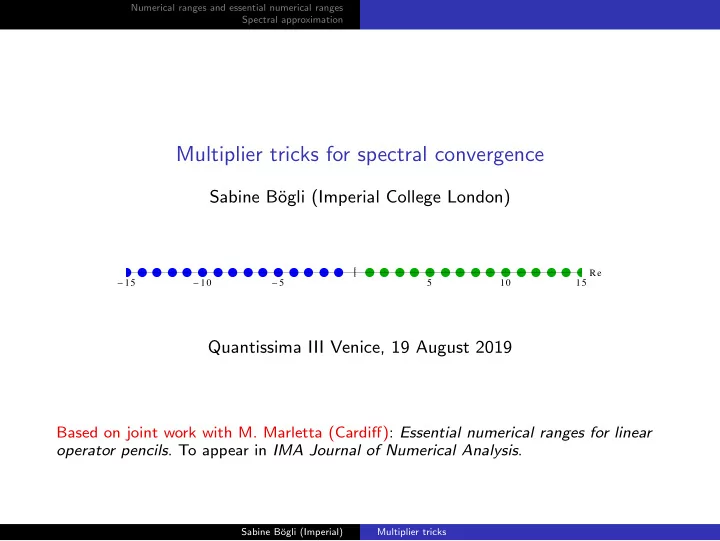
Numerical ranges and essential numerical ranges Spectral approximation Multiplier tricks for spectral convergence Sabine B ogli (Imperial College London) Re 15 10 5 5 10 15 Quantissima III Venice, 19 August 2019 Based on joint


slide-1
SLIDE 1

Numerical ranges and essential numerical ranges Spectral approximation

Multiplier tricks for spectral convergence

Sabine B¨

  • gli (Imperial College London)

Quantissima III Venice, 19 August 2019

Based on joint work with M. Marletta (Cardiff): Essential numerical ranges for linear

  • perator pencils. To appear in IMA Journal of Numerical Analysis.

Sabine B¨

  • gli (Imperial)

Multiplier tricks 15 10 5 5 10 15 Re

slide-2
SLIDE 2

Numerical ranges and essential numerical ranges Spectral approximation

Motivation

Let {ek : k ∈ N} be standard ONB of l2(N). Consider T with matrix representation diag

  • −n

n

  • : n ∈ N
  • = diag(−1, 1, −2, 2, −3, 3, . . . ).

15 10 5 5 10 15 Re Sabine B¨

  • gli (Imperial)

Multiplier tricks

slide-3
SLIDE 3

Numerical ranges and essential numerical ranges Spectral approximation

Motivation

Let {ek : k ∈ N} be standard ONB of l2(N). Consider T with matrix representation diag

  • −n

n

  • : n ∈ N
  • = diag(−1, 1, −2, 2, −3, 3, . . . ).

15 10 5 5 10 15 Re

Compress to Vn := span{ek : k = 1, . . . , 2n}, n ∈ N spectral convergence.

Sabine B¨

  • gli (Imperial)

Multiplier tricks

slide-4
SLIDE 4

Numerical ranges and essential numerical ranges Spectral approximation

Motivation

Let {ek : k ∈ N} be standard ONB of l2(N). Consider T with matrix representation diag

  • −n

n

  • : n ∈ N
  • = diag(−1, 1, −2, 2, −3, 3, . . . ).

15 10 5 5 10 15 Re

Compress to Vn := span{ek : k = 1, . . . , 2n}, n ∈ N spectral convergence. Let λ ∈ R\σ(T). Change ONB: span{e2n−1, e2n} = span{fn, gn}, fn := cos(θn)e2n−1 + sin(θn)e2n, gn := − sin(θn)e2n−1 + cos(θn)e2n, with θn := λ 2n − π 4 .

Sabine B¨

  • gli (Imperial)

Multiplier tricks

slide-5
SLIDE 5

Numerical ranges and essential numerical ranges Spectral approximation

Motivation

Let {ek : k ∈ N} be standard ONB of l2(N). Consider T with matrix representation diag

  • −n

n

  • : n ∈ N
  • = diag(−1, 1, −2, 2, −3, 3, . . . ).

15 10 5 5 10 15 Re

Compress to Vn := span{ek : k = 1, . . . , 2n}, n ∈ N spectral convergence. Let λ ∈ R\σ(T). Change ONB: span{e2n−1, e2n} = span{fn, gn}, fn := cos(θn)e2n−1 + sin(θn)e2n, gn := − sin(θn)e2n−1 + cos(θn)e2n, with θn := λ 2n − π 4 . Then compression to Hn := Vn−1 ⊕ span{fn} has eigenvalue λn := Tfn, fn = n sin(λ/n) → λ / ∈ σ(T). So λ is a spurious eigenvalue (point of spectral pollution).

Sabine B¨

  • gli (Imperial)

Multiplier tricks

slide-6
SLIDE 6

Numerical ranges and essential numerical ranges Spectral approximation

Motivation

Let A := BT = diag

  • n

n

  • : n ∈ N
  • ,

B := diag

  • −1

1

  • : n ∈ N
  • .

(T − λ)f = 0 ⇐ ⇒ (A − λB)f = 0 (eigenvalue problem for linear pencil).

Sabine B¨

  • gli (Imperial)

Multiplier tricks

slide-7
SLIDE 7

Numerical ranges and essential numerical ranges Spectral approximation

Motivation

Let A := BT = diag

  • n

n

  • : n ∈ N
  • ,

B := diag

  • −1

1

  • : n ∈ N
  • .

(T − λ)f = 0 ⇐ ⇒ (A − λB)f = 0 (eigenvalue problem for linear pencil). ◮ Introduce essential numerical range We(T) contains all possible spurious eigenvalues obtained by projection methods. Here: We(T) = R.

Sabine B¨

  • gli (Imperial)

Multiplier tricks

slide-8
SLIDE 8

Numerical ranges and essential numerical ranges Spectral approximation

Motivation

Let A := BT = diag

  • n

n

  • : n ∈ N
  • ,

B := diag

  • −1

1

  • : n ∈ N
  • .

(T − λ)f = 0 ⇐ ⇒ (A − λB)f = 0 (eigenvalue problem for linear pencil). ◮ Introduce essential numerical range We(T) contains all possible spurious eigenvalues obtained by projection methods. Here: We(T) = R. ◮ Introduce essential numerical range We(A, B) contains all possible spurious eigenvalues obtained by projection methods. Here: We(A, B) = ∅.

Sabine B¨

  • gli (Imperial)

Multiplier tricks

slide-9
SLIDE 9

Numerical ranges and essential numerical ranges Spectral approximation

Motivation

Let A := BT = diag

  • n

n

  • : n ∈ N
  • ,

B := diag

  • −1

1

  • : n ∈ N
  • .

(T − λ)f = 0 ⇐ ⇒ (A − λB)f = 0 (eigenvalue problem for linear pencil). ◮ Introduce essential numerical range We(T) contains all possible spurious eigenvalues obtained by projection methods. Here: We(T) = R. ◮ Introduce essential numerical range We(A, B) contains all possible spurious eigenvalues obtained by projection methods. Here: We(A, B) = ∅. In example: no spectral pollution occurs if we calculate eigenvalues λn given by (AHn − λnBHn)fn = 0.

Sabine B¨

  • gli (Imperial)

Multiplier tricks

slide-10
SLIDE 10

Numerical ranges and essential numerical ranges Spectral approximation Definition and basic properties of numerical ranges Definition and basic properties of essential numerical ranges

Numerical ranges for operators and linear operator pencils

Let H be a Hilbert space and let A be a linear operator in H. Recall: The numerical range of A is the convex set W(A) = {Af, f : f ∈ D(A), f = 1}. Then σapp(A) ⊆ W(A) with σapp(A) := {λ ∈ C : ∃ (fn)n∈N ⊂ D(A), fn = 1, (A − λ)fn → 0}.

Sabine B¨

  • gli (Imperial)

Multiplier tricks

slide-11
SLIDE 11

Numerical ranges and essential numerical ranges Spectral approximation Definition and basic properties of numerical ranges Definition and basic properties of essential numerical ranges

Numerical ranges for operators and linear operator pencils

Let H be a Hilbert space and let A be a linear operator in H. Recall: The numerical range of A is the convex set W(A) = {Af, f : f ∈ D(A), f = 1}. Then σapp(A) ⊆ W(A) with σapp(A) := {λ ∈ C : ∃ (fn)n∈N ⊂ D(A), fn = 1, (A − λ)fn → 0}. Now study linear pencil λ → A − λB with B another linear operator. Define σ(A, B) := {λ ∈ C : 0 ∈ σ(A − λB)} (and various parts analogously) and W(A, B) :=

  • λ ∈ C : 0 ∈ W(A − λB)
  • .

Then σapp(A, B) ⊆ W(A, B).

Sabine B¨

  • gli (Imperial)

Multiplier tricks

slide-12
SLIDE 12

Numerical ranges and essential numerical ranges Spectral approximation Definition and basic properties of numerical ranges Definition and basic properties of essential numerical ranges

Essential numerical ranges for operators and linear operator pencils

The essential numerical range of A is the convex set We(A) =

  • lim

n→∞Afn, fn : fn ∈ D(A), fn = 1, fn w

→ 0

  • .

Then σe(A) ⊆ We(A) ⊆ W(A) with σe(A) := {λ ∈ C : ∃ (fn)n∈N ⊂ D(A), fn = 1, fn

w

→ 0, (A − λ)fn → 0}.

Sabine B¨

  • gli (Imperial)

Multiplier tricks

slide-13
SLIDE 13

Numerical ranges and essential numerical ranges Spectral approximation Definition and basic properties of numerical ranges Definition and basic properties of essential numerical ranges

Essential numerical ranges for operators and linear operator pencils

The essential numerical range of A is the convex set We(A) =

  • lim

n→∞Afn, fn : fn ∈ D(A), fn = 1, fn w

→ 0

  • .

Then σe(A) ⊆ We(A) ⊆ W(A) with σe(A) := {λ ∈ C : ∃ (fn)n∈N ⊂ D(A), fn = 1, fn

w

→ 0, (A − λ)fn → 0}. For linear pencils: We(A, B) :=

  • λ ∈ C : 0 ∈ We(A − λB)
  • .

Then σe(A, B) ⊆ We(A, B) ⊆ W(A, B).

Sabine B¨

  • gli (Imperial)

Multiplier tricks

slide-14
SLIDE 14

Numerical ranges and essential numerical ranges Spectral approximation Definition and basic properties of numerical ranges Definition and basic properties of essential numerical ranges

Essential numerical range FOR OPERATORS

◮ We(T) is closed and convex with We(T) ⊇ conv(σe(T)).

Sabine B¨

  • gli (Imperial)

Multiplier tricks

slide-15
SLIDE 15

Numerical ranges and essential numerical ranges Spectral approximation Definition and basic properties of numerical ranges Definition and basic properties of essential numerical ranges

Essential numerical range FOR OPERATORS

◮ We(T) is closed and convex with We(T) ⊇ conv(σe(T)). ◮ Salinas (1972): T bounded and hypo-normal (T ∗T − TT ∗ ≥ 0) = ⇒ We(T) = conv(σe(T)).

Sabine B¨

  • gli (Imperial)

Multiplier tricks

slide-16
SLIDE 16

Numerical ranges and essential numerical ranges Spectral approximation Definition and basic properties of numerical ranges Definition and basic properties of essential numerical ranges

Essential numerical range FOR OPERATORS

◮ We(T) is closed and convex with We(T) ⊇ conv(σe(T)). ◮ Salinas (1972): T bounded and hypo-normal (T ∗T − TT ∗ ≥ 0) = ⇒ We(T) = conv(σe(T)). ◮ With Marletta and Tretter: If T is selfadjoint and unbounded, then We(T) = conv( σe(T))\{±∞}, where the extended essential spectrum σe(T) is defined as σe(T) with −∞ (+∞) added if T is unbounded below (above).

Sabine B¨

  • gli (Imperial)

Multiplier tricks

slide-17
SLIDE 17

Numerical ranges and essential numerical ranges Spectral approximation Definition and basic properties of numerical ranges Definition and basic properties of essential numerical ranges

Essential numerical range FOR OPERATORS

◮ We(T) is closed and convex with We(T) ⊇ conv(σe(T)). ◮ Salinas (1972): T bounded and hypo-normal (T ∗T − TT ∗ ≥ 0) = ⇒ We(T) = conv(σe(T)). ◮ With Marletta and Tretter: If T is selfadjoint and unbounded, then We(T) = conv( σe(T))\{±∞}, where the extended essential spectrum σe(T) is defined as σe(T) with −∞ (+∞) added if T is unbounded below (above). Example: Since T is unbounded below and above, we have σe(T) = {±∞} and We(T) = conv( σe(T))\{±∞} = R.

Sabine B¨

  • gli (Imperial)

Multiplier tricks 15 10 5 5 10 15 Re

slide-18
SLIDE 18

Numerical ranges and essential numerical ranges Spectral approximation Approximation theorems Indefinite Sturm-Liouville operator

Spectral approximation for projection method

Assume that D(A) ∩ D(A∗) = H and B is bounded. Theorem: Let Hn ⊂ D(A) ∩ D(A∗), n ∈ N, be finite-dim. with PHn

s

→ I and ∀ f ∈ D(A) ∩ D(A∗) : AHnPHnf − AfH → 0, A∗

HnPHnf − A∗fH → 0.

Then every spurious eigenvalue belongs to We(A, B), and for every isolated λ ∈ σ(A, B) outside We(A, B) ∃ λn ∈ σ(AHn, BHn), n ∈ N, s.t. λn → λ.

Sabine B¨

  • gli (Imperial)

Multiplier tricks

slide-19
SLIDE 19

Numerical ranges and essential numerical ranges Spectral approximation Approximation theorems Indefinite Sturm-Liouville operator

Spectral approximation for projection method

Assume that D(A) ∩ D(A∗) = H and B is bounded. Theorem: Let Hn ⊂ D(A) ∩ D(A∗), n ∈ N, be finite-dim. with PHn

s

→ I and ∀ f ∈ D(A) ∩ D(A∗) : AHnPHnf − AfH → 0, A∗

HnPHnf − A∗fH → 0.

Then every spurious eigenvalue belongs to We(A, B), and for every isolated λ ∈ σ(A, B) outside We(A, B) ∃ λn ∈ σ(AHn, BHn), n ∈ N, s.t. λn → λ. Theorem: Assume that 0 / ∈ W(A) ∩ W(B) or W(A, B) = C. Let λ ∈ We(A, B). Then there are finite-dim. Hn ⊂ D(A) with PHn

s

→ I and ∃ λn ∈ σ(AHn, BHn), n ∈ N, s.t. λn → λ. Hence if λ ∈ We(A, B)\σ(A, B) then λ is a spurious eigenvalue.

Sabine B¨

  • gli (Imperial)

Multiplier tricks

slide-20
SLIDE 20

Numerical ranges and essential numerical ranges Spectral approximation Approximation theorems Indefinite Sturm-Liouville operator

Spectral approximation for projection method

Assume that D(A) ∩ D(A∗) = H and B is bounded. Theorem: Let Hn ⊂ D(A) ∩ D(A∗), n ∈ N, be finite-dim. with PHn

s

→ I and ∀ f ∈ D(A) ∩ D(A∗) : AHnPHnf − AfH → 0, A∗

HnPHnf − A∗fH → 0.

Then every spurious eigenvalue belongs to We(A, B), and for every isolated λ ∈ σ(A, B) outside We(A, B) ∃ λn ∈ σ(AHn, BHn), n ∈ N, s.t. λn → λ. Theorem: Assume that 0 / ∈ W(A) ∩ W(B) or W(A, B) = C. Let λ ∈ We(A, B). Then there are finite-dim. Hn ⊂ D(A) with PHn

s

→ I and ∃ λn ∈ σ(AHn, BHn), n ∈ N, s.t. λn → λ. Hence if λ ∈ We(A, B)\σ(A, B) then λ is a spurious eigenvalue. ◮ Descloux (1981): Proof for B = I and A bounded ◮ Levitin-Shargorodsky (2004), Lewin-S´ er´ e (2010): Proof for B = I and A selfadjoint, formulation in terms of conv σe(A). ◮ With Marletta and Tretter: Proof for B = I and A unbounded

Sabine B¨

  • gli (Imperial)

Multiplier tricks

slide-21
SLIDE 21

Numerical ranges and essential numerical ranges Spectral approximation Approximation theorems Indefinite Sturm-Liouville operator

Spectral approximation for projection method

Assume that D(A) ∩ D(A∗) = H and B is bounded. Theorem: Let Hn ⊂ D(A) ∩ D(A∗), n ∈ N, be finite-dim. with PHn

s

→ I and ∀ f ∈ D(A) ∩ D(A∗) : AHnPHnf − AfH → 0, A∗

HnPHnf − A∗fH → 0.

Then every spurious eigenvalue belongs to We(A, B), and for every isolated λ ∈ σ(A, B) outside We(A, B) ∃ λn ∈ σ(AHn, BHn), n ∈ N, s.t. λn → λ. Theorem: Assume that 0 / ∈ W(A) ∩ W(B) or W(A, B) = C. Let λ ∈ We(A, B). Then there are finite-dim. Hn ⊂ D(A) with PHn

s

→ I and ∃ λn ∈ σ(AHn, BHn), n ∈ N, s.t. λn → λ. Hence if λ ∈ We(A, B)\σ(A, B) then λ is a spurious eigenvalue. ◮ Descloux (1981): Proof for B = I and A bounded ◮ Levitin-Shargorodsky (2004), Lewin-S´ er´ e (2010): Proof for B = I and A selfadjoint, formulation in terms of conv σe(A). ◮ With Marletta and Tretter: Proof for B = I and A unbounded Remark: Similar result for domain truncation of diff. op. with Dirichlet BC.

Sabine B¨

  • gli (Imperial)

Multiplier tricks

slide-22
SLIDE 22

Numerical ranges and essential numerical ranges Spectral approximation Approximation theorems Indefinite Sturm-Liouville operator

Indefinite Sturm-Liouville operator

Let −∞ < a ≤ b < ∞ and let J ∈ L∞(R) be real-valued with J|(−∞,a) ≡ −1, J|(b,∞) ≡ 1. With real-valued potential V ∈ L∞(R), define T = T ∗ in L2(R) by (Tf)(x) := −f ′′(x) + V (x)f(x), D(T) := W 2,2(R). Aim: Find σ(T, J).

Sabine B¨

  • gli (Imperial)

Multiplier tricks

slide-23
SLIDE 23

Numerical ranges and essential numerical ranges Spectral approximation Approximation theorems Indefinite Sturm-Liouville operator

Indefinite Sturm-Liouville operator

Let −∞ < a ≤ b < ∞ and let J ∈ L∞(R) be real-valued with J|(−∞,a) ≡ −1, J|(b,∞) ≡ 1. With real-valued potential V ∈ L∞(R), define T = T ∗ in L2(R) by (Tf)(x) := −f ′′(x) + V (x)f(x), D(T) := W 2,2(R). Aim: Find σ(T, J). Theorem: i) If lim|x|→∞ V (x) = 0, then We(T, J) = W(T, J) = C and σe(T, J) = R. ii) If there exist m−, m+ > 0 such that limx→±∞ V (x) = m±, then We(T, J) = (−∞, −m−] ∪ [m+, ∞) = σe(T, J). For projection method & interval truncation: no spurious eigenvalues.

Sabine B¨

  • gli (Imperial)

Multiplier tricks

slide-24
SLIDE 24

Numerical ranges and essential numerical ranges Spectral approximation Approximation theorems Indefinite Sturm-Liouville operator

Muliplier trick for indefinite SL operator with lim

|x|→∞ V (x) = 0

Theorem: Assume that lim|x|→∞ V (x) = 0. Let a < b and define Bϕ(x) :=        ei ϕ, x ∈ (−∞, a], ei tϕ, x ∈ (a, b), t = b−x

b−a,

1, x ∈ [b, ∞). Then

  • ϕ∈(−π,0)∪(0,π)

We(BϕT, BϕJ) = R = σe(T, J). Interval truncation commutes with multiplication by Bϕ:

  • T(−n,n)−λnJ(−n,n)
  • fn(x) = 0

⇐ ⇒ Bϕ(x)

  • T(−n,n)−λnJ(−n,n)
  • fn(x) = 0.

no spurious eigenvalues.

Sabine B¨

  • gli (Imperial)

Multiplier tricks

slide-25
SLIDE 25

Numerical ranges and essential numerical ranges Spectral approximation Approximation theorems Indefinite Sturm-Liouville operator

Muliplier trick for indefinite SL operator with lim

|x|→∞ V (x) = 0

Theorem: Assume that lim|x|→∞ V (x) = 0. Let a < b and define Bϕ(x) :=        ei ϕ, x ∈ (−∞, a], ei tϕ, x ∈ (a, b), t = b−x

b−a,

1, x ∈ [b, ∞). Then

  • ϕ∈(−π,0)∪(0,π)

We(BϕT, BϕJ) = R = σe(T, J). Interval truncation commutes with multiplication by Bϕ:

  • T(−n,n)−λnJ(−n,n)
  • fn(x) = 0

⇐ ⇒ Bϕ(x)

  • T(−n,n)−λnJ(−n,n)
  • fn(x) = 0.

no spurious eigenvalues. THANK YOU FOR YOUR ATTENTION!

Sabine B¨

  • gli (Imperial)

Multiplier tricks

slide-26
SLIDE 26

Numerical ranges and essential numerical ranges Spectral approximation Approximation theorems Indefinite Sturm-Liouville operator

Abstract multiplier tricks

Theorem: i) We have σapp(T) ⊆

  • B bounded

W(BT, B) ⊆

  • B,B−1 bounded

W(BT, B) ⊆ σ(T), and σe(T) =

  • B bounded

We(BT, B). ii) Let Λ be a set of bounded operators in H. Let Ω ⊆ C\

  • B∈Λ

W(BT, B) be connected. If Ω ∩ ̺(T) = ∅, then Ω ⊆ ̺(T) and (T − λ)−1 ≤ inf

B∈Λ

B dist(0, W(B)) dist(λ, W(BT, B)), λ ∈ Ω.

Sabine B¨

  • gli (Imperial)

Multiplier tricks

slide-27
SLIDE 27

Numerical ranges and essential numerical ranges Spectral approximation Approximation theorems Indefinite Sturm-Liouville operator

Example: Dirac operator

Dirac operator in L2(R3, C2) ⊕ L2(R3, C2): D + V, D =

  • −I

σ · (−i∇) σ · (−i∇) I

  • where σ = (σ1, σ2, σ3)t vector of 2 × 2 Pauli matrices, ∇ =

∂x1 , ∂ ∂x2 , ∂ ∂x3

t. ◮ Spectrum σ(D) = (−∞, −1] ∪ [1, ∞), numerical range W(D) = R. ◮ Eigenvalue problem (D + V − λ)f = 0 equivalent to pencil problem Bϕ(D + V − λ)f = 0, Bϕ :=

  • eiϕ

e−iϕ

  • ,

ϕ ∈ [0, π). ◮ Take intersection of pencil numerical ranges W(Bϕ(D + V ), Bϕ) σapp(D + V ) ⊂ {µ + ν : µ ∈ σ(D), ν ∈ conv(essran V )}.

Sabine B¨

  • gli (Imperial)

Multiplier tricks