Multiplexer Goals Selectors: DEF: A MUX -gate (also known as a (2 : - - PowerPoint PPT Presentation

multiplexer goals
SMART_READER_LITE
LIVE PREVIEW

Multiplexer Goals Selectors: DEF: A MUX -gate (also known as a (2 : - - PowerPoint PPT Presentation

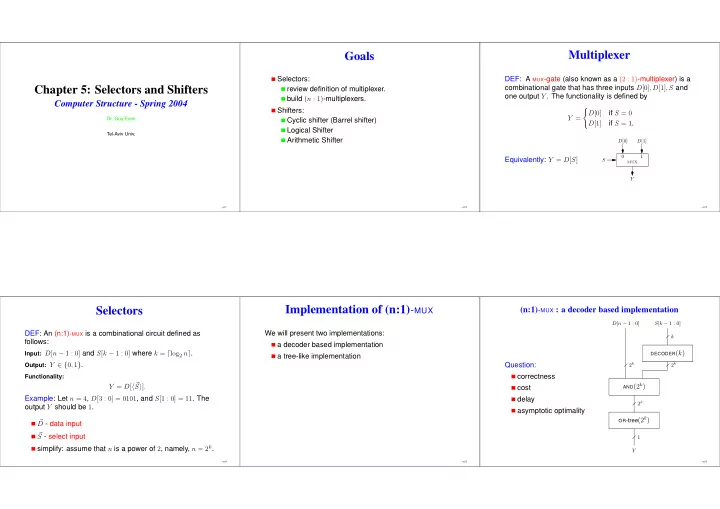
Multiplexer Goals Selectors: DEF: A MUX -gate (also known as a (2 : 1) -multiplexer) is a combinational gate that has three inputs D [0] , D [1] , S and Chapter 5: Selectors and Shifters review definition of multiplexer. one output Y . The


slide-1
SLIDE 1

Chapter 5: Selectors and Shifters

Computer Structure - Spring 2004

  • Dr. Guy Even

Tel-Aviv Univ.

– p.1

Goals

Selectors: review definition of multiplexer. build (n : 1)-multiplexers. Shifters: Cyclic shifter (Barrel shifter) Logical Shifter Arithmetic Shifter

– p.2

Multiplexer

DEF: A MUX-gate (also known as a (2 : 1)-multiplexer) is a combinational gate that has three inputs D[0], D[1], S and

  • ne output Y . The functionality is defined by

Y =

  • D[0]

if S = 0 D[1] if S = 1. Equivalently: Y = D[S]

mux 1 D[0] D[1] S Y

– p.3

Selectors

DEF: An (n:1)-MUX is a combinational circuit defined as follows:

Input: D[n − 1 : 0] and S[k − 1 : 0] where k = ⌈log2 n⌉. Output: Y ∈ {0, 1}. Functionality:

Y = D[ S]. Example: Let n = 4, D[3 : 0] = 0101, and S[1 : 0] = 11. The

  • utput Y should be 1.
  • D - data input
  • S - select input

simplify: assume that n is a power of 2, namely, n = 2k.

– p.4

Implementation of (n:1)-MUX

We will present two implementations: a decoder based implementation a tree-like implementation

– p.5

(n:1)-MUX : a decoder based implementation

Question: correctness cost delay asymptotic optimality

k 2k 2k 2k 1

DECODER(k)

S[k − 1 : 0] D[n − 1 : 0] Y

AND(2k) OR-tree(2k)

– p.6

slide-2
SLIDE 2

(n:1)-MUX : a tree-like implementation

S[k − 1]

( n

2 : 1)-MUX

n/2 1 S[k − 2 : 0] D[ n

2 − 1 : 0]

( n

2 : 1)-MUX

n/2 1 S[k − 2 : 0] D[n − 1 : n

2 ]

1

MUX

Y YL YR 1

Question: correctness cost delay asymptotic optimality

– p.7

Which design is better?

both designs are asymptotically optimal. based on the tables of Müller & Paul, the tree-like design is better. decision is based on specific gate costs in the technology one uses. fast MUX-gates in CMOS (transmission gates) do not restore the signals well. ⇒ long paths consisting only of MUX-gates are not allowed.

– p.8

Cyclic shift - example

9 1 1 1 12 1 2 3 4 5 6 7 8

"clock"reads: 5,3,1,11,...,8,10,12 "clock"reads: 8,10,12,...,2,4,6

9 1 1 1 12 1 2 3 4 5 6 7 8 5 3 1 1 1 9 7 2 4 6 8 1 12 5 3 1 1 1 9 7 2 4 6 8 1 12

rotate clockwise by 3 positions

– p.9

Cyclic shift - definition

The string b[n − 1 : 0] is a cyclic left shift by i positions of the string a[n − 1 : 0] if ∀j : b[j] = a[mod(j − i, n)]. Example: Let a[3 : 0] = 0010. A cyclic left shift by one position

  • f

a is the string 0100. A cyclic left shift by 3 positions of a is the string 0001.

– p.10

Barrel Shifter

DEF: A BARREL-SHIFTER(n) is a combinational circuit defined as follows:

Input: x[n − 1 : 0] and sa[k − 1 : 0] where k = ⌈log2 n⌉. Output: y[n − 1 : 0]. Functionality:

y is a cyclic left shift of x by sa positions. Formally, ∀j ∈ [n − 1 : 0] : y[j] = x[mod(j − sa, n)].

  • x - data input
  • sa - shift amount input

simplify - assume that n is a power of 2, namely, n = 2k.

– p.11

CLS(n, i) - Cyclic Left Shift by 2i positions

DEF: A CLS(n, i) is a combinational circuit defined as follows:

Input: x[n − 1 : 0] and s ∈ {0, 1}. Output: y[n − 1 : 0]. Functionality:

∀j ∈ [n − 1 : 0] : y[j] = x[mod(j − s · 2i, n)]. Equivalently, y[j] =

  • x[j]

if s = 0 x[mod(j − 2i, n)] if s = 1. ⇒ can implement CLS(n, i) with a row of n MUX-gates.

– p.12

slide-3
SLIDE 3

CLS(4, 1)

1 s 1

mux

y[2] 1 s 1

mux

y[1] s 1 y[3] 1 s 1

mux

y[0] 1

mux

x[0] x[1] x[2] x[3]

Evident that a CLS(n, i) requires a lot of area for the wires. Our model does not capture routing cost.

– p.13

BARREL-SHIFTER(n) - a chain of CLS(n, i)

cls(n, 0) sa[0] cls(n, 1) sa[1] cls(n, k − 1) sa[k − 1] x[n − 1 : 0] y[n − 1 : 0]

– p.14

BARREL-SHIFTER(n) - correctness

Define the strings yi[n − 1 : 0], for 0 ≤ i ≤ k − 1, recursively as follows: y0[n − 1 : 0] ← CLSn,0(x[n − 1, 0], sa[0]) yi+1[n − 1 : 0] ← CLSn,i+1(yi[n − 1, 0], sa[i + 1]) Claim: yk−1[n − 1 : 0] is a cyclic left shift of x[n − 1 : 0] by sa[k − 1 : 0] positions. Proof: Induction. k = 0 - trivial because CLS(n, 0) shifts by zero/one position.

– p.15

induction step

yi[j] = CLSn,i(yi−1[n − 1, 0], sa[i])[j] (by definition of yi) = yi−1[mod(j − 2i · sa[i], n)] (by definition of CLSn,i). Let ℓ = mod(j − 2i · sa[i], n).

  • Ind. Hyp. ⇒ yi−1[ℓ] = x[mod(ℓ − sa[i − 1 : 0], n).

Note that

mod(ℓ − sa[i − 1 : 0], n) = mod(j − 2i · sa[i] − sa[i − 1 : 0], n)

= mod(j − sa[i : 0], n). Therefore yi[j] = x[mod(j − sa[i : 0], n)], and the claim follows.

– p.16

Logical Shifting - motivation

Used for shifting binary strings that represent unsigned integers in binary representation. Shifting to the left by s positions corresponds to

  • y ← mod(

x · 2s, 2n). Shifting to the right by s positions corresponds to

  • y ←
  • x

2s

  • .

– p.17

Bi-Directional Logical Shifter - definition

A LOG-SHIFT(n) is a combinational circuit defined as follows:

Input:

x[n − 1 : 0] ∈ {0, 1}n, sa[k − 1 : 0] ∈ {0, 1}k, where k = ⌈log2 n⌉, and ℓ ∈ {0, 1}.

Output: y[n − 1 : 0] ∈ {0, 1}n. Functionality: If ℓ = 1, then logical left shift as follows:

y[n − 1 : 0]

= x[n − 1 − sa : 0] · 0

sa.

If ℓ = 0, then logical right shift as follows: y[n − 1 : 0]

= 0

sa · x[n − 1 :

sa].

– p.18

slide-4
SLIDE 4

Bi-Directional Logical Shifter - example

Example: Let x[3 : 0] = 0010. If sa[1 : 0] = 10 and ℓ = 1, then

LOG-SHIFT(4) outputs y[3 : 0] = 1000. If ℓ = 0, then the output

equals y[3 : 0] = 0000.

– p.19

Bi-Directional Logical Shifter - implementation

As in the case of cyclic shifters, we break the task of designing a logical shifter into sub-tasks of logical shifts by powers of two. Loosely speaking, an LBS(n, i) is a logical bi-directional shifter that outputs one of three possible strings: the input shifted to the left by 2i positions, the input shifted to the right by 2i positions, or the input without shifting. We now formally define this circuit....

– p.20

LBS(n, i) - definition

DEF: An LBS(n, i) is a combinational circuit defined as follows:

Input: x[n − 1 : 0] and s, ℓ ∈ {0, 1}. Output: y[n − 1 : 0]. Functionality: Define x′[n − 1 + 2i : −2i] ∈ {0, 1}n+2·2i as

follows: x′[j]

=

  • x[j]

if n < j ≤ 0

  • therwise.

The value of the output y[n − 1 : 0] is specified by ∀j ∈ [n − 1 : 0] : y[j] = x′[j + (−1)ℓ · s · 2i].

– p.21

y[j] = x′[j + (−1)ℓ · s · 2i]

x′[n − 1 + 2i : −2i] = 02i · x[n − 1 : 0] · 02i. ℓ - determines if the shift is a left shift or a right shift. If ℓ = 1 then (−1)ℓ = −1, and the shift is a left shift (since increasing indexes from j − 2i to j has the effect of a left shift). s - determines if a shift (in either direction) takes place at all. If s = 0, then y[j] = x[j], and no shift takes place.

– p.22

A bit-slice of an implementation of LBS(n, i)

2 2 x′[j − 2i] 1 x′[j + 2i] y[j] 2 x[j]

decoding

s, ℓ

(3 : 1)-mux

  • 1. (3 : 1)-MUX. Implemented either by a “pruned” tree-like

construction or we can simply consider a (3 : 1)-MUX as a basic gate. Simple circuit ⇒ best option can be easily determined based on the technology at hand.

  • 2. decoding circuit - not a decoder! Decoding of s and ℓ

causes the (3 : 1)-MUX to select the correct input.

– p.23

A bit-slice of an implementation of LBS(n, i)

2 2 x′[j − 2i] 1 x′[j + 2i] y[j] 2 x[j]

decoding

s, ℓ

(3 : 1)-mux

Question: This question deals with various aspects and details concerning the design of a logical shifter.

  • 1. Design a “pruned” tree-like (3 : 1)-MUX.
  • 2. Design the decoding box.
  • 3. Show how LBS(n, i) circuits can be cascaded to obtain a

LOG-SHIFT(n).

Hint: follow the design of a BARREL-SHIFTER(n).

– p.24

slide-5
SLIDE 5

Arithmetic Shifters - motivation

Used for shifting binary strings that represent signed integers in two’s complement representation. logical left shifting = arithmetic left shifting. Arithmetic right shifting corresponds to dividing by a power of 2 (with sign extension).

– p.25

Arithmetic right shifter - definition

DEF: An ARITH-SHIFT(n) is a combinational circuit defined as follows:

Input: x[n − 1 : 0] ∈ {0, 1}n and sa[k − 1 : 0] ∈ {0, 1}k, where

k = ⌈log2 n⌉.

Output: y[n − 1 : 0] ∈ {0, 1}n. Functionality: The output

y is a (sign-extended) arithmetic right shift of x by sa positions. Formally, y[n − 1 : 0]

= x[n − 1]

sa · x[n − 1 :

sa]. Example: Let x[3 : 0] = 1001. If sa[1 : 0] = 10, then

ARITH-SHIFT(4) outputs y[3 : 0] = 1110.

– p.26

Arithmetic right shifter - implementation

Question: Consider the definitions of CLS(n, i) and LBS(n, i). Suggest an analogous definition ARS(n, i) for arithmetic right shift (i.e., modify the definition of x′ and use (2 : 1)-MUXs). Suggest an implementation of an arithmetic right shifter based on cascading ARS(n.i) circuits.

– p.27

Further questions

Question: Design a bi-directional cyclic shifter. Such a shifter is like a cyclic left shifter but has an additional input ℓ ∈ {0, 1} that indicates the direction of the required shift. Hint: Consider reducing a cyclic right shift to a cyclic left

  • shifter. To simplify the reduction you may assume that

n = 2k − 1 (hint: use one’s complement negation). Suggest a simple reduction in case n = 2k (hint: avoid explicit subtraction!).

– p.28

Further questions - cont.

Question: CPUs often support all three types of shifting: cyclic, logical, and arithmetic shifting.

  • 1. Write a complete specification of a shifter that can

perform all three types of shifts.

  • 2. Propose an implementation of such a shifter.

– p.29

Summary

(n : 1)-multiplexers: definition. two implementations: decoder based & tree-like. both designs are optimal. three types of shifts: cyclic, logical, and arithmetic shifts. Design method: cascade a logarithmic number of shifters (with parameter i) that either perform a shift by 2i positions or no shift at all.

– p.30