
SLIDE 1
Practical Problems in VLSI Physical Design MCF-based Routing (1/18)
Multi-Commodity Flow Based Routing
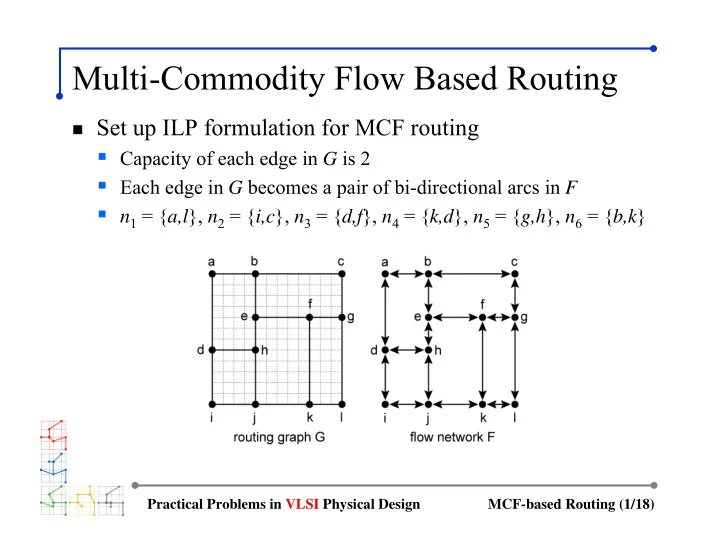
Set up ILP formulation for MCF routing
Multi-Commodity Flow Based Routing Set up ILP formulation for MCF - - PowerPoint PPT Presentation
Multi-Commodity Flow Based Routing Set up ILP formulation for MCF routing Capacity of each edge in G is 2 Each edge in G becomes a pair of bi-directional arcs in F n 1 = { a,l }, n 2 = { i,c }, n 3 = { d,f }, n 4 = { k,d }, n 5 = {
Practical Problems in VLSI Physical Design MCF-based Routing (1/18)
Set up ILP formulation for MCF routing
Practical Problems in VLSI Physical Design MCF-based Routing (2/18)
Each arc has a cost based on its length
k denote a binary variable for arc e w.r.t. net k
k = 1 means net k uses arc e in its route
Practical Problems in VLSI Physical Design MCF-based Routing (3/18)
Minimize
Practical Problems in VLSI Physical Design MCF-based Routing (4/18)
Utilize demand constant
k = 1 means node v is the source of net k (= −1 if sink)
Practical Problems in VLSI Physical Design MCF-based Routing (5/18)
Node a: source of net n1
Practical Problems in VLSI Physical Design MCF-based Routing (6/18)
Node b: source of net n6
Practical Problems in VLSI Physical Design MCF-based Routing (7/18)
Each edge in the routing graph allows 2 nets
Practical Problems in VLSI Physical Design MCF-based Routing (8/18)
Min-cost: 108 (= sum of WL), 22 non-zero variable
Practical Problems in VLSI Physical Design MCF-based Routing (9/18)
Net 6 is non-optimal
Practical Problems in VLSI Physical Design MCF-based Routing (10/18)
ILP is non-scalable
Shragowitz and Keel presented a heuristic instead
Practical Problems in VLSI Physical Design MCF-based Routing (11/18)
Initial set up: shortest path computation
Practical Problems in VLSI Physical Design MCF-based Routing (12/18)
Step 1
Practical Problems in VLSI Physical Design MCF-based Routing (13/18)
Step 2
0 = {c(a,d),
Step 3
0 = {c(a,d), c(e,h), c(i,j), c(j,k), c(d,i), c(e,f)} is ∞
Practical Problems in VLSI Physical Design MCF-based Routing (14/18)
Step 4
0: K1 0 = K1
Practical Problems in VLSI Physical Design MCF-based Routing (15/18)
Step 5
Practical Problems in VLSI Physical Design MCF-based Routing (16/18)
Step 6
Practical Problems in VLSI Physical Design MCF-based Routing (17/18)
Step 7
Practical Problems in VLSI Physical Design MCF-based Routing (18/18)
Details in the book